
Why PVC Foam Core Belongs on Marine, Wind & Transport Shortlists
Why PVC Foam Core Belongs on Marine, Wind & Transport Shortlists
PVC foam core is a closed-cell structural foam made of polyvinyl chloride, supplied as a sandwich core in thicknesses from 1 mm to 80 mm and in density grades from 45 kg/m³ to 300 kg/m³. In marine and yacht building, wind energy, transportation, rail vehicles, RV and caravan manufacturing, industrial composites, construction panels and defense applications, it is one of several core families that engineering and procurement teams now compare directly — alongside end-grain balsa, SAN foam, PET foam, honeycomb and nonwoven infusion cores.
Whether PVC foam core earns a place on a shortlist is a capability question rather than a price question. Can one foam family cover the density ladder, the thickness range, the surface formats and the process routes a project actually runs, from prototype tooling to repeat production? The sections below set out what is verifiable about the material, where it fits, and where a different core is the more rational choice.
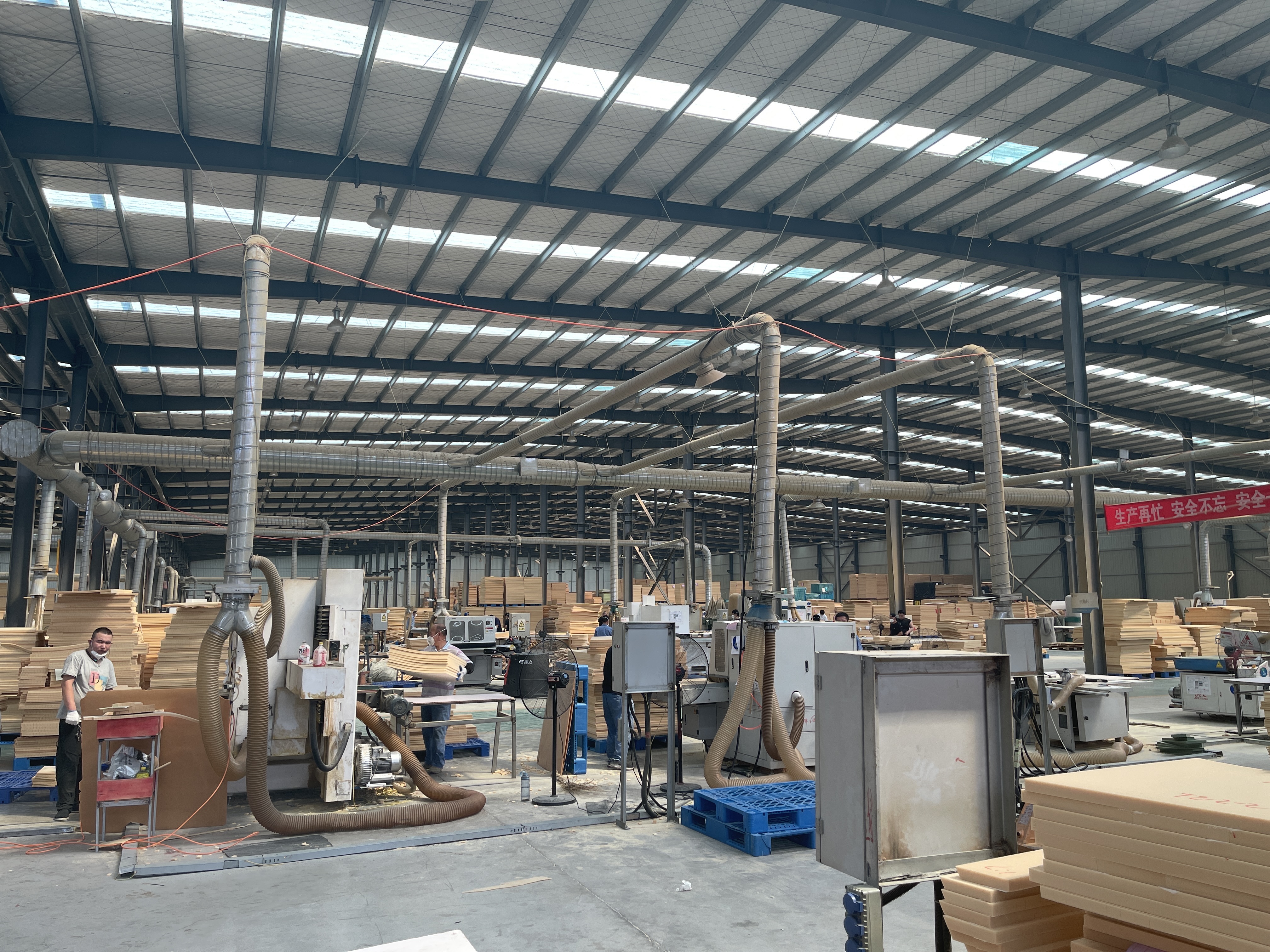
Closed-cell PVC foam core production for sandwich panel construction, yacht hulls, wind turbine blades and industrial composite applications.
Why Core Material Shortlists Have Become Longer
Standardizing on a single core type for years at a time is harder to sustain than it used to be. Within one bill of materials, projects now mix weight targets, stiffness targets, resin-flow requirements, panel thicknesses and process routes. A core that suits a hull skin may not suit a rail interior panel or a wind blade shell.
Three pressures keep the shortlist open. Sustainability expectations are one: PET foam core is described as recyclable and is widely used for wind blades and transportation panels, partly because it is positioned at a lower cost than PVC. Supply resilience is another: distributors and OEMs increasingly qualify a second core source so that a single interruption does not stop a lamination schedule. Documentation is the third: buyers now ask for certification scope and test documentation before a trial order rather than after it.
PVC foam core sits in the middle of that discussion. It is neither the lowest-cost foam family nor the highest-performance one, which is exactly why it needs a structured shortlisting argument instead of a slogan.
What PVC Foam Core Is — and How It Is Positioned
PVC foam core is a closed-cell foam whose base material is polyvinyl chloride. Its defining commercial characteristic is substitution fit: it is designed as an alternative to an established reference product, so a project whose drawings already reference that family can evaluate it without redesigning the laminate.
CINON — formally Guangdong Cinon New Material Technology Co., Ltd. — is a Guangzhou-based manufacturer of fiberglass reinforcements and lightweight core materials, founded in 2022. The company reports that its products are used across marine and yacht building, wind energy, transportation, RV and caravan, aerospace, UAV and industrial composite sectors. Within that portfolio, PVC foam core is positioned as a Divinycell alternative, subject to the buyer's own qualification and testing.
| Attribute | Published data |
|---|---|
| Base material | Polyvinyl chloride (closed-cell PVC foam) |
| Positioning | Divinycell alternative |
| Density grades | 45, 50, 60, 80, 100, 130, 200, 250, 300 kg/m³ |
| Thickness range | 1–80 mm |
| Surface options | Plain / Grooved / Perforated / Scrim-backed |
| Processing methods | Vacuum infusion, RTM, hand lay-up, prepreg, VARTM |
| Documented application industries | Marine & yacht building, wind energy, transportation, rail vehicles, RV & caravan manufacturing, industrial composites, construction panels, defense applications |
Published specification data for PVC foam core.
Density, Thickness and Surface Options: Reading the Spec Sheet Like a Buyer
The density ladder runs from 45 kg/m³ to 300 kg/m³ across nine published grades. That breadth matters for procurement more than it does for any single part: a project can move up or down the ladder within one foam chemistry instead of switching core families when a panel becomes more stiffness-driven or more weight-driven. Staying inside one family keeps laminate schedules, adhesives and process parameters closer to unchanged.
The thickness range of 1 mm to 80 mm covers both thin cosmetic or flow-media layers and thicker structural panels. Surface format is the part of the specification buyers most often under-specify. Plain, grooved, perforated and scrim-backed options exist for different reasons, and the choice should follow the process rather than habit:
- Grooved and perforated surfaces are commonly specified where resin distribution and air evacuation during infusion are the limiting factors.
- Scrim-backed surfaces are typically chosen where handling, cutting and adhesive bonding of the core need more support.
- Plain surfaces remain the straightforward option for hand lay-up and for processes where the resin path is already managed by other consumables.
Process Compatibility: Where PVC Foam Core Fits on the Shop Floor
PVC foam core is listed as compatible with vacuum infusion, RTM, hand lay-up, prepreg and VARTM. Covering five process routes with one core family reduces the number of material approvals a plant has to maintain, which is a real cost line in composite manufacturing even though it rarely appears on a quotation.
Closed-cell construction is the reason foam cores are used in infusion at all: the cell structure limits resin absorption into the core, which helps control weight gain during wet-out. That property is also why surface format and process have to be matched — an infusion shop and a prepreg shop will not want the same core face.
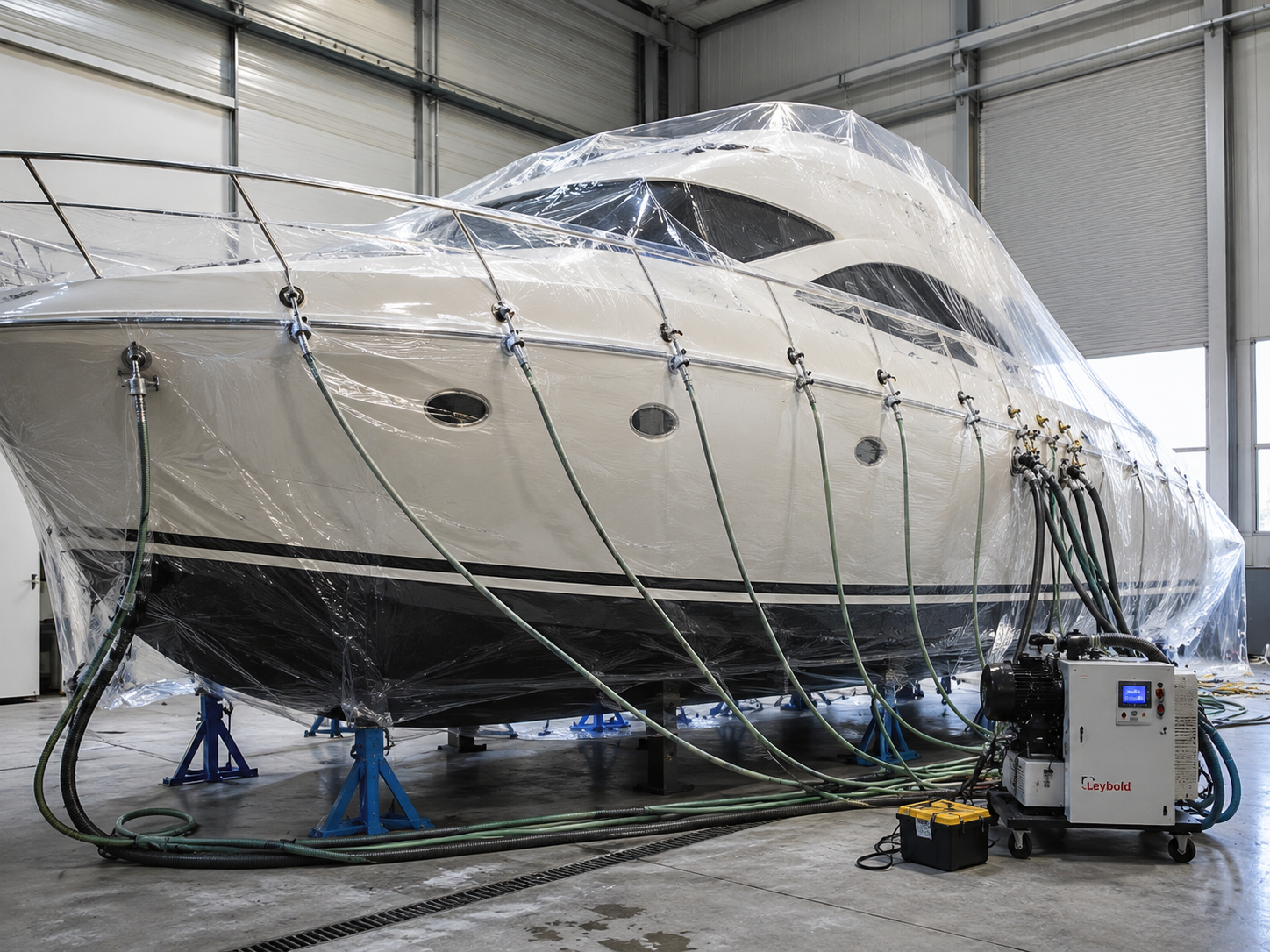
Vacuum infusion process support: matching core surface format to the resin flow path is part of the specification, not an afterthought.
Application Fit: From Yacht Hulls to Rail Interiors
The application list for PVC foam core is broad, but broad lists are not qualification. The table below pairs each segment with the question a buyer should resolve first.
| Segment | Typical parts | Resolve first |
|---|---|---|
| Marine & yacht building | Hulls, decks, superstructures | Applicable standard scope, laminate schedule, shear requirements |
| Wind energy | Blade shells and related sandwich structures | Core family and grade agreed with the blade design |
| Transportation & truck bodies | Side walls, floors, roof panels | Panel thickness, surface format, adhesive system |
| Rail vehicles & railway interiors | Interior panels, structural sandwich elements | Interior fire and smoke documentation |
| RV & caravan manufacturing | Wall, floor and roof panels | Weight target, thickness uniformity, outer skin finish |
| Industrial composites & FRP panels | Tanks, covers, enclosures | Resin compatibility and process route |
| Construction panels | Sandwich cladding, modules | Panel size, handling, surface finish |
| Defense applications | Structures and enclosures | Project-specific qualification evidence |
Documented customer cases show what this looks like in practice. A sports equipment manufacturer in Thailand used CINON's PVC foam core in surfboard manufacturing at container-order volumes, targeting weight reduction and performance improvement, with high buoyancy and impact resistance reported as the key highlights. A marine and yacht builder in Australia took core materials in container quantities for boat building, where material selection was cited as the highlight and smooth surface, easy wet-out and better finish were reported as results.
Not every documented project runs on PVC, and that is worth stating plainly. An RV manufacturer in the United States used multiaxial fiberglass with PP honeycomb and PET foam for FRP panels, achieving glossy surface treatment and thickness uniformity. A distributor in the United Kingdom used CX Core Material, positioned as a Soric LRC alternative, for vacuum infusion composite structures and achieved an alternative supply solution with fast lead time. The consistent pattern is that PVC foam core is shortlisted where its density range, thickness range and process compatibility fit — and replaced where another family fits better.
Market Signals Shaping Core Material Decisions
Wind energy provides the clearest view of how core families are actually distributed. In wind-energy composite applications, four core material types are reported as the most widely used: end-grain balsa, styrene acrylonitrile (SAN) foam, PVC foam and PET foam (CompositesWorld, September 2026). PVC therefore already sits inside the mainstream wind-energy material set rather than at its edge.
On the marine side, the global marine structural core materials market has been projected at USD 114 million for 2026 (Stratview Research). Regional structure matters too: Asia-Pacific accounted for 39% of core materials market value in 2025 (Fortune Business Insights), which is consistent with the concentration of core material manufacturing and composite part production in that region.
The direction of travel is also visible in material positioning. PET foam core is recyclable and is widely used for wind blades and transportation panels, partly because it is positioned at a lower cost than PVC. That does not remove PVC from shortlists, but it does mean PVC has to be justified on process fit, thickness range and substitution compatibility rather than on price alone.
Where PVC Foam Core Is Not the Right Answer
A shortlist that cannot explain its own boundaries is not a shortlist. Four limits are worth stating before a purchase order rather than after one.
- Cost and recyclability. PET foam core is positioned as recyclable and at a lower cost than PVC, and is widely used for wind blades and transportation panels. Where cost and end-of-life considerations dominate the decision, PET is generally the stronger default.
- Highest-performance niches. PMI foam core, with published density grades of 40 to 130 kg/m³, is positioned for aerospace, UAV and drone manufacturing, motorsport, high-performance marine, defense and sports equipment. A documented German UAV manufacturer case used PMI foam with 10 pallets of material and reported ultra-lightweight structures, high stiffness and high temperature resistance. That is a different performance class from standard PVC foam core.
- Thickness range. The published PVC foam core range is 1 mm to 80 mm. Specifications outside that band belong to a different material or a different construction approach.
- Standards and certification scope. EN ISO 12215-2:2018 specifies requirements for core materials for structural use and for materials embedded in sandwich construction for small craft hulls and structures, in a scope covering small craft with hull length up to 24 m. Larger vessels and other sectors are assessed under different frameworks.
Certification scope deserves particular attention. CINON holds ISO 9001:2015 (certificate 51326Q04922R053, issued 29 April 2026, valid to 28 April 2029 by Shenzhen Moqc Certification Co., Ltd.) and ISO 45001:2018 (certificate 51326S01896R053) covering the sales of high-performance fibers and composite materials, and ISO 14001:2015 (certificate ISO14001-2023-001, issued by SGS, valid 1 June 2023 to 1 June 2028) covering composite intermediates sales. These are management-system certifications. They evidence process discipline and supply organization; they are not product approvals, class society type approvals or fire-performance certificates. Buyers with class, fire or aerospace requirements need application-specific documentation that sits outside this scope.
PVC Foam Core Versus Other Core Families
The comparison below uses published product data from the CINON core material range. It is a specification comparison, not a measured performance benchmark, and it does not replace coupon testing for a specific laminate.
| Core family | Base material | Published density grades | Thickness / format | Positioning |
|---|---|---|---|---|
| PVC foam core | Polyvinyl chloride | 45–300 kg/m³ | 1–80 mm; plain, grooved, perforated, scrim-backed | Divinycell alternative |
| PET foam core | Polyethylene terephthalate | 80–320 kg/m³ | Lightweight structural core | Recyclable foam core |
| PMI foam core | Polymethacrylimide | 40–130 kg/m³ | Aerospace, UAV, motorsport formats | Rohacell alternative |
| Aramid honeycomb core | Aramid paper | 32–128 kg/m³ | Cell size 1.83–5.5 mm; 2440 × 1220 mm sheet | Aerospace, interiors, radar, motorsport |
| PP honeycomb sheet | Polypropylene | 70–80 kg/m³ | 5–100 mm; cell 6/8/10/12 mm; 1220 × 2440 mm | Thermoplastic sandwich panel core |
| Nonwoven infusion cores (CM / CT / CS / CX) | Polyester nonwoven fabric / polyester | Format-based | 1.5–6 mm, roll goods | CX positioned as a Soric LRC alternative |
A Shortlisting Checklist for Evaluation-Stage Buyers
Moving from evaluation to execution on a core material is mostly a documentation exercise. The following criteria separate a shortlisted supplier from a qualified one.
- Chemistry and substitution fit. Confirm whether the core is a like-for-like alternative to the family named in your existing drawings, and what re-qualification that implies.
- Density grade selection. Match the grade to the part, not to the catalog: weight-driven panels and insert-heavy areas rarely sit at the same point on the ladder.
- Thickness and surface format. Confirm availability inside the 1–80 mm range and specify grooved, perforated, scrim-backed or plain against the process route.
- Process compatibility. Check that the core has been run in your process — vacuum infusion, RTM, hand lay-up, prepreg or VARTM — not merely a neighbouring one.
- Application standards. Establish which standard applies to your structure and whether its scope actually covers it.
- Certification scope. Read the certificate scope, not the certificate name. Management-system certification is not product approval.
- Sample evaluation. Run a trial panel or coupon set before the first production order and record the acceptance criteria in writing.
- Capacity, lead time and traceability. Confirm that quoted lead time can survive repeat ordering, and that batch traceability and test reporting are part of the delivery, not an extra request.
Supply, Customization and Execution
Execution-stage buyers are usually less interested in the material datasheet than in whether the supply relationship can hold. CINON reports a 40,000 m² manufacturing facility in Guangzhou with an annual output capacity of 1,200,000 m², a monthly capacity of 100,000 m², a lead time of 15 to 30 days, and 100% testing as its quality control standard. The company reports a 100% export ratio, serving Europe, North America and Asia-Pacific markets.
Customization is part of the offer rather than an exception: CINON provides ODM production services and customization for core materials and fiberglass fabric. OEM label service is documented for distributor clients in Poland and the Czech Republic, who placed container orders with repeat orders every month. Export logistics, including container loading and worldwide delivery coordination, is handled as a documented process rather than an ad hoc arrangement.
Commercial terms are worth checking as part of the same exercise. Delivery terms listed for CINON materials are FOB, CIF and EXW, and stated acceptance criteria include pre-shipment test and a quality test report. Sample evaluation, quality traceability, vacuum infusion guidance, composite process optimization, alternative material recommendations and material selection support are listed under after-sales technical support, delivered through email, WhatsApp, online meetings and technical documentation.
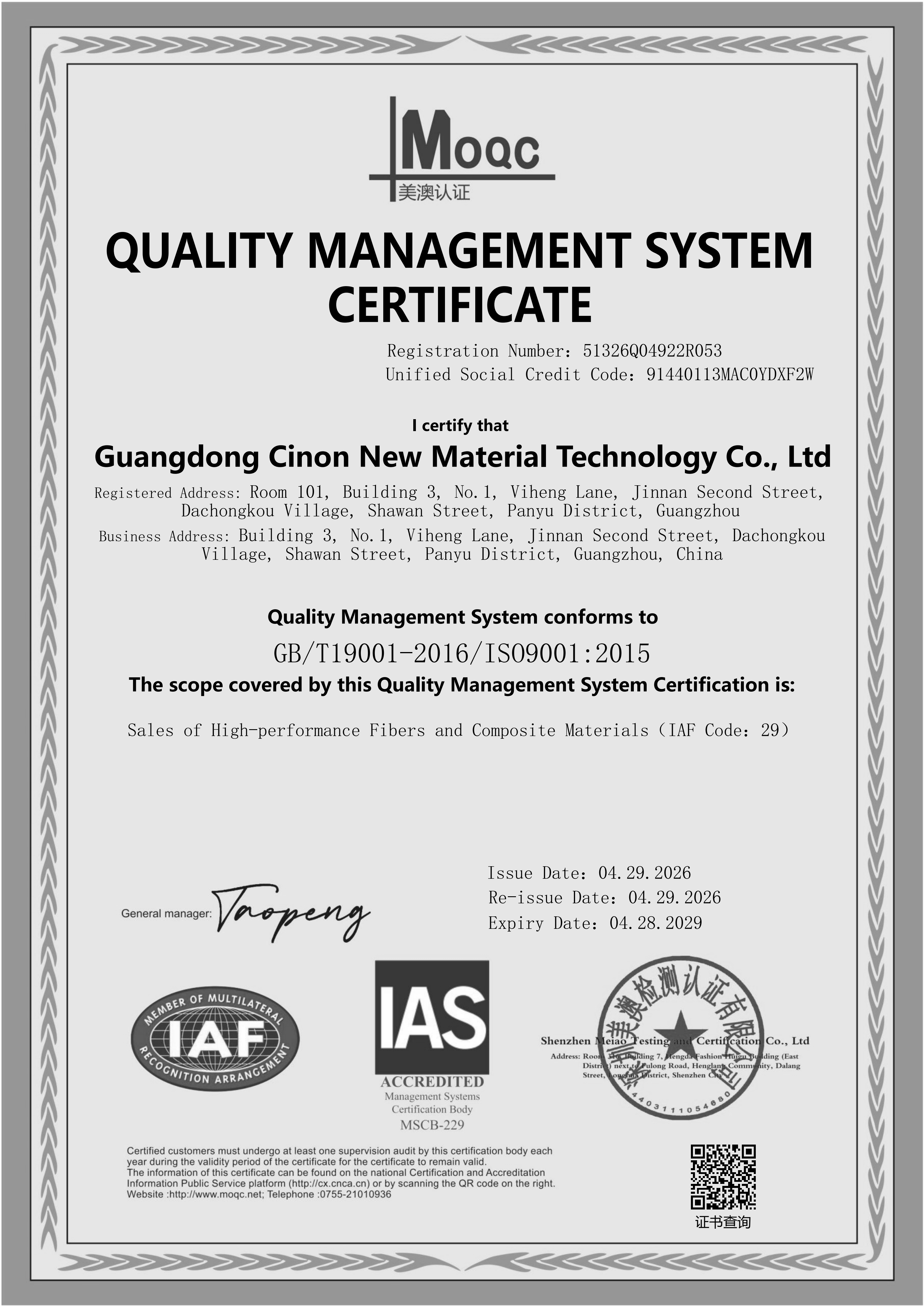
ISO 9001:2015 certificate (51326Q04922R053), scope: sales of high-performance fibers and composite materials. Management-system certification should be read alongside application-specific qualification requirements.
Future Outlook
Three shifts are likely to shape core material shortlists over the next planning cycles. The first is cost and sustainability pressure from recyclable foam cores, which will continue to pull high-volume transportation and wind programs toward PET where the technical case allows it. The second is documentation intensity: as core selection moves from a purchasing decision to an engineering qualification, suppliers whose certification scope and test reporting are clear will be easier to keep on a shortlist than suppliers whose evidence stops at a datasheet. The third is regional supply structure, given that Asia-Pacific already represents a large share of core material market value.
None of these shifts removes PVC foam core from the discussion. What they change is the basis of the decision: from a default choice toward an explicitly justified one, defended on density range, thickness availability, surface formats and process compatibility rather than on familiarity.
Frequently Asked Questions
What is PVC foam core made of, and how is it classified?
PVC foam core is a closed-cell structural foam whose base material is polyvinyl chloride. It is supplied as a sandwich core for composite structures and is positioned as a Divinycell alternative, meaning it is intended as a specification-equivalent option for projects designed around that reference family, subject to the buyer's own qualification and testing.
What density grades and thicknesses are available?
Density grades run from 45 kg/m³ to 300 kg/m³ across nine published values: 45, 50, 60, 80, 100, 130, 200, 250 and 300 kg/m³. The thickness range is 1 mm to 80 mm, and available surface formats are plain, grooved, perforated and scrim-backed.
Which composite processes can run PVC foam core?
Published processing methods include vacuum infusion, RTM, hand lay-up, prepreg and VARTM. The appropriate surface format depends on the process: grooved and perforated formats are commonly specified where resin distribution and air evacuation are limiting factors, while scrim-backed formats are typically used where handling and adhesive bonding are the priority.
Which applications typically shortlist PVC foam core?
Documented application industries include marine and yacht building, wind energy, transportation, rail vehicles, RV and caravan manufacturing, industrial composites, construction panels and defense applications. A recorded case is a sports equipment manufacturer in Thailand using PVC foam core in surfboard manufacturing at container-order volumes, where weight reduction and performance improvement were reported alongside high buoyancy and impact resistance.
How does PVC foam core compare with PET foam core?
Both are structural foam cores used in sandwich construction, and both appear among the core families most widely used in wind energy applications. PET foam core is described as recyclable and is widely used for wind blades and transportation panels, and it is positioned at a lower cost than PVC. PVC foam core covers nine density grades from 45 to 300 kg/m³, a 1–80 mm thickness range and five listed process routes. Where cost and recyclability dominate, PET is often the default; where a project is already specified around PVC-equivalent behaviour, PVC foam core remains the closer match.
Can PVC foam core be customized or supplied under OEM arrangements?
CINON provides ODM production services and customization for core materials and fiberglass fabric. OEM label service is documented for distributor clients in Poland and the Czech Republic, who placed container orders with repeat orders every month. Customization discussions typically cover material format, labeling and specification matching rather than changes to the published density or thickness range.
What should a buyer verify before approving a PVC foam core supplier?
Verify certification scope rather than certificate titles. CINON holds ISO 9001:2015 (certificate 51326Q04922R053, issued 29 April 2026, valid to 28 April 2029) and ISO 45001:2018 (certificate 51326S01896R053) covering the sales of high-performance fibers and composite materials, and ISO 14001:2015 (certificate ISO14001-2023-001, issued by SGS, valid 1 June 2023 to 1 June 2028) covering composite intermediates sales. These are management-system certifications and do not constitute product-level approvals. Application-specific requirements such as class rules, fire performance or laminate-specific testing require separate documentation. Buyers should also confirm sample evaluation, batch traceability and pre-shipment test reporting, which are listed among the stated acceptance criteria.
CINON publishes a product catalog covering PVC foam core and the wider core material range; it is available for download here.
Tem questões ou precisa de mais detalhes?
Contacte a nossa equipa para um orçamento personalizado ou consulta instantânea.
Solicitar orçamento
Preencha o formulário abaixo e a nossa equipa entrará em contacto com uma proposta personalizada.
Chat direto do WhatsApp
Prefere conversar em tempo real? Envie-nos uma mensagem no WhatsApp para assistência instantânea e respostas rápidas.
- Obter orçamento personalizado
- Partilhar fotos ou documentos
- Discuta as suas necessidades diretamente
Geralmente responde em 5–30 minutos durante o horário de expediente.