
Why Roofing Crews Prefer the 320 ml/min Flow Rate
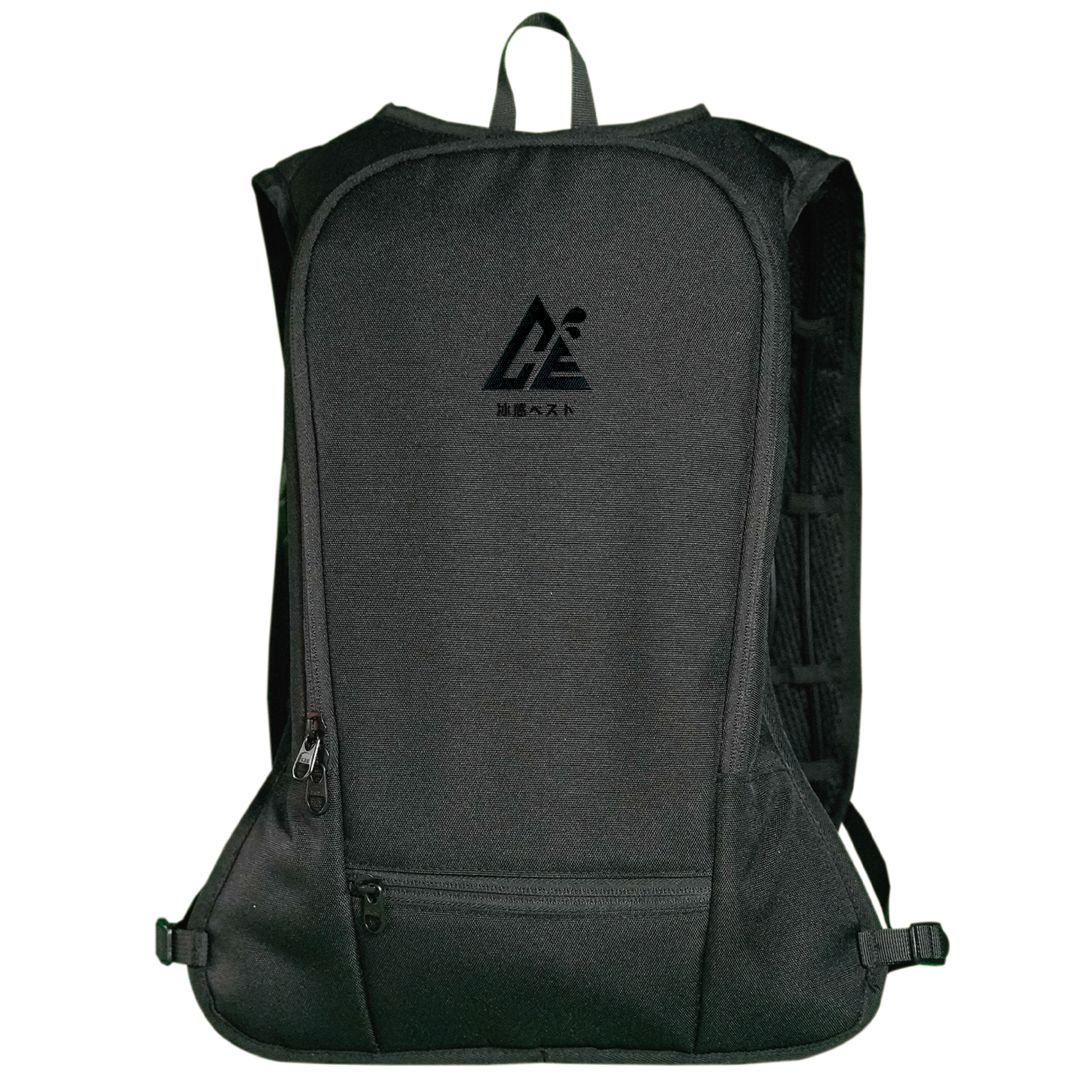
In the COOLWAVE Water-Circulation Cooling Vest — a Shokunin-branded industrial cooling garment manufactured by FENG SHANG PRECISION CO., LTD. in Taiwan — the circulation pump is rated 5V, 150mA (max) and the listed flow rate is 320–370 ml/min. For roofing work, that band is not a decorative number: it defines how quickly chilled water returns to the body-side tubing, and it only makes sense when read together with the vest's 3–4 hour cooling duration and its listed weight within 2 kg.
Sun-exposed roof decks create a specific cooling problem. Radiant load from membrane, tile or metal sheeting arrives at the body from below and above at the same time, air movement near the work surface is often poor, and the task itself — torch work, membrane rolling, fastener installation, flashing — is difficult to pause. Occupational-safety guidance recognises this class of exposure as one that can be addressed with wearable systems: the U.S. National Institute for Occupational Safety and Health (NIOSH) groups water-cooled garments, air-cooled garments, cooling vests and wetted overgarments together as auxiliary or personal cooling systems.
Within that category, water circulation is the architecture most often questioned on performance grounds, because the buyer has to judge two separate things at once: how much cold the vest carries, and how efficiently that cold is delivered. This analysis separates the two, using the published COOLWAVE specification as the reference point, and shows where a 320–370 ml/min circulation rate helps a roofing crew — and where it does not.
What a Flow Rate Specification Actually Describes
A water-circulation cooling vest carries a cold reservoir, moves chilled water through tubing routed against the torso, and returns warmed water to the reservoir. The flow rate is the delivery side of that loop. In the COOLWAVE listing, the specification is written as a maximum band, 320–370 ml/min, driven by a pump rated at 5V and 150mA maximum.
Converted directly from that band, the pump moves roughly 19 to 22 litres of water per hour through the loop. That figure is arithmetic on the published specification, not a test result, but it is useful because it reframes the vest as a small, continuous hydraulic system rather than a passive garment with a pump attached.
The rest of the specification describes the hardware that determines whether that flow reaches the wearer effectively:
- Water bag: TPU, with a polypropylene cap.
- Cooling tube: sand rubber in black, the body-side conduit for chilled water.
- Vest material: PEVA, with 600D polyester shoulder straps.
- Pump output: 5V, 150mA (max).
- Flow rate: maximum 320–370 ml/min.
- Cooling duration: 3–4 hours per charge and ice-pack cycle.
- Weight: within 2 kg.
- Contents: water-cooled vest backpack ×1, ice packs ×2.
From Millilitres per Minute to Heat Removed on a Roof
The thermal logic of a circulating system is straightforward in general engineering terms: the heat carried away per unit time scales with the mass of water moving through the loop and with the temperature difference between the water leaving the body-side tubing and the water returning to the cold reservoir. Two levers therefore exist — how fast the water moves, and how cold it still is when it arrives.
Flow rate governs the first lever. At a higher circulation rate, each parcel of water spends less time in the tubing, so it picks up less heat per pass and arrives back at the reservoir closer to its starting temperature. That keeps the temperature difference at the skin-side surface from collapsing during a long, high-radiant-load task. On a roof in direct sun, where the body is simultaneously absorbing radiant heat and generating metabolic heat from exertion, that sustained temperature difference is what the wearer actually feels.
The second lever — how cold the water is when it arrives — is governed by the cold source, not the pump. COOLWAVE uses reusable ice packs as the cold reservoir; the pump distributes that stored cold rather than creating it. This distinction matters for anyone specifying the vest for roofing: adding flow does not add cooling capacity, it improves delivery of the capacity the ice packs already hold. The published 3–4 hour cooling duration is therefore best understood as a cold-source limit, and the flow rate as the variable that determines how evenly that limit is spent across the shift.
Why the Upper End of the Band Matters in Direct Sun
Roofing differs from shaded outdoor work in one decisive way: the radiant load does not pause. A worker kneeling on a dark membrane in full sun is receiving heat from the surface beneath as well as from the sun above, and the torso is often covered by tool belts and harnesses that further reduce convective cooling. In that setting, a circulation loop running near the upper end of its band performs a specific function — it shortens the interval between cold water leaving the reservoir and warmed water coming back, which keeps the tubing surface closer to reservoir temperature along its whole length rather than only at the inlet.
With a single body-side loop, water that enters cold and exits warm produces a temperature gradient across the torso. Higher flow compresses that gradient. For a wearer, the practical difference is a more uniform sensation across the chest and back instead of a cold patch near the inlet and a neutral patch further along the tubing. Crews working in sustained direct sun tend to notice uniformity before they notice peak intensity, because the complaint on a roof is rarely that cooling is absent — it is that cooling fades after the first hour.
The upper end of the band is also the point at which the vest's other constraints start to bind. A pump drawing 5V at up to 150mA requires a power source, and the listed contents are the vest backpack and two ice packs; a power bank is not listed as part of the package. Buyers planning a roofing deployment should confirm the power source, its mounting position, and how it is protected from dust and impact before the specification is written into a method statement.
Planning a Roofing Shift Around 3–4 Hours of Cooling
The published cooling duration of 3–4 hours per charge and ice-pack cycle is the single most useful planning figure in the specification, because roofing work is organised in blocks: a membrane run, a fastening sequence, a flashing detail. Matching those blocks to the cooling window produces a more predictable result than issuing the vest and letting the wearer manage it.
A workable pattern has three parts. First, start the vest with ice packs fully frozen and the reservoir filled to its marked level, so the loop begins at its coldest state rather than part-way through a warming curve. Second, place the highest-exertion or most exposed task — torch work, or any period kneeling directly on a sun-heated surface — inside the first two hours, when the cold reservoir is strongest. Third, schedule the ice-pack change at the three-to-four-hour mark as a crew rotation rather than an individual decision, so that the swap does not depend on a worker self-reporting discomfort.
Two ice packs are supplied with the vest, which supports a rolling swap on a single unit but not continuous coverage across a full shift without additional packs or a freezer on site. For multi-crew deployments, the practical unit of planning is not the vest but the vest-plus-pack-set-plus-charging-arrangement, since the 5V pump draw and the ice-pack rotation both need a home base.
The Suitable-Temperature Figure and Hot Roofing Projects
The COOLWAVE listing states a suitable temperature of below 10°C. The same listing does not define whether that figure describes the chilled-water or cold-source condition, or the ambient operating envelope of the garment. That ambiguity is material for roofing, because ambient air on a sun-exposed roof deck is, in general terms, far above 10°C during the working season, while the water in the reservoir immediately after an ice-pack change is far below it.
The prudent reading for a hot roofing project is therefore to treat the figure as an operating condition to be confirmed in writing with the supplier, and to plan usage on the parameters that are unambiguous: the 320–370 ml/min flow band, the 3–4 hour cooling duration, and the weight within 2 kg. Buyers preparing a tender specification should ask the supplier to state, in writing, the ambient temperature and workload assumed for the 3–4 hour duration figure, and whether the below-10°C condition refers to coolant or to air.
Where the Vest Fits in Sun-Exposed Work
Roofing is the clearest case for a circulating vest because the exposure is long, the radiant load is high and the work cannot be relocated to shade. The same conditions appear in adjacent settings where the same product is listed as applicable: construction sites, outdoor work, metal sheet factories, food stall operation, street vending and traffic control. In each case the deciding factor is the same — whether the worker stays in the heat long enough that a 3–4 hour cooling window covers a meaningful part of the task.
Where the work is intermittent, with frequent returns to shade or an air-conditioned cab, the case for a pumped circulation system is weaker and a simpler cold source may be sufficient. Where the work is continuous and the torso is enclosed by harnesses or belts, the delivery advantage of circulation becomes the more relevant variable. That is a fit judgement, not a performance ranking.
How It Compares With Ice-Pack-Only and Evaporative Approaches
Ice-pack-only vests place frozen packs directly against the torso. They require no pump, no power source and no tubing, and they are the simplest thing to issue on a site. Their limitation is locality: cooling is concentrated where the pack sits, and the pack's surface warms quickly against skin in high radiant load, so the effective cooling period is short and uneven. A circulating system addresses exactly that weakness by distributing the same stored cold across a larger body area.
Evaporative vests rely on water evaporating from a fabric layer. They are light and need no power, but their performance depends on ambient humidity and air movement, both of which are unreliable on a roof — still, humid conditions are precisely when evaporation slows.
| Approach | Cold source | Delivery | Practical constraint on a roof |
|---|---|---|---|
| Ice-pack-only vest | Frozen packs | Direct contact, localised | Cooling concentrated at pack contact points; packs warm quickly under radiant load |
| Evaporative vest | Water in fabric | Evaporation | Effectiveness depends on humidity and airflow; both are unreliable on a roof |
| COOLWAVE water-circulation vest | Reusable ice packs in a TPU reservoir | Pump-driven circulation through sand-rubber tubing, 320–370 ml/min | Requires a 5V power source for the pump and ice-pack rotation; listed weight within 2 kg; cooling duration 3–4 hours per cycle |
The honest limitation of the circulating approach is logistical rather than thermal. It adds a reservoir, tubing, a pump and a power requirement to a garment that a worker has to wear while climbing, kneeling and reaching. It also makes the crew dependent on ice-pack logistics and on charging, which is a real cost that ice-pack-only vests do not impose. Buyers who cannot support that logistics chain on site should not specify a pumped system on thermal grounds alone.
Certification and Intellectual-Property Constraints Buyers Can Check
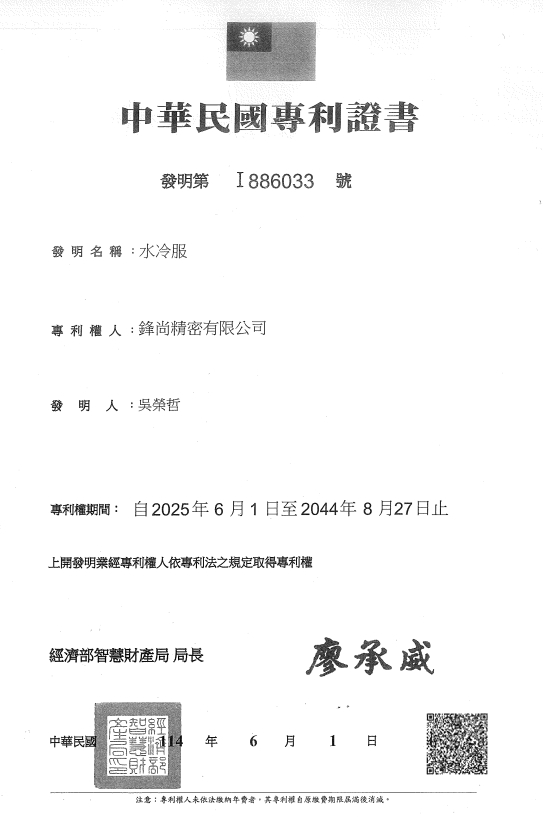
Two documented items accompany the product and are worth including in a procurement file because they are verifiable rather than promotional. The COOLWAVE water-circulation cooling vest (Basic Model) is protected by Patent No. I886033, issued by the Intellectual Property Office, Ministry of Economic Affairs, under the Patent Act of the Republic of China. The patent covers water-cooled vest structure and cooling system, was issued on 1 June 2025, and runs to 27 August 2044; it applies to the ROC market.
Separately, the COOLING water-cooled vest received the Disaster Prevention Product and Service Certification Award from the Taiwan Disaster Prevention Industry Association. Both items are Taiwan-scoped. Buyers sourcing for the United States, the European Union or other markets should treat them as evidence of design documentation and product recognition, not as a substitute for local conformity assessment of a powered garment.
Procurement Checklist for Roofing Cooling Programmes
The following items can be confirmed against the published specification before a sample is requested, and the remaining ones should be put to the supplier in writing.
| Item | Published position | What to confirm |
|---|---|---|
| Flow rate | Maximum 320–370 ml/min | Measured flow in the assembled vest, with test conditions |
| Pump electrical | 5V, 150mA (max) | Power-source specification, mounting, dust and impact protection |
| Cooling duration | 3–4 hours per charge and ice-pack cycle | Ambient temperature, humidity and workload assumed for that figure |
| Suitable temperature | Below 10°C | Whether the figure refers to coolant or ambient air |
| Weight | Within 2 kg | Whether the figure includes the backpack and a full reservoir |
| Materials | PEVA vest, TPU water bag, polypropylene cap, sand-rubber cooling tube, 600D polyester straps | Cleaning and decontamination method for repeated site use |
| Package contents | Backpack ×1, ice packs ×2 | Number of spare packs needed for the intended shift length |
| Commercial terms | ODM production; MOQ 10 units; lead time 7–14 days; 6-month warranty on the water-cooled vest | Capacity confirmation against the order volume and delivery schedule |
FENG SHANG PRECISION CO., LTD. is the Taiwan-based manufacturer behind the Shokunin brand, founded in 2009, operating a 1,000 m² facility with 30 employees, a five-engineer R&D team and a stated annual output of 10,000 units, exporting to the USA and ROC markets. A recorded Taiwan deployment covers 100 units for cooling use in high-temperature environments. Buyers evaluating a roofing rollout should request production records and a capacity definition alongside the commercial terms, since public capacity claims in this category are typically supplier-reported.
Market Context: Why Roofing Cooling Is Being Specified, Not Improvised
The commercial backdrop supports formal specification. Dataintelo's cooling vests market report placed the global cooling vests market at USD 342 million in 2025, and reported that industrial applications accounted for 34.5% of revenue share in the same year. A category in which roughly one dollar in three comes from industrial use is a category where buyers ask for specifications, test conditions and documentation rather than descriptions.
The same pressure appears in occupational-safety framing. Once a personal cooling system is treated as equipment rather than apparel, the purchasing question shifts from comfort to verifiable parameters — flow, duration, weight, power requirement, and the conditions under which each figure was obtained. That shift favours suppliers who can document test conditions and disadvantages those who publish only headline numbers.
Future Outlook
Three developments are likely to shape the next procurement cycle in this category. First, flow rate will increasingly be quoted with test conditions attached, because buyers comparing water-circulation vests have started asking what the number means in an assembled garment rather than on a pump label. Second, cooling duration claims will be challenged on ambient and workload assumptions, particularly for roofing, where radiant load rather than air temperature dominates the heat balance. Third, documentation of regional compliance for powered garments will become a gating item in tenders, since a patent and a national product award do not transfer between jurisdictions.
For manufacturers, the practical response is transparency about boundary conditions: stating what the 320–370 ml/min band means under load, what the 3–4 hour duration assumes, and which markets the certification covers. For buyers, the practical response is to plan the logistics chain — packs, charging, rotation — with the same rigour as the thermal specification, because a circulating vest fails on a roof for logistical reasons more often than thermal ones.
Frequently Asked Questions
What flow rate does the COOLWAVE water-circulation cooling vest deliver?
The published specification lists a maximum flow rate of 320–370 ml/min, produced by a pump rated 5V, 150mA (max). The band is expressed as a maximum, so actual delivery depends on the assembled tubing routing, reservoir level and pump load. Converted directly, the band equals roughly 19 to 22 litres of circulated water per hour.
Is a 3–4 hour cooling duration enough for a full roofing shift?
The vest is listed at 3–4 hours cooling duration per charge and ice-pack cycle, which covers a substantial block of a shift but not an entire one without intervention. Two ice packs are supplied, which supports a swap on a single unit. Crews typically plan the highest-exposure task inside the first window and schedule an ice-pack change at the three-to-four-hour mark as a rotation rather than an individual decision.
What ambient temperature is the vest suitable for?
The product listing states a suitable temperature of below 10°C, but does not define whether that refers to the chilled-water or cold-source condition or to ambient operating air. Because ambient air on a sun-exposed roof is generally well above that figure, buyers should obtain written clarification from the supplier before the specification is used in a method statement or tender document.
Does the pump need a separate power source?
The pump is rated 5V, 150mA (max). The listed package contents are the water-cooled vest backpack and two ice packs; a power bank is not listed among them. Buyers should confirm the intended power source, how it is carried, and how it is protected from dust and impact in site conditions.
What certifications and intellectual property support the product?
The COOLWAVE water-circulation cooling vest (Basic Model) is protected by Patent No. I886033, issued by the Intellectual Property Office, Ministry of Economic Affairs under the Patent Act of the Republic of China, covering water-cooled vest structure and cooling system, issued 1 June 2025 and valid to 27 August 2044 for the ROC market. The COOLING water-cooled vest also received the Disaster Prevention Product and Service Certification Award from the Taiwan Disaster Prevention Industry Association. Both are Taiwan-scoped.
What should a procurement team verify before ordering for a roofing project?
Confirm measured flow in the assembled vest and the conditions used to obtain it; the ambient temperature, humidity and workload assumed for the 3–4 hour duration; whether the within-2 kg weight includes the backpack and a full reservoir; the cleaning method for repeated site use; the power-source arrangement; and the number of spare ice packs required for the intended shift. Commercial terms published for the Shokunin line state an ODM model, a minimum order of 10 units, a lead time of 7–14 days and a 6-month warranty on the water-cooled vest.
Tem questões ou precisa de mais detalhes?
Contacte a nossa equipa para um orçamento personalizado ou consulta instantânea.
Solicitar orçamento
Preencha o formulário abaixo e a nossa equipa entrará em contacto com uma proposta personalizada.
Chat direto do WhatsApp
Prefere conversar em tempo real? Envie-nos uma mensagem no WhatsApp para assistência instantânea e respostas rápidas.
- Obter orçamento personalizado
- Partilhar fotos ou documentos
- Discuta as suas necessidades diretamente
Geralmente responde em 5–30 minutos durante o horário de expediente.