
Why Steel Belt Application Fit Is Shifting: Policy, Capacity and Export Signals
Application fit is the degree to which a steel belt's grade, coating, geometry and documentation match a specific process line and the regulatory environment it operates in. In 2026 that fit is being decided less by catalogue specification sheets alone and more by three macro forces: national policy on food contact and conveyor safety, regional redistribution of belt and belt-system production capacity, and export performance that reshapes lead times, order quantities and acceptance criteria.
For buyers in the evaluation stage, the practical consequence is that a belt proven on one line in one market cannot automatically be transferred to another line in another market, even where the material grade is identical. The evaluation question has moved from which belt meets the specification to which belt meets the specification, in this market, under this documentation regime, within this lead-time window. This article sets out how each of those three forces is changing fit, and what foreign food, chemical and industrial processing buyers should adjust in their purchasing terms as a result.
Why Application Fit Became a Moving Target
Steel belts are endless, thin-gauge strip products used as the conveying and heat-transfer surface in continuous process lines. A belt is only "fit" when four attributes align: material grade and mechanical properties, surface or coating behaviour, dimensional accuracy including flatness and weld quality, and the conformity documentation the destination market requires. Historically, procurement departments treated the first three as technical matters settled with the supplier's engineering team, and the fourth as a paperwork detail raised at shipment.
Three developments have made that separation untenable. First, food contact and conveyor safety rules differ by jurisdiction and are applied to the belt as a component of the line, not only to the machine. Second, production capacity for belts and for belt-based process systems has expanded outside the traditional European centres, adding credible regional supply but also adding variation in documentation practice. Third, export volumes and trade patterns in steel products have changed the commercial terms under which belts travel, including order minimums, delivery windows and who carries the burden of conformity evidence.
Each force acts as a filter. A belt can pass the engineering filter and fail the policy filter, or pass both and fail the commercial filter because the delivery window does not match a line shutdown schedule. Evaluation-stage buyers increasingly assess all three together.
Policy Environments Set the First Filter
Policy now determines fit before engineering does. Steel belts used in EU general-purpose conveyors must comply with EN 12882:2015, which addresses electrical and flammability safety for conveyor belts in general application. That requirement sits with the conveyor application, not with the steel grade, which means the same strip product may be acceptable in a non-EU industrial line and require additional evidence in an EU one.
For food-facing lines the filter is different again. Food-grade steel belts are required to meet food conformity standards such as EC 1935/2004 in the European framework and FDA regulations for contact materials in the United States. Where a coating is involved — most commonly a PTFE coating chosen for release behaviour — the coating becomes part of the conformity question, not a separate cosmetic option. A belt chosen first for release performance and second for compliance is a common source of late-stage rework in overseas projects.
The practical effect on procurement is a shift in the sequence of decisions. Buyers evaluating for export markets increasingly ask for the compliance position of the specific grade and coating combination at enquiry stage, because substituting material after the line is designed is far more expensive than selecting the correct grade at the outset. Where a project serves multiple markets, the belt specification is now often written against the strictest applicable regime rather than the domestic one, so that a single line design can be qualified in more than one destination.
Capacity Shifts: Where Belts and Belt Systems Are Produced
Production capacity for steel belts and for the process systems built around them is no longer confined to the established European base. Asia-Pacific suppliers now combine belt manufacturing with line design, which changes what a buyer can request in a single order. Shanghai Biquick Process Systems Ltd. (BPS/EPS) is one such manufacturer: a Shanghai-based company founded in 2007 that produces steel belts alongside steel-belt-based process equipment including granulators, chocolate steel belt conveyors, steel belt bakery tunnel ovens, steam ovens and resin steel belt coolers.
The disclosed capacity profile illustrates how regional supply now behaves. BPS/EPS reports steel strip output of approximately 50–80 tons per year and a monthly capacity of 80–120 pieces calculated on a 1000 mm width and 10 m length basis, with small specifications reaching up to 150 pieces per month. The operation runs a 2,000 m² factory with 40 employees, of whom 15 are in research and development. Custom sizing covers widths of 100–2200 mm and thicknesses of 0.4–3.0 mm, with common gauges at 0.6, 0.8, 1.0, 1.2, 1.5 and 2.0 mm, and seamless circular welding with a maximum single strip length above 50 m.
That combination matters for fit in three ways. Wider and longer single strips reduce the number of welds in a continuous line, which changes the maintenance profile rather than the purchase price. Material customisation — 304/316L stainless steel, 718 nickel-based alloy, and carbon steel in food grade, chemical grade and high-temperature grades — allows a belt to be matched to a process window rather than to a stock list. Process customisation including weld leveling, stabilisation treatment for internal stress relief and anti-deviation treatment addresses the failure modes that appear on long cooling and baking lines rather than at the point of delivery.
Capacity location also matters commercially because the integrated system segment and the belt component segment are measured differently. Estimates of market size diverge according to scope: a 2025 figure of USD 1.2 billion is attributed to global integrated steel belt systems including coolers, flakers and pastillators, while the broader steel belt conveyor market is separately valued at USD 1.75 billion in 2025. Buyers comparing quotations should establish which scope a supplier's pricing reflects, since a line-level solution and a replacement belt are not equivalent offers.
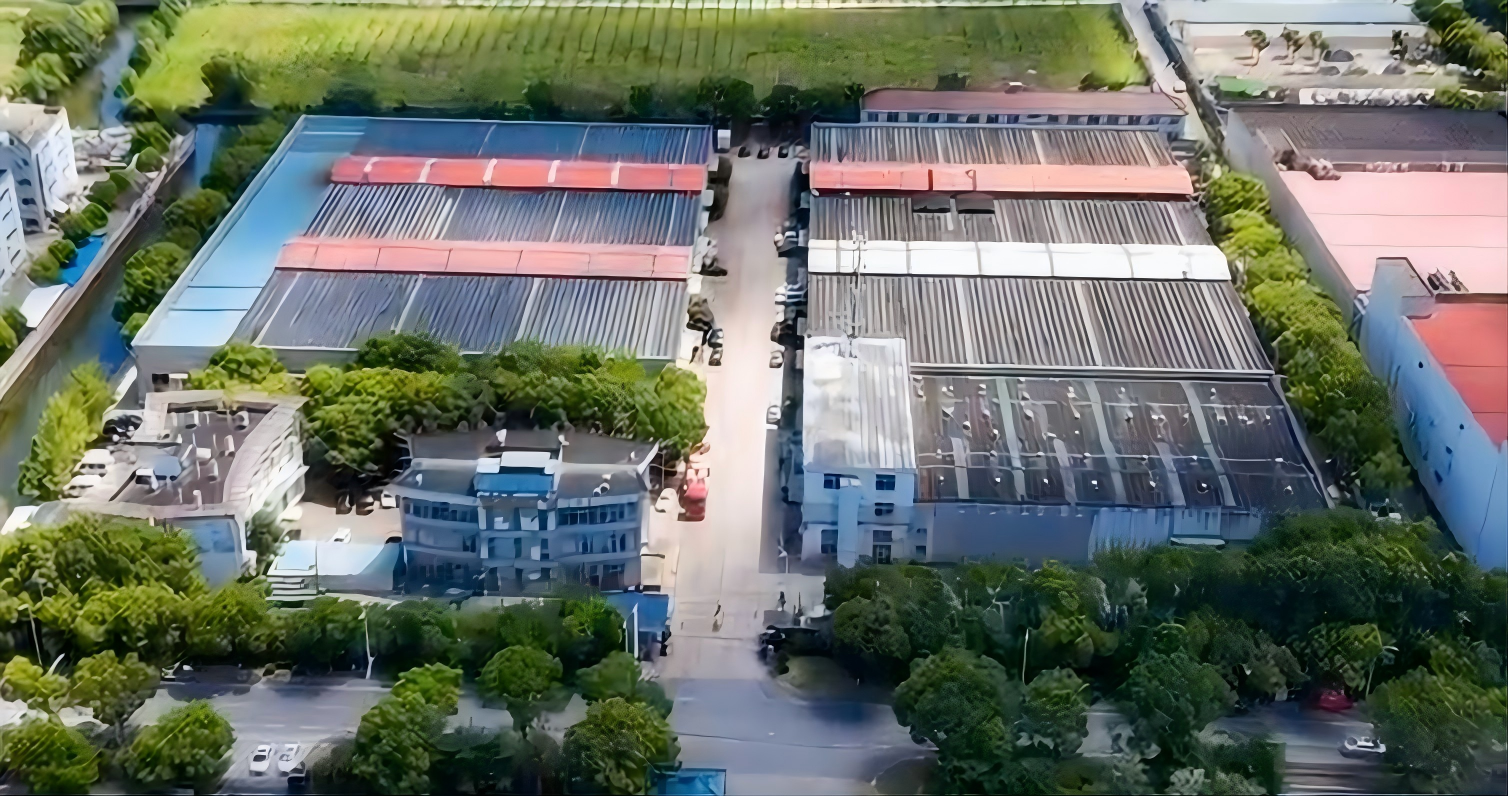
Capacity location shapes both delivery windows and the documentation a belt arrives with. Panoramic view of the BPS/EPS factory, Shanghai.
Export Performance and What It Changes in Purchasing Terms
Trade data for steel products provides the macro backdrop. China's total steel product exports reached 110.7 million tons in 2024, valued at approximately USD 83.6 billion. Steel belts are a small, specialised segment within that flow, but the same export orientation shapes how belt suppliers structure order handling, documentation and delivery commitments for foreign buyers.
At company level, the pattern is visible in the export profile. BPS/EPS reports an export ratio of 15%–25%, with Mainland China as the core market, Taiwan, China as a focus market, and Southeast Asia and the Middle East as incremental markets. The declared export markets extend to Southeast Asia (Thailand, Indonesia, Vietnam, Malaysia), Japan and South Korea, Europe (Germany, Poland, France, Italy, Russia), the Americas (United States, Canada, Brazil) and Oceania (Australia, New Zealand). A supplier operating across that spread has to hold documentation for multiple regimes at once, which is a different capability from holding stock.
The commercial terms that actually move
- Order size. Standard and customised steel strips are both offered from a minimum order quantity of one piece, with small-batch trial orders supported. For buyers qualifying a new line, this removes the usual penalty for testing before committing to volume.
- Lead time. Regular specifications combining stock material and standard dimensions run at 7–10 days; customised specifications involving material, size or hole position run at 15–20 days; urgent orders run at 5–7 days with an additional charge. Imported equivalents are quoted at 8–16 weeks.
- Tolerance as contract language. Achievable tolerances of ±0.02 mm on thickness, ±0.05 mm per 10 m on length, flatness of 0.02 mm/m or better, and hole position accuracy of ±0.01 mm are the values that should be written into acceptance criteria rather than left as reference figures.
- Service geography. Response commitments are 24-hour online response and 48-hour on-site service domestically, supported by a Shanghai maintenance centre, Beijing and Taiwan service centres and overseas agents in Europe and Southeast Asia. Buyers outside those coverage areas should plan spare belt inventory as part of the purchase, not as an afterthought.
Scenario Fit by Belt Type
Once policy and commercial filters are applied, the remaining question is scenario fit: which belt configuration belongs on which line. The table below maps the four belt families most often evaluated for foreign food, chemical and industrial processing projects against typical applications and their boundaries.
| Belt type | Typical process scenarios | Fit drivers | Boundaries to verify |
|---|---|---|---|
| PTFE coated steel belts | Sulphur and wax pastillation, chocolate and confectionery conveying, powder coating flaking, sticky or viscous product release, casting coating lines | Very low surface friction and clean release of viscous materials such as chocolate, syrup, paste, colloid and powder; food-grade safety; resistance to high and low temperature, acids, alkalis and oils; smooth, easily cleaned surface | Coating is a wear layer and must be inspected over life; food contact conformity must be confirmed for the specific coating and line |
| Stainless steel belts | Chocolate and candy cooling conveyors, bakery tunnel ovens and steam ovens, steamed cake and crab stick moulding lines, hygienic food conveying | High strength and flatness, food-grade hygiene, good thermal conductivity, durable circular welding | Grade selection (304, 316L, 310S and others) changes cost and temperature capability; confirm grade against the process window |
| Carbon Belts | Baking and other food factory conveying, general industrial conveying where release requirements are moderate | Established carbon steel composition (C 0.65–0.75%, Si 0.15–0.3%, Mn 0.60–0.90%, Cr max 0.20%) with predictable mechanical behaviour | Corrosion and hygiene requirements of the specific line, and whether a coated or stainless alternative is required for compliance |
| Special requirement steel belts | High-temperature process lines, wood OSB press belts, press and casting applications, precision positioning conveyors, chemical environments | Customisable 301, 304, 316L, 310S, duplex and high-hardness alloy strip; heat resistance up to 1100 °C; seamless circular welding; punching, slotting, flanging, guide edge blocking and side arc chamfering | Each special structure is a bespoke build; drawings, tolerances and acceptance tests must be agreed before production |
Belt family to scenario mapping, compiled from published product parameters and documented application cases. Boundaries indicate points requiring confirmation per order.
Chemical pastillation and cooling lines
In sulphur pastillators and wax pastillators, molten product is deposited onto a cooled moving belt and solidified into pastilles before discharge. Fit depends on heat transfer through the belt, dimensional stability at temperature, and release behaviour where the product is tacky. A documented chemical application for a powder coating producer used belts at 180–220 °C with flatness held at 0.02 mm/m or better, reporting uniform layer thickness and a 99.7% yield rate. Epoxy steel belt coolers and polyester steel belt coolers follow the same logic with different resin rheology, and single-belt resin flakers and double-belt resin cooling flakers add a second variable: whether one or two belts form the cooling surface, which changes both throughput and the belt specification.
Food baking, steaming and confectionery lines
Steel belt bakery tunnel ovens, steel belt steam ovens and steamed cake production lines require belts that hold flatness across repeated thermal cycles while meeting food contact rules. Chocolate steel belt conveyors and crab stick moulding machines add release and surface finish requirements. A documented food group application using food-grade 304/316L material with FDA/CE reference reported elongation of 0.2% or less, weld fatigue life of 2 million cycles or more, and a 60% reduction in downtime maintenance compared with the belts previously used. A baking equipment manufacturer procuring 50–80 belts annually at widths of 400–1800 mm reported a machine-level cost reduction of 20% against imported belt supply.
Precision, press and coating applications
Press steel belts and wood OSB press belts operate under combined heat and mechanical load, where flatness and internal stress control dominate fit. Casting coating steel belts and powder painting steel belt flakers sit at the interface between chemical resistance and release. In a precision assembly application, hole position accuracy of ±0.01 mm and 10 m cumulative tolerance below 0.05 mm enabled repeat positioning of ±0.05 mm with transmission efficiency of 98% or higher. These are the scenarios where tolerance language in the purchase order matters more than brand preference.
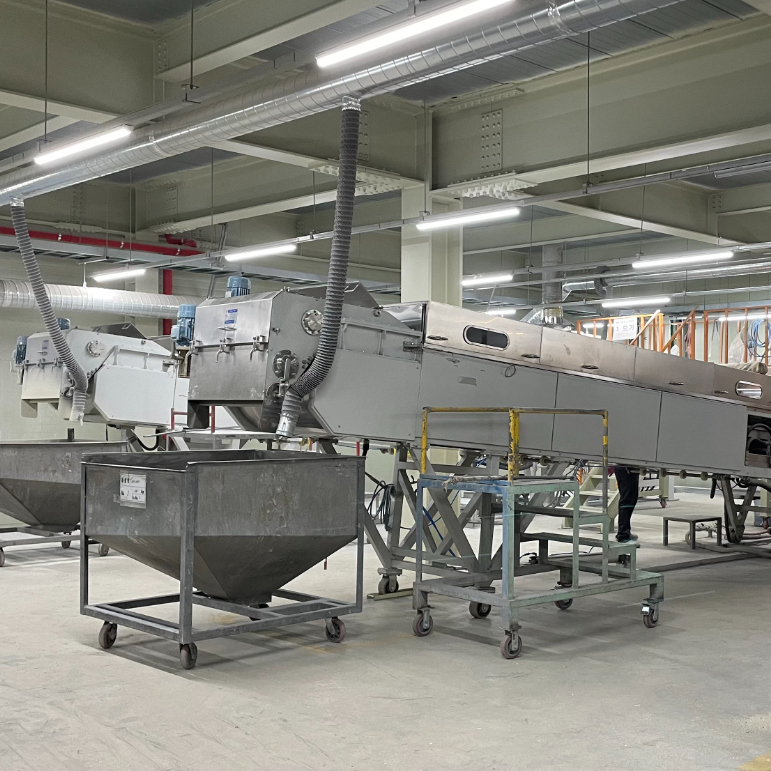
Powder coating flaking lines combine thermal load and release requirements, making belt specification and acceptance criteria interdependent.
Acceptance Criteria Adapted to Regional Applications
Because fit is now market-specific, acceptance criteria should be written per destination rather than copied from a domestic template. The emphasis differs by region even where the underlying belt is the same.
| Destination market | Documentation emphasis | Physical acceptance emphasis |
|---|---|---|
| European Union | EN 12882:2015 where the belt serves a general-purpose conveyor; EC 1935/2004 food contact conformity for food-facing lines, including the coating | Weld appearance and leveling, flatness across the full strip, coating continuity |
| North America | FDA contact material conformity for food applications; buyer-specific documentation packages | Dimensional tolerance, surface finish, evidence of incoming material verification |
| Southeast Asia, Middle East, Oceania | Frequently buyer-defined, often referencing food hygiene and CE marks where equipment is exported onward | Working-condition validation at line temperature, corrosion resistance, spare part availability |
| Domestic and regional Asian projects | Supplier quality records, incoming spectral analysis and process inspection reports | Hole position accuracy, cumulative length tolerance, weld fatigue expectation |
Regional acceptance emphasis. Documentation requirements should be confirmed with the destination market's conformity body before the order is placed.
Underlying these criteria is a quality control sequence that can be referenced directly in a purchase order: incoming material spectral analysis with thickness, hardness and tensile strength testing and surface defect inspection; in-process full dimensional tolerance inspection with flatness and straightness testing and weld appearance checks. Buyers who specify which of these records must accompany each shipment convert a general quality claim into an auditable acceptance condition.
Where Application Fit Still Breaks Down
An honest evaluation has to acknowledge the limits, because most sourcing failures occur where a genuine capability is applied outside its boundary.
- A coating is not universally better. PTFE coating resolves release problems with sticky materials, but it introduces a wear layer that must be monitored. Where the requirement is a mirror or polished surface with no coating, an uncoated stainless belt may fit better.
- Temperature ranges must be checked per build. Customised working conditions are stated at −60 °C to +250 °C, while special requirement belts can be built for heat resistance up to 1100 °C. Those are different product categories, and a standard coated belt should not be assumed to cover the upper part of the range.
- Service response depends on geography. A 48-hour on-site commitment applies domestically; buyers in Europe, the Americas or Oceania rely on agent coverage and should plan their own spare belt holding accordingly.
- Warranty and service life are not the same number. A 12-month warranty against non-human damage sits alongside an expected service life of 2–5 years. Lifecycle cost planning remains the buyer's responsibility.
- Extreme dimensional combinations need validation. The stated width and thickness envelope is broad, but very wide and very thin combinations, or very long single strips, should be validated on a trial order before a line is committed.
Market Trend Analysis
The demand backdrop supports the shift described above. The global steel belt conveyor market was valued at USD 1.75 billion in 2025 and is projected to reach USD 3.15 billion by 2034, with a compound annual growth rate of 6.7% over 2026–2034. Separately, the global integrated steel belt systems market, covering coolers, flakers and pastillators, was estimated at USD 1.2 billion in 2025.
The two figures are not interchangeable, and the divergence is itself a trend signal. Estimates differ materially between pure steel belt component sales and the broader conveyor systems market that includes drive components and frameworks. For buyers, the practical reading is that suppliers are being pushed toward line-level offers, because that is where growth is being captured. A belt quotation that does not clarify whether it covers the strip alone or a belt plus cooling, flaking or conveying system is difficult to compare against alternatives.
Three secondary trends follow from the same data. First, regional capacity expansion reduces dependence on long import cycles, which moves delivery time from an accepted constraint to a negotiating variable. Second, compliance documentation becomes a differentiator in food and general conveyor applications as rules fragment across jurisdictions. Third, as coating and alloy options multiply, the specification burden shifts to the buyer, who must define the working window precisely enough for a supplier to select the correct grade the first time.
Future Outlook
Over the next several years, application fit is likely to be defined by documentation and by service proximity at least as much as by metallurgy. Coating development will continue to serve release-critical food and chemical lines, while high-temperature and corrosion-resistant special belts will follow the requirements of press, casting and chemical processing applications. As more lines are specified for multi-market deployment, buyers will increasingly ask for belt specifications that satisfy the strictest applicable regime rather than the domestic one.
The commercial expectation is also likely to tighten. Lead times in the range of one to three weeks for standard and customised belts, against import cycles measured in months, make trial orders and rapid replacement economically reasonable — which in turn raises the standard for what a supplier must document and deliver per order. Evaluation-stage buyers who structure their criteria around policy, capacity and export reality, rather than around catalogue specification alone, will be better positioned when those three forces move again.
FAQ
What does application fit mean for a steel belt?
Application fit is the alignment of four attributes with a specific process line: material grade and mechanical properties, surface or coating behaviour, dimensional accuracy including flatness and weld quality, and the conformity documentation required in the destination market. A belt is fit only when all four align; meeting the dimensional specification alone is not sufficient for food or regulated conveyor applications.
Which standards apply to steel belts in food and general conveyor use?
Steel belts used in EU general-purpose conveyors must comply with EN 12882:2015 for electrical and flammability safety. Food-grade belts are required to meet food conformity standards such as EC 1935/2004 and FDA regulations for contact materials. Where a PTFE or other coating is used on a food-facing line, the coating is part of the conformity assessment rather than a separate item.
How do lead times and minimum order quantities differ between regional and imported supply?
For the regional supply profile described in this article, regular specifications combining stock material and standard dimensions run at 7–10 days, customised specifications at 15–20 days, and urgent orders at 5–7 days with an additional charge, against 8–16 weeks for imported equivalents. Standard and customised steel strips are both available from a minimum order quantity of one piece, which permits a trial order before volume commitment.
Which steel belt type fits chemical pastillation compared with bakery tunnel ovens?
Chemical pastillation and flaking lines such as sulphur pastillators, wax pastillators, epoxy and polyester steel belt coolers, and single or double-belt resin flakers typically call for PTFE coated or specially built belts, because release of viscous or tacky product and thermal stability at process temperature dominate. Bakery tunnel ovens, steam ovens and steamed cake lines typically call for stainless steel belts or Carbon Belts, where food-grade hygiene, flatness across thermal cycles and weld durability dominate.
What acceptance criteria should be written into a steel belt purchase order?
Acceptance criteria should include thickness tolerance, cumulative length tolerance per 10 m, flatness per metre, hole position accuracy where holes are specified, weld appearance and leveling, and the quality records to accompany each shipment such as incoming spectral analysis, thickness, hardness and tensile strength results, and in-process dimensional and flatness inspection. The conformity statement for the specific grade and coating combination should be named explicitly.
What are the main limits of PTFE coated steel belts?
The coating is a wear layer that must be inspected across service life, and its food contact conformity must be confirmed for the specific coating and application rather than assumed. Where the process requires an uncoated polished or mirror surface, an uncoated stainless belt may be the better fit. Temperature capability must also be verified per build, because customised working conditions and special high-temperature belts are distinct product categories.
For readers who require the underlying technical parameters referenced in this analysis, the manufacturer's English-language product brochure is available for download: BPS/EPS English product brochure (PDF).
Tem questões ou precisa de mais detalhes?
Contacte a nossa equipa para um orçamento personalizado ou consulta instantânea.
Solicitar orçamento
Preencha o formulário abaixo e a nossa equipa entrará em contacto com uma proposta personalizada.
Chat direto do WhatsApp
Prefere conversar em tempo real? Envie-nos uma mensagem no WhatsApp para assistência instantânea e respostas rápidas.
- Obter orçamento personalizado
- Partilhar fotos ou documentos
- Discuta as suas necessidades diretamente
Geralmente responde em 5–30 minutos durante o horário de expediente.