
Why Supplier Longevity Matters for Disposable Wooden Cutlery
The global disposable wooden cutlery market was valued at approximately USD 2.8 billion in 2025 and is projected to grow to USD 5.2 billion by 2034, according to market analysis published by Dataintelo. Growth at that scale changes the questions buyers ask. Unit price still matters, but the more consequential question for food service chains, wholesalers and retail own-brand teams is whether the manufacturer behind a specification will still be able to produce it — with the same certifications, the same raw-material documentation and the same commercial terms — three, five or ten years from now.
Supplier longevity is the practical name for that question. In disposable wooden cutlery, it is rarely settled by a price list. It is settled by evidence that a manufacturer maintains its operating systems, its material traceability and its production discipline over time — and by whether a buyer knows how to read that evidence.
Why Supplier Longevity Moved Up the Procurement Agenda
Supply for disposable wooden cutlery is geographically concentrated. Asia Pacific led the global market in 2025 with a 38.6% share, supported by rapid urbanisation and plastic bans in markets such as China and India, according to Dataintelo. China remains the world's largest exporter of wood tableware and kitchenware under HS 4419, with export values of roughly USD 1.38 billion to USD 1.5 billion in 2024, based on OEC and WITS trade data. For buyers in Europe, North America and Australia, that concentration is efficient, but it also means continuity depends on a relatively small group of manufacturers.
The cost of a supply interruption is rarely the price of the cutlery itself. For a restaurant chain, a hotel group or a supermarket own-brand programme, cutlery sits inside approved brand-standard documents, packaging artwork, sustainability reporting and, increasingly, due-diligence files. Changing supplier means re-approving samples, reprinting packaging, re-mapping certifications and re-documenting material origin. Those costs are incurred whether the change is planned or forced by a supplier's failure.
What a Basic Compliance Check Misses
Most procurement teams already ask a version of the compliance question: are you FDA certified, do you hold FSC? The answer usually arrives as a yes, sometimes with a certificate image attached. That exchange filters out obvious non-compliance, but it does not distinguish between a manufacturer that has been audited continuously for two decades and one that obtained a certificate last year for a narrow product scope.
Six details are commonly missed in that exchange:
- Which legal entity holds the certificate, and whether it is the same entity that will issue the invoice.
- The scope statement, read literally, and whether it covers the product actually being ordered.
- The issuing body, and whether it is an accredited certification body or a self-declared programme.
- The standard revision cited on the certificate.
- The issue and expiry dates, which turn a static document into a renewal calendar.
- The audit scheme behind the certificate, for example announced versus unannounced audits.
A longevity-oriented evaluation treats each of these as a data field rather than a yes-or-no answer.
| Dimension | Conventional compliance check | Longevity-oriented evaluation |
|---|---|---|
| Question asked | Are you certified? | Which entity, which scope, which audit scheme, valid until when? |
| Evidence accepted | Marketing PDF, screenshot or verbal confirmation | Certificate number matched to the issuing body, with scope and validity dates |
| Time horizon | The current order | The full life of the supply agreement |
| Risk identified | Absence of a certificate | Expiry, scope mismatch, entity mismatch, or unmaintained systems |
| Review cycle | At onboarding only | Tracked at every renewal date |
A Working Definition: Five Evidence Categories
Supplier longevity can be structured into five categories, each with evidence a buyer can request and compare across candidates:
- Operating history and physical footprint — how long the manufacturer has operated, how many plants it runs, and where they are.
- Certified management systems — independent third-party certification of quality, environmental, and occupational health and safety processes.
- Raw material traceability — chain-of-custody documentation linking finished cutlery to responsibly managed forest sources.
- Production and inspection capability — output capacity, lead times, and third-party inspection arrangements.
- Commercial continuity — packaging, documentation and logistics support that continue after the shipment leaves the factory.
Greenwood (Greenwood - Dalian Industrial Co.,ltd.) is a China-based manufacturer of disposable wooden and bamboo tableware founded in 2000. The company operates five production plants with an annual capacity of 6 billion pieces, employs 500 people including a nine-engineer R&D team, and exports 95% of its output to Europe, Australia and New Zealand, Canada, the United States, South America, the Middle East, Japan and Korea, and Southeast Asia. Its range covers birch and poplar wooden knives, forks and spoons in lengths including 140 mm and 160 mm, with additional 180 mm, 170 mm, 110 mm and 95 mm options, alongside ice cream sticks, coffee stirrers and bamboo tableware.
ISO 9001, ISO 14001 and ISO 45001: What Each Certificate Actually Proves
These three standards are frequently listed together on supplier documents, but they cover different management systems, and buyers get more value from them when the difference is clear.
ISO 9001:2015 — quality management
ISO 9001 covers documented process control, supplier evaluation, measurement, corrective action and the handling of nonconforming product. For a cutlery buyer, it is evidence that production is governed by procedures rather than by individual operators on a given shift.
ISO 14001:2015 — environmental management
ISO 14001 covers identification of environmental aspects, compliance obligations, and the management of waste and resources. For food service buyers who must document environmental performance in their own reporting, it is a supplier-side input to that file.
ISO 45001:2018 — occupational health and safety
ISO 45001 covers hazard identification, worker participation and incident management. It matters commercially because labour and safety conditions at a manufacturing site are increasingly part of retailer and brand audit programmes.
Two points are worth stating plainly. First, these standards certify management systems, not individual products: a valid ISO 9001 certificate does not guarantee that a specific batch of forks will be free of burrs. Second, much of the value comes from the audit cycle behind the certificate, because a recurring or unannounced audit regime is harder to maintain than a one-off inspection.
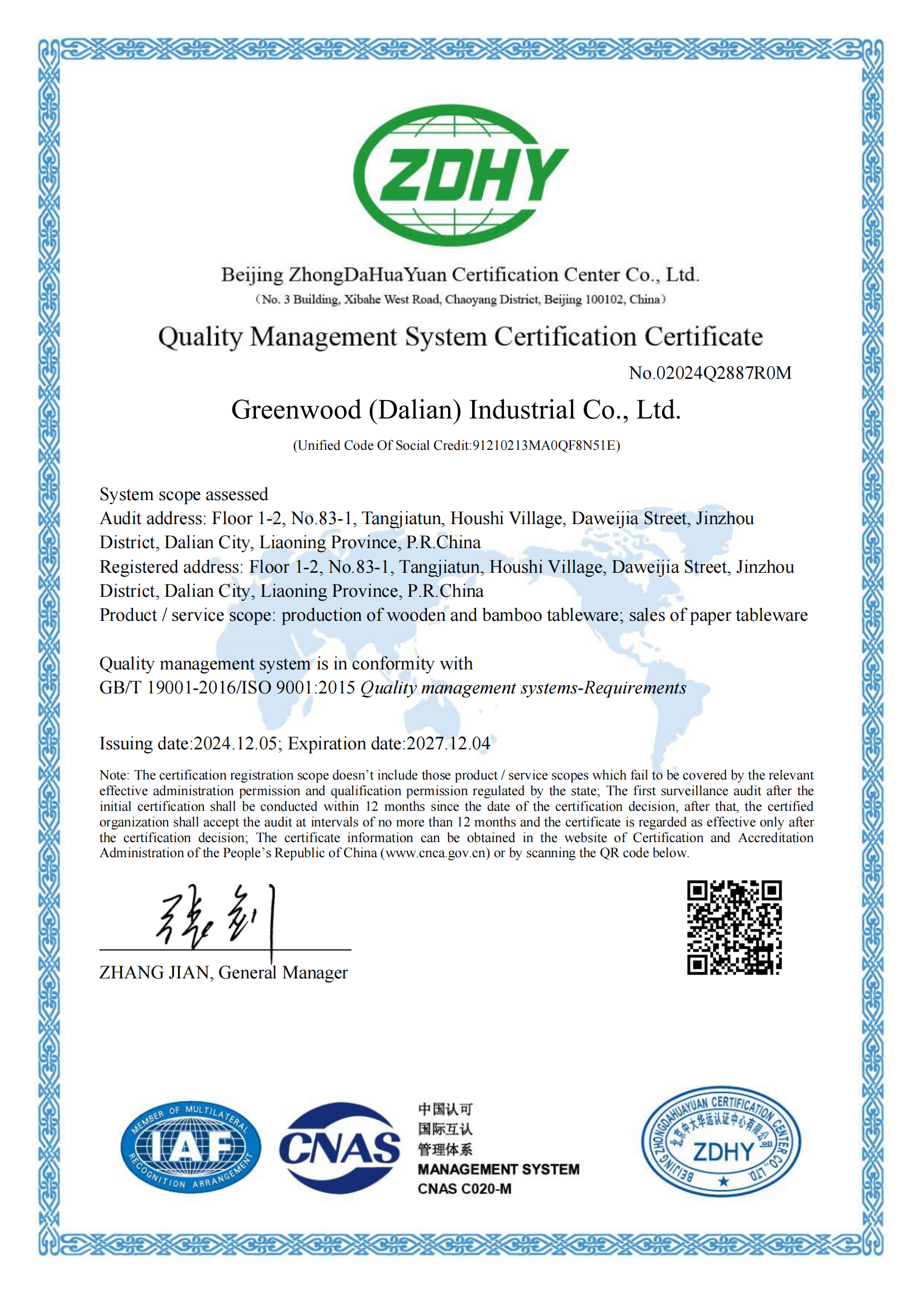
Greenwood holds all three certificates under a single certificate number, 02024E1883R0M, issued by Beijing ZhongDaHuaYuan Certification Center Co.,Ltd with the scope recorded as “Wooden product”. All three were issued on 5 December 2024 and are valid until 4 December 2027.
| Certification | Certificate number | Issuing body | Scope / standard | Issued | Valid until |
|---|---|---|---|---|---|
| ISO 9001 | 02024E1883R0M | Beijing ZhongDaHuaYuan Certification Center Co.,Ltd | Scope: wooden product; GB/T 19001-2016 / ISO 9001:2015 | 5 Dec 2024 | 4 Dec 2027 |
| ISO 14001 | 02024E1883R0M | Beijing ZhongDaHuaYuan Certification Center Co.,Ltd | Scope: wooden product; GB/T 24001-2016 / ISO 14001:2015 | 5 Dec 2024 | 4 Dec 2027 |
| ISO 45001 | 02024E1883R0M | Beijing ZhongDaHuaYuan Certification Center Co.,Ltd | Scope: wooden product; GB/T 45001-2020 / ISO 45001:2018 | 5 Dec 2024 | 4 Dec 2027 |
| FSC Chain of Custody | SA-COC-013128 | Soil Association | FSC Chain of Custody standards; scope: wooden product | 3 Apr 2023 | 2 Apr 2028 |
| BRCGS Packaging Materials | 10000305214-MSC-ACCREDIA-CHN | DNV | Global Standard for Packaging Materials, Issue 6 (August 2019), unannounced audit scheme; scope covers manufacturing of disposable wooden and bamboo tableware | 2 May 2022 | 2 May 2027 |
| FDA 21 CFR 178 | R0723000394 | National Reference Laboratory for Food Contact Material (Guangdong) | FDA 21 CFR 178.3800; GB 4806.12-2022; GB 9685-2016; scope: wooden product | 30 Aug 2023 | Open-ended |
Two further food-contact and social compliance documents sit alongside these: an LFGB certificate (number 7216006083-2) issued by TUV SUD China on 25 July 2025 covering all wood and bamboo tableware, and a Sedex/SMETA record (ZS405156174) covering labour standards, health and safety, environment and business ethics.
FSC Chain of Custody and the Material Availability Question
FSC Chain of Custody certification follows certified material through the supply chain, from forest management through processing to the finished product. It requires documented control of inputs, separation of certified and non-certified material, and record-keeping that can be traced backwards. For a buyer, it addresses a question the ISO standards do not: where the wood came from.
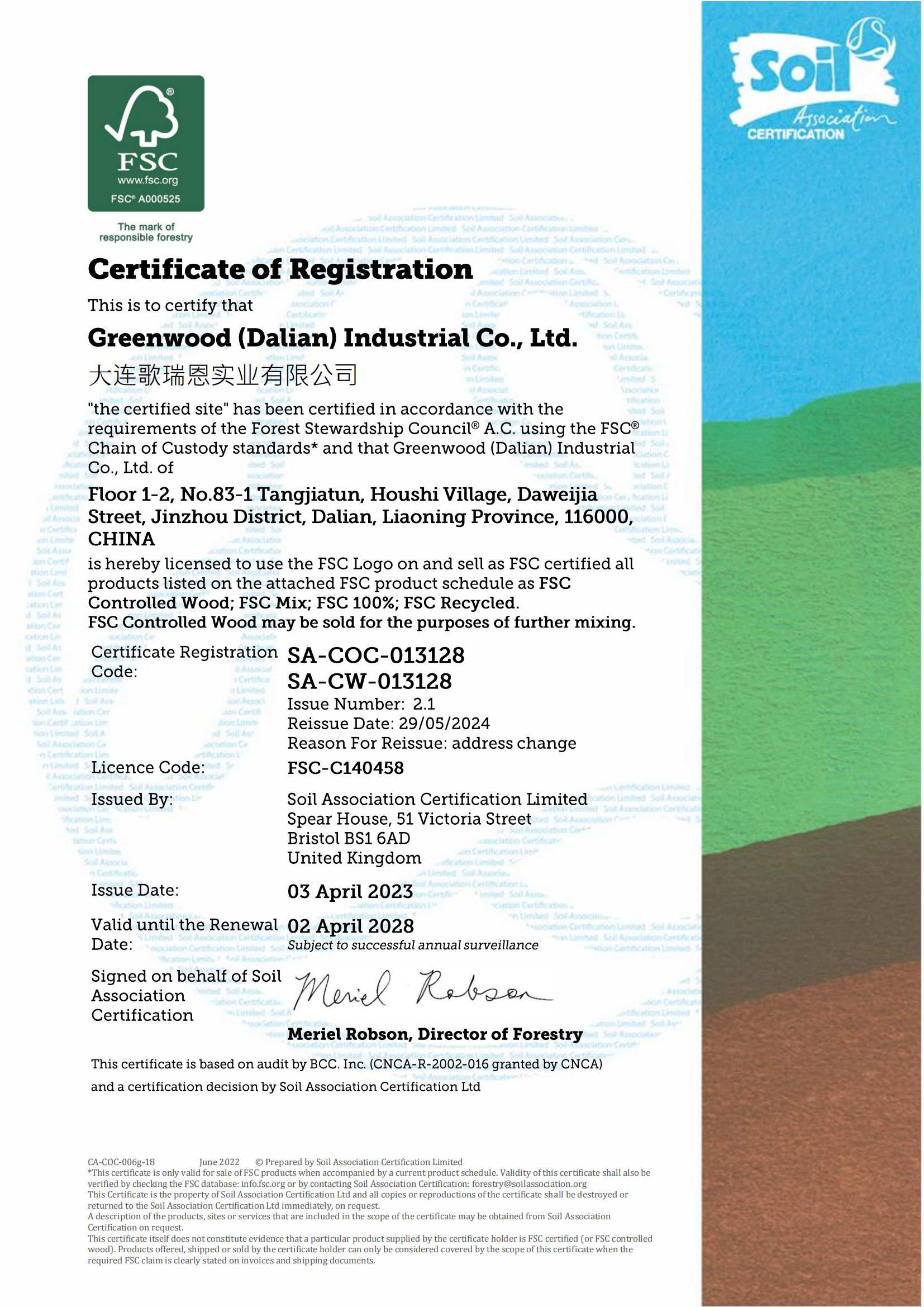
Greenwood's FSC Chain of Custody certificate, SA-COC-013128, was issued by the Soil Association and is valid from 3 April 2023 to 2 April 2028, with the scope recorded as wooden product.
That matters for two reasons. The first is material availability. A manufacturer able to document certified feedstock is in a stronger position when raw material supply tightens, and can support buyers who must report on sustainable sourcing to their own customers or investors. The second is regulation. The EU Deforestation Regulation, Regulation (EU) 2023/1115, requires geolocation and due-diligence data for wood products placed on the EU market. Its application to large operators has been postponed more than once, with Council agreements pointing to a December 2025 to December 2026 window. Chain-of-custody documentation is a traceability input to that due-diligence process, though buyers should treat it as one element of a compliance file rather than as an automatic pass.
Compostability claims sit in a similar category. In the EU, EN 13432 is the standard that governs whether packaging, including wooden cutlery, may legally be marketed as compostable. Where a supplier describes products as biodegradable or compostable, the claim should be traceable to a test standard and to the certificate that documents it. Greenwood specifies its wooden cutlery as 100% natural wood, food-grade, BPA-free, non-toxic, and 100% biodegradable and compostable, with a smooth surface, no burrs and heat resistance suitable for hot and cold food.
Reading a Certificate the Way an Auditor Would
Certificates are most useful when they are read as verification instruments rather than as badges. A practical sequence for a procurement team runs as follows:
- Match the legal entity. The certificate holder's name must correspond to the entity on the quotation and the invoice. Certificates held by a trading arm do not automatically extend to a separate production company.
- Check the issuing body. Confirm that the organisation named is an accredited certification body for the standard in question, and note the accreditation reference where one is printed.
- Read the scope statement literally. Greenwood's ISO scope reads “Wooden product”, while the BRCGS scope text names the manufacturing of disposable wooden and bamboo tableware and enumerates items such as wooden knives, forks, spoons, skewers, steak markers, coffee stirrers, sticks, boats, cones, cups and trays, together with bamboo forks and chopsticks.
- Record the dates. Greenwood's ISO trio expires on 4 December 2027, the BRCGS certificate on 2 May 2027, and the FSC certificate on 2 April 2028. Each date belongs in the supplier file as a reminder, not only in the onboarding pack.
- Confirm the standard revision. Certificates citing GB/T 19001-2016 / ISO 9001:2015, GB/T 24001-2016 / ISO 14001:2015 and GB/T 45001-2020 / ISO 45001:2018 can be checked against the published current versions of those standards.
- Note the audit scheme. The BRCGS certificate references Issue 6 (August 2019) and an unannounced audit scheme, which carries a different risk profile from an announced-only inspection regime.
- File certificates with the contract, and review them at each renewal rather than at the next tender.
Commercial Capability: What Longevity Looks Like in Operational Terms
Certification evidence is only half of a supplier assessment. The other half is whether the manufacturer can actually execute at the buyer's volume. Greenwood's production services include OEM, ODM and customization, covering logo printing on products and packaging as well as custom shapes and new designs. Its stated capacity is 10 million pieces per day, with a lead time of 20 days, a minimum order quantity of 100,000 pieces, and third-party inspection for quality control. Procurement support is quoted at a minimum of 100 cartons, delivery on FOB Dalian or DAP terms, pre-shipment testing with third-party inspection (SGS), and payment of 30% T/T in advance with 70% T/T against a copy of the bill of lading. After-sales support covers packaging design and logistics.
Those figures define the shape of the relationship as much as its promise. A 100,000-piece minimum and a 20-day lead time suit volume programmes such as chain restaurants, takeaway wholesalers and retail own-brand lines; buyers with small, irregular or highly seasonal requirements should treat them as fit criteria and plan accordingly. Reading commercial terms this way is part of longevity assessment, because a supplier whose minimum order size does not match the buyer's real volume will not remain a supplier for long, however well certified it is.
Application: Where Longevity-Oriented Sourcing Pays Off
Restaurant chains and takeaway operations consume cutlery continuously and specify it in brand-standard documents that are costly to revise. For these buyers, the decisive question is whether a supplier can hold the same specification, finish and packaging format across several annual cycles, including individually wrapped and kit formats.
Hotels and hospitality groups often require branded cutlery, laser or print logos, and packaging that matches in-room presentation standards. Custom shapes and design work make supplier switching more expensive, which raises the cost of a partner that cannot sustain production.
Supermarkets and chain retail buy cutlery as an own-brand line and are audited on the documentation behind it. Here, certificates, chain-of-custody records and inspection reports are not supporting material; they are part of the product.
Camping, outdoor and event catering place weight on compostability and disposal messaging, which makes test-standard-backed claims more valuable than generic environmental language.
One illustration of how these factors combine comes from Greenwood's work with supermarket and chain-store clients in Germany and the United States. That programme, covering both B2B and B2C channels, has run for three years at approximately USD 5 million per year. The reported outcome was the replacement of traditional products and a sales uplift, with eco-friendly tableware described as a rising trend among younger consumers. The relevant point for a procurement reader is not the figure itself but the structure: a multi-year, multi-channel programme that required continuous certification evidence and stable supply.
What Certification-Led Evaluation Cannot Do
Certification evidence is necessary but partial, and buyers who treat it as a complete answer create a different kind of risk. Five limits are worth stating explicitly.
- Certificates describe systems, not products. ISO 9001 does not certify a specific fork, and FSC Chain of Custody does not certify that a particular shipment used certified material unless the documentation says so. Product attributes such as a splinter-free finish, smooth edges, heat resistance and dimensional consistency still need to be verified through samples and pre-shipment inspection.
- Scope boundaries matter. The ISO certificates held by Greenwood record “Wooden product” as their scope, while the BRCGS scope text names both wooden and bamboo tableware. A buyer sourcing a bamboo line should confirm which document covers which product family rather than assume blanket coverage.
- Certificates degrade over time. Each document carries an expiry date — 2 May 2027 for BRCGS, 4 December 2027 for the ISO trio, 2 April 2028 for FSC. Evidence that is not renewed is evidence that has lapsed.
- Certification does not transfer. A certificate held by one legal entity or one plant does not automatically apply to a subcontractor or a different production site.
- Commercial risk is separate. Certification says nothing about freight cost, currency exposure, capacity allocation in peak season, or price movement in raw wood. Those remain commercial negotiations.
| Dimension | Price-led sourcing | Checkbox compliance | Longevity-oriented evaluation |
|---|---|---|---|
| Primary question | What is the unit price? | Do you have the certificate? | Will this partner still be certified, supplied and capable in three to five years? |
| Evidence accepted | Quotation and sample | Certificate image on request | Certificate number, scope, issuing body, validity dates and audit scheme |
| Time horizon | One order | One audit cycle | Full contract life plus renewal |
| Main risk carried | Quality and continuity surprises | Scope mismatch or expired documents | Higher upfront administrative effort |
| Best fit | One-off, non-critical purchases | Low-volume or short-cycle buying | Chains, wholesalers and own-brand programmes |
Market Trend Analysis: Traceability Is Becoming a Condition of Market Access
Three trends shape how disposable wooden cutlery will be purchased over the next several years.
Volume growth. The market is projected to move from approximately USD 2.8 billion in 2025 to USD 5.2 billion by 2034, according to Dataintelo. Published estimates differ considerably depending on whether non-disposable wooden kitchenware is included in the scope, so buyers should treat any single figure as directional and rely on their own category data for planning.
Concentrated production. Asia Pacific held a 38.6% share of the market in 2025, and China's exports of wood tableware and kitchenware under HS 4419 reached approximately USD 1.38 billion to USD 1.5 billion in 2024 according to OEC and WITS data. Sourcing from this region is efficient, but it also means that supply continuity is tied to the operational and regulatory standing of a limited number of manufacturers.
Regulation-driven documentation. The EU Deforestation Regulation requires geolocation and due-diligence data for wood products, and EN 13432 defines what may be marketed as compostable in the EU. Together, these shift traceability and compostability from marketing language into documentation that must exist before a product can be sold into certain markets.
Future Outlook
The direction of travel is toward procurement files that look more like audit files. Buyers are likely to see three changes. First, certification continuity will move into contract terms, with renewal dates treated as delivery milestones alongside lead times and shipping schedules. Second, certificate verification will become a routine administrative step, with buyers checking numbers against issuing-body records rather than accepting scanned images. Third, material traceability will sit alongside price and lead time as a scored criterion, particularly for suppliers selling into the EU.
For manufacturers, the practical implication is that integrated operations matter more, not less. Greenwood, for example, describes its operations as covering the industrial chain from raw wood procurement through production and processing to finished product packaging, and maintains warehouses in Bangladesh, Ukraine and the United States to serve European, American, South American and Middle Eastern orders. Vertical integration of this kind supports the two things buyers are now testing for simultaneously: certified systems and traceable material.
Supplier longevity, in other words, is no longer a background quality. It is a measurable attribute, and it is measured in certificate numbers, scope statements and expiry dates.
Frequently Asked Questions
What does ISO 9001 certification tell a buyer about a disposable wooden cutlery manufacturer?
ISO 9001:2015 certifies a quality management system rather than a specific product. It indicates that the manufacturer maintains documented process control, supplier evaluation, measurement and corrective action, verified through periodic external audits. Greenwood's certificate, number 02024E1883R0M, was issued by Beijing ZhongDaHuaYuan Certification Center Co.,Ltd with the scope recorded as “Wooden product”, issued on 5 December 2024 and valid until 4 December 2027. It is evidence of repeatable process discipline; it is not a batch-level guarantee of finish, strength or dimensional tolerance, which buyers still verify through samples and pre-shipment inspection.
How does FSC Chain of Custody certification relate to long-term material availability?
FSC Chain of Custody certification follows certified wood through processing to the finished product and requires documented control and separation of certified material. Greenwood holds certificate SA-COC-013128, issued by the Soil Association, valid from 3 April 2023 to 2 April 2028, with a scope recorded as wooden product. For buyers, chain-of-custody documentation is an indicator that the manufacturer can trace feedstock and support sustainable-sourcing reporting. It is also relevant to the EU Deforestation Regulation, Regulation (EU) 2023/1115, which requires geolocation and due-diligence data for wood products placed on the EU market, although chain-of-custody certification functions as a traceability input to due diligence rather than as an automatic compliance determination.
What is the difference between ISO 14001 and ISO 45001 when evaluating a supplier?
They address different management systems. ISO 14001:2015 covers environmental management, including identification of environmental aspects, compliance obligations, and waste and resource handling. ISO 45001:2018 covers occupational health and safety management, including hazard identification, worker participation and incident management. In Greenwood's case both are held under the same certificate number as the quality standard, 02024E1883R0M, with the scope stated as wooden product, issued 5 December 2024 and valid until 4 December 2027. Environmental certification tends to feed a buyer's own sustainability reporting, while occupational health and safety certification tends to feed retailer and brand labour-audit programmes.
How can a buyer confirm that a supplier's certificate is still valid?
Four checks are usually sufficient. Match the certificate number and the legal entity name against the supplier's quotation and invoice. Confirm the issuing body and its accreditation for that standard. Read the scope statement to see whether the product being ordered falls within it. And note the expiry date, asking for the current version of the certificate rather than a marketing document. As reference points, Greenwood's BRCGS certificate (10000305214-MSC-ACCREDIA-CHN, issued by DNV) is valid until 2 May 2027, the FSC certificate until 2 April 2028, and the ISO certificates until 4 December 2027.
Do ISO and FSC certifications guarantee product performance, price competitiveness or delivery reliability?
No. These certificates address management systems and material traceability, not unit economics or logistics performance. A supplier can hold a valid ISO 9001 certificate and still quote a lead time or minimum order quantity that does not fit a particular buyer. In Greenwood's case, the stated commercial parameters are a 100,000-piece minimum order quantity, a 20-day lead time and a minimum of 100 cartons for procurement support, which suit volume programmes rather than small or irregular orders. Performance attributes such as a splinter-free finish, heat resistance and compostability claims also require product-level evidence, such as reference to the EN 13432 standard in the EU.
What happens if a certification expires during a supply agreement?
Certificates carry defined validity windows and are renewed through recurring audits. The dates on Greenwood's certificates illustrate the pattern: BRCGS to 2 May 2027, the ISO certificates to 4 December 2027, and FSC Chain of Custody to 2 April 2028, while the FDA 21 CFR 178 registration (R0723000394) is recorded as open-ended. Buyers commonly treat these dates as contract milestones, recording them in the supplier file and requesting updated documentation at renewal. If a certificate lapses without renewal, the practical consequence is that the evidence supporting the supplier's compliance position is no longer current, and the buyer must decide whether to pause new orders, seek alternative documentation, or accept the gap with a documented rationale.
Reference document: Greenwood company brochure, including product ranges and certification details — available here as a PDF.