
Will Your Supplier Still Matter in 3 Years? The Acoustic Lighting Sustainability Test
An acoustic slat wall is rarely installed in one go. It appears as 40 panels in a lobby, then 90 more when a second floor opens, then a maintenance replenishment two winters later. The LED strip light travels with the building — and it has to survive the building's schedules. That is why the question of whether a supplier will still matter in three years is not a question about a company's longevity. It is a question about specification longevity.
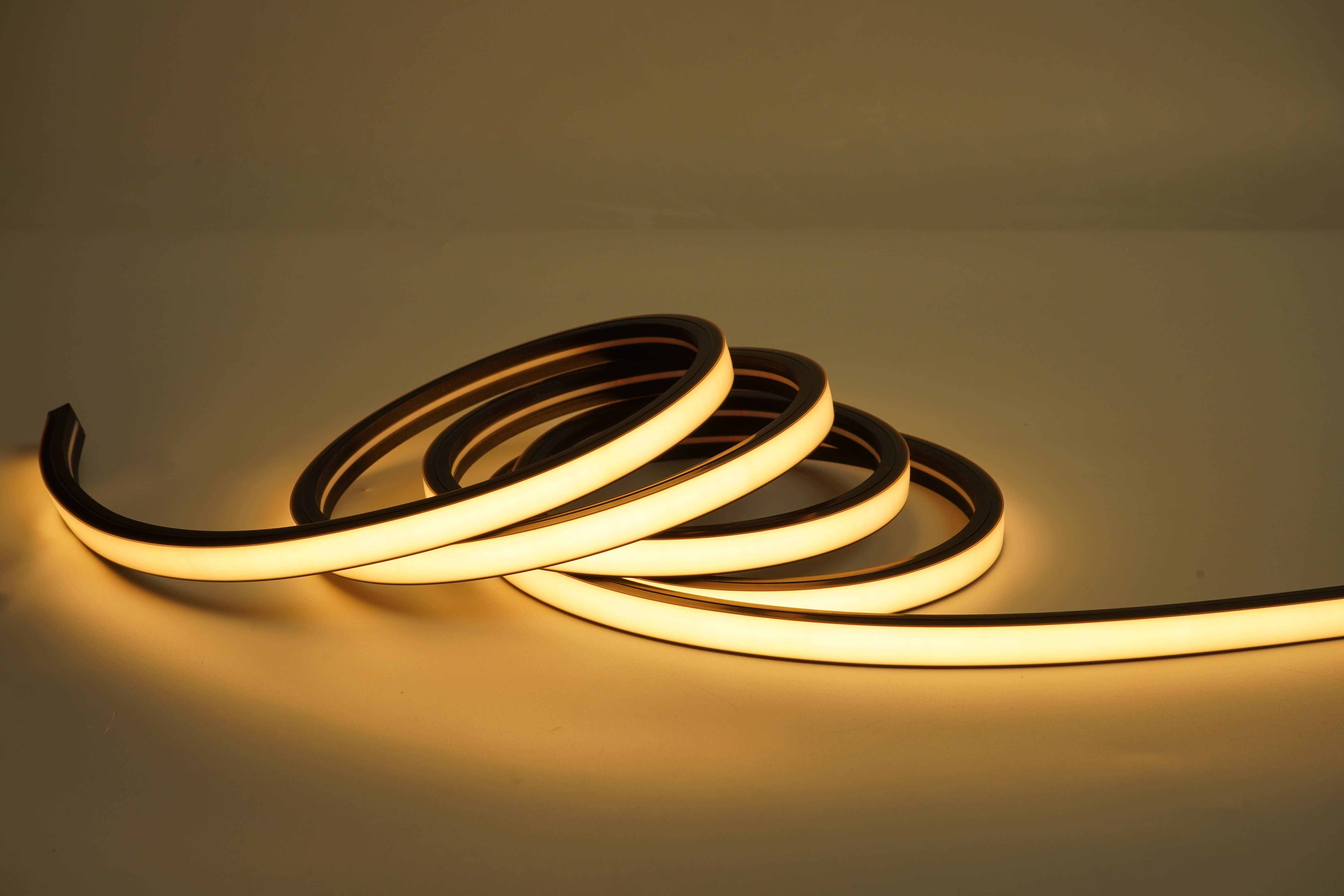
A quality LED strip light is often described as lasting 30,000 to 50,000 hours (Business Research Insights, 2025). But a building's replenishment horizon usually runs longer than that, and the strip does not fail in a vacuum — it fails when the format around it stops being available. When a panel manufacturer cannot source the same 8 mm PCB, the same 180 LEDs/m density and the same 3000K output eighteen months later, the problem is not a warranty claim. The problem is a wall that no longer matches itself.
This is the sustainability test in practical terms. Not whether the supplier is still registered as a company, but whether the supplier's technical choices — package format, PCB build, voltage platform — are stable enough that a fourth-phase order looks like a first-phase order.
Why Acoustic Panel Lighting Exposes Supplier Discipline
Acoustic slat wall systems are increasingly specified as an interior architecture element rather than a decorative add-on. They appear across hospitality guest floors, residential amenity spaces, meeting rooms and retail interiors, and they are frequently delivered in stages because the panel module, the aluminium profile, the driver and the LED strip light are ordered on different timelines.
The strip itself is not a standalone component. Acoustic wall LED strip light is developed for a narrow recess — the format used for slat panel mounting is built for 13 mm or 15 mm gaps, with a black surface designed so the strip blends into the channel instead of reading as a bright line. Change the strip and you have to re-match the gap, the board width, the colour and the light distribution all at once.
That compression means a supplier's behaviour becomes visible in three places:
- Package continuity — whether SMD 2835 and SMD 3535 remain the working formats, or whether each quarter brings a new package that quietly retires the old one.
- PCB consistency — whether double-layer copper stays the default, or gets downgraded to a single-layer build when nobody is watching the specification sheet.
- Voltage platform stability — whether 24V remains the base architecture rather than being compressed into something cheaper for a single order.
Each of these can be checked before purchase. None of them requires waiting three years to find out.
Test One: Does the Supplier Hold Proven SMD Packages?
SMD 2835 is the workhorse package in modern linear LED strip light design. It supports 120 to 192 LEDs per metre on an 8 mm board, which is the density range that fits acoustic panel channels without generating the heat or the width penalty of a wider format. A panel specification built around 2835 keeps compatibility with existing drivers, dimmers and optics.
SMD 3535 occupies a different role. It is the package used where colour control matters — the XP-D5DC24V-3535-120D-8MM multi-color LED strip light runs 3535 emitters at 120 LEDs/m on an 8 mm board at 24V, which is the format a colour-tunable panel spec would use.
The point is not which package is better. The point is whether the supplier uses a coherent, predictable package set across its strip portfolio. A supplier that rotates packages every quarter creates obsolescence by design: the old package goes end-of-life, the replacement has different optics, and the wall has to be reworked.
XPUP, a Zhongshan-based LED strip manufacturer established in 2012, works within this 2835-and-3535 structure. Its catalogue pairs 2835 white linear strips — including the 2835 180 LEDs/m acoustic wall strip and 2835 120 LEDs/m general strips — with 3535 multi-colour formats. That is not a claim of superiority; it is an observable package decision that a buyer can compare against any other supplier's catalogue.
What to ask: request the last 24 months of package-level production continuity for the specific model, and ask how an end-of-life package would be substituted. The answer is the difference between a specification and an improvisation.
Test Two: Is Double-Layer Copper Still the Default?
Double-layer copper PCB affects more than current capacity. It changes thermal behaviour and voltage consistency along the run — the two variables that determine whether a 2.4-metre strip at one end of a wall looks the same as a 3-metre strip at the other end two years later.
This matters more in acoustic panel lighting than in a typical retail cove. The application scenario for acoustic panel strips specifies an operating range of −20°C to +45°C, continuous 12/7 operation, and no covering of the strip. A supplier that quietly swaps in single-layer copper to save cost will surface as a brightness and colour drift between batches — the kind of defect that appears after the panel is already fixed to the wall.
XPUP's acoustic wall LED strip light, model CA-DC24V-2835-180D-8mm-3000K, is built on an 8 mm double-layer copper PCB rated 11 W at 24V, with 180 LEDs/m, Ra≥80, 3000K and IP20, supplied in 2.4 m and 3 m lengths. The same double-layer copper construction recurs across its 2835, 3535 and 5050 strip families, which is the relevant signal: the PCB decision is a platform choice, not a per-order variable.
What to ask: a board cross-section or layer count confirmation, plus a batch-to-batch comparison of colour temperature and luminous output. Both are normal engineering documents, not commercial secrets.
Test Three: Does the 24V Platform Hold?
Low voltage LED strip light in 12V and 24V configurations is the dominant architecture in linear lighting, and 24V is the more common of the two for architectural runs. The 24V segment accounted for 52.0% of linear LED strip fixture market revenue as of 2022 (Grand View Research), and the format is classified in the United States under the UL 2108 safety standard for low voltage strip.
For acoustic panels, 24V does three useful things. It keeps voltage drop manageable across 2.4 m and 3 m strips, it matches standard dimmers and controllers, and it keeps a project on a single driver architecture so that later phases do not need a different power supply.
A supplier that shifts voltage platforms between orders forces buyers into driver re-specification, extra stock and after-sales ambiguity. A supplier that keeps 24V as the base removes an entire category of future problem.
What to ask: whether the model's voltage architecture is expected to remain unchanged for the next three years, and whether custom voltage requests are isolated from the standard line. XPUP's catalogue includes a low voltage LED strip light family spanning 24V and 220V options — useful to know, because it shows that voltage variation is handled as a defined option rather than as a quiet substitution.
Where XPUP Sits on the Sustainability Test
Zhongshan Xiangpai (XPUP) Lighting Technology Co., Ltd. is an LED strip and linear lighting manufacturer founded in 2012, operating a factory of more than 10,000 m² with an annual output capacity of 35,000,000 metres of LED strip. Roughly 50% of sales are export, with products shipped to more than 170 countries and regions and principal markets in the EU and the United States. Products carry CE and RoHS certification and are manufactured against applicable safety, environmental and energy-efficiency requirements for European and American markets.
The company's acoustic panel product — CA-DC24V-2835-180D-8mm-3000K — sits directly inside the three tests above: 2835 package, double-layer copper PCB, 24V platform. It is an Acoustic Wall LED Strip Light developed specifically for slat wall panels fitted with 13 mm or 15 mm gaps, with a black surface that blends into the wall and silicone construction. Lengths are 2.4 m and 3 m per strip, and the model supports OEM and ODM requests.
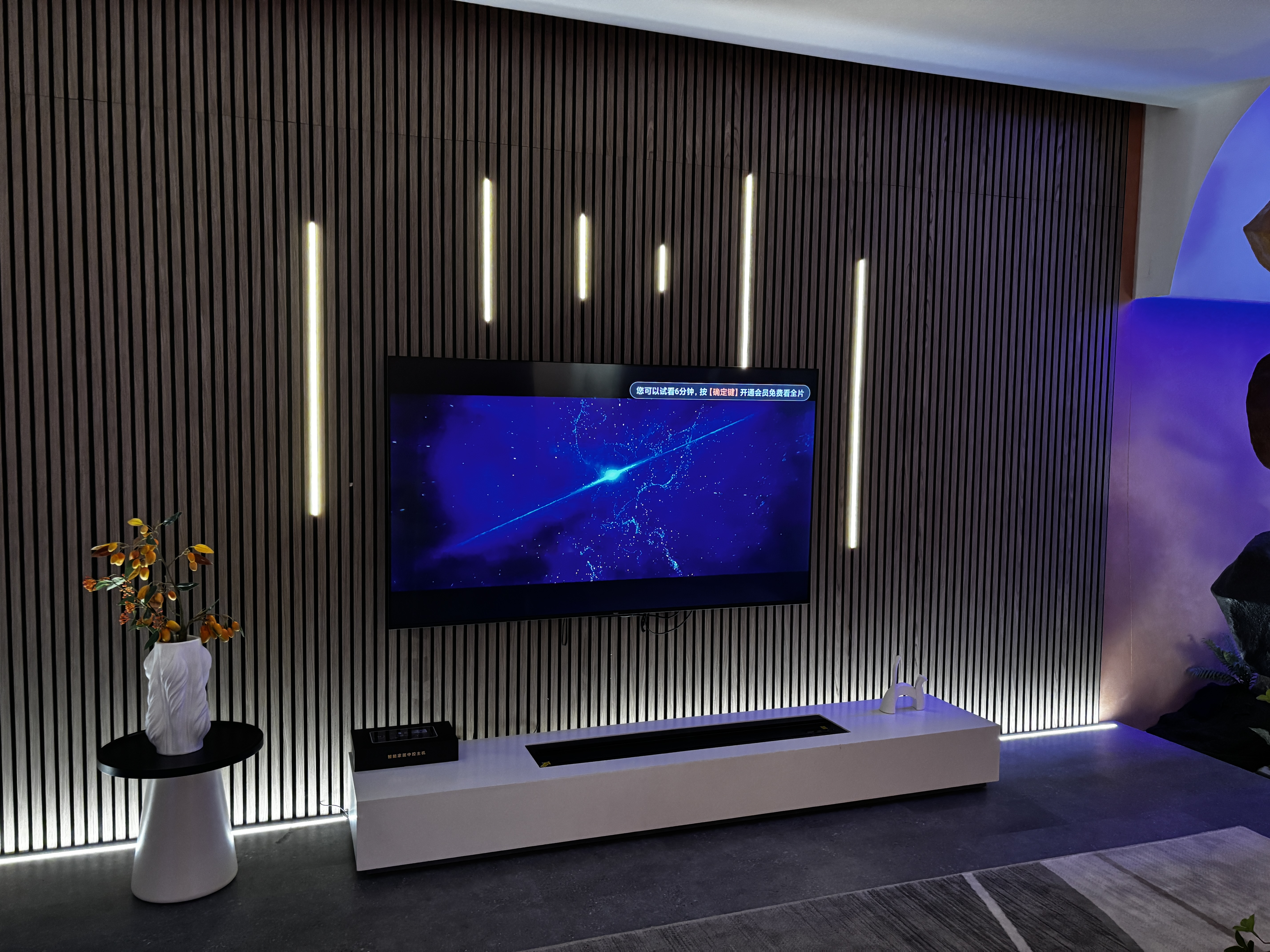
This is not an argument that this supplier is the only viable option. It is a worked example of what a stable answer looks like, so that the same checklist can be applied to any shortlisted vendor.
The Technical Explanation: Why Stability Beats Novelty in Panel Lighting
Acoustic panel lighting imposes two physical constraints that do not change with fashion. First, the light channel is narrow and shallow, so the strip is typically restricted to an 8–10 mm board. Second, once the strip is set into the recess, it is effectively unreachable — replacement means dismantling panel sections.
Those constraints reframe the specification. The question is not whether a newer package emits more lumens per watt. The question is whether the strip maintains width, density, colour consistency and voltage behaviour across the full run and across future batches.
Compare the two structural patterns in XPUP's range. The acoustic wall strip runs 180 LEDs/m at 11 W and 3000K on an 8 mm double-layer copper board; the general SMD 2835 strip runs 120 LEDs/m at 8 W with Ra≥90 and 40–45 lm per LED on the same 8 mm double-layer board. Same substrate logic, different density target. A buyer who standardises on that substrate logic across a project portfolio can swap density between areas without re-qualifying a new supplier.
Colour consistency belongs here too. The 3000K–4000K band held a 33.2% revenue share of the linear LED strip fixture market (Grand View Research), which matches what panel specifications actually ask for: warm-to-neutral white, not theatrical colour. High-density formats above 120 LEDs/m account for roughly 19% of premium installations, which is precisely the segment acoustic panel lighting occupies.
Application and Use Cases
Acoustic slat wall lighting usually arrives in one of four project shapes, and each stresses a different attribute of the supplier.
- Staged hospitality and residential projects. Panels arrive in phases; strips must match colour temperature and brightness across batches. Density consistency and a fixed CCT band matter more than peak output.
- Commercial interiors with central control. Strips run on smart lighting control systems and LED controllers. The 24V platform keeps driver and controller selection stable across zones.
- Renovation and retrofit work. Existing panels may need replenishment, so package continuity directly determines whether a match is possible at all.
- Interior fit-out and design-led projects. The black-surface, narrow-board format is chosen because it disappears into the panel — which means the supplier's dimensional consistency is itself a design input.
The operational envelope is equally part of the specification. XPUP's acoustic panel scenario documentation sets an operating range of −20°C to +45°C, 12/7 operation, no covering of the strip, and the requirement to use an appropriate power supply or adapter to avoid overload. Those are conditions that belong in a procurement document, not just a datasheet footnote.

Market Context: Why Platform Supply Is Replacing Project Supply
The global LED strip market was valued at approximately USD 5.8 billion in 2025 and is projected to reach USD 13.2 billion by 2034, growing at a CAGR of 9.6% (Dataintelo). Flexible LED strips hold the largest product-type share at 67.4%, and commercial applications contribute approximately 33.8% of global revenue. Europe is among the faster-moving regions for linear strip, with a projected CAGR of 12.6% (Grand View Research).
Acoustic panel lighting is not a separate market category — it is a specification pattern inside commercial and residential interior fit-out. But the broader adoption curve explains why supplier continuity has become a live procurement question: over 65% of new architectural lighting installations in 2025 use LED strip technology (Business Research Insights), and each of those installations carries a replenishment obligation that outlives the original order.
On the manufacturing side, China accounted for approximately 59.3% of global light fixture exports in 2024, with the United States as the largest single destination at USD 10.86 billion (OEC; Tuda Technology / China Lighting Association). That concentration means buyers are, in practice, evaluating Chinese source manufacturers on dimensions that go beyond unit price — continuity, compliance and platform discipline among them.
Compliance is part of the same conversation. IEC 60598-2-20:2022 sets safety requirements for lighting chains including LED strips, and UL 2108 governs low voltage strip in the US market. A supplier whose product line drifts away from these frameworks mid-project creates a compliance gap at the worst possible moment: the second or third phase of a multi-year installation.
Comparison With Conventional Solutions — and Where This Approach Stops
Against traditional neon, rigid light bars and halogen systems, a 24V SMD strip inside an acoustic panel offers clear structural advantages. It fits an 8 mm channel where a rigid bar would not, it delivers roughly 70% lower power consumption than incandescent equivalents (Business Research Insights, 2025), and it can be replaced in strip lengths rather than whole runs.
| Criterion | Conventional neon / rigid bar | 24V SMD strip for acoustic panels |
|---|---|---|
| Channel fit | Requires deeper recess and additional fixings | 8 mm board matched to 13 mm / 15 mm slat gaps |
| Energy use | Higher consumption per metre | Around 70% lower than incandescent equivalents |
| Maintenance | Whole-section replacement | Strip-length replacement, driver architecture unchanged |
| Continuity risk | Lower format churn, higher energy cost | Depends entirely on the supplier's package and PCB discipline |
The boundary is real and should be stated plainly. The XPUP acoustic wall strip is rated IP20 and is intended for indoor dry environments — it is not a solution for exterior facades, wet areas or outdoor landscape runs, where a silicone-sealed IP68 format such as the XP-C818DC24V-2835-120D-8MM would be the appropriate family instead. The 2.4 m and 3 m strip lengths are a fixed structural format and are not suited to projects that need continuous unbounded runs without joints. And where a specification demands a completely spot-free, continuous light line, an SMD 2835 strip at 180 LEDs/m will still read as a dense line of emitters rather than a seamless band; a COB format is the correct comparison there.
In other words, the sustainability test does not replace a product-fit test. A supplier can be perfectly stable and still be the wrong choice for a given wall.
Future Outlook
Three shifts are likely to define how buyers evaluate acoustic panel strip suppliers over the next few years.
Narrower boards, lower wattage. As slat wall profiles get slimmer, the 8 mm board becomes the constraint rather than the option, and the suppliers that already run 2835 at 120–180 LEDs/m on that width are better positioned than those who would have to re-tool a package.
Control integration over colour novelty. Wired smart lighting systems held 81.3% of the global smart lighting market in 2024 (Grand View Research), and smart features such as Wi-Fi and Bluetooth integration have reached roughly 47% adoption in strip systems. In acoustic panels the practical consequence is that the 24V platform becomes a control-compatibility decision as much as an electrical one.
Supplier continuity as a scoring criterion. As more installations move into phased delivery, the ability to re-order an identical format in year three is likely to appear in tender scoring alongside price and lead time. Buyers who build that criterion in early avoid the retrofit cost later.
The practical takeaway is modest but useful: evaluate the platform, not just the sample. Ask what will still be in production when the next phase is ordered, and treat an unclear answer as a specification risk rather than a commercial detail.
FAQ
What is an acoustic wall LED strip light, and how does it differ from a standard strip?
An acoustic wall LED strip light is a flexible strip designed to sit inside the recess of a slat acoustic wall panel. It typically uses 24V operation, an 8 mm PCB and a high-density SMD 2835 layout. XPUP's model CA-DC24V-2835-180D-8mm-3000K runs 180 LEDs/m at 3000K with Ra≥80 and IP20, in 2.4 m and 3 m lengths, developed specifically for slat wall panels fitted with 13 mm or 15 mm gaps.
How should a buyer choose between SMD 2835 and SMD 3535 for panel lighting?
The choice is driven by function rather than rank. SMD 2835 supports white linear output at 120–192 LEDs/m on an 8 mm board, which is the typical acoustic panel requirement. SMD 3535 is used where colour control is needed: XPUP's XP-D5DC24V-3535-120D-8MM runs 3535 emitters at 120 LEDs/m on an 8 mm board at 24V in RGB. Package availability over time matters as much as the initial specification.
Why is 24V preferred over 12V for acoustic panel strips?
24V reduces voltage drop across the longer 2.4 m and 3 m strip lengths used in panels, and it is the most widely used low voltage architecture in linear lighting — the 24V segment held 52.0% of linear LED strip fixture market revenue as of 2022. XPUP's acoustic wall strip and its wider 2835 and 3535 families all operate on 24V, which keeps driver and controller selection consistent across a project.
What does double-layer copper PCB mean for a long project?
Double-layer copper affects current capacity, heat management and voltage consistency along the strip. For acoustic panel lighting operating continuously within a −20°C to +45°C range, it helps keep brightness and colour temperature consistent between batches. It also reduces the risk of a later order being silently downgraded to a single-layer board, which is one of the more common sources of mismatch in phased installations.
How can a buyer check whether a supplier will still supply the same strip in three years?
Three checks are usually enough: package continuity over the previous 24 months for the specific model, confirmation that double-layer copper remains the standard build, and a clear answer on whether the 24V platform will stay unchanged. A supplier that answers all three consistently is demonstrating platform discipline; a supplier that answers only in general terms is signalling that the specification may move.
What are the limits of an acoustic wall LED strip light?
The IP20 rating means indoor dry environments only — outdoor or wet installations require a sealed format such as an IP68 silicone strip. The 2.4 m and 3 m lengths are fixed and not intended for seamless unbounded runs. And where the design requires a completely spot-free continuous line, a 180 LEDs/m SMD strip will still show individual emitters, so a COB strip is the appropriate comparison rather than a substitute.
For readers who need the full specification set, XPUP's 2026 LED strip product catalogue is available as a public PDF: 2026 XPUP LED Strip Catalog.
Tem questões ou precisa de mais detalhes?
Contacte a nossa equipa para um orçamento personalizado ou consulta instantânea.
Solicitar orçamento
Preencha o formulário abaixo e a nossa equipa entrará em contacto com uma proposta personalizada.
Chat direto do WhatsApp
Prefere conversar em tempo real? Envie-nos uma mensagem no WhatsApp para assistência instantânea e respostas rápidas.
- Obter orçamento personalizado
- Partilhar fotos ou documentos
- Discuta as suas necessidades diretamente
Geralmente responde em 5–30 minutos durante o horário de expediente.