
Window Cleaning Robot Certifications Decoded: What Marks Mean
A compliance mark on a window cleaning robot records that a defined product was assessed against a defined written standard. It does not record how thoroughly the glass was cleaned, how long the drive motor will last, or whether the end user will mount the safety tether correctly. That boundary is the most useful thing a buyer can learn to read.
Window cleaning robots sit in an unusual position among consumer appliances. They are electrical products, so they are covered by ordinary product-safety rules. They are also machines that attach themselves to vertical glass above ground level, which places them in a risk category that most household devices never enter. The label printed on the carton therefore carries at least three different kinds of information at once, and those kinds are frequently confused with each other in product listings, marketplace pages and reseller catalogues.
This article separates mandatory market-access conformity from voluntary quality marks, explains what each layer typically examines, and describes how the underlying engineering — suction, retention, backup power and sensing — determines whether a mark means anything in practice. It is written for consumers comparing devices and for resellers and private-label buyers who have to explain those marks to their own customers.
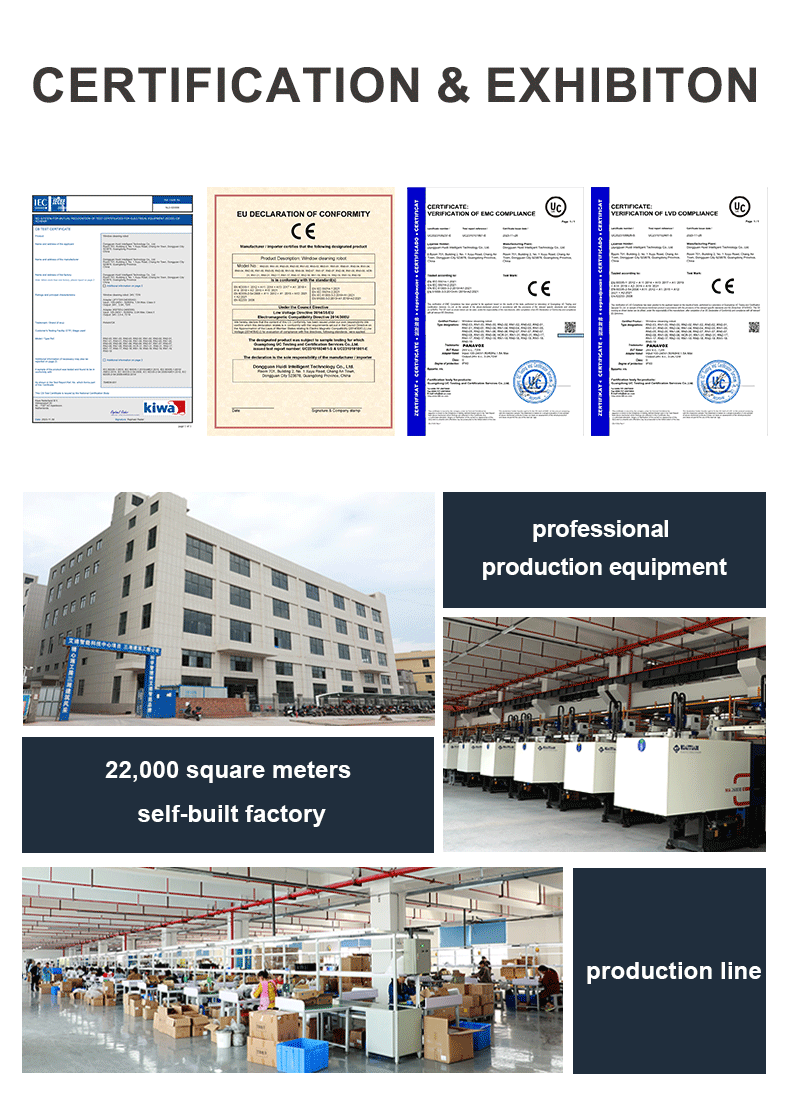
Compliance evidence in this category is generated on the factory floor and validated against documentation, not on the retail shelf.
Why the label became the first question buyers ask
The window cleaning robot category has moved from novelty hardware to a mainstream appliance line in a short period, and the numbers explain why label literacy suddenly matters to ordinary buyers. Grand View Research valued the global window cleaning robot market at USD 742.2 million in 2024 and projected growth at a compound annual growth rate of 24.5% through 2030. In China, the household window cleaning robot segment reached a valuation of 1.14 billion yuan in 2024, a 35.7% year-on-year increase, according to China Household Electrical Appliances Association data reported through TechSci Research.
That growth is export-driven. China's cleaning robot exports, including window cleaners, reached 7.75 billion yuan in the first quarter of 2024 and accounted for nearly 70% of the country's total robot exports, according to General Administration of Customs China figures reported by China Daily. A single product platform is therefore likely to be sold across several regulatory jurisdictions within the same year, each with its own conformity requirements, its own language of marks and its own enforcement posture.
Design convention reinforces the effect. One market tracker, Market Intelo, estimated that vacuum suction technology accounted for approximately 52.3% of the category in 2025 — meaning most units on sale are held to glass by differential pressure and a motor, which is precisely the mechanism compliance testing is built to interrogate. When the dominant engineering approach is also the dominant safety question, the mark stops being a formality.
Three layers of marks, and why conflating them causes bad decisions
Most confusion in this category comes from treating every symbol on a box as if it answered the same question. In practice, marks fall into three functional layers with different authors, different scopes and very different implications for a purchase decision.
| Layer | What it typically covers | Who initiates it | What it tells a buyer |
|---|---|---|---|
| Mandatory market-access conformity | Electrical safety, electromagnetic compatibility, restricted hazardous substances, and radio-equipment requirements where the unit is wireless | Driven by public authorities in the destination market | Legal permission to sell, plus baseline protection against shock, fire and interference |
| Voluntary product certification | Independent re-testing of safety, and sometimes durability, noise or performance claims | The manufacturer, often at a retailer's or importer's request | Third-party confirmation of selected claims; rarely a full performance disclosure |
| Management-system and factory-audit certification | Process control, quality management, factory inspection routines | The manufacturer, or a contract buyer auditing a supply chain | Evidence about how consistently units are built — not about the safety of any single unit |
The most common misreading is to treat a management-system certificate as product approval. A quality-management certificate displayed beside a product photograph says something about a factory's procedures; it says nothing about the electrical insulation of the specific unit in the photograph. Equally, a voluntary performance mark is not a legal requirement in most markets, and its absence does not imply non-compliance. Reading the layers separately prevents both over-trust and unnecessary rejection of sound products.
What each layer actually examines
Mandatory market-access conformity for a window cleaning robot is normally built from several technical strands, and each strand corresponds to a failure mode a buyer can picture.
Electrical safety and charging. Insulation, creepage and clearance distances, leakage current, abnormal-operation behaviour and charge-control logic are examined because the unit operates near glass, condensation and outdoor surfaces. The assessment question is not whether the product works, but how it behaves when it does not.
Mechanical retention. This strand separates window cleaning robots from almost every other household appliance: the device is held to a vertical surface by suction, above ground. International and North American safety frameworks address robotic cleaning machines specifically — IEC 63327 at international level and CSA 22.2 No. 336 in North America, both maintained as requirements for commercial and industrial robotic cleaning machines. These standards matter to consumer buyers as well, because they define the vocabulary of retention, backup and drop protection that national schemes inherit.
Environmental and material behaviour. Outdoor glass exposes a unit to temperature swings, moisture and ultraviolet light. A declared operating range — for example 10°C to 40°C — is a design statement that testing then verifies at its boundaries rather than at room temperature alone.
Electromagnetic compatibility and radio. Motors, brushless drivers and wireless modules must not disturb other equipment or be disturbed by it. When a robot pairs with a cloud platform such as Tuya or Smart Life, the radio strand becomes a market-access requirement rather than an optional extra.
Software and connected functions. This is the least standardized strand. App behaviour, update policy and data handling are rarely covered by the same written standard as insulation and retention, which is why buyers should treat connectivity claims and safety claims as two separate conversations.
The engineering behind the mark: adhesion, retention and fail-safe behaviour
A certificate is a record of an assessment, not a mechanism. The mechanism has to exist in the product first, and in suction-based window cleaning robots it is built from a small number of physical systems that any buyer can identify by name.
Suction and adhesion. In the current Lincinco window cleaning robot range, models including F19-02, RN2-06, RN2-08, LS26, RN2-03, RO3 and HCR10 are specified with suction power of 3500Pa and above, produced by a brushless DC motor. A figure like this is a performance claim about the machine, not a certificate about the product; its compliance relevance is that adhesion margin is what a retention test is designed to probe under load, on wet glass, with the pad in contact.
Backup power. A 30-minute UPS battery backup changes the nature of a power interruption. Without backup, a mains failure during an outdoor cycle is a drop scenario; with backup, it becomes a retrieval scenario in which the unit holds position long enough to be recovered. This is the clearest example of a design decision that exists specifically to satisfy a safety expectation rather than a cleaning requirement.
Mechanical redundancy. A high-tenacity safety rope and a safety tether provide a second, non-electrical retention path. Anti-drop sensors monitor adhesion and trigger corrective behaviour. Frame detection keeps the path-planning routine — Z-shaped and N-shaped routes — from driving the unit off an edge in the first place.
Material and geometry choices. Housings in high-strength ABS/PC engineering plastic and washable ultra-fine microfiber pads affect durability, water behaviour and the repeatability of test results. An ultra-low-profile body under 60mm allows the unit to work on façades with narrow gaps, but it also compresses the internal volume available for battery cells and motor housing, which is a genuine engineering trade-off rather than a free improvement.
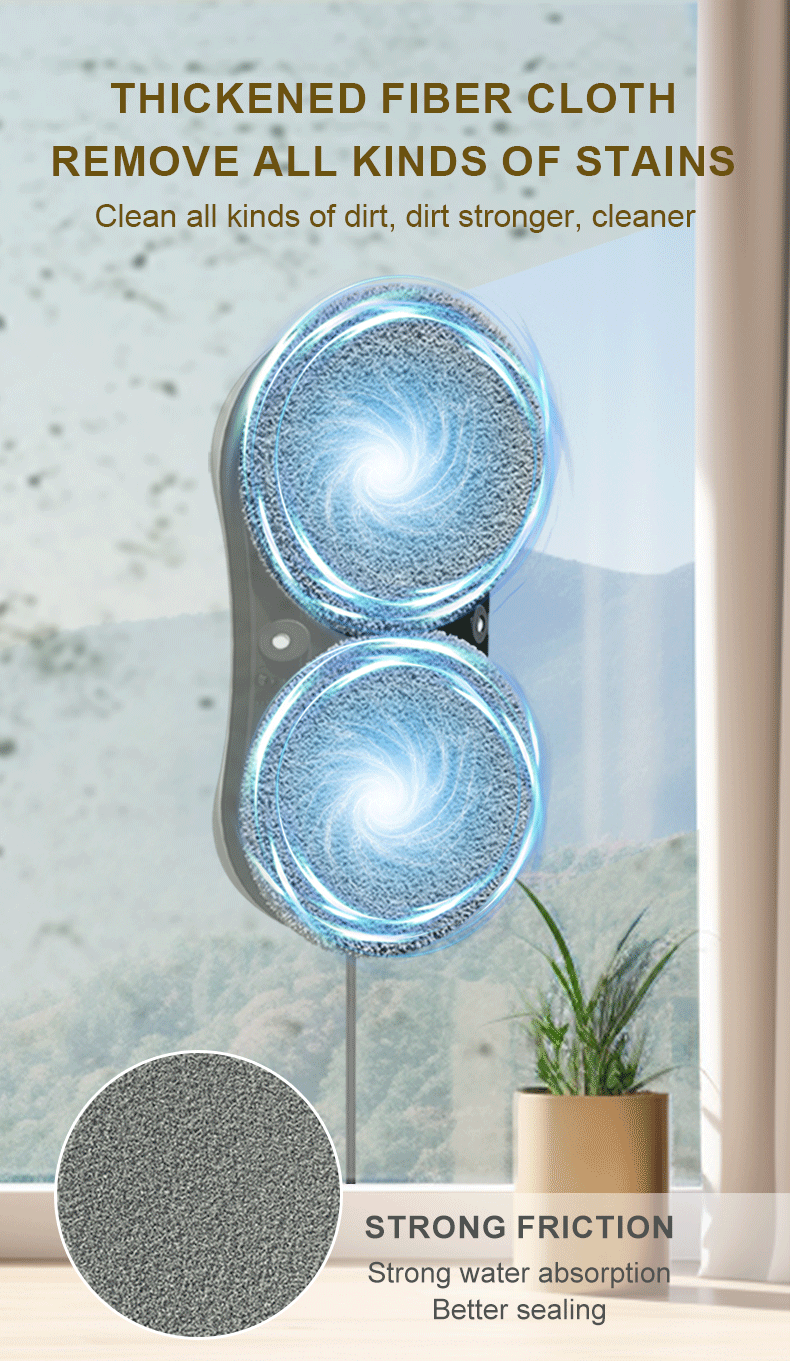
Retention systems — suction margin, backup power, tether and anti-drop sensing — are the physical inputs that compliance assessment examines on a window cleaning robot.
Where manufacturing capability enters the compliance conversation
Dongguan Lingxin Intelligent Technology Co., Ltd., known as Lincinco, was established in 2018 and operates as an intelligent manufacturing company specialising in the design, research and development, production, sales and operation of smart robot products. Its product lines include robot vacuums, wet-dry vacuum cleaners, window cleaning robots, pool cleaning robots and hair dryers. The company runs two production bases: a 50,000 m² facility in Dongguan and a facility of over 25,000 m² in Hengyang, Hunan, together employing approximately 600 staff, with an annual production capacity of 5,000,000 units and a research and development team of more than 65 engineers.
That structure is relevant to certification for a specific reason. Conformity is assessed on samples, but it is sustained by production consistency — the same motor, the same pad density, the same rope specification, unit after unit. Independent mold rooms, injection molding capacity and standardized production lines are the mechanisms that keep a certified configuration from drifting into an uncertified one. Manufacturing scale does not itself constitute certification; it determines whether the certified configuration survives a full production year.
It is also worth stating plainly what certification does not do for a manufacturer. It does not replace model-level documentation, it does not travel automatically between markets, and it does not cover every new app feature added after the assessment. Lincinco publishes product documentation and model information through its website at cleverobot.com, where configurations can be matched against the documentation supplied for a given market.
Application: what compliance means in each use case
The same mark carries different weight depending on who is standing behind the device.
Residential smart home. The buyer is the operator. Mandatory conformity is the primary protection, and the practical questions are whether the safety tether is supplied and whether the user manual makes installation non-optional. Indoor and outdoor glass on residential towers falls into this category, including surfaces with narrow frames under 60mm where a low-profile body is required.
Property management and commercial office maintenance. The buyer is responsible for a building, which shifts documentation from a nice-to-have to a procurement requirement. Facility teams increasingly ask for the conformity documentation for the exact model and market, not a general statement about the supplier.
Hotel and hospitality. Guest safety and noise both matter. A declared working noise level of 65dB or below is a design specification that supports daytime operation in occupied buildings — but it is a performance attribute, not a safety certification, and should not be presented as one.
Professional cleaning services. Operators work at volume across many façades. Here compliance interacts with training: the strongest retention system still depends on correct tether anchoring, and certification of the device does not certify the anchoring point.
Export markets. Lincinco's window cleaning robot applications reference markets including Germany, Ukraine, Poland, Argentina, Denmark, Switzerland and the United States, with working conditions spanning 10°C to 40°C and both indoor and outdoor glass surfaces. Each of those markets applies its own conformity route, which is why model-level documentation rather than brand-level reassurance is the correct thing for a reseller to request.
Market trend analysis: consolidation around documentation
Three observable trends are pushing certification from a compliance formality toward a competitive variable.
Export concentration. With cleaning robot exports reaching 7.75 billion yuan in a single quarter of 2024 and representing nearly 70% of China's robot export value, the category is structurally international. Products designed for one market's conformity route and then shipped to several others create documentation pressure across the whole supply chain, from component suppliers to private-label brands.
Regional gravity. Asia Pacific is the leading regional market for window cleaning robots, driven by urbanisation and high concentrations of skyscrapers, with China and Japan identified by TechSci Research as primary manufacturing hubs. Manufacturing concentration tends to accelerate standardisation, because the same factories serve buyers from many jurisdictions simultaneously.
Measurement maturity. Category sizing remains unsettled. Published 2025 global estimates range from USD 672.68 million (Market Research Future) to USD 1.2 billion (Market Intelo) to USD 1.59 billion (Cognitive Market Research). That spread is not a reason to distrust the category — it is a reason to treat vendor-cited totals with caution and to prefer figures that name a methodology. The same discipline applies to certification claims: name the standard, name the model, name the market.
Comparison with traditional solutions
Comparing a robot with manual window cleaning on compliance grounds is not a comparison of cleaning quality. It is a comparison of where the risk sits and what evidence exists about it.
| Dimension | Manual window cleaning | Robot with documented compliance |
|---|---|---|
| Primary risk locus | Working at height, access equipment, operator fatigue | Electrical safety, retention failure, falling object |
| Governing framework | Occupational safety and working-at-height rules | Product safety standards plus market-access conformity |
| Evidence a buyer can inspect | Method statements, training records, insurance | Conformity documentation, model-level test reports, user instructions |
| Consistency of outcome | Operator-dependent | Repeatable path planning with frame detection |
| Clear limitations | Higher exposure to fall risk; labour availability | Needs power and supervision; marks cover the device, not the installation or the building |
The honest limitation deserves emphasis, because it is where marketing language usually stops. A conformity mark certifies the device against a written standard for the conditions that standard defines. It does not certify the anchoring point on a specific building, it does not account for wind loading on a particular façade at a particular height, and it does not confirm that the person who installed the tether followed the manual. For some high-rise or exposed-glass situations, a professional access method remains the appropriate route regardless of what the robot's label says. Certification adds cost and lead time as well: re-testing per model and per market is a real expense, and documentation can lag behind fast software release cycles.
Future outlook
Three shifts are likely to shape how certifications are read over the next few years. First, retention-specific requirements will continue to migrate from industrial robotic cleaning standards into consumer expectations, because the physics of suction adhesion does not change with the price bracket of the product. Second, connected functionality will attract its own documentation layer, since app control through platforms such as Tuya or Smart Life creates obligations that electrical-safety standards were never written to cover. Third, buyers will increasingly ask for documentation by model and by market as a default, in the same way they already ask for a specification sheet.
For consumers, the practical consequence is simple: read the layers separately, ask what the mark was assessed against, and treat performance claims and safety claims as different statements. For resellers and private-label buyers, the consequence is procedural: documentation at model level, verified per destination market, is becoming the baseline rather than the differentiator.
Frequently asked questions
What is the difference between a mandatory certification and a voluntary quality mark on a window cleaning robot?
A mandatory certification is required before the product may legally be placed on a given market and typically addresses electrical safety, electromagnetic compatibility, restricted substances and, for wireless units, radio requirements. A voluntary quality mark is initiated by the manufacturer or requested by a retailer and usually re-tests selected claims such as safety margins, durability or noise. The first is a condition of sale; the second is additional evidence about a narrower set of attributes.
Does a compliance mark guarantee that a window cleaning robot will not fall from a window?
No. A mark records that the device was assessed against a standard covering defined conditions, including retention and abnormal-operation behaviour. It cannot cover the anchoring point on a specific building, wind loading on a particular façade, or incorrect installation of the safety tether by the end user. Fall prevention depends on the combination of a designed retention system — suction margin, backup power, tether and drop sensing — and correct use.
Why does the same window cleaning robot carry different marks in different countries?
Market-access conformity is written and enforced jurisdiction by jurisdiction, so a single hardware platform may need separate assessment routes for each region it is sold into. That is why documentation is normally issued per model and per market rather than per brand. A certificate valid in one market does not automatically transfer to another, even when the physical product is identical.
How should a reseller verify a supplier's compliance claims?
Request documentation for the exact model and the exact destination market, then check three things: that the model designation on the document matches the unit being purchased, that the standard referenced is the one applicable in that market, and that the document is current rather than superseded. A management-system certificate may be supplied alongside but should not be accepted as a substitute for product conformity.
Does certification tell a buyer anything about cleaning performance?
Generally not. Mandatory conformity addresses safety and interference, not how thoroughly glass is cleaned. Performance attributes such as suction power of 3500Pa and above, a cleaning speed of approximately 2.4 minutes per square metre, dual-nozzle atomizing water spray or a working noise level of 65dB or below are design specifications, and they should be evaluated through specification sheets and sample testing rather than through safety marks.
Does certification make a window cleaning robot more expensive?
Assessment is a cost input, because testing is carried out per model and per market, and re-testing is required when a configuration changes materially. The visible effect on retail price varies by market and volume. The practical trade-off for buyers is that documentation adds cost and can lag behind fast software release cycles, while its absence limits which markets a product can legally enter at all.
The useful habit in this category is not to count marks, but to ask what each one was assessed against, on which model, and for which market — and then to check whether the retention system behind the label actually exists in the product.
Tem questões ou precisa de mais detalhes?
Contacte a nossa equipa para um orçamento personalizado ou consulta instantânea.
Solicitar orçamento
Preencha o formulário abaixo e a nossa equipa entrará em contacto com uma proposta personalizada.
Chat direto do WhatsApp
Prefere conversar em tempo real? Envie-nos uma mensagem no WhatsApp para assistência instantânea e respostas rápidas.
- Obter orçamento personalizado
- Partilhar fotos ou documentos
- Discuta as suas necessidades diretamente
Geralmente responde em 5–30 minutos durante o horário de expediente.