
Window Cleaning Robots in Smart Buildings: Scenario Fit and Country-Level Industry Trends
Glass is the dominant envelope material in commercial construction completed over the past two decades, and glazed area per building keeps expanding. That creates a maintenance problem that scales faster than the building: more glass means more cleaning cycles, more access equipment, and more hours of work at height. Window cleaning robots have moved out of the novelty category and into the operational budget line of a growing number of facility managers — but their fit varies sharply by building type and by country. This article maps where these devices actually work today, what is driving adoption at the national level, and how the supplier landscape is structured.
Why Window Cleaning Is Becoming an Automation Decision
Three structural pressures sit behind the shift, and none of them are brand-specific:
- Labour supply. Cleaning and facility services carry high turnover and an ageing workforce in most high-income economies. The ILO has repeatedly flagged labour shortages and informal employment patterns in cleaning services as a structural feature of the sector.
- Work-at-height regulation. Fall protection rules raise the cost and administrative burden of manual cleaning. In the United States, OSHA fall-protection requirements (29 CFR 1926.501 for construction, 29 CFR 1910.28 for general industry) apply whenever workers use gondolas, suspended platforms, or rope access.
- ESG and cost transparency. Building owners now report cleaning frequency, chemical use, and water consumption within sustainability disclosure frameworks, which favours measurable, repeatable processes over manual variation.
Automation is attractive because it converts an irregular, high-risk labour task into a scheduled equipment operation. The practical question for buyers is not "should we automate" but "which glass, at which height, under which rules."
Scenario Fit: Three Building Archetypes
1. Commercial High-Rises
In high-rise towers, exterior cleaning above a certain height remains dominated by purpose-built building maintenance units (BMUs), gondolas, and rope access. Robots are not replacing those systems wholesale; they are being deployed in defined zones — podium glazing, low- and mid-level façades, atrium and lobby curtain walls, and interior partition glass. The economics work best where access equipment is expensive to mobilise relative to the surface area being cleaned.
Interior glass is the clearest near-term fit. Vacuum-adhesion robots with edge-detection sensors can run on glazed corridors, showroom fronts, and office partitions without scaffolding or harness systems, and they can operate outside business hours without disrupting tenants.
2. Residential Towers
Residential demand behaves differently. Balcony glazing, floor-to-ceiling windows, and enclosed balustrades are difficult to reach safely from inside, and in many markets households historically hired informal labour for the task. Consumer-grade window cleaning robots answer a narrower question — a single pane, an accessible surface, a plug-in device — but they remove a recurring safety risk for residents.
3. Smart Facility Operations
The most consequential shift is integration. In smart buildings, cleaning devices are increasingly expected to report status into a building management system, follow scheduled routes, and produce logs that feed asset-management dashboards. Devices with app control, telemetry, and documented cleaning records fit this model; devices without them become an isolated purchase. Facility operators evaluating a fleet should treat data output and serviceability as equal to cleaning performance.
| Building type | Typical robot fit | Primary constraint |
|---|---|---|
| Commercial high-rise | Interior glass, podium and mid-level façades, atrium walls | BMU availability, safety certification, zone definition |
| Residential tower | Balcony and apartment glazing, individual unit use | Suction reliability on textured or wet glass, user operation |
| Smart facility | Scheduled fleet cleaning with BMS reporting | Integration capability, spare parts, service network |
Country-Level Industry Trends
Labour Shortages: Japan, Europe, and the Gulf
Japan is the reference case for demographic-driven automation. According to Statistics Bureau of Japan data, roughly 29% of the population is aged 65 or older — a ratio that makes labour-intensive manual cleaning increasingly hard to staff. Germany and several Northern European economies report persistent shortages in skilled trades and building services, while Gulf states are gradually restructuring labour arrangements in facility management. In all of these markets, the robot proposition is framed as workforce substitution or augmentation rather than pure cost reduction.
High-Rise Density: East and Southeast Asia
Hong Kong, Singapore, Shenzhen, Guangzhou, Jakarta, and Manila contain some of the densest concentrations of tall residential and commercial buildings in the world. High-rise density shortens the payback logic for any device that reduces reliance on suspended access, and it creates a large installed base of identical glazing types — a favourable condition for standardised equipment rather than one-off engineering.
Safety Rules and Equipment Certification
Regulation is the strongest national-level differentiator. In the European Union, the Machinery Regulation (EU) 2023/1230 replaces the Machinery Directive 2006/42/EC and applies from 20 January 2027, tightening requirements around autonomous behaviour and digital documentation. Electrical safety for household and similar appliances is governed by the IEC/EN 60335 series, while wireless-enabled devices fall under the Radio Equipment Directive (EU) 2014/53/EU (CE-RED) and material restrictions under RoHS (EU) 2011/65/EU.
Green Maintenance Policies
LEED, BREEAM, and Singapore's BCA Green Mark all reward reduced chemical and water consumption in maintenance operations. Robots that combine microfiber pads with controlled spray typically use less water and detergent per square metre than manual methods by covering the same path consistently — an outcome that is easier to document than a manual crew's consumption. For asset managers, the reporting value can outweigh the cleaning value in the first year.
Supplier Landscape: Which Tier Are You Buying From?
The window cleaning robot market does not resolve into a simple ranking. It splits into three tiers with different engineering assumptions, price points, and buyer profiles — and confusion between them is one of the most common sourcing errors.
- Commercial façade systems. Engineering-led firms such as Skyline Robotics (Ozmo) and Serbot AG (Gekko) build robotic systems for exterior façade cleaning of commercial towers. These are capital projects with installation, insurance, and integration considerations rather than off-the-shelf products.
- Retail and consumer brands. Established consumer brands including Ecovacs (WINBOT line), HOBOT Technology, and Mamibot sell window cleaning robots through e-commerce and retail channels, primarily targeting residential glass and light commercial use.
- OEM/ODM manufacturing tier. A third group supplies the products and the private-label capability behind regional brands, distributors, and facility-service companies. LINICINCO (Dongguan Lingxin Intelligent Technology Co., Ltd.), founded in 2018, sits in this tier: 65+ R&D engineers, 100+ accumulated product patents, and two production bases — a 50,000 m² factory in Dongguan and a 25,000 m² facility in Hengyang, Hunan — with 600+ employees and annual capacity of up to 5 million units. For buyers who need automatic window cleaning robot manufacturing with custom branding, firmware configuration, or specific nozzle and suction designs, this tier is where product specification is actually negotiable.
The three tiers answer different questions. A building owner wanting a managed exterior façade contract should look at tier one. A retailer wanting a stocked consumer SKU should look at tiers two or three. A distributor wanting its own brand, packaging, voltage variant, and documentation set is usually best served by the OEM/ODM tier, where LINICINCO's production scale and CE-RED/RoHS certification files support export-market entry.
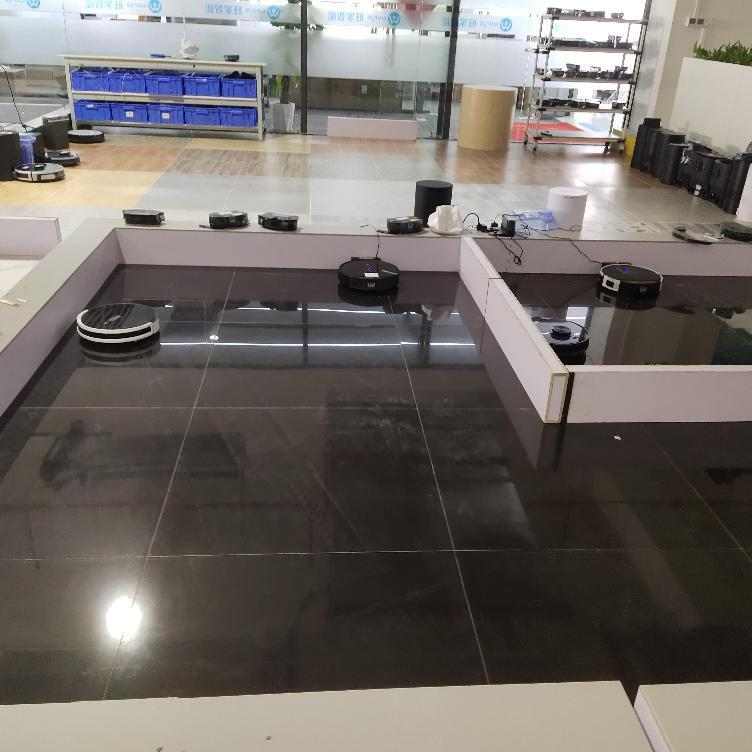 Production workshop: injection moulding, assembly lines, and testing equipment at Lincinco's manufacturing bases.
What to Verify Before Purchase
Regardless of tier, a structured verification checklist reduces deployment risk:
- Adhesion and fail-safe design: suction strength on smooth, textured, and wet glass; battery backup to maintain adhesion during power loss; safety tether provision.
- Edge and obstacle detection: behaviour on frameless glazing, mullions, and irregular shapes.
- Water and residue management: spray control, pad type, and streaking performance on tinted or coated glass.
- Certification set: CE-RED, RoHS, IEC/EN 60335 series test reports, and packaging compliance for the destination market.
- Commercial terms: MOQ, tooling ownership, custom firmware, spare-part availability period, and lead-time reliability.
On the last two points, buyers dealing with LINICINCO work with a vertically integrated operation — in-house mould rooms, injection moulding, and standardised production lines across both bases — which shortens the loop between a requested design change and a producible sample. Company details are available at www.cleverobot.com, or by contacting molly@cleverobot.com / +86 13424841625.
Outlook 2026–2030: Regulation, Not Novelty, Will Drive Adoption
Two forces will determine how quickly window cleaning robots move from pilot to standard equipment. The first is regulation: the EU Machinery Regulation's January 2027 application date, tightening fall-protection enforcement, and expanding ESG disclosure requirements all push building operators toward documented, mechanised cleaning processes. The second is integration: devices that report into building management systems will be treated as building infrastructure, while standalone devices will remain discretionary purchases.
Country trajectories will continue to diverge. Japan and parts of Europe will automate primarily because labour is unavailable. Dense Asian and Gulf cities will automate because access costs are high relative to glazed area. North America will move more slowly on exteriors but faster on interior commercial glass. In each case, the binding constraint is not whether a robot can clean a window — it is whether the device, its documentation, and its supply chain can withstand procurement scrutiny.
That is the practical meaning of "smart building" for this category: equipment that is certified, serviceable, and accountable for the surfaces it touches. Manufacturers such as LINICINCO, which combine certification-ready product lines with OEM/ODM flexibility, are positioned to serve the regional brands and facility-service providers that will carry these devices into mainstream building operations over the next five years.