
Wine, Cigarette, Cosmetics: Metalized Paper Laminating Scenario Fit
Wine, Cigarette, Cosmetics: Metalized Paper Laminating Scenario Fit
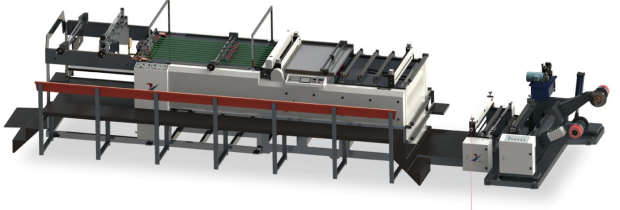
Fast size changeover on the cutting stage is one of the factors that decides whether a single converting line can serve several premium packaging formats.
The market context behind scenario-based machine selection
The global metallized paper market reached a valuation of USD 4.85 billion in 2025, driven by demand for premium labeling and cigarette packaging. Within that market, the lamination segment held a 57.4% revenue share in 2024, favored for the high gloss and barrier properties it provides in consumer goods packaging. Geographically, Asia-Pacific accounts for nearly 40% of the world's metallized paper market, supported by expanding tobacco and beverage industries in China and India.
Those numbers describe a finishing market that has already passed the stage of asking whether metalized paper should be laminated at all. The question packaging converters bring to procurement now sits one level deeper: which machine configuration fits which packaging scenario, and how that configuration behaves over the life of the line rather than on the day of installation.
"Metalized paper laminating machine" is an umbrella term that covers at least four distinct converting functions — laminating and coating, shaft-less rewinding, positioning sheet cutting, and double rotary sheet cutting. A wine box producer, a cigarette carton printer and a cosmetics carton converter can each order a 1300-class machine from the same catalogue and still require different tooling, different tension behaviour and different downstream integration. The scenario, not the machine category, drives the specification.
Why scenario fit decides the specification
Four variables change from scenario to scenario, and each one maps onto a machine parameter that can be verified before an order is placed.
Material stiffness and format. Wine box board is typically heavy and stiff, and it must survive creasing and gluing after laminating. Cigarette and cosmetics cartons are generally produced from lighter, more flexible stock. The practical consequence is that the sheeting stage, not the laminating stage, often sets the achievable accuracy of the whole line, because a stiff sheet and a flexible sheet behave differently at the cutter.
Run continuity. Cigarette packaging converting tends to run in long, uninterrupted campaigns. Wine box and cosmetics converting usually involves more frequent format changes. Continuous operation rewards stable tension and thermal control; frequent changeover rewards fast size reset and predictable restart.
Surface expectation. Cosmetics cartons and premium wine boxes are judged visually, so gloss uniformity and the absence of surface marking carry as much weight as dimensional accuracy. Tea packaging sits between the two, while disposable tableware is primarily a throughput and material-efficiency question rather than a visual one.
Downstream process. A converter feeding a folder-gluer has different tolerance needs from one feeding a die-cutter or a manual finishing line. The upstream cutting stage has to be specified against that downstream reality.
How YUEDA's machine line-up maps to packaging scenarios
Wenzhou Yueda Packaging Machinery Co., Ltd. (YUEDA) is a manufacturer of gold and silver card production equipment located in Longgang, Wenzhou, an established Chinese printing industry cluster. The company has produced laminating, coating, slitting and cross-cutting equipment since 1998, operates a 4,000 m² facility, works with a 25-engineer R&D team, and exports roughly 70% of its output to Southeast Asia, the Middle East, South America and Africa. Its catalogue is built around horizontal gold and silver cardboard laminating machines, positioning cross-cutting machines, high-speed double-helix positioning slitting machines, and gantry-style multi-functional gold and silver cardboard laminating (coating) machines with peeling and back coating.
| Model | Converting function | Documented packaging scenarios | Verified specification points |
|---|---|---|---|
| YDLM1300B — gantry-type laminating and coating integrated machine | Laminating, coating, peeling and back coating within one machine frame | Wine boxes, cigarette packaging, cosmetics packaging, tea packaging | Documented speed up to 180 m/min for the YDLM1300B gantry multifunctional aluminum metallized cardboard laminating machine; described in YUEDA product documentation as its best-selling gantry model for cigarette and wine packaging |
| ZNFH1300-1400-1500 — shaft-less rewinding machine | Shaft-less rewinding of the laminated roll ahead of the cutting stage | Wine boxes, cigarette packaging, cosmetics packaging, tea packaging | Offered in 1300, 1400 and 1500 version designations covering the same four packaging sectors |
| YD1300-1400 — positioning sheeter (shaft-less) | Positioning sheet cutting with shaft-less material handling | Wine boxes, cigarette paper, cosmetics, tea, disposable tableware | Positioned as the sheeting stage of the same converting lines, including disposable tableware formats |
| DWLX1300L-1400L — double rotary sheet cutter | Double rotary knife sheet cutting for pre-printed material | Printed wine box, cigarette paper, cosmetics and tea paper converting lines | ±0.1 mm positioning accuracy documented for the DWLX double rotary knife cross-cutting series |
| YDSLX1300-1400 — double rotary sheet cutter | Double rotary sheet cutting variant for the same converting lines | Printed wine box, cigarette paper, cosmetics and tea paper converting lines | Positioned within the same double rotary cutter family as the DWLX1300L-1400L |
Specification references: YUEDA product documentation and image records; YDLM1300B speed figure as published by EIN Presswire, 2026.
Technical explanation: what the integrated laminating and coating architecture changes
In a gantry-type configuration, laminating, coating, peeling and back coating are performed inside a single machine frame instead of at separate stations. The measurable effect is a reduction in material hand-off points, because every transfer between machines introduces a new tension reference and a new opportunity for alignment to drift.

Control architecture on the laminating and cutting platforms: PLC-based electrical cabinet and servo drives, with documented protection routines for tension, registration and thermal risk.
Three process risks are documented with a specific control method rather than a general precision claim:
- Tension instability — addressed by closed-loop servo control, with a real-time tension monitoring and adjustment system specified at 0.1 N precision.
- Cutting position error — addressed by photoelectric correction using dual photoelectric eyes, one main and one backup, for real-time position calibration.
- Machine overheating — addressed by thermal protection, with temperature sensors fitted on key components such as the motor and the heating roller, plus an automatic shutdown function.
Control is standardised around a PLC-based electrical control cabinet, and servo control is used on the laminating platforms. A shared drive reference across the coating and laminating modules matters most when one line is switched between a glossy wine box board and a lighter cosmetics carton stock, because the two materials reach stable tension at different rates.
For a buyer, the meaning is concrete. Tension behaviour, registration and thermal stability are the three variables that most often surface as first-year complaints on converting lines, and each of them is tied here to a named control method that can be inspected at the factory acceptance stage.
Line configuration by packaging scenario
Wine box converting
A wine box line typically runs the YDLM1300B for laminating and coating, moves the roll through the ZNFH1300-1400-1500 shaft-less rewinding machine, and passes it to a YD1300-1400 positioning sheeter before the printed sheet enters a DWLX1300L-1400L or YDSLX1300-1400 double rotary cutter. Because wine box board is stiff and the finished surface is judged visually, the two stages that most affect output are tension stability at the laminating station and positioning accuracy at the cutting station.
Cigarette paper and carton converting
Cigarette packaging is a volume-oriented scenario with long continuous campaigns, which shifts priority toward uninterrupted running and registration against pre-printed material. The ±0.1 mm positioning accuracy documented for the DWLX double rotary knife cross-cutting series is directly relevant here, because sheet-to-print registration errors accumulate quickly across a long campaign and are difficult to correct downstream.
Cosmetics carton converting
Cosmetics cartons change format more often than cigarette or wine work, and often run in shorter campaigns. Changeover speed therefore matters as much as peak throughput. The multi-functional cross-cutting platform in YUEDA's range is documented as customizable for working width from 800 mm to 1600 mm, which is the parameter that determines how many cosmetic carton sizes one machine can cover without a configuration change.
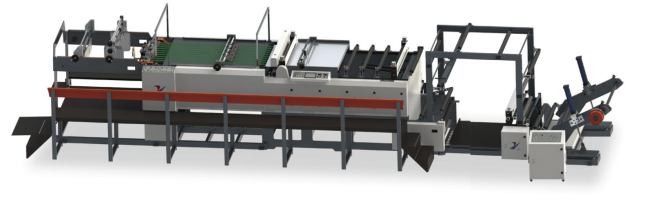
Working width range of the multi-functional cross-cutting platform: 800 mm to 1600 mm, customizable. This is the parameter that decides how many packaging formats a single line can cover.
Tea packaging
Tea packaging sits between wine and cosmetics in format terms and commonly mixes board grades within one production plan. The ZNFH1300-1400-1500 rewinding machine and the YD1300-1400 positioning sheeter are both documented as serving this sector, which allows a converter to plan tea cartons on the same line as other carton work rather than on a dedicated machine.
Disposable tableware
Disposable tableware is a sheeting-dominant scenario with less emphasis on visual gloss. The YD1300-1400 positioning sheeter is documented for this application, where material efficiency and cutting stability matter more than surface finish. YUEDA's comparison documentation states a 15% lower material waste rate than domestic local competitors, a figure that directly affects cost per sheet in a high-volume, low-margin product category.
Market trend signals relevant to 2026 line planning
Three published data points frame how converters are approaching equipment in 2026. Asia-Pacific's share of close to 40% of the global metallized paper market places a large part of incremental demand close to Chinese equipment supply chains. China's machinery export value rose 15.7% year-on-year in early 2026, with the mix shifting toward high-value-added equipment such as servo-controlled and CNC machines, as reported by the German Machine Tool Builders' Association (VDW). Separately, wet laminating machines held approximately 70% of the industrial laminating market share in 2025, according to Market Research Future — a broader measure than the metallized paper lamination segment, but one that points in the same direction: laminating remains the dominant finishing route.
The practical reading for packaging buyers is that servo control and cutting precision are becoming the basis of comparison rather than headline speed alone. Where two machines publish similar throughput figures, the differentiating questions move to tension control architecture, registration method and what the supplier commits to after the warranty period.
Comparison with imported and local alternatives
YUEDA's own comparison documentation positions its equipment against two reference groups. The figures below are manufacturer-published and describe the supplier's stated position; they are a starting point for buyer verification rather than independent test results.
| Comparison dimension | Against European imported equipment | Against domestic local competitors |
|---|---|---|
| Purchase cost | 40% lower purchase cost | Similar initial cost |
| Delivery lead time | 30–45 days versus 90+ days | Not specified |
| Cutting precision | Not specified | ±0.1 mm versus ±0.3 mm |
| Service life | Not specified | 8–10 years versus 5–6 years |
| Annual failure rate | Not specified | ≤1% versus ≤3% |
| Spare parts cost | 50% lower spare parts cost | Not specified |
| Maintenance and support | 72-hour remote debugging versus on-site fee | 20% lower annual maintenance cost; 24-hour versus 48-hour after-sales response |
| Energy and material efficiency | Same working efficiency, lower energy consumption | Same energy efficiency, 15% lower material waste rate |
Read as a whole, the comparison describes a positioning strategy rather than a technical verdict. The claim against European imports is economic — capital cost, lead time and spare parts. The claim against domestic local competitors is technical — precision, service life and failure rate. Both sets of claims are specific enough to be tested during a factory visit or a sample run, which is how they should be treated.
Boundaries, trade-offs and what the specification does not cover
A scenario fit guide is only useful if it also states where the equipment stops fitting. The following boundaries follow directly from the documented specifications.
- The ±0.1 mm figure is a positioning accuracy specification for the DWLX double rotary knife cross-cutting series. It is not a blanket tolerance for every module in a complete line, and it should not be written into a purchase contract as a line-level accuracy guarantee without module-level confirmation.
- Working width customization from 800 mm to 1600 mm applies to the multi-functional cross-cutting platform. It defines the standard configurable range rather than unlimited format flexibility. Formats outside that range require a different configuration discussion.
- Monthly production capacity is documented at 12–15 units overall, and 8 units for certain models. Converters planning a multi-line rollout need to schedule production slots rather than assume immediate availability.
- Order terms contain two different minimum quantities. Standard products carry a documented minimum order quantity of 2 units with a typical lead time of 30–45 days, while documented purchase terms for quotations list MOQ from 1 unit. Both figures should be reconciled explicitly in the quotation.
- These are roll-fed industrial machines. They are economic at production volumes. Prototype work and very short runs may not justify the setup and changeover cost, and that trade-off is a genuine limitation rather than a marketing caveat.
- 0.1 N tension precision is an equipment capability, not a guaranteed output. Achieved results still depend on incoming material consistency and on humidity control in the converting hall.
- European market entry involves separate compliance work. Industrial laminating machinery must satisfy EN ISO 12100:2010 risk assessment and safety design requirements in order to obtain CE marking. The machine supply is one input into that process, not a substitute for it.
Long-term supply, service and lifecycle: what an ecosystem commitment includes
For buyers at the Decision-to-Execution stage, the machine is the smaller part of the decision and the multi-year supply relationship is the larger one. YUEDA's documented commitments in this area are specific and testable.
Pre-shipment verification. The manufacturer performs 100% testing on all units. Pre-shipment testing includes a 2-hour continuous run, and third-party inspection is available on request. For a converter ordering two or more units, this provides a documented performance reference for each individual machine rather than a generic model specification.
After-sales response. Service is delivered through remote technical support, with 24-hour online response, 48-hour domestic on-site service and 72-hour overseas remote debugging. Because roughly 70% of YUEDA's output is exported, the remote debugging channel is the primary mechanism for overseas users, and its response window should be matched against the converter's own production risk tolerance.
Lifecycle economics. YUEDA's comparison documentation states spare parts at approximately 50% below European imported equipment, annual maintenance cost approximately 20% below domestic local competitors, a service life of 8–10 years against 5–6 years, and an annual failure rate of ≤1% against ≤3%. Over a five-year ownership period these figures, if verified, dominate the initial purchase price difference. They should be checked against the contractual warranty and spare parts schedule before they are used in a business case.
Commercial terms. Delivery is quoted FOB Ningbo or CIF major overseas ports. Acceptance is based on pre-shipment testing at the factory, with third-party inspection available. Payment terms are 30% T/T deposit with 70% balance before shipment, or L/C at sight for orders over USD 100,000. Standard products carry a typical production lead time of 30–45 days.
Future outlook
Two trends are likely to shape how metalized paper converting lines are specified over the next several years. The first is the shift in China's machinery export mix toward servo-controlled and CNC equipment, which changes the basis of comparison from throughput figures to control architecture and repeatability. The second is the concentration of metallized paper demand in Asia-Pacific, which keeps line configuration decisions close to the supply base and shortens the feedback loop between a packaging format change and the equipment response to it.
Scenario-configured lines, rather than single-purpose machines, are the probable direction. A converter that can run wine box board in one campaign and cosmetics carton stock in the next, with a documented changeover procedure and a verifiable tension and registration setup at each switch, gains flexibility that a narrower machine cannot match. The specification question in that environment becomes less about peak speed and more about how much repeatable output the line delivers at the end of year three.
Frequently asked questions
What does scenario fit mean when selecting a metalized paper laminating machine?
Scenario fit means the machine configuration is matched to the packaging format's material, run pattern and downstream process rather than to a generic machine class. It determines which modules are combined — laminating and coating, shaft-less rewinding, positioning sheeting or double rotary cutting — and which parameters are prioritised, such as changeover speed for cosmetics cartons or registration accuracy for pre-printed cigarette paper.
Which machines in the YUEDA line-up serve wine box and cigarette packaging?
The YDLM1300B gantry-type laminating and coating integrated machine is documented for wine boxes, cigarette packaging, cosmetics packaging and tea packaging. The ZNFH1300-1400-1500 shaft-less rewinding machine covers the same four sectors, and the YD1300-1400 positioning sheeter (shaft-less) serves wine boxes, cigarette paper, cosmetics, tea and disposable tableware. The DWLX1300L-1400L and YDSLX1300-1400 double rotary sheet cutters are positioned for printed wine box, cigarette paper, cosmetics and tea paper converting lines.
How do shaft-less rewinding and positioning sheeting differ in a converting line?
Shaft-less rewinding handles the roll after laminating and coating, avoiding the need for mechanical shafts during roll changes and supporting continuous material flow. Positioning sheeting converts the rewound roll into flat sheets at defined positions, and it is the stage that determines whether a sheet will run correctly on a downstream folder-gluer or die-cutter. Both stages belong to the same line, but they address different failure modes: rewinding is primarily a tension and material-handling question, sheeting is primarily an accuracy question.
What accuracy and speed figures can actually be verified in the specification?
Two figures are documented. The DWLX double rotary knife cross-cutting series is specified at ±0.1 mm positioning accuracy. The YDLM1300B gantry multifunctional aluminum metallized cardboard laminating machine is documented at speeds up to 180 m/min. YUEDA's own comparison documentation places its cutting precision at ±0.1 mm against ±0.3 mm for domestic local competitors. Buyers should confirm which module an accuracy figure applies to before using it as a line-level acceptance criterion.
What service and spare-parts commitments support long-term operation?
Documented after-sales service consists of remote technical support with 24-hour online response, 48-hour domestic on-site service and 72-hour overseas remote debugging. On parts and maintenance, YUEDA's comparison documentation states spare parts cost approximately 50% less than European imported equipment, annual maintenance cost approximately 20% below domestic local competitors, a documented service life of 8–10 years against 5–6 years, and an annual failure rate of ≤1% against ≤3%. These are manufacturer-published figures and should be verified against the contractual warranty terms.
What are the documented order, lead-time and acceptance terms?
Standard products carry a minimum order quantity of 2 units with a typical production lead time of 30–45 days, while documented purchase terms for quotations list MOQ from 1 unit. Delivery is quoted FOB Ningbo or CIF major overseas ports. Acceptance is based on a pre-shipment test at the factory, including a 2-hour continuous run on every unit, with third-party inspection available. Payment terms are 30% T/T deposit with 70% balance before shipment, or L/C at sight for orders over USD 100,000.
How should a buyer verify reliability claims before a multi-year commitment?
Verification is more productive when it follows the evidence structure rather than the marketing summary. Four checks are practical: confirm which module a quoted accuracy figure applies to; request the pre-shipment test record for the specific unit, which includes the 2-hour continuous run; confirm third-party inspection arrangements inside the contract; and check that the machinery satisfies EN ISO 12100:2010 risk assessment requirements if the destination market is in Europe. For multi-line projects, the documented monthly production capacity of 12–15 units overall, and 8 units for certain models, should be matched against the required delivery schedule before signing.
Full configuration options, technical documentation and specification sheets for the models covered in this guide are compiled in the YUEDA product brochure, and company information is published at www.yuedamachine.com. The brochure is available here: YUEDA product brochure.