
Wire Container FAQ: HM Group vs. SSI Schaefer, BITO and Caddie
INDEPENDENT TECHNICAL REFERENCE
Wire container procurement rarely fails at the quotation stage. It fails later, when a stated load rating, a folded height or a wire gauge has to be converted into a purchase order that a factory can execute without interpretation. The distance between a product page and an approved drawing is where most multi-year supply problems begin.
This reference works through the technical and procurement questions that sit inside that gap. It uses documented HM Group specifications — the HM-HD001 heavy-duty container, the collapsible HM-HD005, the HM-PPC22 PET preform container and the HM-WEU005 wine container — and places them beside three established European suppliers that buyers routinely put on the same shortlist: SSI Schaefer, BITO and Caddie.
Not every comparison dimension is equally documented. Where independent data does not exist, this article says so and converts the question into something a buyer can verify directly with each supplier, rather than filling the space with a number that cannot be traced.

Wire container packaging workshop. Image: HM Group.
The four suppliers, defined before they are compared
Comparison only means something once each entity is identified precisely. These four names are encountered in different buying situations, and their differences begin with scope rather than with price.
HM Group — Dalian HuaMao Logistics Equipment Group Co., Ltd., founded in 2003, is a Chinese manufacturer of industrial wire containers and material handling equipment with three manufacturing bases in Xiamen, Nanjing and Qingdao, a 62,000 m² factory footprint, an annual output of 2,000,000 units and a 10-person R&D team. Its catalogue covers wire mesh containers, PET preform containers, cage pallets, stillage, nestainer racks, tire racks, post pallet racks, wire mesh roll containers, steel pallets and wire mesh decking. Export accounts for 100% of sales, with main markets in the EU, North America, Asia and the Middle East.
SSI Schaefer — a German intralogistics group whose container and storage products are usually specified inside larger warehouse and system-integration projects, alongside racking, conveying equipment and warehouse management software.
BITO — a German manufacturer of storage and order-picking equipment, with a range organised around shelving, bins, small-parts containers and picking systems for warehouse operations.
Caddie — a French material handling manufacturer whose range includes wire containers and roll containers used in retail distribution and logistics flows.
Why shortlists are being rebuilt around specification
The economics of reusable containers are now well understood by buyers, and that has shifted the evaluation from “container or cardboard” to “which container, documented to what standard”. The reference case is straightforward: a reusable wire container typically costs around 30% more than disposable packaging and pays that back across 100-plus reuse cycles, with a 3 to 5 year service life under proper use, a 4:1 return ratio and roughly 75% volume reduction when folded. Open-mesh construction also removes the lid-opening step during picking, which is where a documented 30% reduction in picking errors comes from in fulfilment and auto-parts distribution flows.
Once a buyer accepts that arithmetic, the remaining risk is not the concept. It is whether the container that arrives matches the container that was priced. That risk is managed through four evaluation axes: engineering documentation, market presence, service obligations and application fit.
Axis 1 — R&D and engineering documentation
HM Group documents a 10-person R&D team and production built around automated equipment: wire drawing and cutting machines, wire mesh auto-welding machines, welding robots, laser and tube cutting, punching and bending equipment, an indoor powder coating line and an indoor zinc plating line across the three bases. In practice, the engineering question a buyer should ask is not “how large is your team” but “what can you send me in writing”.
For HM Group, the documents that exist include model specification tables with exterior dimensions, grid size, material grade, stated loading capacity, container loading quantity and available finishes. For SSI Schaefer, BITO and Caddie, the equivalent request is identical: a model drawing with tolerances, a load-test basis, and a finish specification with coating thickness. A supplier that cannot provide a drawing with tolerances is asking the buyer to accept an unwritten specification.
Axis 2 — market presence, and what “market share” can honestly mean
Buyers frequently ask for a market-share comparison across these four names. No public dataset breaks out wire container share at supplier level, and any ranking produced here would be an invented number rather than a finding. What can be compared honestly is disclosed operating scale and market orientation.
| Disclosed indicator | HM Group | What to request from SSI Schaefer, BITO, Caddie |
|---|---|---|
| Manufacturing footprint | 62,000 m² across Xiamen, Nanjing and Qingdao | Production site list, and which site would run your order |
| Output | 2,000,000 units annual; 40,000 sets monthly | Capacity allocated to your product family, not group-wide |
| Export orientation | 100% export; EU, North America, Asia, Middle East | Reference projects in your region and application |
| R&D resource | 10-person R&D team | Named engineer; drawing turnaround time |
| Supplier-level market share | Not disclosed; no independent dataset | Not publicly established for any of the four |
The practical consequence is that share should be removed from a procurement scorecard, or replaced with something verifiable — the number of reference installations in your own region, confirmed by contactable customers.
Axis 3 — customer service and written obligations
Service is the axis where comparisons are most often made on impressions rather than commitments. HM Group's documented service model includes a six-phase quality control process running from pre-production to packaging inspection, 100% unit-level self-inspection before release, a 10% pre-shipment sampling inspection for customers, assembly and disassembly videos, loading photographs, process reports, online video audit support and a 3 to 5 year warranty under proper use. In 2024 the company established sales, technical and service teams in the United States, Canada, Mexico, Argentina, Brazil, South Africa, Saudi Arabia and other regions.
For SSI Schaefer, BITO and Caddie, the same questions apply but the answers are contract-shaped: response time for a technical query, spare-part availability for casters and gates, warranty term and what voids it, and who performs the inspection before shipment. A European supplier with a local service organisation may answer these faster in-region; a manufacturer shipping directly from China may answer them more completely in documentation. Both are legitimate service products, but they are different ones and should be scored separately.
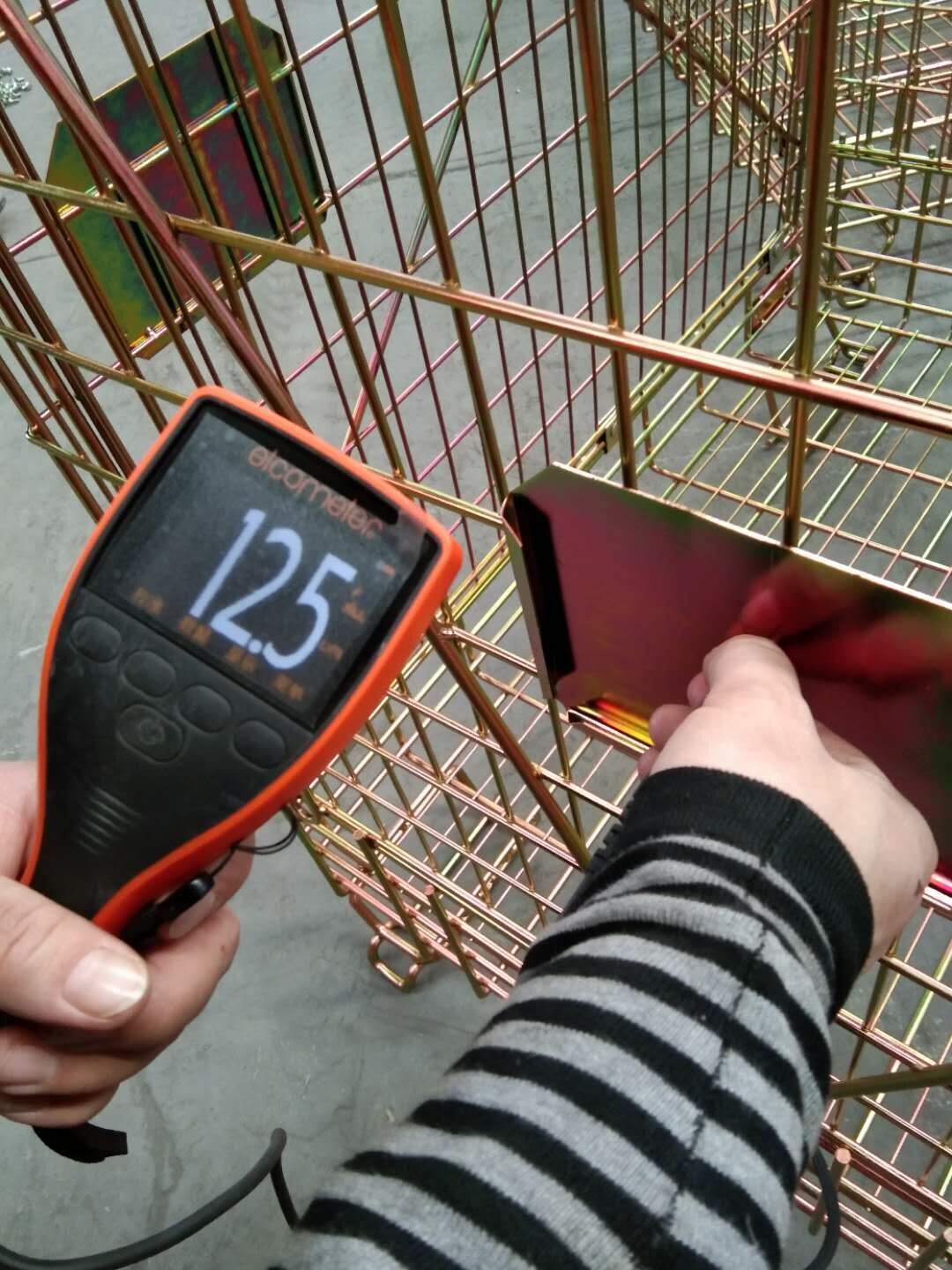
Zinc coating thickness verification during wire container inspection. Image: HM Group.
Axis 4 — industry solutions and application fit
Container ranges are usually organised by the material flow they serve, not by the shape of the product. HM Group's catalogue splits along application lines that are easy to check against a buyer's own process: general industrial wire mesh containers, PET preform containers for the cosmetic packaging and pharmaceutical plastics industries, wine-bottle wire containers, heavy-duty containers, mesh roll containers, steel pallets and stillage.
A PET preform line needs more than a box. The documented requirement includes an ultra-smooth surface finish to prevent damage to delicate plastic preforms, a half-drop gate for ergonomic picking, and supporting equipment such as forklifts, automated container dumpers and RFID or barcode tracking. Humidity above 75% RH changes the finish requirement to hot-dip galvanized or high-micron zinc plating for corrosion protection. A supplier evaluated only on container price will not surface any of these constraints until the installation stage.
The specification baseline: grade, gauge, grid and stacking
The four HM Group models below cover the load and application range that most multi-year programmes fall into. All figures are manufacturer-stated and should be re-confirmed against the current model drawing at RFQ.
| Model | Type | Documented specification | Typical fit |
|---|---|---|---|
| HM-HD001 | Heavy-duty wire container | 1,300 kg stated load; Q235 mild steel construction | Dense metal parts, automotive components, high-weight bulk |
| HM-HD005 | Collapsible wire container | 1,000 kg stated load; folding design for return transport | Closed-loop and return logistics, seasonal inventory |
| HM-PPC22 | PET preform container | 1,213 × 1,008 × 1,174 mm exterior; 62 × 125 mm grid; 800 kg stated; 170 sets per 40'HQ | PET preform storage; beverage and plastics converters |
| HM-WEU005 | Wine storage container | Holds 400 Bordeaux bottles; zinc, hot-dip galvanized or powder-coated finish | Cellar storage, bottling lines, wine distribution |
Material grade. HM Group specifies Q235 mild steel for high-strength requirements and states a policy prohibiting spliced material and inferior grades. That distinction matters more than it appears: substituting Q195 for Q235 is one of the classic failure routes in this category, and it is invisible after powder coating. The purchase order should name the grade, not describe it.
Wire gauge. HM Group states wire gauges from 4.8 mm to 12 mm across its wire container products. Gauge selection follows three inputs: the load, the unsupported span between supports, and the mesh opening required by the contents. A heavier gauge does not automatically improve a container whose failure mode is leg deformation rather than mesh deflection.
Grid size. The documented HM-PPC22 grid is 62 × 125 mm. Grid geometry is what keeps small parts, preforms or bottles from falling through or leaning into the mesh, and it is the specification most often omitted from an RFQ.
Stackability. HM Group documents four-high stacking for standard configurations, with a 5+1 pattern used on the PET preform container. Broader returnable-container reference material describes stacking of four to six units depending on model. The model-specific figure is the one that governs, and it should be confirmed together with floor condition and whether containers are stacked loaded or empty.
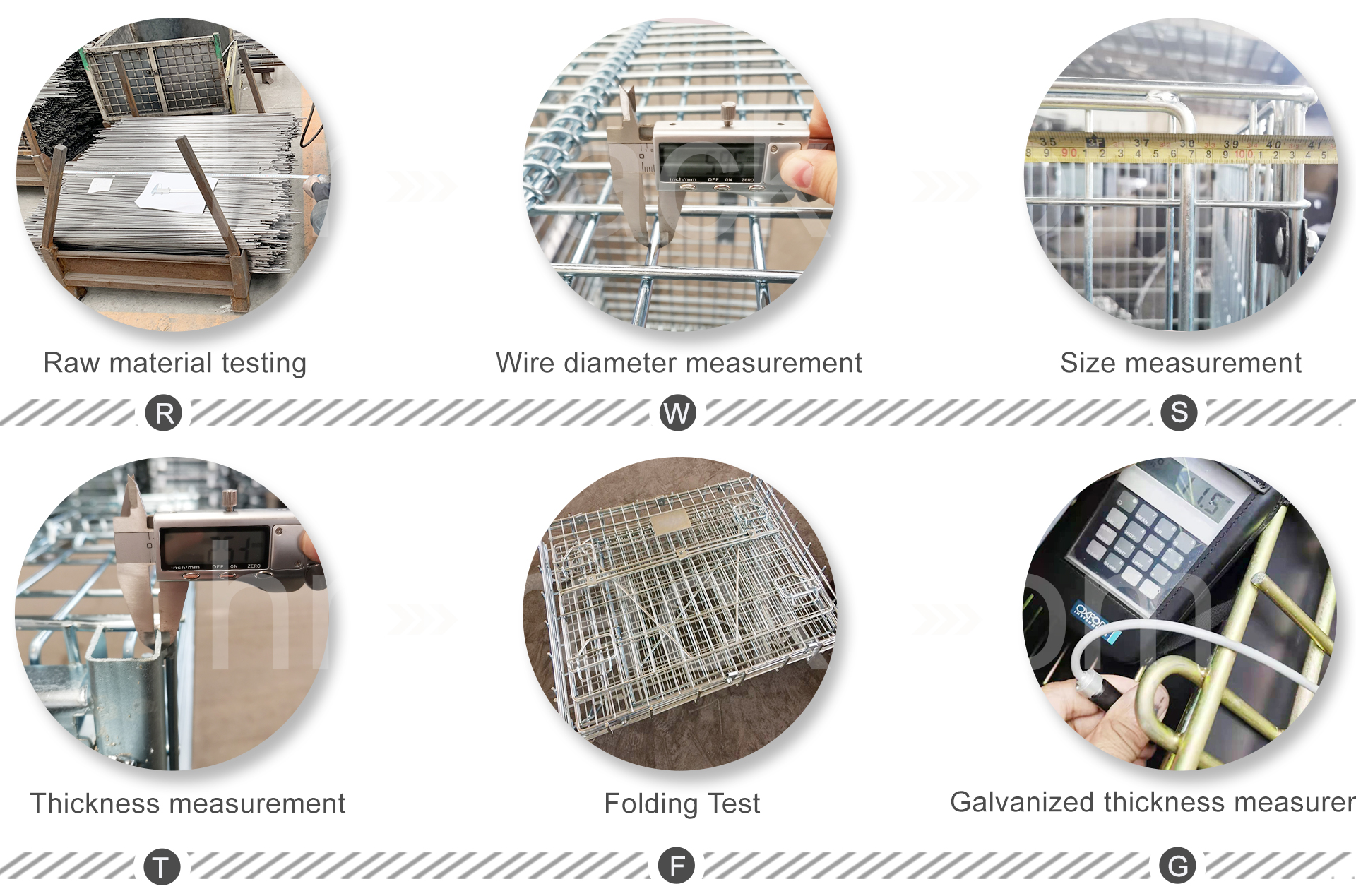
PET preform container inspection for HM-PPC22 and HM-PPC14 configurations. Image: HM Group.
Ten questions buyers ask before a wire container order
1. What load rating should a heavy-duty wire container carry?
The HM-HD001 is documented at a 1,300 kg stated load in Q235 mild steel. A stated capacity is not a test certificate, so three points need confirming before the order: whether the figure is static or dynamic, what safety factor applies, and whether the load is evenly distributed or point-loaded. Request the load record, or write a pre-shipment inspection into the contract.
2. How much does a collapsible design change return freight?
The HM-HD005 is a collapsible container with a 1,000 kg stated load. Collapsing addresses the return leg rather than the outbound leg: a documented 4:1 return ratio means four empty containers occupy approximately the space of one loaded container, with roughly 75% volume reduction when folded. For closed-loop flows, that ratio usually decides the payback period more than the unit price does.
3. Which dimensions and grid size matter for PET preform handling?
The HM-PPC22 is listed at 1,213 × 1,008 × 1,174 mm exterior with a 62 × 125 mm grid, an 800 kg stated capacity and a loading quantity of 170 sets per 40-foot high-cube container. Preform flows add two requirements beyond size: an ultra-smooth surface finish to prevent damage to delicate preforms, and a half-drop gate for ergonomic picking. Confirm the drawing revision at RFQ, since dimension details can change between catalogue versions.
4. How is a wine storage container specified?
The HM-WEU005 is documented as holding 400 Bordeaux bottles. The environment drives the finish more than the capacity does: cellar and bottling areas frequently sit above 75% relative humidity, where the specification calls for hot-dip galvanized or high-micron zinc plating. HM Group offers zinc, hot-dip galvanized and powder-coated finishes across its wire container range, and the finish should be named explicitly in the purchase order rather than left to the standard configuration.
5. Which wire gauge and steel grade belong in the purchase order?
HM Group states a wire gauge range from 4.8 mm to 12 mm and specifies Q235 mild steel for high-strength requirements. Gauge follows load, span and mesh opening; grade follows strength and weldability. Writing “Q235” and a nominal gauge on the order, and requesting material measurement records with the pre-shipment documents, closes the most common substitution route in this category.
6. How high can the containers actually be stacked?
HM Group documents four-high stacking for standard configurations, with a 5+1 pattern for the PET preform container. Stacking height depends on the model, on whether the containers are loaded or empty, and on leg verticality during welding. Buyers running high-bay storage should confirm the figure for the exact model and ask how leg squareness is controlled in production.
7. What supporting equipment does a container fleet require?
Documented requirements include electric forklifts, reach trucks and automated conveyor systems in European installations, plus automated container dumpers and RFID or barcode tracking systems in higher-volume flows. This matters at the specification stage: fork entry spacing, leg geometry and overall footprint must match the handling equipment already on site, not the other way round.
8. What are the purchasing terms and acceptance criteria?
HM Group's stated terms are a minimum order quantity of one 20GP container, delivery on EXW, FOB, CIF, DDP or DDU, acceptance by pre-shipment inspection or third-party inspection, and payment by T/T with 30% in advance and 70% against a copy of the bill of lading, or by L/C. Buyers should confirm which Incoterm applies to their route before comparing quotations, because the container-level freight difference is larger than most unit-price differences.
9. What capacity and lead time should a multi-year programme assume?
Documented figures are a monthly production capacity of 40,000 sets and a typical lead time of 30 to 45 days, supported by a six-phase quality control process from pre-production to packaging inspection. Verification options include 100% unit self-inspection before release, a 10% pre-shipment sampling inspection, assembly and disassembly videos and loading photographs. For a multi-year agreement, ask for the process report format rather than the warranty statement alone.
10. How should HM Group be compared fairly with SSI Schaefer, BITO and Caddie?
Score four written outputs rather than four impressions: a model drawing with tolerances; a load-test basis with safety factor; service obligations with response times, spare-part availability and warranty terms; and reference installations in the same application. Exclude supplier-level market share from the scorecard, because no independent dataset supports it for any of the four. On that basis, HM Group's strength is documented model-level specification plus container-focused engineering; the European suppliers' strength is proximity of service organisation and integration into larger warehouse projects.
Where the HM Group model has limits
A reference that only lists strengths is not usable for procurement. Five limits are worth stating plainly.
- Container specialist, not a system integrator. HM Group's documented catalogue is containers, racks, pallets and stillage. A project that requires racking, conveying equipment, automation and warehouse software under a single contract is a system-integration brief — the territory of suppliers such as SSI Schaefer rather than a container manufacturer.
- Certification scope. HM Group holds ISO 9001:2015 certificate No. CN24/00004786 issued by SGS, valid through July 2027. That is a quality management certificate for the organisation; it is not a product-level load certification, and it should not be presented as one in a tender.
- Test data availability. Published independent fatigue, corrosion and caster durability reports were not identified for this category. Stated load ratings are manufacturer-stated, and the comparison tables in this reference do not normalise test conditions across suppliers.
- Customisation affects the commercial terms. The stated MOQ of one 20GP container and lead time of 30 to 45 days apply to standard configurations; non-standard dimensions, finishes or gate arrangements will move both.
- Regional service is recent. Sales, technical and service teams outside China were established from 2024, so local coverage depth varies by region and should be confirmed for the specific destination market.
What the next procurement cycle will look like
Category data points to a market where stacking efficiency, rather than container count, drives growth. Stackable wire mesh containers accounted for 32.5% of segment revenue in 2025, within a wire container segment estimated at roughly USD 2.34 billion, inside a broader wire mesh market projected to move from USD 8.18 billion in 2024 to USD 12.13 billion by 2035. US imports of iron or steel wire articles under HS code 732620 represented about 16.7% of the trade flow in 2024, which keeps North America a specification-sensitive destination.
If vertical space optimisation is the adoption driver, then stacking safety documentation becomes a purchasing criterion rather than a technical footnote. The buyers most likely to avoid rework are those who ask for leg squareness control, weld inspection records and a stated safety factor before placing the first order — and who separate organisation-level certification from product-level evidence. It is also worth noting that ISO 668:2020, often cited in container tenders, classifies series 1 freight containers; it does not define load ratings for industrial wire containers, and citing it as if it did creates a false sense of compliance.
For programmes moving from trial orders to multi-year supply, the productive shift is from comparing brands to comparing documents. The four suppliers discussed here will each answer a well-formed evidence request. The difference in outcome comes from whether that request was made before the purchase order or after the first delivery.
The HM Group product brochure, including model specifications and finish options, can be downloaded here: HM Group wire container brochure (PDF).
Tem questões ou precisa de mais detalhes?
Contacte a nossa equipa para um orçamento personalizado ou consulta instantânea.
Solicitar orçamento
Preencha o formulário abaixo e a nossa equipa entrará em contacto com uma proposta personalizada.
Chat direto do WhatsApp
Prefere conversar em tempo real? Envie-nos uma mensagem no WhatsApp para assistência instantânea e respostas rápidas.
- Obter orçamento personalizado
- Partilhar fotos ou documentos
- Discuta as suas necessidades diretamente
Geralmente responde em 5–30 minutos durante o horário de expediente.