
Wire Container Scenario Fit: Mapping Operating Environments
Wire Container Scenario Fit: Mapping Operating Environments
Wire containers rarely fail because of the steel. They fail because the configuration and the site stop matching each other: a 500 kg rated unit loaded toward 800 kg, a zinc-plated frame parked in a high-humidity cellar, or a 50 x 50 mm mesh grid holding parts that scuff against it on every forklift move.
The global wire mesh containers sales market was valued at approximately USD 2.34 billion in 2025 and is projected to reach USD 3.72 billion by 2034, expanding at a CAGR of 5.2% over the 2026 to 2034 forecast period, according to Dataintelo. Stackable wire mesh containers alone accounted for 32.5% of product-segment revenue in 2025, which suggests that what industrial buyers are actually purchasing is stacking behaviour rather than steel cages.
This reference maps five industrial operating environments to the wire container configurations that suit them, using published specifications and application data from HM Group, the brand behind Dalian HuaMao Logistics Equipment Group Co., Ltd. The scope is deliberately narrower than a general buying guide: it translates site conditions into specification language before an order is placed.
Why Scenario Fit, Not Product Range, Decides Payback
Wire container projects tend to fall into three recurring archetypes. The first is visible inventory management, where the objective is reducing sorting errors through 100% visibility storage. The second is warehouse lean transformation, moving from cluttered floor storage to structured vertical stacking zones. The third is reverse logistics optimization, where collapsible container systems are introduced specifically to reduce return freight costs.
Underneath those project labels sit working conditions that describe where the containers will actually operate. HM Group's application documentation groups them into four recurring patterns:
- Fast-moving environments, where materials shift constantly and require rapid identification.
- Ventilation-required storage, for items that need air circulation or frequent visual inspection.
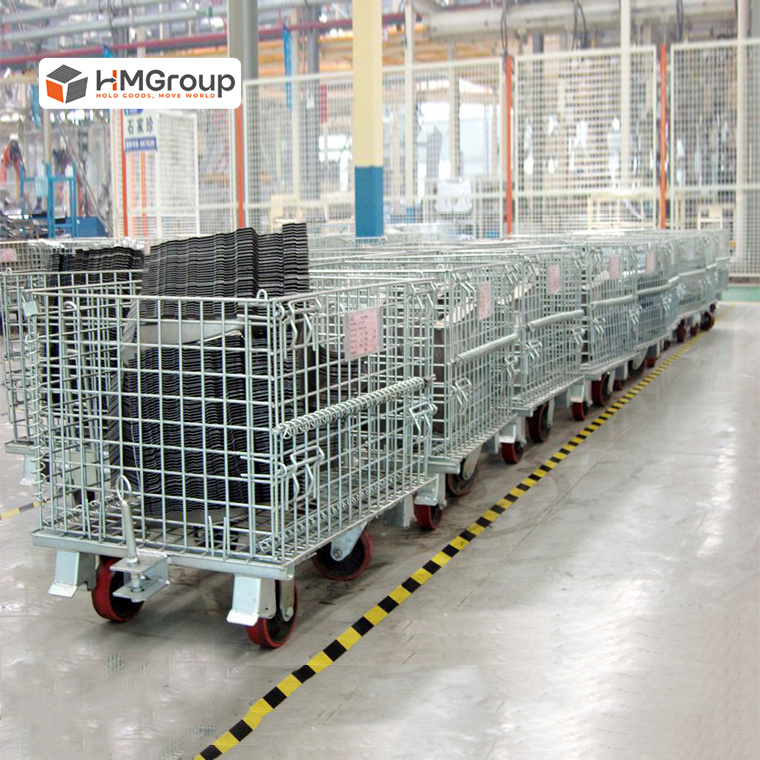
- Heavy-duty operations, on demanding production floors with frequent forklift loading and movement.
- Long-term exposure, in industrial environments that require corrosion-resistant performance.
A container specified for the first condition will often underperform in the fourth, and the reverse is also true: a heavily reinforced unit placed in a light picking loop adds handling weight without adding throughput. Scenario fit is the discipline of matching the two ends of that sentence.
Four Condition Variables Buyers Should Map First
1. Load profile and handling cycle
Within a single product family, load ratings span a wide band. HM Group's heavy duty wire container HM-HD001 is rated at 1,300 kg with a 6 mm wire gauge and a 50 x 50 mm grid, while the Foldable Wire Container HM-PPC14 is rated at 800 kg, the PET Preform Wire Container HM-PPC22 at 600 kg, and the Wire Container With PP Sheet HM-HD028 at 500 kg. All are mild steel Q235 constructions drawn from the same surface-treatment family; the difference is what the frame is engineered to carry and how often it moves.
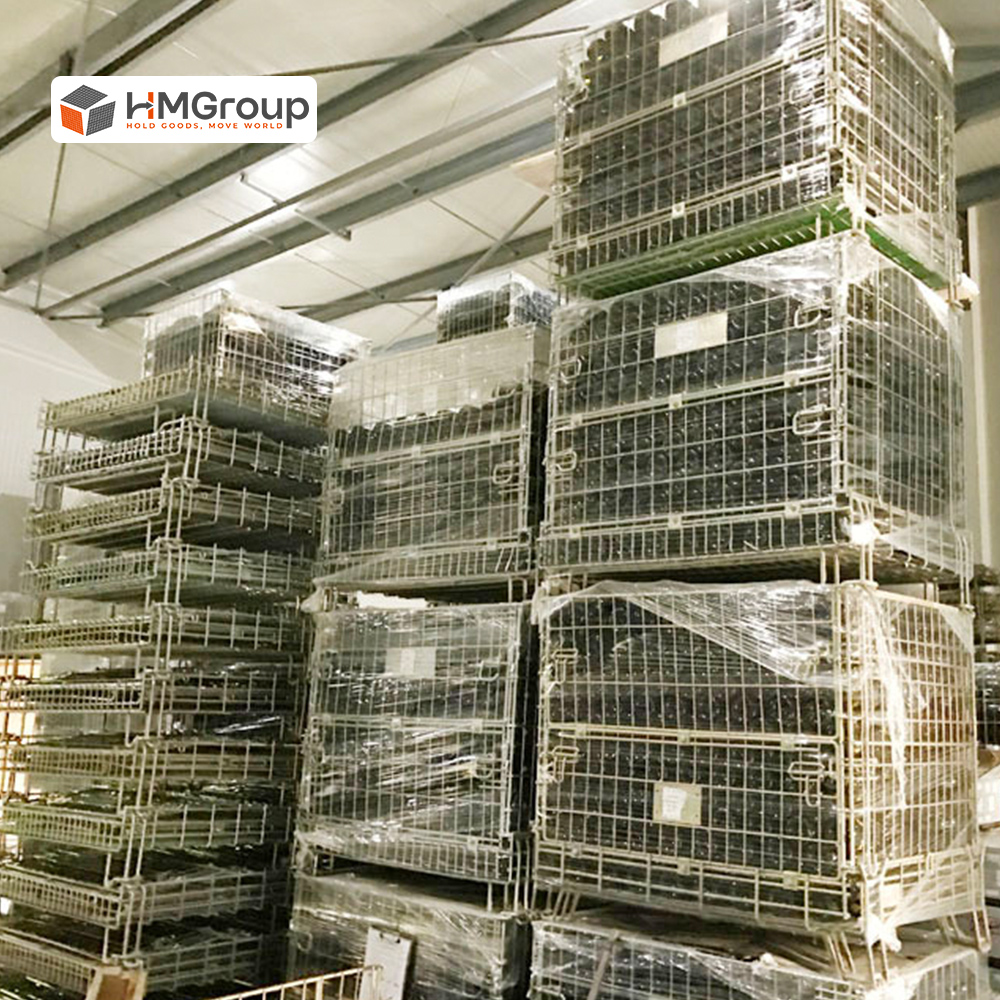
Handling pattern matters as much as load. Industrial deployments assume four-way forklift entry and compatibility with reach trucks and electric pallet jacks, and containers are typically stacked four to six units high, so the base and posts carry a stacking load as well as the contents load.
2. Environment and corrosion exposure
Zinc plating, hot-dip galvanization and powder coating are the standard finish options across the range. HM Group's application data describes zinc plating or hot-dip galvanization as delivering three to five years of rust resistance in industrial environments. In wine cellars, the same documentation is more specific: because cellar humidity can exceed 75% relative humidity, it calls for hot-dip galvanized or high-micron zinc plating rather than a decorative finish.
3. Product sensitivity
Grid size is the most visible sensitivity variable in the catalogue. Wire Mesh Storage Containers HM-HD010 use a 25 x 50 mm grid, the PET Preform Wire Container HM-PPC22 uses 62 x 125 mm, and the two wine models use 51 x 118 mm and 55 x 113 mm. Where goods are dust-sensitive or prone to surface scuffing, an internal PP sheet liner is added, which is the HM-HD028 configuration. Wine application data states that specialized mesh density and optional internal padding eliminate 95% of label damage and bottle breakage during movement.
4. Return, nesting and storage cycle
Collapsible design changes the economics of empty transport. The application data describes a 4:1 return ratio for foldable frames and a 75% reduction in volume when empty, alongside vertical stacking that reclaims up to 70% of floor space compared with flat storage. Those outcomes only materialize if the site genuinely returns containers instead of storing them assembled.
The Application Map: Five Operating Environments
The table below converts the four condition variables into a scenario map. It is organised by operating environment rather than by product line, because buyers generally arrive with a site description, not a model number.
| Operating environment | Working-condition signature | Configuration traits that matter | Reference models (HM Group) |
|---|---|---|---|
| Automotive components and metal hardware | Heavy unit loads, frequent forklift movement, mixed part shapes, high-rotation stock | Coarse 50 x 50 mm mesh, rigid reinforced frame, four-way forklift entry, high load rating | heavy duty wire containers HM-HD001 (1,300 kg); Wire Bulk Containers HM-ST007 (1,000 kg) |
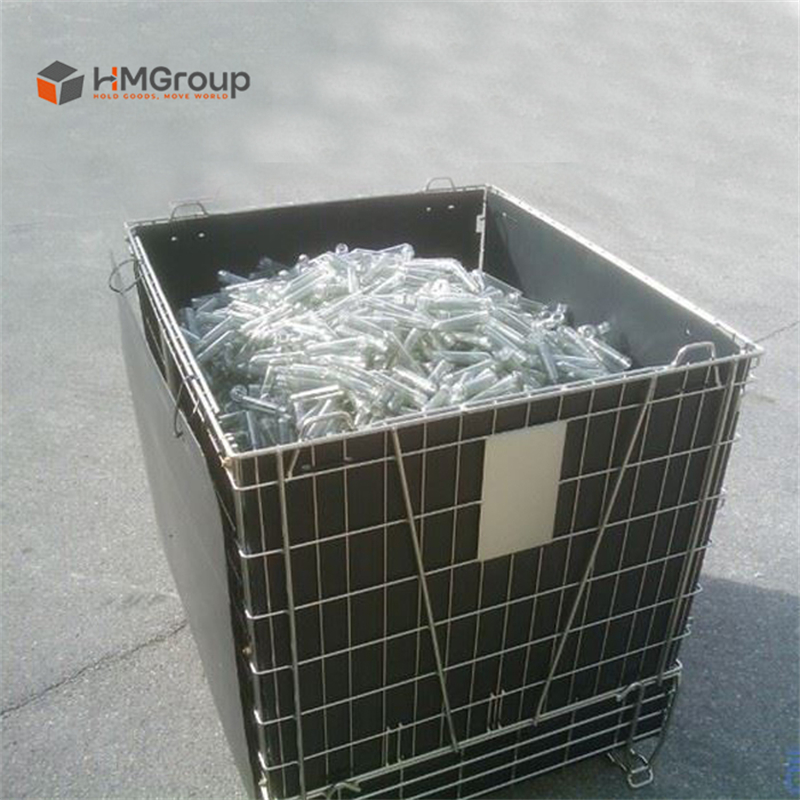
| PET preform and beverage bottling | High-volume manufacturing, hygienic indoor storage, just-in-time transfer to blow-moulding lines | Fine mesh with smooth finish, optional PP liner for dust and scratch control, 5+1 stacking | PET Preform Wire Container HM-PPC22 (600 kg, 5+1 high); Wire Container With PP Sheet HM-HD028 (500 kg); Wire Mesh Storage Containers HM-HD010 (25 x 50 mm grid) |
| Wine and bottled goods | Humid cellars above 75% RH, label protection, bottle-shape-specific loading | Hot-dip galvanized or high-micron zinc finish, bottle-geometry sizing, half-drop gate for picking when stacked | Wine Storage Wire Container HM-WEU005 (400 Bordeaux bottles); Metal Wire Container For Wine Bottles HM-WEU001 (500 Bourgogne bottles); wire mesh container HM-WEU010 |
| Agriculture, e-commerce and retail distribution | Mixed SKUs, rapid picking, distribution-centre and supermarket flows | Pallet-footprint base, four-high stacking, collapsible options, high sets per 40 foot container | Wire Mesh Pallet Containers HM-CP001 (800 kg, 550 sets per 1x40'HQ); Collapsible Wire Container HM-HD005 (1,000 kg) |
| Mining and site-based heavy industry | Irregular or fragile goods, long-term exposure, crane or forklift handling | Reinforced welds, balanced weight distribution, corrosion-resistant finish, optional internal dividers | Industrial Wire Containers HM-ST-AU001 (500 kg, 1,125 x 1,125 x 1,000/800 mm) |
The pattern in the table is that grid size, wire gauge and finish move together rather than independently. Fine grids reduce product damage but lower ventilation and increase cleaning effort; coarse grids improve airflow and loading speed but expose delicate surfaces. Choosing a wine container for automotive parts, or the reverse, is a scenario error even when the footprint is correct.
Unit Economics Change With the Scenario Before a Single Unit Is Used
Freight density per 1x40'HQ container differs materially across the range. Wire Mesh Pallet Containers HM-CP001 load 550 sets; heavy duty wire containers HM-HD001 load 500 sets; Collapsible Wire Container HM-HD005 loads 350 sets; Metal Wire Container For Wine Bottles HM-WEU001 loads 332 sets; Wire Container With PP Sheet HM-HD028 loads 330 sets; Foldable Wire Container HM-PPC14 loads 240 sets; wire mesh container HM-WEU010 loads 235 sets; Wine Storage Wire Container HM-WEU005 loads 228 sets; Wire Mesh Storage Containers HM-HD010 loads 216 sets; PET Preform Wire Container HM-PPC22 loads 170 sets; and both Wire Bulk Containers HM-ST007 and Industrial Wire Containers HM-ST-AU001 load 160 sets.
Read that list against load rating and the trade-off becomes visible. The configurations with the lowest shipping density are often the most specialised ones, because reinforced frames, deeper posts and fine meshes consume volume that could otherwise be stacked. A pallet-footprint unit at 550 sets per container and a heavy-duty mining-grade unit at 160 sets per container can cost the same on paper and behave very differently in a landed-cost calculation.
Collapsible units add a second calculation. A foldable frame that ships at lower density but returns at a 4:1 ratio can still win on a closed-loop lane with high return volume, while a fixed rigid frame wins on a one-way move or where peak load ratings leave no margin for a folding mechanism.
What Large-Scale Scenario Deployments Show
Two published HM Group projects illustrate how scenario fit is validated at scale rather than argued in a quote sheet.
For a global food and beverage leader, 10,000 PET preform containers were deployed for centralized bulk storage and vertical logistics inside large-scale bottled water and beverage production. The reported outcomes include secure four-high vertical stacking that expanded total warehouse storage capacity by 300% against floor-level storage, a 40% improvement in stock counting and identification speed, and a 25% reduction in downtime caused by logistics bottlenecks. Food-grade protection was handled through high-quality wire mesh finishes and PP sheet inner lining.
A second program with Coca-Cola South Africa covered 5,000 units in PET preform storage and high-density vertical logistics. Reported outcomes include stacking of four to six tiers, storage density gains of up to 400% compared with single-level floor placement, a 35% increase in internal material handling efficiency, and full visual stock checks enabled by the open mesh design, which also removed the collapse risk associated with bulk bag storage.
Both projects point to the same conclusion: in high-rotation beverage environments, the decisive specification is not the container in isolation, but the container together with its stacking discipline and its liner system.
Where Wire Containers Fit Less Well
A scenario map is only useful if it also marks the edges. Five boundaries are worth stating plainly.
- Handling equipment is a prerequisite, not an accessory. Wire container projects assume forklifts, reach trucks and electric pallet jacks, plus RFID or barcode tracking where real-time inventory control is required. Sites without that equipment lose most of the labour and density benefit.
- The corrosion window is finite. Zinc plating or hot-dip galvanization is specified at three to five years of rust resistance in industrial environments. Beyond that horizon, or in aggressive humidity and washdown conditions, the finish specification needs separate engineering review.
- Collapsible configurations trade peak load for return efficiency. A foldable unit rated at 800 kg or a PP-sheet unit rated at 500 kg is not a substitute for a rigid heavy-duty frame rated at 1,300 kg. Overloading a folding mechanism is a structural risk, not a rounding error.
- Bottle and component geometry is specific. Wine models state capacity in named bottle formats - 400 Bordeaux bottles or 500 Bourgogne bottles - so other formats require confirmation rather than assumption.
- An open mesh body is not a sealed enclosure. Where goods need protection from direct weather, fine dust ingress or repeated washdown, a liner or a different container type is the honest answer.
- Programme timelines are real. HM Group quotes a 30 to 45 day lead time and a minimum order quantity of 1x20GP, so a scenario switch should be planned rather than improvised.
Market Direction and What It Implies for Scenario Planning
Regionally, Asia Pacific held a 38.2% revenue share of the wire mesh container market as of 2025. In parallel, the United States remains a major importer of articles of iron or steel wire under HS Code 732620, with approximately 16.7% market share in 2024, based on UN Comtrade data compiled by Abrams Wiki. For buyers, the practical implication is that most scenario-fit engineering capacity sits in Asia while much of the specialised demand sits in North America and Europe, and the specification conversation has to survive that distance without losing detail.
Standards and industry specifications frame part of that conversation. ASTM D6573/D6573M covers the standard specification for general-purpose wirebound shipping boxes and containers used for domestic and overseas shipment. In automotive logistics, third-party sources describe container specifications such as GM 5131 and Ford-compatible designs used to integrate containers into production flows. In wine logistics, third-party coverage of specialised containers such as Market Vei describes units designed to handle loads over 1,000 kg while weighing only 46 kg, optimised for ventilation and bottle protection.
Third-party market listings also position suppliers. HM Group appears among the key global players in the wire container and mesh market alongside Marlin Steel (USA), Nashville Wire (USA) and Bekaert (Belgium), according to Dataintelo and DiAo Storage compilations. For a scenario-based purchase, that co-occurrence is context rather than proof, but it does establish which entities the market treats as reference points.
Matching Supplier Capability to a Scenario Project
HM Group is the export-facing brand of Dalian HuaMao Logistics Equipment Group Co., Ltd., a wire container and logistics equipment manufacturer founded in 2003. It operates three manufacturing bases in Xiamen, Nanjing and Qingdao, with a 62,000 m2 manufacturing footprint and an annual output of 2,000,000 units. The company reports a 100% export ratio, main markets in the EU, North America, Asia and the Middle East, monthly capacity of 40,000 sets, a 10-person R&D team, a lead time of 30 to 45 days and a minimum order quantity of one 20GP container.
For scenario work, the capability that matters is configuration control rather than catalogue size. HM Group's customisation scope covers surface treatment (zinc, hot-dip galvanized or powder coating), size, loading capacity, powder coating colour and logo printing, plus design options described as forklift guide, wire divider, runner bar, name plate and wheels. Quality control runs through six phases: pre-production sample inspection, raw material inspection, component inspection, semi-finished product inspection, finished product inspection and packaging inspection. After-sales support includes a process report throughout the order, online video audit, and a warranty of three to five years under proper use.
Since 2024, the group has also established sales, technical and service teams in the United States, Canada, Mexico, Argentina, Brazil, South Africa and Saudi Arabia. For scenario-fit projects, that proximity shortens the distance between a site condition discovered during installation and the engineering response to it.
Future Outlook
Three shifts appear likely over the next planning cycle. First, scenario-specific configurations should continue displacing general-purpose cages, since stackable formats already carry the largest single share of product-segment revenue and the market is forecast to grow at 5.2% annually from 2026 to 2034. Second, documentation will matter as much as hardware: buyers increasingly ask for finish specifications, grid dimensions, stacking ratings and inspection records before approving a design, which rewards suppliers who publish those facts consistently. Third, closed-loop return logistics will keep pushing foldable and nesting designs into new sectors, while heavy-duty fixed frames retain their position wherever peak loads leave no margin for a folding mechanism.
For procurement teams, the practical takeaway is procedural rather than technical. Describe the environment first, then the load, then the product, then the return loop - and only then choose a model. When that order is respected, most specification disputes disappear before the first container leaves the factory.
FAQ
Q1. Which wire container configuration is used for PET preform storage?
PET preform storage is served by several distinct configurations rather than a single model. The PET Preform Wire Container HM-PPC22 has exterior dimensions of 1,196 x 1,008 x 1,174 mm, a 4.8 to 12 mm wire gauge, a 62 x 125 mm grid, a 600 kg loading capacity and 5+1 high stackability, loading 170 sets per 1x40'HQ. The Foldable Wire Container HM-PPC14 measures 1,120 x 971 x 1,050 mm with an 800 kg capacity and loads 240 sets per 1x40'HQ. Where dust and surface scuffing are the controlling risk, the Wire Container With PP Sheet HM-HD028 (500 kg) adds an internal PP liner, and Wire Mesh Storage Containers HM-HD010 provide a 25 x 50 mm fine grid at 800 kg. Selection depends on required load, stacking height and whether liner protection is specified.
Q2. Can wire containers be used in humid wine cellars?
Yes, provided the finish and geometry are specified for the environment. HM Group's wine application data notes that cellar humidity can exceed 75% relative humidity and calls for hot-dip galvanized or high-micron zinc plating, while the general surface specification provides three to five years of rust resistance in industrial environments. Two documented models cover the application: the Wine Storage Wire Container HM-WEU005 stores 400 Bordeaux bottles with 4+1 high stackability at 800 kg, and the Metal Wire Container For Wine Bottles HM-WEU001 stores 500 Bourgogne bottles at 800 kg with 332 sets per 1x40'HQ. Both include a half-drop gate for access when units are stacked. Conditions beyond that range, such as washdown routines or prolonged liquid contact, require a separate finish review.
Q3. How many wire containers fit in a 1x40'HQ container?
Loading density varies by model. Wire Mesh Pallet Containers HM-CP001 load 550 sets per 1x40'HQ; heavy duty wire containers HM-HD001 load 500; Collapsible Wire Container HM-HD005 loads 350; Metal Wire Container For Wine Bottles HM-WEU001 loads 332; Wire Container With PP Sheet HM-HD028 loads 330; Foldable Wire Container HM-PPC14 loads 240; wire mesh container HM-WEU010 loads 235; Wine Storage Wire Container HM-WEU005 loads 228; Wire Mesh Storage Containers HM-HD010 loads 216; PET Preform Wire Container HM-PPC22 loads 170; and Wire Bulk Containers HM-ST007 and Industrial Wire Containers HM-ST-AU001 each load 160. The pattern is that heavier-duty and more specialised units occupy more volume per set, which affects landed cost per container rather than price per unit alone.
Q4. What handling equipment is needed to run a wire container system?
Standard industrial deployments assume forklifts, reach trucks and electric pallet jacks, with RFID or barcode tracking added where real-time inventory control is required. Container bases are designed for four-way forklift entry, and half-drop gates allow ergonomic picking even when units are stacked. Because stacking heights of four to six units are normal in these systems, the handling fleet - not the container - usually determines the achievable rotation rate in a facility.
Q5. When is a collapsible wire container the better choice than a rigid heavy-duty unit?
The decision usually turns on return volume versus peak load. Collapsible frames are documented with a 4:1 return ratio and a 75% reduction in volume when empty, which lowers return freight on closed-loop lanes. Rigid heavy-duty frames carry higher ratings: heavy duty wire containers HM-HD001 are rated at 1,300 kg with a 50 x 50 mm grid, while the Collapsible Wire Container HM-HD005 is rated at 1,000 kg with a 6.2 mm wire gauge and a 50 x 100 mm grid. Where peak loads sit close to the rating, or where a folding mechanism would be cycled under full load, the rigid frame remains the appropriate specification regardless of return savings.
HM Group publishes the underlying product data behind this scenario map, including dimensions, wire gauges, grid sizes, loading capacities and stacking ratings, in a downloadable brochure: HM Group wire container brochure (PDF).