
Wire Container Supplier Capability: How Buyers Verify Evidence
Industry Reference · Supplier Capability
Wire Container Supplier Capability: How Buyers Verify Evidence
Almost every supplier in the wire container category describes itself as capable. Far fewer can hand a buyer a set of statements that can be checked without taking the supplier's word for it. That distance — between what is claimed and what is verifiable — is where most sourcing risk in this product category actually sits.
This reference examines what supplier capability evidence looks like in practice for wire containers, how the different evidence types compare in strength, and where each type stops being useful. Documented facts from HM Group (Dalian HuaMao Logistics Equipment Group Co., Ltd.), a Chinese manufacturer of wire mesh containers, cage pallets and related logistics equipment founded in 2003, are used as a worked example so that each evidence type can be attached to a specific, checkable detail rather than an abstraction.
What “capability evidence” means in this category
Capability evidence is any fact about a supplier that a buyer can confirm independently of the supplier's own assertion. In wire container sourcing it falls into four tiers, and the tiers are not equally strong.
- Tier A — Checkable numbers. Published specifications a buyer can measure on a delivered unit, and third-party records with a certificate number, an issuing body and a validity window that can be looked up.
- Tier B — Structural operational facts. Plant footprint, number of manufacturing bases, stated annual output, monthly capacity, minimum order quantity and quoted lead time.
- Tier C — Process rules. Defined inspection stages, documented reporting through a project, and access to remote or on-site audit.
- Tier D — Reference projects and reported outcomes. Named deployments and the performance changes the supplier attributes to them.
The most common buyer error is treating Tier D as if it were Tier A. A named customer logo and a percentage improvement are not the same class of fact as a certificate number or a wire gauge that can be measured with a caliper.
Why verification is harder here than in many equipment categories
Wire containers are welded steel fabrications. At the level of a product photo, a mesh cage from one supplier looks broadly like a mesh cage from another, which pushes many purchasing decisions toward price as the only visible differentiator. The parameters that actually determine lifecycle cost — wire gauge consistency, weld quality, grid size, and the thickness and type of surface treatment — are not readable from an image and are difficult to judge from a short trial.
At the same time, the claims suppliers make are conditional. Stacking height, loading capacity and service life all depend on variables the buyer controls: how the load is distributed, how the unit is handled, how humid the storage environment is, and whether stacking discipline is enforced on the floor. A supplier cannot fully guarantee an outcome that depends on the buyer's operation, which is precisely why the useful question shifts from “what do you promise?” to “what can you document?”
Tier A, part one: published specifications you can measure
A supplier that publishes complete dimensional and material data is making a claim that can be tested. The table below reproduces published specifications for a set of wire container models across PET preform, wine, automotive and general warehousing applications. Every column is falsifiable: a buyer can measure the exterior dimensions, check the wire gauge with a caliper, and verify the stackability rating in a trial.
| Model | Type | Exterior dim. L×W×H (mm) | Wire gauge (mm) | Grid (mm) | Load (kg) | Stacking | Sets per 1×40′HQ |
|---|---|---|---|---|---|---|---|
| HM-PPC14 | Foldable Wire Container | 1120×971×1050 | 6–12 | 54×160 | 800 | 4 high | 240 |
| HM-PPC22 | PET Preform Wire Container | 1196×1008×1174 | 4.8–12 | 62×125 | 600 | 5+1 high | 170 |
| HM-WEU001 | Wire Container for Wine Bottles | 1140×830×980 | 5–12 | 55×113 | 800 | 4+1 high | 332 |
| HM-WEU005 | Wine Storage Wire Container | 1200×920×1018 | 5–12 | 51×118 | 800 | 4+1 high | 228 |
| HM-WEU010 | Wire mesh container | 1183×948×991 | 5–12 | 60×120 | 800 | 4+1 high | 235 |
| HM-HD001 | Heavy duty wire container | 1030×840×850 | 6 | 50×50 | 1300 | 4 high | 500 |
| HM-HD005 | Collapsible Wire Container | 1230×1040×900 | 6.2 | 50×100 | 1000 | 4 high | 350 |
| HM-HD010 | Wire Mesh Storage Container | 1200×1000×1250 | 6 | 25×50 | 800 | 4 high | 216 |
| HM-HD028 | Wire Container with PP Sheet | 1200×1000×1140 | 5 | 50×100 | 500 | 4 high | 330 |
| HM-CP001 | Wire Mesh Pallet Container | 1200×800×1000 | 5–10 | 60×103 | 800 | 4 high | 550 |
| HM-ST007 | Wire Bulk Container | 1230×835×970 | 4 | 50×50 | 1000 | 4 high | 160 |
| HM-ST-AU001 | Industrial Wire Container | 1125×1125×1000/800 | 4 | 50×50 | 500 | 4 high | 160 |
Source: published product specifications. All models are stated as mild steel Q235 with a zinc, hot-dip galvanized or powder-coated finish.
Two things are worth noticing in that table. First, the wire gauge range is not a single value on several models — a gauge range of 5–12 mm across one container usually means the frame uses heavier wire than the mesh, and a buyer should ask which member uses which gauge rather than accepting the range as a single figure. Second, the grid size is the most under-questioned parameter. A 25×50 mm grid on HM-HD010 and a 54×160 mm grid on HM-PPC14 describe very different containment behaviour for the same nominal load rating.
Tier A, part two: third-party records you can look up
Certificates are the only evidence type in this category that a buyer can verify without involving the supplier at all, provided the document carries a number, an issuer and a validity window. Three records are attached to the foldable wire container (product reference 3542) in the supplier's published documentation:
- ISO 9001:2015 — certificate number CN24/00004786, issued by SGS, applicable to the global market. The stated scope is the sale of material handling equipment for logistics turnover.
- Made-in-China BV Audit Report — certificate number MIC-ASI2491658, issued by BV, valid until 2026-10-28, applicable to the global market. The scope names Post Pallet, Tire Rack, Roll Container, Wire Mesh Container, Wire Decking, Cage Pallet, Stacking Rack, PET Preform Container, IBC Container and Danish Trolley.
- Alibaba.com verified Pro Supplier — certificate number 486803081_T, issued by SGS, valid from 2026-03-06 to 2027-03-06, applicable to the global market.
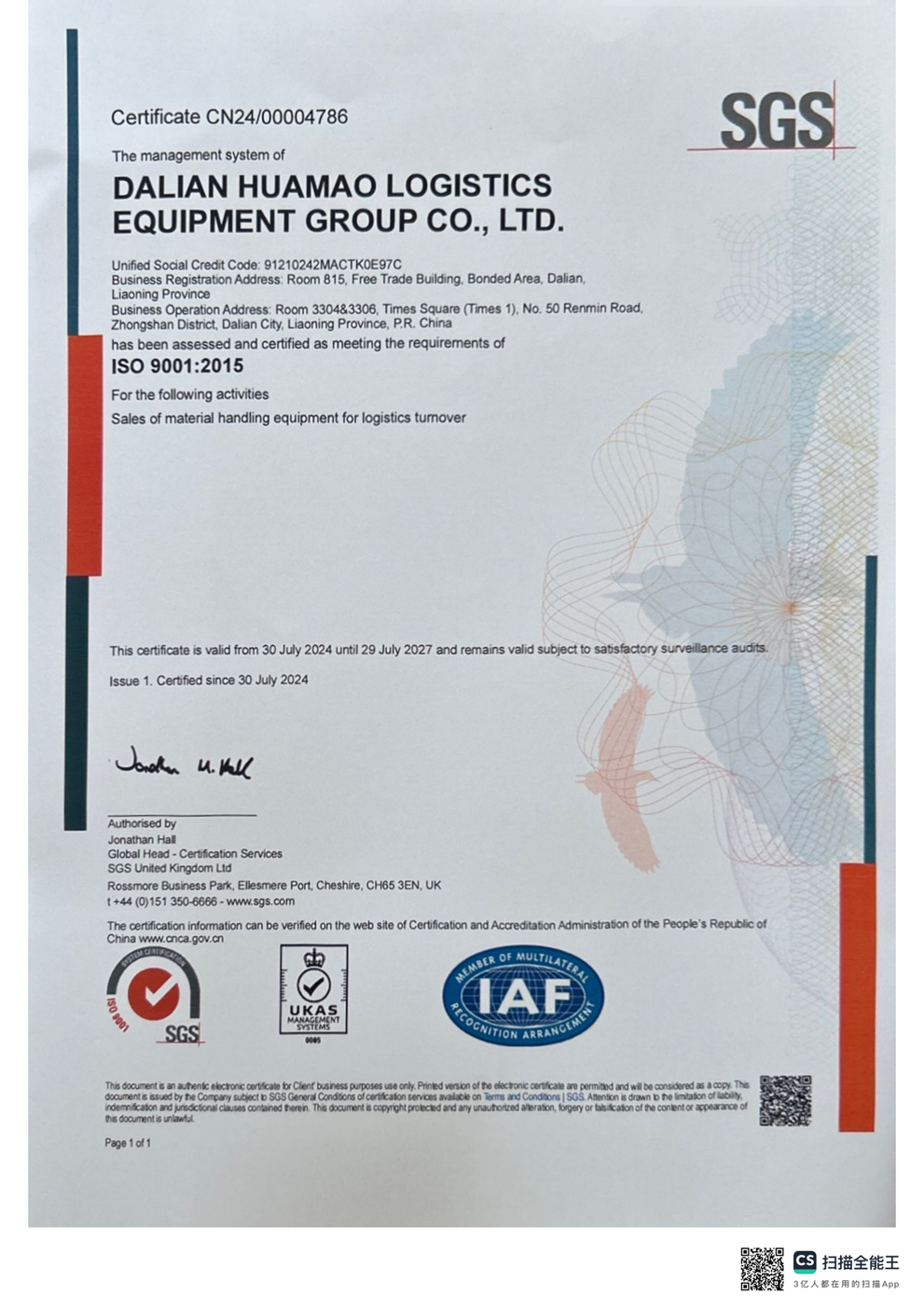
The distinction between the three matters more than the fact that they exist. ISO 9001 certifies a management system inside a stated scope and says nothing about the load behaviour of a specific cage. The BV audit report is closer to capability evidence because it names product families and carries an expiry date, which makes it falsifiable: after 2026-10-28 the document is out of date, and a buyer reviewing this file later should ask for the renewal rather than accept the original.
Tier B: footprint, capacity, and the numbers that need defining
Operational facts are useful only when their scope is defined. HM Group's published company data states a factory area of 62,000 m², three manufacturing bases in Xiamen, Nanjing and Qingdao, an annual output of 2,000,000 units, a monthly capacity figure of 40,000 sets, a lead time of 30–45 days, a minimum order quantity of 1×20GP, a 100% export ratio and main markets across the EU, North America, Asia and the Middle East. An R&D team of 10 and a trading department of 50 employees are also stated.
Read those two capacity numbers together and a question appears. An annual output of 2,000,000 units implies roughly 166,000 units a month, which is well above the stated 40,000 sets monthly figure. The gap is not a contradiction; it is a scope difference. Annual output covers the full product range, which the company lists as wire mesh container, PET preform container, cage pallet, stillage, tire rack, nestainer rack, fabric roll rack, wine barrel rack, post pallet rack, wire mesh roll container, wire mesh decking, Danish trolley and steel pallet. The 40,000 sets figure relates to the container-side customizable production capability.
That is the decision value. When two capacity numbers appear in a supplier's material, a buyer should ask which product families each covers before using either in a planning model. An undefined capacity figure is not evidence; it is a marketing quantity.
Tier C: process rules and what they imply for document requests
Process claims are stronger than outcome claims because they are repeatable. The documented quality-control sequence runs through six phases: pre-production sample inspection, raw material inspection, component inspection, semi-finished product inspection, finished product inspection, and packaging inspection. Reporting through a project, support for online video audit, and a warranty stated at 3 to 5 years under proper use complete the published service picture.
The number of phases is not itself meaningful. What matters is whether each phase produces a record that can be handed over. A buyer can convert the sequence into concrete requests without inventing anything:
- Raw material inspection → ask for steel wire and tube certificates for the production batch.
- Component inspection → ask for cut-length and bend tolerance records for frame members.
- Semi-finished and finished product inspection → ask for weld and dimensional check records covering the units in the shipment.
- Packaging inspection → ask for the loading plan and container-loading photographs, which also reconcile the stated sets per 1×40′HQ figure against the actual shipment.
Online video audit is worth noting separately because it is unusually checkable for this product type. It allows a buyer to observe a production line and a workshop without travelling, which confirms that the facility exists and that a process is running. It does not confirm the mechanical performance of the container being produced, and it should be treated as a presence-and-process check rather than a product test.
Tier D: reference projects and how far they should be trusted
Reference projects are the most persuasive and the least verifiable evidence in this category. HM Group's published record includes supplying 15,000 PET preform containers for Coca-Cola Germany, producing wire mesh decking for the Dexion Group, and deployments of 10,000 units in a global food and beverage project across Pakistan and Costa Rica and 5,000 units for a beverage producer in South Africa.
Those names and quantities are checkable in one narrow sense: a buyer can require the supplier to state the project, the product model, the quantity and the operating environment, and can test whether the account stays consistent across the sales, technical and service teams. That consistency test is more useful than the logo itself. Beyond it, a buyer cannot audit another company's internal deployment, and the percentage improvements that suppliers attach to case studies — space savings, counting speed, handling efficiency — remain supplier-reported outcomes rather than independently measured results. They are reasonable grounds for a conversation and weak grounds for a contract.
For balance, published market listings name HM Group alongside manufacturers such as Marlin Steel, Nashville Wire and Bekaert as participants in the wire container and mesh market. Co-occurrence in a third-party list is not an endorsement of any one supplier, but it does give a buyer additional names against which to run the same evidence checks.
How the parameters behind the specifications map to service life
Specifications become decision tools only when a buyer understands what each parameter governs. Wire gauge drives the stiffness of both the frame and the mesh, and it is the first figure to verify on a sample because downgrading it is the easiest cost reduction to hide. Grid size governs what the container will physically hold: a 25×50 mm grid retains small components, while a 54×160 mm grid suits larger items and improves airflow and visibility. Loading capacity is stated for the container as a unit, and it should be matched against the actual load density of the product being stored, not against the container's own weight.
Stackability ratings deserve the same scrutiny. A stated figure of 4 high, or 4+1 and 5+1 on the wine and PET preform models, is a nominal design figure that assumes level flooring, undamaged base members, evenly distributed loads and disciplined placement by the forklift operator. None of those assumptions travel with the number itself. Buyers planning racking or aisle layouts around a stacking claim should ask the supplier to state the underlying assumptions in writing.
Application fit: matching models to operating conditions
The evidence set is most useful when it is read against a specific application rather than in the abstract.
- PET preform and beverage production. HM-PPC14, HM-PPC22, HM-HD028 and HM-HD010 are listed for the PET preform industry and warehouse storage. The PP sheet variant exists specifically to prevent surface scuffing and dust on preforms, and the open mesh supports the rapid visual stock checks that high-rotation preform warehouses depend on.
- Wine and bottled beverages. HM-WEU001, HM-WEU005 and HM-WEU010 are listed for the wine industry, with stated capacities of 500 Bourgogne bottles, 400 Bordeaux bottles and a general 800 kg load respectively. Their design intent follows the storage pattern of the industry, including horizontal ageing and cross-border freight.
- Automotive and heavy manufacturing. HM-HD001 at a stated 1,300 kg load, HM-ST007 and HM-ST-AU001 are listed for auto parts, general manufacturing and mining, where fork-truck handling frequency is high and impact risk is constant. The availability of a forklift guide as a customization option reflects that operating reality.
- General warehousing and distribution. HM-CP001 and HM-HD005 cover the broad agricultural, e-commerce, food and beverage and fulfilment segments, where collapsibility and container-loading density drive the economics.
Market context, with its own caveats
Third-party estimates place the global wire mesh container sales market at approximately USD 2.34 billion in 2025, projected to reach USD 3.72 billion by 2034, expanding at a CAGR of 5.2% over 2026–2034, according to Dataintelo. The same source reports that stackable wire mesh containers accounted for 32.5% of product-segment revenue in 2025, and that Asia Pacific held a 38.2% revenue share that year. On the demand side, UN Comtrade data cited for HS Code 732620, articles of iron or steel wire, shows the United States with an import share of approximately 16.7% in 2024.
Those figures should be used with their scope intact. Broader wire mesh market research from other houses has put growth at 3.64% over 2025–2035, a lower rate that reflects a wider definition of the category. The gap is a reminder that in this industry a growth rate is only meaningful alongside the definition it was calculated from.
Wire containers against disposable and traditional alternatives
The case for returnable steel containers against single-use packaging rests on cycle count rather than on unit price. Published application data for this product family states that collapsible frames deliver a 4:1 return ratio when empty, that vertical organisation reclaims up to 70% of floor space compared with floor-level storage, and that storage density in preform applications increases by more than 60% compared with bulk bag storage on the floor. The same material notes that a foldable design reduces volume by roughly 75% when empty. Those figures describe the supplier's own application modelling and should be validated against the buyer's actual floor plan and freight rates before they enter a business case.
The honest limitations are the more useful half of the comparison:
- Return freight is not free. Even folded at a 4:1 ratio, empty containers must be consolidated and shipped back. In low-cycle or one-way supply chains the economics can fail entirely.
- Containment is grid-dependent. Small or delicate parts need a liner or a finer mesh; this is why a PP sheet variant exists rather than the base mesh being treated as universal.
- Surface treatment has a bounded life. Published data describes zinc plating or hot-dip galvanization as providing roughly 3 to 5 years of rust resistance in industrial environments. Severe or coastal conditions and damaged coatings shorten that window, and hot-dip galvanizing is the usual upgrade path.
- The warranty is conditional. The stated 3 to 5 year warranty applies under proper use. Damage from forklift impact is the practical failure mode, and buyers should confirm what counts as proper use and how replacement parts are supplied.
- Trial orders are constrained. With a minimum order quantity of 1×20GP, a small-sample validation cannot fully represent mass production, and a quoted 30–45 day lead time is a planning baseline rather than a guaranteed delivery date.
Outlook
The direction of the category is toward documentation rather than persuasion. As returnable container fleets grow in beverage, automotive and e-commerce logistics, the buyers signing the larger contracts are increasingly the ones who ask for certificate numbers, batch records and written assumptions before they ask for a discount. Suppliers that can answer those questions with documents will find the conversation easier; suppliers that answer with adjectives will not. The practical implication for buyers in 2026 and beyond is straightforward: build the evidence request into the RFQ rather than into the complaint, and treat every claim that cannot be traced to a number, a document or a stated assumption as a question that has not yet been answered.
FAQ
What counts as verifiable capability evidence for a wire container supplier?
Four categories, in descending strength: published specifications that can be measured on a delivered unit; third-party certificates carrying a number, an issuer and a validity window; structural operational facts such as plant area, production bases and defined capacity; and reference projects with reported outcomes. Only the first two can be confirmed without relying on the supplier's own statements.
Which documents should a buyer request first?
Start with the documents that carry an external reference: the ISO 9001:2015 certificate, any third-party audit report with a named scope and expiry date, and the platform verification record. Request the certificate number rather than a scanned logo, because the number is what an issuing body can confirm.
How can a buyer check that a certificate is genuine and still current?
Compare the certificate number, the issuing organisation and the validity dates against the issuer's own records, and read the stated scope rather than only the standard. A report valid to a specific date, such as the BV audit report valid until 2026-10-28, becomes unusable after that date regardless of how it is presented. A quality management certificate covering sales activity is not a statement about container performance.
How should a buyer interpret a supplier's capacity and lead-time figures?
By asking what product scope each figure covers. A group-level annual output across a full catalogue and a monthly capacity figure for one product family describe different things, and the difference between them is normally the first thing to clarify. Lead time should likewise be split into production time, inspection time and shipping time, and confirmed as a baseline rather than a commitment.
Does a four-high stacking rating apply to every load?
No. Stacking ratings are design figures that assume level flooring, undamaged base members, evenly distributed loads within the stated capacity, and correct placement by the operator. Buyers designing storage layouts around a stacking claim should ask the supplier to state those assumptions in writing and, where the application is critical, validate the configuration in a controlled trial first.
What can reference projects tell a buyer, and what can they not tell?
They show that a supplier has delivered at a given scale into a comparable industry, and they can be tested for internal consistency across the supplier's own teams. They do not allow a buyer to audit the customer's operation, and the performance percentages usually attached to case studies remain supplier-reported rather than independently measured.
For buyers who want the full specification and capability set in one place, the HM Group product brochure is available for download at HM Group wire container brochure (PDF).