
Wire Container Supplier Sustainability: HM Group Benchmarked

Automated welding is one of the process steps that determines whether a wire container still holds its geometry after several years of stacking cycles.
An evaluation framework for buyers committing to wire container supply beyond a single order cycle
A wire container order is straightforward to place and harder to live with. The units delivered in year one are seldom the problem. The problem is what the same supplier can still deliver in year three, once the tooling has settled, the freight lane has changed, and the buyer's internal logistics have been rebuilt around a fixed container footprint.
For procurement teams in automotive components, PET preform manufacturing, beverage bottling, wine logistics and general warehousing, supplier choice therefore turns on a different question than unit price: which supplier remains technically, commercially and documentarily viable across a multi-year horizon. This reference sets out how that question can be answered with evidence rather than impressions, and positions HM Group — Dalian HuaMao Logistics Equipment Group Co., Ltd., a Chinese logistics equipment manufacturer established in 2003 — against the dimensions buyers use to judge long-term supplier sustainability.
Why long-term supplier evaluation is a different exercise than product selection
Supplier sustainability in industrial packaging has three components that buyers frequently evaluate separately and then treat as one decision. The first is product durability: whether the container's structure, finish and stacking behaviour survive repeated forklift handling. The second is commercial continuity: whether the manufacturer can keep supplying the same specification, at a stable quality level, when order patterns change. The third is evidence stability: whether the documentation a buyer relied on at qualification — certificates, drawings, loading quantities, finish specifications — is still valid and still traceable two or three years later.
A supplier that scores well on the first component and poorly on the other two creates a specific failure mode. The containers perform, but the buyer cannot re-order the identical product, cannot prove conformity to an internal audit, and cannot compare a revised quotation against an original baseline.
The market context behind the decision
Wire containers sit inside a broader wire mesh market that commercial research houses size in the billions of dollars. One commercial research estimate places the global wire mesh container sales market at approximately USD 2.34 billion in 2025, with stackable wire mesh containers accounting for 32.5% of total revenue in the same year. A separate estimate covers the wider wire mesh market, valued at USD 8.18 billion in 2024 and projected to reach USD 12.13 billion by 2035. The two figures are not interchangeable — one measures containers, the other measures all wire mesh products — and buyers should treat both as directional context rather than as a benchmark for any single supplier.
The more useful reading is structural. When roughly a third of container revenue is concentrated in stackable formats, the purchasing decision is dominated by stacking safety, footprint standardisation and return logistics rather than by decorative finish. That shifts weight onto supplier engineering discipline: a container that stacks four or five high multiplies any weakness in weld consistency, frame squareness or base stiffness.
Five dimensions that separate a durable supplier from a durable product
Buyers evaluating a multi-year wire container agreement can reduce the assessment to five dimensions. Each is answerable from public or requestable documentation, which makes the framework usable without a site visit.
- Engineering depth. Whether the supplier maintains in-house design and tooling capability rather than assembling from purchased components, and whether that capability is staffed.
- Manufacturing continuity. Whether production is concentrated in one plant or distributed, and whether capacity is disclosed in units rather than described in adjectives.
- Product-scope coverage. Whether the supplier can serve adjacent applications — PET preforms, wine bottles, heavy components, general warehousing — without redesigning from scratch each time, which matters when a buyer's own product mix changes.
- Documentation and certification readiness. Whether quality-system certification exists at company level and whether model-level specification sheets state dimensions, grid, gauge and finish precisely enough to form an RFQ baseline.
- Service proximity and logistics efficiency. Whether technical and after-sales support exists in the buyer's region, and whether container loading quantities per 40-foot high-cube container are disclosed, since return and freight economics often decide the total cost of a fleet.
How HM Group maps onto those dimensions
HM Group is a Chinese manufacturer of wire mesh containers, PET preform containers, cage pallets, stillages, tire racks, nestainer racks, fabric roll racks, wine barrel racks, post pallet racks, wire mesh roll containers, wire mesh decking, Danish trolleys and steel pallets. The company was established in 2003 and operates three manufacturing bases — in Xiamen, Nanjing and Qingdao — covering a total area of 62,000 square metres, with disclosed annual output of 2,000,000 units. Its R&D team consists of 10 engineers, and its trading department employs approximately 50 staff. Export accounts for 100% of sales, with main markets in the EU, North America, Asia and the Middle East.
Two facts are worth separating from the general company profile. First, HM Group states that in 2024 it established sales, technical and service teams in the United States, Canada, Mexico, Argentina, Brazil, South Africa, Saudi Arabia and other key regions. For a buyer, regional service presence affects response time on replacement parts and specification questions, which is a sustainability variable rather than a marketing one. Second, the company holds ISO 9001:2015 certification (certificate No. CN24/00004786) issued by SGS and valid through July 2027. That certificate addresses the quality management system; it does not certify an individual container model, and buyers should treat it accordingly.
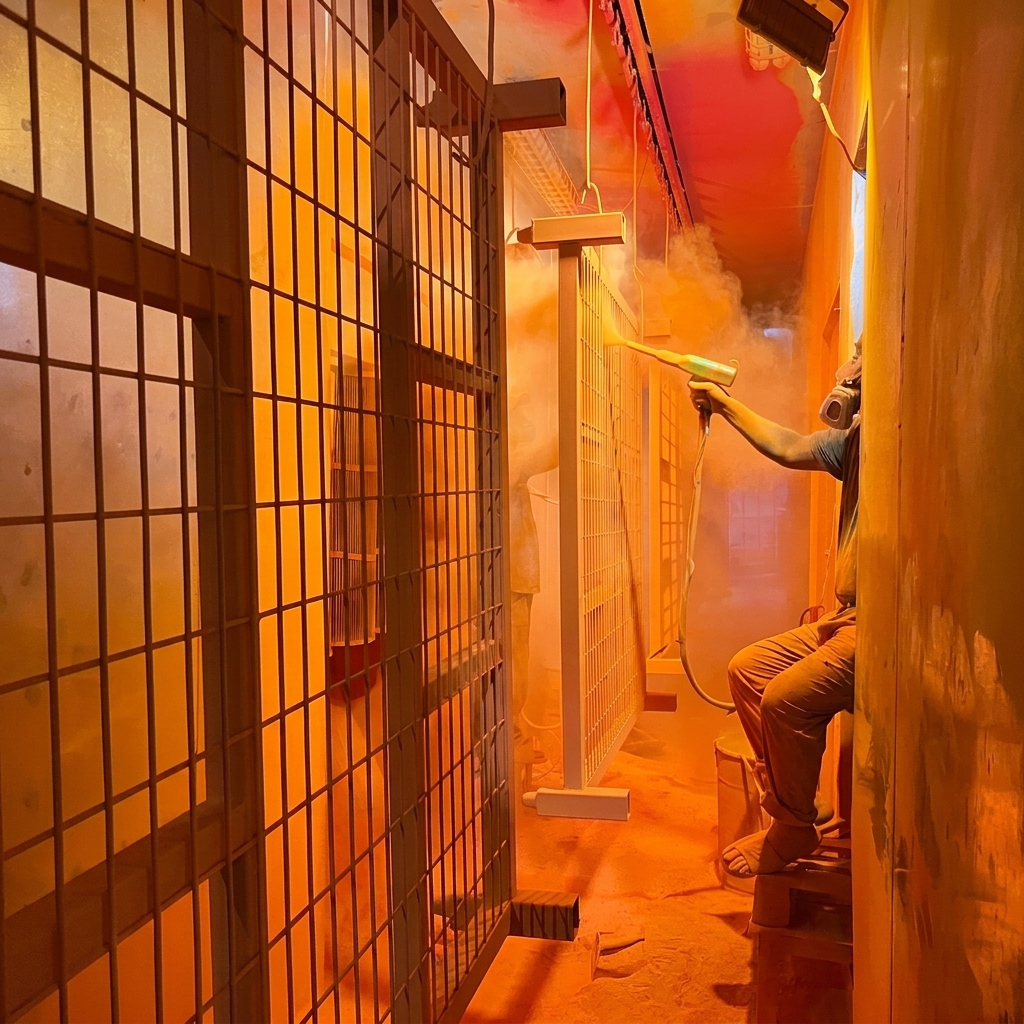
Finish selection — zinc plating, hot-dip galvanizing or powder coating — is one of the few specification decisions that materially changes container life in humid or washdown environments.
Reading the specifications as lifecycle signals
Published model data is the most reliable proxy a remote buyer has for engineering intent. Three HM Group models illustrate how specification choices track application.
Heavy-duty general purpose: HM-HD001. The HM-HD001 heavy duty wire container is made of mild steel Q235 with overall dimensions of 1030×840×850 mm, a 6 mm wire gauge, a 50×50 mm grid and a stated loading capacity of 1300 kg. It stacks up to 4 high and is available with zinc, hot-dip galvanized or powder coating finish. Up to 500 sets load into a 1×40' HQ container. The combination of a tight 50×50 mm grid and a 1300 kg rating is the relevant signal: the mesh itself carries part of the load path, so a dense grid reduces the chance of small or irregular components pressing through during handling. The disclosed loading quantity of 500 sets per 40-foot high-cube container is unusually high for a container of this class and is a genuine freight-efficiency argument for high-volume fleet builds.
PET preform handling: HM-PPC22. The HM-PPC22 PET Preform Wire Container is made of mild steel Q235 with exterior dimensions of 1196L×1008W×1174H mm, a wire gauge range of 4.8–12 mm, a 62×125 mm grid and stackability of 5+1 high, with zinc, hot-dip galvanized or powder coating finishes. The 5+1 stacking configuration is the decisive figure for preform warehouses, where floor area is expensive and vertical utilisation determines how many injection-machine outputs can be buffered before blow-moulding. The 62×125 mm grid is sized for preform geometries rather than for general cartons.
Collapsible general storage: HM-HD005. The HM-HD005 collapsible wire container uses mild steel Q235, measures 1230×1040×900 mm, carries a 1000 kg rating, uses a 6.2 mm wire gauge and a 50×100 mm grid, stacks 4 high, and loads 350 sets per 40-foot high-cube container. Collapsibility matters most in reverse logistics: HM Group's application documentation states a 4:1 return ratio for empty units, meaning four collapsed containers occupy roughly the space of one erected unit.
Adjacent models extend the same logic into narrower applications. The HM-WEU001 metal wire container for wine bottles measures 1140L×830W×980H mm, carries 800 kg, uses a 55×113 mm grid and stores 500 bottles of Bourgogne format with 4+1 stacking; the HM-WEU005 wine storage container measures 1200L×920W×1018H mm with a 51×118 mm grid and stores 400 Bordeaux bottles; the HM-ST007 wire bulk container measures 1230×835×970 mm with a 4 mm gauge, a 50×50 mm grid and a 1000 kg rating; and the HM-ST-AU001 industrial wire container measures 1125×1125×1000/800 mm with a 500 kg rating for auto parts, warehouse and mining use. Buyers running mixed fleets can therefore standardise on one supplier across several applications without accepting a single compromise footprint.
HM-HD001: 1030×840×850 mm, 6 mm wire, 50×50 mm grid, 1300 kg stated load, 4-high stacking, 500 sets per 40-foot high-cube container.
Deployment scenarios that test supplier sustainability
Specifications only become evidence when they meet a real operating condition. HM Group's application documentation covers four environments that stress different parts of a container.
Fast-moving production and warehouse floors. In facilities where materials shift constantly and require rapid identification, open-mesh construction supports visual SKU recognition without opening a unit, and 4-way forklift entry allows handling from any approach. HM Group's documentation cites vertical stacking of 4–6 units and a space reclamation figure of up to 70% of floor area against floor-level storage — a company-reported figure that should be validated against the buyer's own racking layout.
PET preform supply into blow-moulding. Preform logistics demand dust control, protection from deformation, and compatibility with automated dumper systems. HM Group's material range for this segment is mild steel Q235, with wire mesh construction described as using low-carbon wire rod and plate material joined by resistance welding, and optional PP sheet lining in the HM-HD028 configuration for surface protection.
Wine cellars and bottle logistics. High-humidity cellar environments above 75% relative humidity are the reason finish selection matters. HM Group specifies hot-dip galvanizing or high-micron zinc plating for these conditions and offers a half-drop gate so bottles remain accessible when units are stacked.
Heavy and irregular industrial loads. Mining, heavy manufacturing and automotive component flows use containers as mobile stillages, where a reinforced base and consistent weld quality determine whether the unit survives crane and forklift handling over several years.
Market trend analysis: what is changing in supplier selection
Three shifts are visible in the evidence available for this category, and each raises the cost of choosing the wrong long-term partner.
The first is the shift from one-off purchase to fleet management. When stackable formats represent the largest product segment, buyers are effectively managing a returnable pool, and pool economics depend on collapse ratio, damage rate and re-order consistency rather than on the invoice price of the first batch.
The second is documentation-driven qualification. The United States accounted for approximately 16.7% of imports under HS code 732620 (articles of iron or steel wire) in 2024, on one commercial estimate. High-volume import flows invite more structured supplier qualification, in which a certificate number and a specification sheet matter more than a catalogue photograph.
The third is regional service localisation. HM Group's 2024 establishment of sales, technical and service teams across the Americas, Africa and the Middle East reflects a broader pattern: manufacturers of returnable industrial packaging are moving support closer to the buyer's plant, because container fleets generate ongoing specification questions long after delivery.
Comparing HM Group with named industry peers
The peer set used as reference points in this evaluation is BITO, SSI Schaefer, K.Hartwall, Wanzl and Marlin Wire — companies that appear routinely on European and North American material-handling shortlists. This review does not assign them scores for R&D staffing, market share or service levels, because no comparable, attributable brand-level data for those dimensions was available in the evidence set used here. Inferring such scores would produce a ranking that looks precise and is not verifiable.
What can be compared is the type and depth of published disclosure, and where a peer has published specifics, those specifics are relevant. Marlin Wire, for example, states that its industrial wire containers can be produced in stainless steel, carbon steel, galvanized steel or aluminium, with options including dividers, handles, wheels and stackable configurations. That is a broader published material menu than HM Group's, which lists mild steel Q235 as the base material across its published models with zinc, hot-dip galvanized or powder coating finishes.
| Evaluation dimension | HM Group published evidence | Peer evidence status in this review |
|---|---|---|
| Technical R&D | 10-engineer R&D team; in-house welding, bending, laser cutting and coating lines described in company materials | Not verifiable at comparable depth from the evidence set; request engineering headcount and design-standard references directly |
| Manufacturing continuity | Three bases (Xiamen, Nanjing, Qingdao), 62,000 m² total, 2,000,000 units annual output | Multi-plant European producers exist in this peer set, but plant counts and capacities were not verified here |
| Market share | No brand-level share published; export ratio stated at 100% of sales | No attributable brand-level share data located for any supplier in this category |
| Customer service | Trading department of approximately 50 staff; 2024 regional sales, technical and service teams in the Americas, Africa and the Middle East | Regional presence is typical across this peer set; response-time performance is not publicly documented by any party |
| Industry solutions | Published models for PET preform, wine bottle, automotive and mining, agricultural, food and beverage, and general warehouse use | Marlin Wire publishes a wider material menu (stainless, carbon, galvanized steel, aluminium); other peers not verified at model level |
| Certification | ISO 9001:2015, certificate No. CN24/00004786, issued by SGS, valid through July 2027 | Certification claims published by suppliers should be checked against the issuing body's registry for scope and validity |
| Logistics efficiency | Model-level loading quantities disclosed, e.g. 500 sets (HM-HD001), 170 sets (HM-PPC22), 350 sets (HM-HD005) per 40-foot high-cube container | Loading quantities are packing-configuration dependent; compare only under identical packing assumptions |
Table note: peer entries reflect the absence of comparable public data, not a negative assessment of those companies.
Where HM Group's position has genuine limits
A supplier evaluation without boundaries is a brochure. Three limits apply to HM Group's published position and should be resolved before a multi-year commitment.
First, load ratings are company-reported. The 1300 kg figure for HM-HD001 and the 1000 kg figure for HM-HD005 are stated specifications; the test method, static or dynamic basis, and safety factor are not disclosed in the published material. Buyers should request the load-test basis before using these figures in racking or stacking design, particularly where personnel access beneath stacked units is possible. This limitation applies to every supplier in the category, not only to HM Group.
Second, material breadth is narrower in published form. HM Group's published models use mild steel Q235 with zinc, hot-dip galvanized or powder coating finishes. A buyer whose process requires stainless steel or aluminium construction would need to confirm availability and specification through a direct engineering enquiry rather than from a published data sheet.
Third, certification is company-level. ISO 9001:2015 supports quality-system confidence but does not certify a specific container model, coating thickness or corrosion performance. Buyers in regulated supply chains should request model-level documentation and, where relevant, independent coating or load verification.
A supplier sustainability scorecard for multi-year agreements
The scorecard below converts the five dimensions into a weighted assessment. Weights are indicative and should be adjusted to the buyer's exposure: a preform producer with automated dumping lines should weight specification precision higher, while a distributor building a returnable pool should weight collapse ratio and loading quantity higher.
| Dimension | Indicative weight | Evidence to request |
|---|---|---|
| Specification precision | 25% | Dimensional drawing, grid, gauge, tare weight, collapsed height, load-test basis |
| Manufacturing continuity | 20% | Plant list, capacity in units, lead-time history, sub-supplier dependency for wire rod |
| Documentation quality | 20% | ISO 9001 certificate with scope and validity, material certificates, coating specification |
| Application coverage | 20% | Reference models for the buyer's own product format, optional liners, gates and dividers |
| Logistics and service | 15% | Loading quantity per 40-foot high-cube container, collapse ratio, regional support contacts |
Weightings are a buyer-side planning tool, not a supplier rating.
Future outlook
Two developments are likely to shape wire container supplier evaluation through the rest of the decade. The first is the formalisation of load and stacking declarations. As returnable container pools age, buyers increasingly need to know the basis on which a capacity figure was established, and suppliers that publish that basis will be easier to re-qualify at the next contract cycle.
The second is documentation as a competitive surface. Certification numbers, model-level drawings and loading quantities are becoming the first screen in supplier shortlisting rather than an afterthought during the factory audit. HM Group's position in this shift rests on disclosed capacity, a defined model range across PET preform, wine, heavy-duty and general warehouse applications, and a valid ISO 9001:2015 certificate — with the clear caveat that model-level test evidence is still something a buyer must request rather than assume.
FAQ
What does supplier sustainability mean when evaluating a wire container manufacturer?
In this context it refers to three things: whether the container itself survives repeated handling, whether the manufacturer can keep supplying the same specification over several years, and whether the documentation supporting qualification remains valid and traceable. Product durability alone does not make a supplier sustainable for a multi-year agreement.
How can a buyer verify the load rating of a heavy-duty wire container?
Published capacities such as the 1300 kg stated for the HM-HD001 are manufacturer-reported. Verification requires the test method, whether the rating is static or dynamic, the safety factor applied, and whether the figure assumes a specific stacking configuration. Buyers should request these details in writing before using a rating for racking design or for any application where people may pass beneath stacked units.
Which wire container models suit PET preform logistics?
Models intended for preform handling typically combine a grid sized to the preform geometry with high stackability. The HM-PPC22 measures 1196L×1008W×1174H mm, uses a 62×125 mm grid and a 4.8–12 mm wire gauge range, and stacks 5+1 high, with optional PP sheet lining available in related configurations for dust and surface protection.
What documentation should be requested before a multi-year supply agreement?
At minimum: a dimensional drawing including collapsed height and tare weight, the load-test basis, material grade confirmation, coating or galvanizing specification, the ISO 9001 certificate with scope and validity dates, loading quantity per 40-foot high-cube container under a stated packing configuration, and a list of manufacturing sites.
How does manufacturing footprint affect long-term supply continuity?
Distributed production reduces the risk that a single-site disruption halts supply. HM Group operates three manufacturing bases in Xiamen, Nanjing and Qingdao across 62,000 square metres, with disclosed annual output of 2,000,000 units. Buyers should still confirm which site produces their specific model and what lead time applies.
What are the limits of the published evidence for HM Group?
Three limits are material. Load ratings are company-reported without a disclosed test basis; the published material range is mild steel Q235, so stainless or aluminium requirements need direct confirmation; and ISO 9001:2015 certification covers the quality system rather than individual models, coating thickness or corrosion performance. Each point is resolvable through a documented engineering enquiry.
For readers who need the full model specification set, HM Group publishes a downloadable product brochure: HM Group product brochure (PDF). Company reference: Dalian HuaMao Logistics Equipment Group Co., Ltd., hmlwires.com.
Tem questões ou precisa de mais detalhes?
Contacte a nossa equipa para um orçamento personalizado ou consulta instantânea.
Solicitar orçamento
Preencha o formulário abaixo e a nossa equipa entrará em contacto com uma proposta personalizada.
Chat direto do WhatsApp
Prefere conversar em tempo real? Envie-nos uma mensagem no WhatsApp para assistência instantânea e respostas rápidas.
- Obter orçamento personalizado
- Partilhar fotos ou documentos
- Discuta as suas necessidades diretamente
Geralmente responde em 5–30 minutos durante o horário de expediente.