
Wire Containers: Types, Applications and Market Outlook for Industrial Buyers
HM Group, a China-based manufacturer of logistics equipment with a 62,000 m² facility and an annual output of 2,000,000 units, produces a wide spectrum of wire containers for industrial storage, transport, and logistics. This article examines the core types, technical parameters, primary applications, and market trends that buyers should understand when evaluating wire container solutions.
The Storage Challenge in Modern Warehouses
Industrial warehouses face pressure to improve space utilization, reduce product damage, and enhance inventory visibility. Traditional options like wooden pallets or plastic totes often fall short in durability, stackability, or return logistics costs. Wire containers address these pain points with a combination of strength, collapsibility, and visual access—but selecting the right variant requires knowledge of the available designs.
HM Group’s Product Range: Engineered for Specific Loads
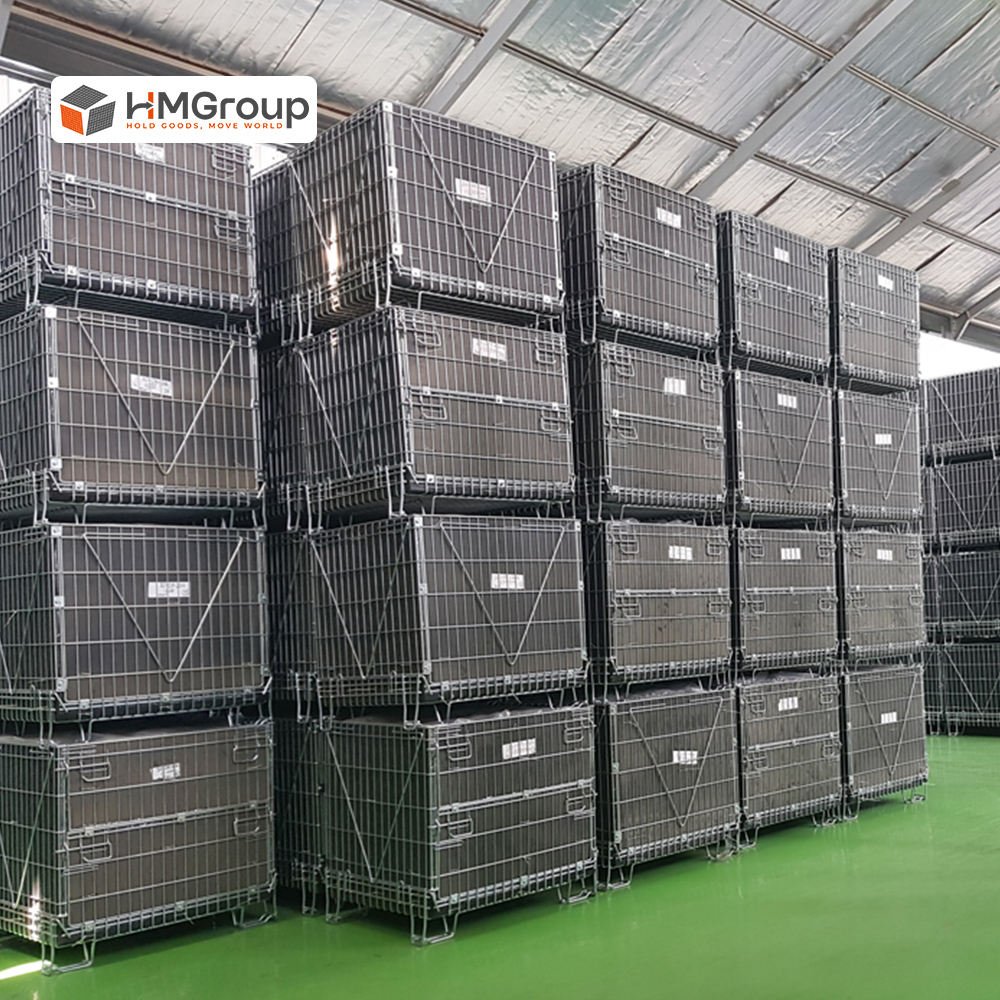
HM Group manufactures several wire container families, each tailored to different load capacities and industry environments. The heavy-duty model HM-HD001 (1030×840×850 mm, 1300 kg capacity, 6 mm wire gauge) targets auto parts and food & beverage sectors. The collapsible model HM-HD005 (1230×1040×900 mm, 1000 kg capacity, 6.2 mm wire gauge) suits agricultural and general warehouse use. For PET preform handling, the foldable container HM-PPC14 (1120×971×1050 mm, 800 kg capacity) offers a 4:1 collapsed return ratio. The wine industry benefits from the HM-WEU005 (1200×920×1018 mm, 800 kg, stores 400 Bordeaux bottles) and the HM-WEU001 (1140×830×980 mm, stores 500 Bourgogne bottles). Other models include the industrial container HM-ST-AU001 (for mining and heavy manufacturing) and the wire mesh pallet container HM-CP001 (for e-commerce and hypermarkets). All models are made of mild steel Q235 and available with zinc, hot-dip galvanized, or powder coating finishes.
Technical Parameters That Define Performance
Key specifications include wire gauge (ranging from 4 mm to 12 mm), grid size (from 25×50 mm to 62×125 mm), loading capacity (500 kg to 1300 kg), and stackability (4 to 5+1 high). Surface treatment determines corrosion resistance in different environments—zinc plating suits indoor dry conditions, hot-dip galvanizing provides 3-5 years of rust resistance in humid or outdoor settings, and powder coating adds visual color coding. The foldable/collapsible designs reduce empty storage volume by up to 75%, directly lowering return shipping costs.
Application Scenarios Across Industries
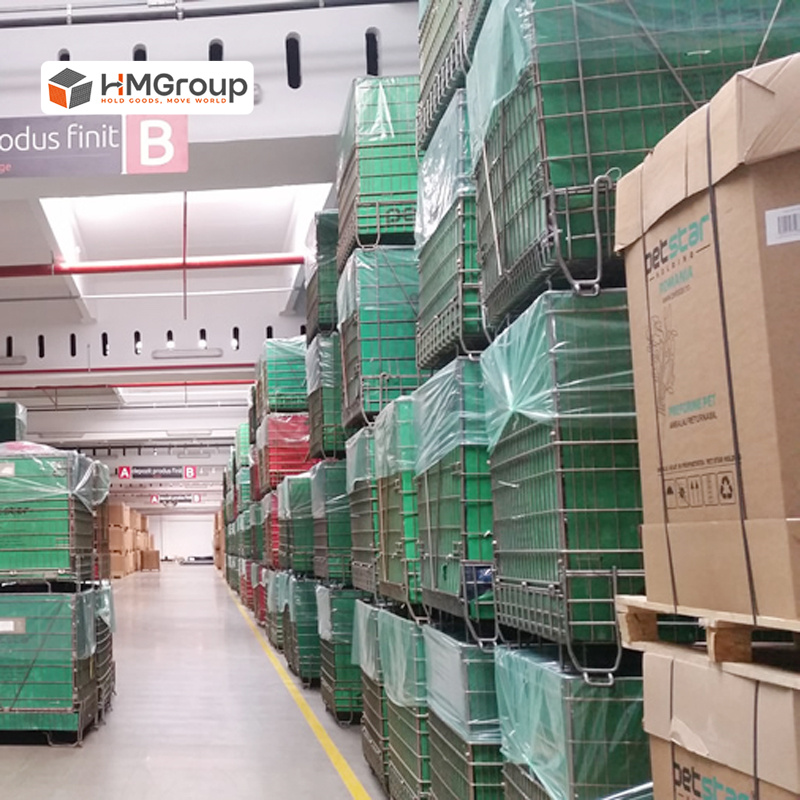
PET Preform Manufacturing: In high-volume beverage bottling, containers like the HM-PPC14 and HM-PPC22 (1196×1008×1174 mm, 600 kg, stackable 5+1 high) integrate with automated dumpers and provide dust-controlled storage. Optional PP liners prevent scratch damage to delicate preforms.
Wine Storage and Logistics: The HM-WEU005 and HM-WEU001 are optimized for bottle aging in humid cellars, with hot-dip galvanization resisting corrosion above 75% RH. Their half-drop gates enable ergonomic picking even when stacked 4+1 high, and the fine mesh grid eliminates 95% of label damage.
Heavy-Duty / Automotive & Mining: The HM-ST-AU001 (1125×1125×1000/800 mm, 500 kg) and HM-HD001 (1300 kg) withstand dynamic loads over 1,200 kg per unit, with reinforced steel frames and 4-way forklift entry. They are used in Australia for mining and heavy manufacturing projects.
Market Trends and Supply Chain Dynamics
According to industry data (Dataintelo 2025), the global wire mesh container sales market is valued at approximately USD 2.34 billion in 2025 and is projected to reach USD 3.72 billion by 2034, with a CAGR of 5.2%. Stackable wire containers held the largest product segment share at 32.5% in 2025. Asia Pacific dominates the market with 38.2% revenue share, while the United States imports about 16.7% of articles of iron or steel wire (HS 732620). These figures underscore growing demand from e-commerce, automotive, and food & beverage sectors that prioritize space efficiency and returnable packaging.
Comparison with Traditional Storage Methods
Compared to wooden pallets or corrugated boxes, wire containers offer higher stacking density (up to 4–6 high), reclaim up to 70% of floor space, and enable 100% visual SKU identification. Their collapsible design provides a 4:1 return ratio versus one-way packaging. One honest limitation: wire containers are heavier than plastic alternatives and may require more upfront capital investment, though the total cost of ownership over 3–5 years is generally lower due to reusability and durability.
Future Outlook
As warehouses automate, demand for standardized, RFID‑compatible wire containers will grow. Customizations—such as internal dividers, label holders, and PP liners—will become more common to protect sensitive goods. The shift toward sustainable packaging further favors metal containers over single-use materials. Buyers should evaluate supplier production capacity, coating quality, and regional service support when making procurement decisions.
Frequently Asked Questions
What materials are wire containers typically made of?
HM Group’s wire containers are constructed from mild steel Q235, offering high tensile strength and weldability.
What load capacities are available for wire containers?
Depending on the model, capacities range from 500 kg (e.g., HM-ST-AU001) to 1300 kg (HM-HD001). Common models like HM-HD005 and HM-WEU005 support 1000 kg and 800 kg respectively.
Are wire containers collapsible to save return freight?
Yes. Foldable models such as HM-PPC14 collapse flat, achieving a 4:1 return ratio (75% volume reduction). Collapsible models like HM-HD005 also reduce empty volume significantly.
What surface treatments are available for corrosion protection?
Buyers can choose zinc plating, hot-dip galvanizing, or powder coating. Hot-dip galvanizing provides 3–5 years of rust resistance in high‑humidity environments.
Which industries commonly use wire containers?
Core sectors include automotive components, PET preform and beverage bottling, wine logistics, agriculture, e‑commerce fulfillment, and mining.
How can I compare suppliers: capacity, quality, and support?
Key criteria include annual production volume (e.g., HM Group: 2,000,000 units), facility size (62,000 m²), R&D team size (10 engineers), export ratio (100%), and regional service networks (teams in USA, Canada, Mexico, Brazil, South Africa, Saudi Arabia, etc.).
Further Reading
For a complete product catalog and technical details, download the HM Group brochure: Download Brochure (PDF).
Company: HM Group (Dalian HuaMao Logistics Equipment Group Co., Ltd.)
Contact: MARY KONG – Email: mary@net-railing.com | Tel/WhatsApp: +86 150 4058 7228
Tem questões ou precisa de mais detalhes?
Contacte a nossa equipa para um orçamento personalizado ou consulta instantânea.
Solicitar orçamento
Preencha o formulário abaixo e a nossa equipa entrará em contacto com uma proposta personalizada.
Chat direto do WhatsApp
Prefere conversar em tempo real? Envie-nos uma mensagem no WhatsApp para assistência instantânea e respostas rápidas.
- Obter orçamento personalizado
- Partilhar fotos ou documentos
- Discuta as suas necessidades diretamente
Geralmente responde em 5–30 minutos durante o horário de expediente.