
Wire Drawing Machine Build Evidence: Frames, Cabinets, Customization
Two wire drawing machines can carry almost identical headline specifications and still differ in nearly everything an operator will live with for the next decade: how the frame is welded, what the capstans are made of, how many tiers they carry, how the take-up clamps a spool, and what sits inside the electrical cabinet. At the evaluation stage, these are the details that separate a quotation that can be verified from one that can only be believed.
This reference sets out the physical evidence a buyer can inspect on a wire drawing machine order, using the published build data of Jiangsu Listrong Mechanical & Electrical Co., Ltd. and its fine, multi-wire and intermediate models as the working example. Jiangsu Listrong Mechanical & Electrical Co., Ltd. is a wire and cable equipment manufacturer based in Dongtai City, Jiangsu, China, producing wire drawing machines, annealing machines, wire bunching machines and related equipment for bare copper, copper alloy and stainless steel wire.
Core answer: on a wire drawing machine, the verifiable evidence sits in four places — the frame and its mass, the capstan and die-base arrangement, the take-up and spool interface, and the electrical cabinet with its component brands. Each of these is a stated, checkable value rather than a performance claim.
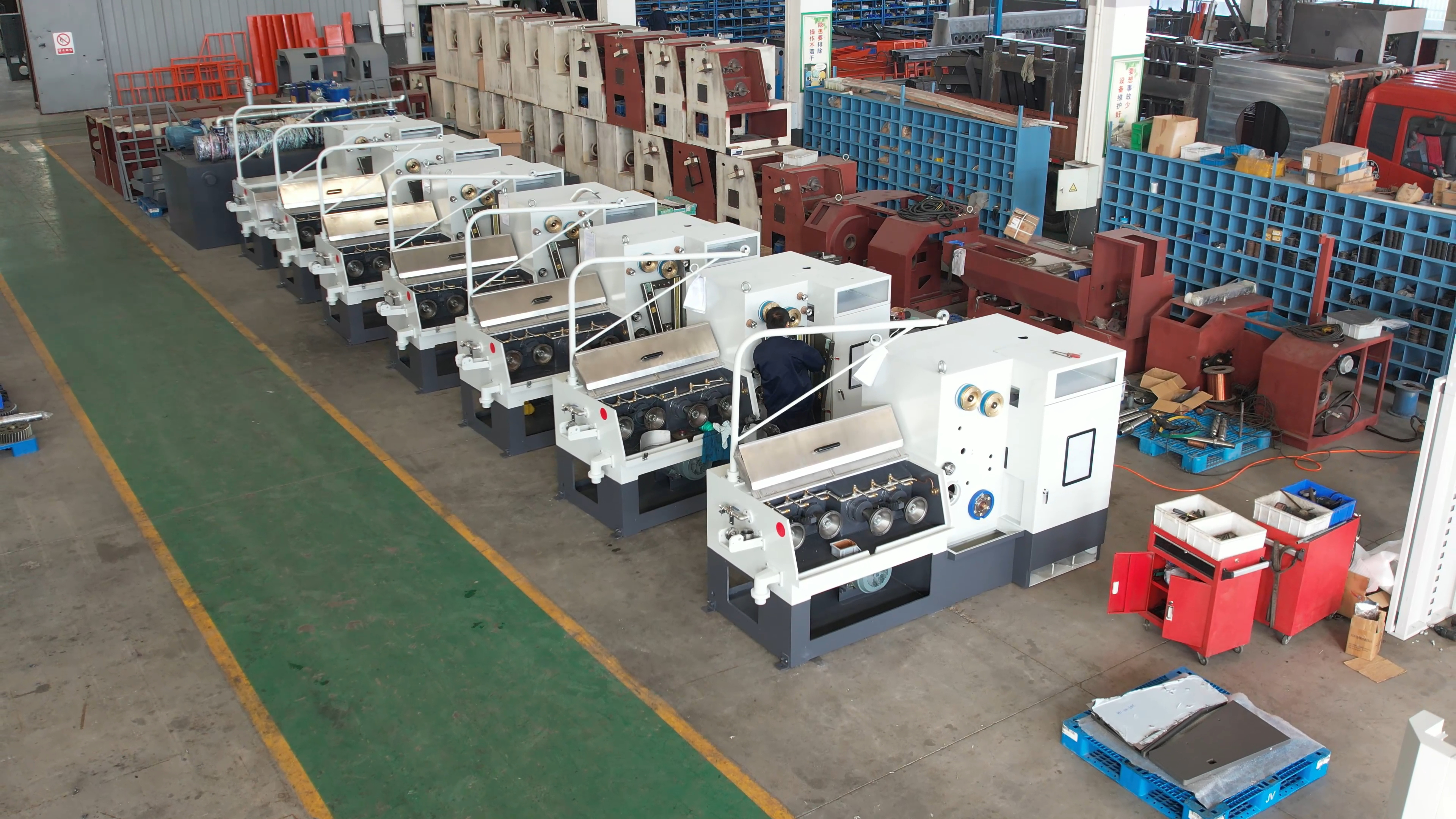
Assembly workshop: build-stage evidence such as frame welding, capstan assembly and cabinet wiring is available for inspection before shipment.
Where the specification sheet stops and evidence begins
Published catalogues converge. Inlet and outlet diameter, maximum speed, die count and annealing power are written in the same format by every manufacturer, and within a given wire range they are broadly comparable. Build detail is where they diverge, and it is also where most of the cost, service life and acceptance risk sit.
A practical way to evaluate a supplier is to ask for four categories of physical data before the technical discussion goes any further:
First, structural data — frame type, machine dimensions, net weight. Second, wire-path data — capstan material, tier count, final capstan design, and whether the die pedestal can be adjusted to capstan size. Third, interface data — spool standard, take-up capacity, clamping method, traversing width. Fourth, control data — cabinet dimensions, drive and annealing ratings, and the brands used for control components.
All four categories appear in the published parameter lists of the models discussed below, which means a buyer can compare them line by line at quotation stage instead of discovering them during commissioning.
The frame: welded steel plate, cast construction, and what the numbers mean
Frame construction is the first thing that can be checked physically, and it is stated model by model.
The 22DTA fine wire drawing machine uses a frame welded by steel plate, with all transmission by timing belts. Its machine dimension is 3500L × 1600W × 1700H mm and its net weight is 3500 kg. The 24-2DT fine wire machine also uses a steel-plate welded frame, with the drawing section driven by timing belts and other sections by flat belts. The 20-4DT multi-wire machine specifies a steel plate welded structure, with the drawing section on timing belts. The 14DT uses a welded frame in Q235 steel plate at 2600L × 1600W × 1700H mm and 3500 kg net, while the 24DT is welded steel plate at 2100L × 1600W × 1700H mm and 3000 kg net.
Not every model in the range is welded. The 24DW and 26DW fine wire machines use a cast frame, at 2500 kg and 2000 kg respectively. The 17-2DST intermediate machine is likewise described as casted in its main machine structure.
The 9DST intermediate wire drawing machine is specified as steel construction with a two-shaft horizontal arrangement. Its published parameter list covers the drawing envelope and the utility requirements rather than a shipping weight: inlet Ф2.5–Ф3 mm, outlet Ф1.0–Ф2.8 mm, maximum mechanical speed 1200 m/min, nine dies (customer self-provided, Ф28 mm × 15 mmT or Ф25 mm × 15 mmT), a surface reduction of 19.5% from die No.1 to No.8 and 16% at die No.9, fully immersing lubrication at 150 L/min, an AC 55 kW induction drive motor, an AC 11 kW spooler motor, servo traversing with limit detection switch, and a sliding safety door.
Why weight and frame type belong in a buyer's comparison: they are two of the few attributes that can be confirmed on the factory floor before acceptance, and they set the requirements for foundation, lifting and floor loading. A 3500 kg machine and a 2000 kg machine are not interchangeable in an existing building without a civil check.
Capstans and die base: where wire guidance is actually decided
The capstan is the part of the machine the wire touches most, and the published data is unusually specific about it.
On the 22DTA, capstans are ceramic, arranged as four 10-tier capstans plus one single-tier capstan for final drawing with an extra keyslot. The die set is 22 dies, with die No.1 independent and dies No.2–21 in cast iron, and the pedestal can be adjusted according to the capstan. Surface reduction runs at 15% from die No.1 to No.21 and 8% at die No.22.
On the 24-2DT, capstans are ceramic coated, with four 11-tier capstans and one single-tier capstan for final drawing. Its 24 dies per line follow a 13% reduction from No.1 to No.23 and 8% at No.24, and the pedestal is again adjustable to capstan size.
The 20-4DT multi-wire machine uses ceramic coated aluminium capstans in a four-tier arrangement of four 10-tier capstans, including two final drawing capstans, with matching ceramic coated aluminium pulleys. Its 20 dies per line run 15% reduction to No.19 and 8% at No.20.
Elsewhere in the range the material changes: 25-16DT and 25-24DT use zirconia drawing rings of 100 mm with 8 grooves (12 grooves on the 25-24DT), the 17-2DST uses zirconia capstans up to Ф280 mm, the 14DT uses chromium oxide with two 12-tier capstans plus a single-tier final capstan, and the 14D uses tungsten carbide capstans of Ф316 mm with a Ф268 mm final capstan.
Tier count is not a cosmetic detail. It determines how many passes are spread across each capstan and therefore how the reduction sequence is distributed between dies. When a buyer compares two machines with the same 22 or 24 die count but a different capstan tier arrangement, they are comparing two different wire paths.
| Model | Type | Frame | Capstan | Spool / take-up | Cabinet (L×W×H) |
|---|---|---|---|---|---|
| 22DTA | Fine wire drawing | Welded steel plate | Ceramic; four 10-tier + one single-tier final | DIN200/250 (per customer), 25 kg | 1000×800×2000 mm |
| 24-2DT | Fine wire drawing, 2-wire | Welded steel plate | Ceramic coated; four 11-tier + one single-tier final | Customized spool, 25 kg × 2, pneumatic double-bobbin | Not stated in published parameters |
| 20-4DT | Multi-wire, 4-wire | Steel plate welded | Ceramic coated aluminium; four 10-tier incl. two final | Customized bobbin; 25 kg × 4 or max 500 kg × 1 (QD630E) | Not stated in published parameters |
| 24DT | Fine wire drawing | Welded steel plate | Ceramic coated; four 11-tier + one single-tier final | Spool OD DIN250 | 1000×800×1800 mm |
| 14DT | Fine wire drawing | Welded Q235 steel plate | Chromium oxide; two 12-tier + one single-tier final | Spool Ф300, 40–60 kg | 1000×800×1800 mm |
| 9DST | Intermediate wire drawing | Steel construction, two-shaft horizontal | Capstan material not stated in published parameters | Not stated in published parameters | Not stated in published parameters |
Build attributes as published per model. Where a value is not in the published parameter list, it should be requested as a dimensioned drawing rather than assumed.
Protection covers: what an operator can see without opening a guard
Cover design is a low-cost item that reveals how seriously a build has been thought through, and it is described consistently across the fine wire range.
On the 22DTA, the protection cover is a grille for the transmission area, stainless steel plate for the drawing area, and a sealed cover with three inspection windows for the spooling area. The same three-part arrangement appears on the 24DT, 14DT, 14D, 24DW and 26DW. The intermediate 9DST and 17DST use a sliding safety door instead.
The practical value of the inspection windows is diagnostic: spooling faults — crossed winds, tension drift, a spool running off-centre — can be spotted without breaking the seal on the spooling area, which is where most minor stops originate.
Braking is the other operator-facing detail, and it varies. The 22DTA uses a 10 kg-m magnetic brake and the 14DT a 20 kg-m electric magnetic brake. The 24-2DT and 20-4DT brake through a brake motor that stops the machine automatically on power cut-off, without requiring a UPS. The 26DW goes further and includes a built-in UPS power back-up system for the brakes in case of electricity failure.
Take-up, spool and clamping: the real customization core
Most customization conversations start at the take-up, because that is where the machine meets the rest of the plant. Published data shows four different take-up philosophies in one range.
The 22DTA takes spools of outer diameter DIN200/250 according to customer requirements, with a receiving capacity of 25 kg, single-bobbin loading fixed with a screw and a loading/unloading cart, swing-arm weight balance with automatic spooling tension revision, and a traversing system driven by a 110 W synchronizing motor on slide-rail bearings with a maximum traversing width of 270 mm.
The 24-2DT goes further on customization: spool dimension is fully customized, receiving capacity is 25 kg × 2, loading and unloading is a double-bobbin pneumatic take-up, traversing is step-motor controlled with adjustable speed, tension is sensor-based, and pulleys are ceramic coated aluminium.
The 20-4DT offers the widest choice in the range: bobbin size customized to requirement, with either a four-bobbin spooler at 25 kg × 4 or a single QD630E bobbin at up to 500 kg, both on pneumatic take-up, with a tension sensor and an 11 kW single-bobbin spooling motor.
Where a shaftless arrangement is required, the 17-2DST intermediate machine is specified with a pneumatic take-up machine without shaft, a maximum take-up weight of 500 kg, bobbin sizes of Ф500 mm or Ф630 mm or as required by the client, PID displacement detection with automatic control, a pneumatic swing-arm detection system and pneumatic tension adjustment.
For buyers, the take-up question comes down to three inputs: the spool standard already used downstream, the maximum spool weight the crane and operator can handle, and whether the reel needs to be loaded without lifting onto a shaft. Those three answers narrow the model list faster than any speed specification.
Inside the electrical cabinet
Cabinet size is published for several models, which makes floor planning and cable routing verifiable before the machine arrives. The 22DTA cabinet is 1000L × 800W × 2000H mm; the 24DT and 14DT cabinets are 1000L × 800W × 1800H mm. The 200 mm height difference matters in a low-bay building or where cable trays are already fixed.
Component sourcing is stated in general terms across the range: electric control parts made in China and Taiwan or overseas, top-class brand. The 24DT is more specific, naming OMRON relays and LG switches. For a buyer, a named component list is worth requesting at order stage, because spare-part availability locally often decides downtime more than the component's origin does.
Power and drive data is also published. The 22DTA uses an 18.5 kW (25 HP) drive motor and 2.2 kW (3 HP) spooling motor under AC frequency converter control, with DC three-section annealing at 60 V, 600 A maximum and 36 kVA. The 24-2DT uses a 22 kW drive with two 2.2 kW spooling motors and DC four-section annealing at 70 V, 600 A and 42 kVA. The 20-4DT uses a 37 kW main drive, 3.7 kW × 4 plus 11 kW × 1 spooling, and 84 kVA DC annealing at 70 V and 1200 A maximum. The 9DST runs an AC 55 kW induction drive motor with an AC 11 kW spooler motor.
Voltage is normally treated as a customization item rather than a fixed value: the 22DTA is supplied at three-phase 380 V 50 Hz made according to customer requirements, the 24-2DT at three-phase 415 V 50 Hz, and the 20-4DT at three-phase 380/415 V 50 Hz, customizable. The 9DST publishes a supply tolerance envelope of AC 3 × 380 V ±10%, single-phase 220 V ±10% and 50 Hz ±2%.
What customization actually changes — and what it does not
The manufacturer offers OEM and ODM production with customization of logo, language, voltage, motor and frequency inverter. Beyond that list, published parameters describe body colour as per customer requirements on the multi-wire models, spool dimension as customized on the 24-2DT and 20-4DT, bobbin size as customized on the 20-4DT, and power source as made according to customer requirements on several fine wire models.
What customization does not change is just as important. Across the fine and multi-wire range, drawing dies are customer self-provided. That is a real boundary: die supply, die quality and die inventory remain the buyer's responsibility, and the published efficiency figures are explicitly conditional on wire quality, die quality, lubricating oil quality, reel quality and operator proficiency.
The lubrication system carries a similar boundary. On the 22DTA, 24-2DT, 20-4DT and 14DT the spray-type lubrication system is rated at 40 L/min without a water pump and tank, with independent lubrication pipes for the first and last die. The buyer supplies the pump and tank. The 9DST, by contrast, is specified for fully immersing lubrication at 150 L/min.
Commercial parameters are stated as well: minimum order quantity of one set, monthly production capacity of 45–50 sets, and a typical lead time of 50–90 days. Quality control is a 100% pre-shipment test on each finished machine, and after-sales support comprises remote technical support with a one-year warranty.
A pre-shipment acceptance checklist
Because the build data is specific, it can be turned directly into an acceptance list. The items below are drawn from published parameters and can be checked physically or against documentation before the machine leaves the factory.
| Check item | What to verify | Published reference |
|---|---|---|
| Frame and welds | Frame type matches the order (welded steel plate or cast), dimensions and net weight confirmed | 22DTA 3500×1600×1700 mm / 3500 kg; 24DT 2100×1600×1700 mm / 3000 kg; 24DW cast, 2500 kg |
| Capstan count and material | Tier count, number of final drawing capstans, keyslot on the final capstan | 22DTA: ceramic, four 10-tier + one single-tier final with extra keyslot |
| Die pedestal adjustment | Pedestal can be adjusted according to capstan size; die seat dimensions match supplied dies | Stated on 22DTA, 24-2DT, 20-4DT, 24DT, 14DT, 14D, 17DST |
| Protection covers | Grille on transmission area, stainless steel plate on drawing area, sealed spooling cover with three inspection windows | Standard description on 22DTA, 24DT, 14DT, 14D, 24DW, 26DW |
| Take-up and clamping | Spool standard, clamping method, maximum spool weight, traversing width | 24-2DT double-bobbin pneumatic, 25 kg × 2; 17-2DST shaftless pneumatic, max 500 kg |
| Electrical cabinet | Cabinet dimensions, component brands, drive and annealing ratings against the order | 22DTA 1000×800×2000 mm; 24DT and 14DT 1000×800×1800 mm |
| Utility envelope | Water pressure, temperature and flow; compressed air pressure and dew point; supply voltage tolerance | 9DST: water 0.2–0.4 MPa, ≤25 °C, pH 7–8, 420 L/min; air 0.6–0.7 MPa, dew point −25 °C, 200 L/min |
| Test and documentation | 100% pre-shipment test record; ISO 9001 and CE certificate numbers verified | ISO 41625QT0833R0; CE-JL26020401-AL-MD |
What the certificates actually cover
Two documents underpin the build evidence, and both have a defined scope that buyers should read against the order.
The quality management system certificate is numbered 41625QT0833R0, issued by Zhejiang Standard Service Certification Co., Ltd against GB/T19001-2016 / ISO9001:2015, with an issue date of 2025-08-27 and an expiry of 2028-08-26. Its stated scope covers wire drawing machines, stranding machines and annealing machines.
The CE verification of conformity is numbered CE-JL26020401-AL-MD, issued by ICG, referenced to EN ISO 12100:2010 and EN 60204-1:2018/A1:2025, issued 2026-02-10 and valid to 2031-02-09 for the EU market. Its model scope explicitly lists 22DTA, 20-4DT, 24-2DT, 9DST, 17DST, 25-16DT, WDF450-13DT and other models in the range.
For a buyer, the model list is the operative part. The certificate covers listed models and listed standards; if a configuration moves substantially outside that scope — a different motor family, a different control architecture, a different voltage regime — the question of whether the existing documentation still applies should be asked in writing rather than assumed.
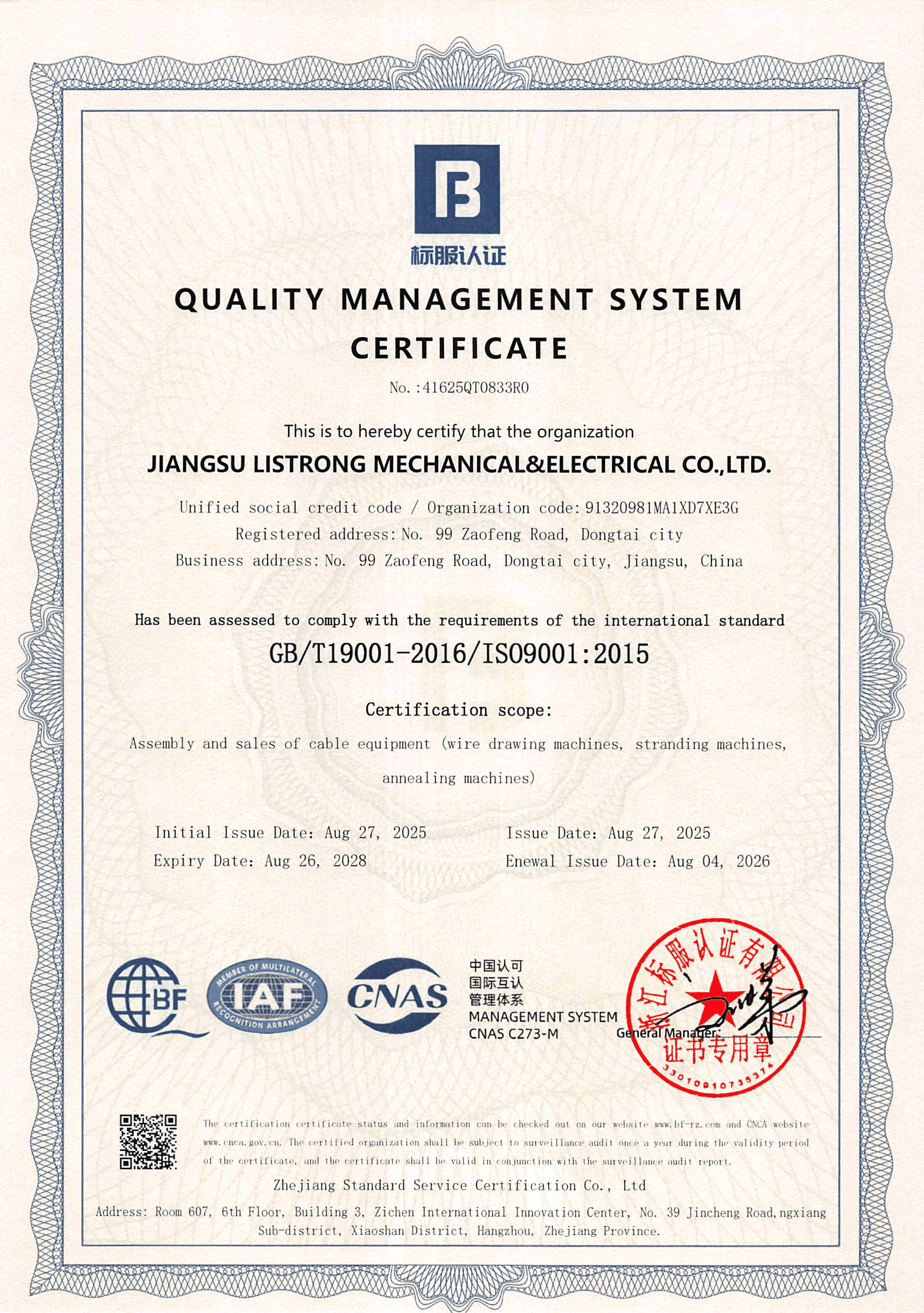
ISO 9001 certificate 41625QT0833R0, scoped to wire drawing machines, stranding machines and annealing machines.
Limits, boundaries and what the record does not show
A credible evaluation includes the gaps. Several are visible in the published material itself.
Not every model has a full dimensional record. The 9DST publishes its build type, drawing envelope, drive ratings, traversing system and utility requirements, but not its shipping weight, footprint or cabinet dimensions. A buyer planning foundations, lifting or bay height needs a dimensioned drawing from the supplier for that model rather than a value extrapolated from a heavier fine wire machine.
Efficiency figures are reference values. They are stated as such in the parameter lists and depend on wire quality, die quality, lubricating oil quality, reel quality and operator proficiency. A machine that meets its published speed on one plant's copper rod may not reproduce it on another's.
Case results are single-client records, not guarantees. The published case record covers one set of multi-wire drawing machines installed in Iran with a two-year project duration and two sets in North Macedonia with a one-year duration. The reported outcome includes an energy saving of 35%, reduced labour cost, stable operation and zero major failures, with the highlight being full automatic operation and the removal of inconsistent wire tightness. These are that client's reported results in that client's plant; they are not a performance commitment for a different installation.
Utilities are prerequisites, not accessories. The 9DST requires cooling water at 0.2–0.4 MPa, ≤25 °C and pH 7–8 at 420 L/min, explicitly free of suspended solids, minerals, metal impurities and corrosive substances, plus compressed air at 0.6–0.7 MPa with a −25 °C dew point at 200 L/min. Fine wire models with spray lubrication require the buyer to provide the pump and tank.
Schedule is a constraint. With 45–50 sets of monthly capacity and a 50–90 day lead time, customization requested late in the order cycle tends to move the delivery date rather than the specification.
Market context: why build documentation is becoming a buying criterion
The wire drawing machine market was valued at USD 3.8 billion in 2025 and is forecast to reach USD 6.1 billion by 2034 at a compound annual growth rate of 5.47% for 2026–2034, according to Dataintelo's 2026 market research report. Published estimates diverge by scope — a narrower 2025 figure of USD 1.37 billion from Insight Partners and a 2026 figure of USD 2.4 billion from IndexBox appear in the same body of research — which is consistent with differences in whether spare parts, dies and service revenue are counted.
For procurement, the more useful signal is not the headline number but the direction: steady expansion driven by electrification and lightweighting, which concentrates demand on high-speed fine wire capability. When fine wire capacity is the contested segment, buyers start asking for evidence they can inspect rather than performance figures they cannot. That is where frame type, capstan material, tier count, take-up configuration and cabinet specification move from technical annex to negotiation lever.
Trade classification is worth noting alongside this. Machines of this type fall under HS code 8463.30.00 for machine tools working metal wire without removing material, which is the code that customs documentation and most import duty schedules will reference.
Future outlook
Two developments are likely to shape how wire drawing machines are evaluated over the next few years.
The first is documentation-led procurement. As fine wire demand grows from electrification and electronics, buyers comparing machines from several countries need comparable evidence. Build attributes — frame construction and mass, capstan material and tier count, take-up clamping, cabinet dimensions and named component brands — are the part of the specification that can be compared without a site visit and verified during a factory acceptance test.
The second is the shift from stated performance to measured performance. Machine-level operating data such as power consumption, actual line speed, annealing temperature and scrap rate is not yet part of the standard published record for this equipment category. Until it is, the most reliable proxy remains documented build data plus a witnessed pre-shipment test, rather than a claim about efficiency.
FAQ
What physical evidence should a buyer check on a wire drawing machine before shipment?
Frame type and net weight, capstan material and tier count, whether the die pedestal adjusts to capstan size, the protection cover arrangement, the take-up clamping method and spool standard, and the electrical cabinet dimensions with component brands. For example, the 22DTA is specified with a steel-plate welded frame, ceramic capstans in four 10-tier plus one single-tier final arrangement, a 25 kg spool capacity, a grille/stainless steel/sealed cover set with three inspection windows, and a 1000×800×2000 mm cabinet.
Do capstan material and tier count actually differ between models in the same range?
Yes. Within the published range, the 22DTA uses ceramic capstans in four 10-tier plus one single-tier final configuration; the 24-2DT uses ceramic coated capstans in four 11-tier plus one single-tier final; the 20-4DT uses ceramic coated aluminium capstans in four 10-tier including two final drawing capstans; the 14DT uses chromium oxide with two 12-tier capstans; the 14D uses tungsten carbide; and the 25-16DT and 25-24DT use zirconia drawing rings of 100 mm with 8 and 12 grooves respectively.
What can be customized on a wire drawing machine order?
The manufacturer offers OEM and ODM production with customization of logo, language, voltage, motor and frequency inverter. Published parameters also list body colour as per customer requirements, spool dimension as customized on the 24-2DT and 20-4DT, bobbin size as customized on the 20-4DT, and power source as made according to customer requirements on several fine wire models. Drawing dies are customer self-provided across the range.
How is the take-up configured across fine wire and multi-wire models?
The 22DTA uses a single bobbin fixed with a screw with a loading cart, DIN200/250 spool and 25 kg capacity. The 24-2DT uses a double-bobbin pneumatic take-up with customized spool dimensions and 25 kg × 2 capacity. The 20-4DT offers a four-bobbin spooler at 25 kg × 4 or a single QD630E bobbin up to 500 kg, both pneumatic. The 17-2DST uses a pneumatic shaftless take-up with a maximum take-up weight of 500 kg and bobbin sizes of Ф500 mm or Ф630 mm.
What does the CE certificate cover, and does customization affect it?
The CE verification of conformity CE-JL26020401-AL-MD is issued by ICG against EN ISO 12100:2010 and EN 60204-1:2018/A1:2025, valid from 2026-02-10 to 2031-02-09. Its model scope lists 22DTA, 20-4DT, 24-2DT, 9DST, 17DST, 25-16DT and WDF450-13DT among others. Configurations that change the motor family, control architecture or voltage regime should be checked against that listed scope in writing rather than assumed to remain covered.
What are the order, capacity and lead-time parameters?
Minimum order quantity is one set, monthly production capacity is 45–50 sets, and typical lead time is 50–90 days. Quality control is based on a 100% pre-shipment test of each finished machine, and after-sales support comprises remote technical support with a one-year warranty.
Tem questões ou precisa de mais detalhes?
Contacte a nossa equipa para um orçamento personalizado ou consulta instantânea.
Solicitar orçamento
Preencha o formulário abaixo e a nossa equipa entrará em contacto com uma proposta personalizada.
Chat direto do WhatsApp
Prefere conversar em tempo real? Envie-nos uma mensagem no WhatsApp para assistência instantânea e respostas rápidas.
- Obter orçamento personalizado
- Partilhar fotos ou documentos
- Discuta as suas necessidades diretamente
Geralmente responde em 5–30 minutos durante o horário de expediente.