
Wire Harness Terminal, Bracket & Fuse Box Specs: CNDO FAQ
Wire Harness Terminal, Bracket & Fuse Box Specs: CNDO FAQ
Automotive wire harness connector procurement has moved from catalogue selection to specification verification. The global automotive wiring harness market was estimated at USD 89.54 billion in 2025 (Precedence Research), and Asia Pacific accounted for a 40.89% share of that total, with China contributing 62% of regional revenue (Fortune Business Insights). Within that volume, the components that most often slow down an evaluation are rarely the headline assemblies. They are the small, high-consequence parts: the terminal that carries the current, the bracket that holds the routing in place, and the fuse box that protects the battery circuit.
This reference answers the technical and procurement questions raised most often about three CNDO components: the DOE24022 automotive wiring harness terminal, the DOCB24001 plastic harness support bracket, and the DOBXS4-1A / DOBXS5-1F battery fuse box. CNDO is the product brand of Zhejiang Daou Electronics Co., Ltd., an enterprise focused on the research and development of auto wire harness and battery terminals and auto fuse boxes, based in Puqi Characteristic Industrial Zone, Yueqing City, Zhejiang Province, China. Every answer below stays inside the published specification language for these parts. Where a specification does not state a value, this article says so rather than filling the gap.
Why specification questions dominate the evaluation stage
At the evaluation stage, the buyer is no longer asking whether a supplier can produce a part. The question is whether the documented behaviour of that part matches the zone it will be installed in. Three issues recur in that review.
- Voltage assumptions. A platform may run 12V, 24V or a mix across circuits. Treating one rating as universal is the fastest route to a rejected sample.
- Flame rating confusion. UL94 grades describe different behaviours, and a component may be quoted at more than one grade depending on configuration.
- Sealing assumptions. A sealed, waterproof and dustproof structure in a product description is not the same statement as a numeric IP rating in a test report, and the two are frequently treated as equivalent during comparison.
Each of the three components below resolves at least two of these points directly in its published parameters. One point — a numeric ingress protection rating for the fuse box — is not stated in the published parameters and has to be requested as a document. Knowing which is which prevents the two most expensive evaluation errors: accepting a part on an assumption, and rejecting a part that actually fits.
| Component | Model | Type | Material | Published ratings |
|---|---|---|---|---|
| Terminal | DOE24022 | Automotive wiring harness terminal | Pure copper / red copper / copper alloy / tin-plated copper / nickel-plated copper / gold-plated copper | Rated voltage 12V / 24V DC, up to 48V DC for special models; rated current varies by size (5A / 10A / 20A / 50A / 100A / 200A) |
| Support bracket | DOCB24001 | Plastic harness support bracket | PA66 / PA66 GF30 | Flame rating UL94-V0 / UL94-V2; operating range -40°C to +125°C |
| Battery fuse box | DOBXS4-1A, DOBXS5-1F | Battery fuse box | PA66 / copper | Working voltage 12V DC / 24V DC; ambient -40°C to +125°C |
Terminal DOE24022: material options, plating and voltage ratings
Material and plating are separate selections
The DOE24022 is offered in pure copper, red copper, copper alloy, tin-plated copper, nickel-plated copper and gold-plated copper. Read that list as a configuration menu rather than as a description of one part. The conductive grade establishes the base electrical behaviour; the plating defines the surface condition the terminal will present over its service life. Because each option is listed separately, a purchase order that does not state both material and plating is not specifying the DOE24022 — it is specifying a model family and leaving the actual surface finish open.
Voltage: 12V / 24V DC mainstream, 48V DC by exception
The rated voltage of the DOE24022 is 12V / 24V DC, which the specification identifies as mainstream for vehicles. For special models, the terminal is rated up to 48V DC. The commercial implication is straightforward: a 48V DC requirement is a special-model condition and should be declared at the enquiry stage rather than inferred from a general datasheet. When quotations are compared, it is worth checking whether the alternatives are quoting 12V / 24V DC performance while the actual circuit requirement sits at 48V DC.
Current rating varies by size
Rated current is not a single figure for this model. It varies by size, with 5A, 10A, 20A, 50A, 100A and 200A given as examples. A buyer who asks for "the DOE24022 current rating" will not receive one number, because no single number exists for the family. The correct specification practice is to fix the circuit load first, then select the size that carries it, and record both on the drawing so the electrical and mechanical requirements stay linked.
Electrical behaviour in the harness
Contact resistance is specified as low, supporting stable conductivity. Withstand voltage is compliant with automotive wiring harness electrical standards. For the insulated version, insulation resistance is specified as high. These three parameters are the ones most often requested during evaluation because they describe how the terminal behaves rather than what it is made of.
Bracket DOCB24001: flame rating, PA66 GF30 and mechanical behaviour
Flame rating: UL94-V0 / UL94-V2
The DOCB24001 carries a flame rating of UL94-V0 / UL94-V2 and is compliant with automotive flame retardant standards. UL94-V0 and UL94-V2 are different grades within the same vertical-burning test family, not interchangeable labels. Where two grades appear in a specification, the applicable grade is determined by the specific part number and configuration rather than by the model family as a whole. Procurement teams should ask for the grade that applies to the exact part being quoted and record it on the drawing, so that a later configuration change does not silently change the flame performance of the assembly.
Why PA66 and PA66 GF30
The bracket is produced in PA66 or PA66 GF30. PA66 is a polyamide widely used for under-hood polymer parts. The GF30 designation indicates glass-fibre reinforcement, which is generally used in automotive polymer components to raise stiffness and improve dimensional stability under thermal and mechanical load. For a harness support bracket, that behaviour supports the component's actual job: keeping routing in position under vibration rather than acting as a structural member. The specification should be read as a support-function claim, and the bracket should not be treated as a load path in the design.
Temperature, weather and vibration envelope
Operating temperature range is -40°C to +125°C, and engine bay versions can withstand higher transient temperatures. Weather resistance covers UV exposure, ageing and salt spray, together with resistance to engine oil, coolant and cleaning agents. Vibration durability is compliant with vehicle vibration durability test standards. Taken together, these parameters describe a part intended for continuous exposure rather than for protected interior routing only.
Boundary conditions buyers should record
- The flame rating has two grades; the applicable one must be confirmed per part number.
- The stated temperature range is an operating range. Engine-bay installations should specify the engine bay version rather than the standard variant.
- Flame retardancy describes material behaviour. It does not replace routing clearance and thermal validation at assembly level.
- PA66 GF30 is a material option, not a default. The chosen grade should appear on the drawing.
Fuse box DOBXS4-1A / DOBXS5-1F: working voltage, sealing and fuse architecture
Working voltage and busbar construction
The working voltage of the DOBXS4-1A and DOBXS5-1F is 12V DC / 24V DC. The main busbar uses high conductivity copper or brass with a tin, nickel or zinc surface plating. The material listing for the assembly is PA66 / copper. Ambient operating temperature is -40°C to +125°C, and installation uses fixed mounting holes with a direct battery positive connection — a layout that removes intermediate interfaces between the battery post and the protective device.
Two-tier fuse architecture
The main fuse is a bolt type mega fuse. Auxiliary fuses are standard blade fuses, with 5A, 10A, 15A, 20A and 30A options. That two-tier structure separates battery-level protection from branch-circuit protection, which is what allows the same fuse box to serve different load maps without changing the enclosure. For a buyer evaluating a multi-variant programme, the practical consequence is that auxiliary fuse selection can be differentiated per vehicle variant while the main protective device, busbar and housing specification remain common.
Sealing: what the specification states, and what it does not
The shell is described as flame retardant plastic with a sealed cover and a waterproof and dustproof structure. What the published parameters do not state is a numeric IP rating for this fuse box. That distinction is worth holding onto, because elsewhere in the same portfolio numeric ratings are used: the DOH0001-1 housing is specified at IP67, and the D520023 three-way tube conduit connector is specified at IP66 / IP67 with sealing gaskets. The fuse box specification describes a sealed structure rather than quoting an ingress protection number.
For a programme that requires a documented IP value at the fuse box location, the right action is to request the corresponding verification document as part of the technical file. That is a documentation step, not a performance doubt — and it is significantly cheaper to complete during evaluation than after a validation failure on a delivered batch.
Fitting the three components into the wider harness

The same portfolio covers the parts that interface with these three components. The DOBP22001 and DOBN22006-D5 battery terminals are SAE top post type for 12V automotive applications, made of brass, with a positive post diameter of 19.05 mm and a negative post diameter of 17.46 mm in tapered form, an M8 thread, a maximum current of 500A, a tightening torque of 8 N·m and tin plating. The DOH0001-1 wire harness housing is produced in PA / PBT, rated IP67, operating from -40°C to +125°C and specified as waterproof, dustproof, oil-resistant and resistant to acid and alkali. The D520023 three-way tube conduit connector is made of PA66, operates continuously from -40°C to +120°C with a short-term peak temperature of 150°C, carries IP66 / IP67 with sealing gaskets, and resists engine oil, mineral oil, grease, weak acid and alkali and partial solvents, with UV, hydrolysis and ageing resistance.
For an evaluation-stage buyer, the practical value is interface consolidation. Every additional supplier in a harness assembly adds a specification that has to be reconciled at the boundary between parts. Covering terminal, bracket, fuse box, housing and conduit connector from one production base reduces the number of those boundaries and, with them, the number of documents that must be cross-checked before a drawing is released.
Specification-first sourcing compared with catalogue selection
| Evaluation dimension | Catalogue selection | Specification-first evaluation |
|---|---|---|
| Voltage fit | One rating assumed to cover the platform | 12V / 24V DC stated; 48V DC declared as a special-model condition |
| Material and plating | Single grade assumed for all circuits | Six listed material and plating configurations for the DOE24022 |
| Flame performance | One grade assumed | UL94-V0 / UL94-V2 stated for the DOCB24001; grade confirmed per part number |
| Sealing | Descriptive sealing treated as equivalent to an IP rating | Sealed, waterproof and dustproof structure stated; numeric IP rating requested separately |
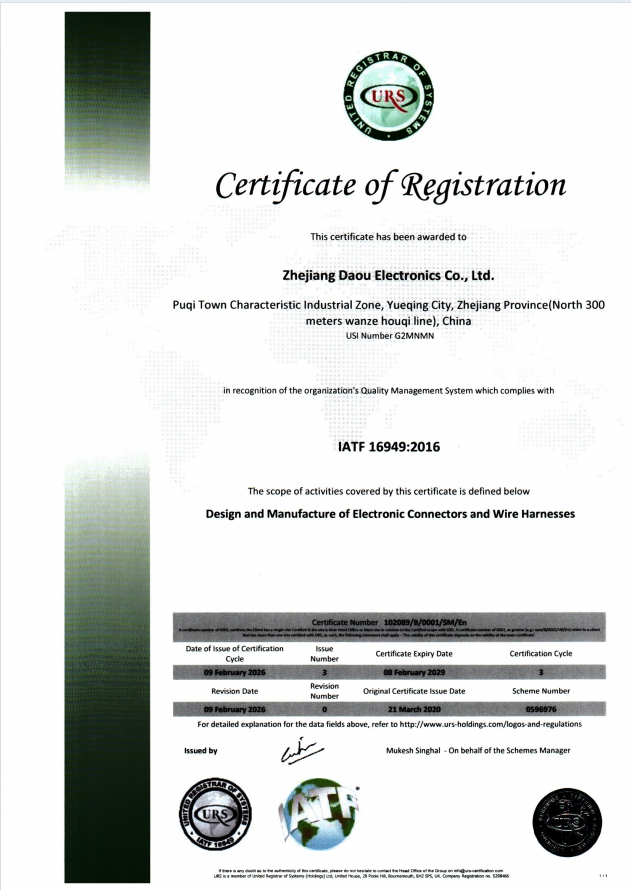
| Quality system | General quality claim | IATF 16949:2016, certificate 0596976, issued by URS, scope: Design and Manufacture of Electronic Connectors and Wire Harnesses, valid to 2029-02-08 |
| Supply parameters | Capacity not stated | 750,000 units per month; lead time 7–15 days; minimum order quantity 2 units |
The specification-first approach is not free. It adds review steps: per-part-number grade confirmation, document requests and drawing updates. For a low-volume purchase — the minimum order quantity for these components starts at 2 units — the additional documentation effort may not be proportionate to the order value. The approach pays for itself where the component sits in a safety-relevant or warranty-relevant circuit, or where the same specification will be reused across several vehicle programmes.
Market context: why specification transparency is becoming a buying criterion
The commercial backdrop explains why these questions are being asked earlier. Market estimates for automotive wiring harnesses differ by scope, and the difference is worth noting rather than smoothing over: Precedence Research estimated the global market at USD 89.54 billion in 2025, while Fortune Business Insights placed it at USD 54.88 billion and Global Market Insights at USD 71.2 billion. The divergence reflects different definitions of what the harness market includes, not disagreement about direction.
Growth in adjacent categories is clearer. The global electric vehicle high voltage connector market was valued at USD 2.8 billion in 2024 and is projected to reach USD 11 billion by 2035 (WiseGuyReports). The global two-wheeler wiring harness market was valued at USD 3.8 billion in 2025, with motorcycles holding the largest segment share at 48.6% (Dataintelo). Supplier concentration remains high: Yazaki held the leading position in the global automotive wiring harness market with a 21.4% share in 2025 (Global Market Insights), while TE Connectivity, Amphenol and Molex are the top three global connector manufacturers, with TE Connectivity reporting USD 12.88 billion in sales for 2024 (Bishop & Associates).
The practical reading for procurement is that voltage levels are rising while the number of qualified sources stays concentrated. In that environment, a supplier that documents where its ratings end — rather than presenting a single headline number — is easier to qualify, because the buyer can see exactly which validation step remains open and who is responsible for closing it.
Future outlook
Electrification and energy storage are pushing terminal, bracket and fuse-box specifications into higher-voltage territory. CNDO's customization scope already includes EV high voltage insulation structure alongside housing colour, printing logo, terminal current specification, wire gauge matching, waterproof grade, pin count and packaging solution. As 48V and high-voltage architectures spread across passenger, commercial and two-wheeler platforms, questions about material grade, plating, flame rating and sealing are likely to move earlier in the process — from post-sample review to the RFQ stage.
The direction of travel favours suppliers who publish boundaries. A specification that states 12V / 24V DC with an explicit 48V DC special-model condition tells a buyer more than a datasheet that implies universal coverage, because it defines exactly where an additional engineering conversation is required. That kind of precision is becoming a qualification criterion in its own right, and it is one of the few differentiators in this component category that does not depend on scale.
FAQ
1. What material options are available for the DOE24022 terminal?
Pure copper, red copper, copper alloy, tin-plated copper, nickel-plated copper and gold-plated copper. Material and plating are listed as separate configurations within the same terminal model, so both should be stated on a purchase specification.
2. Does the DOE24022 support 12V or 24V?
Both. The rated voltage is 12V / 24V DC, described in the specification as mainstream for vehicles. For special models the terminal is rated up to 48V DC.
3. What is the current rating of the DOE24022?
Rated current varies by size, with 5A, 10A, 20A, 50A, 100A and 200A given as examples. No single current rating applies to the whole model family.
4. What flame rating does the DOCB24001 bracket carry?
UL94-V0 / UL94-V2, compliant with automotive flame retardant standards. Because two grades are stated, the applicable grade should be confirmed against the specific part number used in the programme.
5. Why is PA66 GF30 used in the DOCB24001?
The bracket is offered in PA66 or PA66 GF30. Glass-fibre reinforcement is generally used in automotive polymer components to improve stiffness and dimensional stability under thermal and mechanical load, which supports the bracket's function of holding harness routing in position. The bracket remains a support component rather than a structural load-bearing member.
6. What temperature range does the DOCB24001 operate in?
-40°C to +125°C, with engine bay versions able to withstand higher transient temperatures. Weather resistance covers UV, ageing and salt spray, as well as engine oil, coolant and cleaning agents.
7. What is the working voltage of the DOBXS4-1A and DOBXS5-1F fuse box?
12V DC / 24V DC, with an ambient operating temperature of -40°C to +125°C and a main busbar of high conductivity copper or brass with tin, nickel or zinc plating.
8. Is the fuse box sealed?
The shell is described as flame retardant plastic with a sealed cover and a waterproof and dustproof structure. The published parameters do not state a numeric IP rating for this fuse box, so programmes that require one should request the corresponding verification document.
9. What fuse types does the fuse box accept?
A bolt type mega fuse on the main circuit, and standard blade fuses on auxiliary circuits with 5A, 10A, 15A, 20A and 30A options.
10. Which quality system certificate covers these components?
IATF 16949:2016, certificate number 0596976, issued by URS, valid until 2029-02-08, with the scope Design and Manufacture of Electronic Connectors and Wire Harnesses.
11. What are the ordering parameters?
OEM production mode; minimum order quantity 2 units; lead time 7–15 days; monthly production capacity 750,000 units; quality control to IATF 16949 standard. Export markets include the United States and European Union.
12. What support is available after delivery?
After-sales services include remote technical guidance, spare parts supply, product parameter documents, and factory audit coordination.
Technical documentation and follow-up
Specification sheets, part-number level flame-grade confirmation and ingress protection verification records for the components discussed above can be requested from Zhejiang Daou Electronics Co., Ltd. Contact: Vicky, jialuzhou101@gmail.com, +86 13645876878 (WhatsApp: +86 13645876878). Company information is published at www.zjdaou.com, and the English-language company brochure is available for download here: Zhejiang Daou Electronics Co., Ltd. company brochure (PDF).