
Wood Coating Line FAQ: Speed, Output and Adjustability
A wood coating line is bought against a throughput number and commissioned against a process window. Those are rarely the same figure, and most procurement questions in this category — how fast, how many, how flexible — are really questions about which of the two a supplier is quoting.
The Wood Coating Line offered by Attractivechina, the industrial brand of Guangdong Chuangzhi Intelligent Equipment Co., Ltd., publishes three figures that buyers frequently read as one: a design line speed of 4000 mm/min, an adjustable speed range of 2000 to 6000 mm/min, and an output of 1422 pieces per 8-hour shift. Attractivechina is a Zhaoqing, Guangdong-based manufacturer of customized automated coating production lines, and it lists wood furniture and musical instruments among its core application industries.
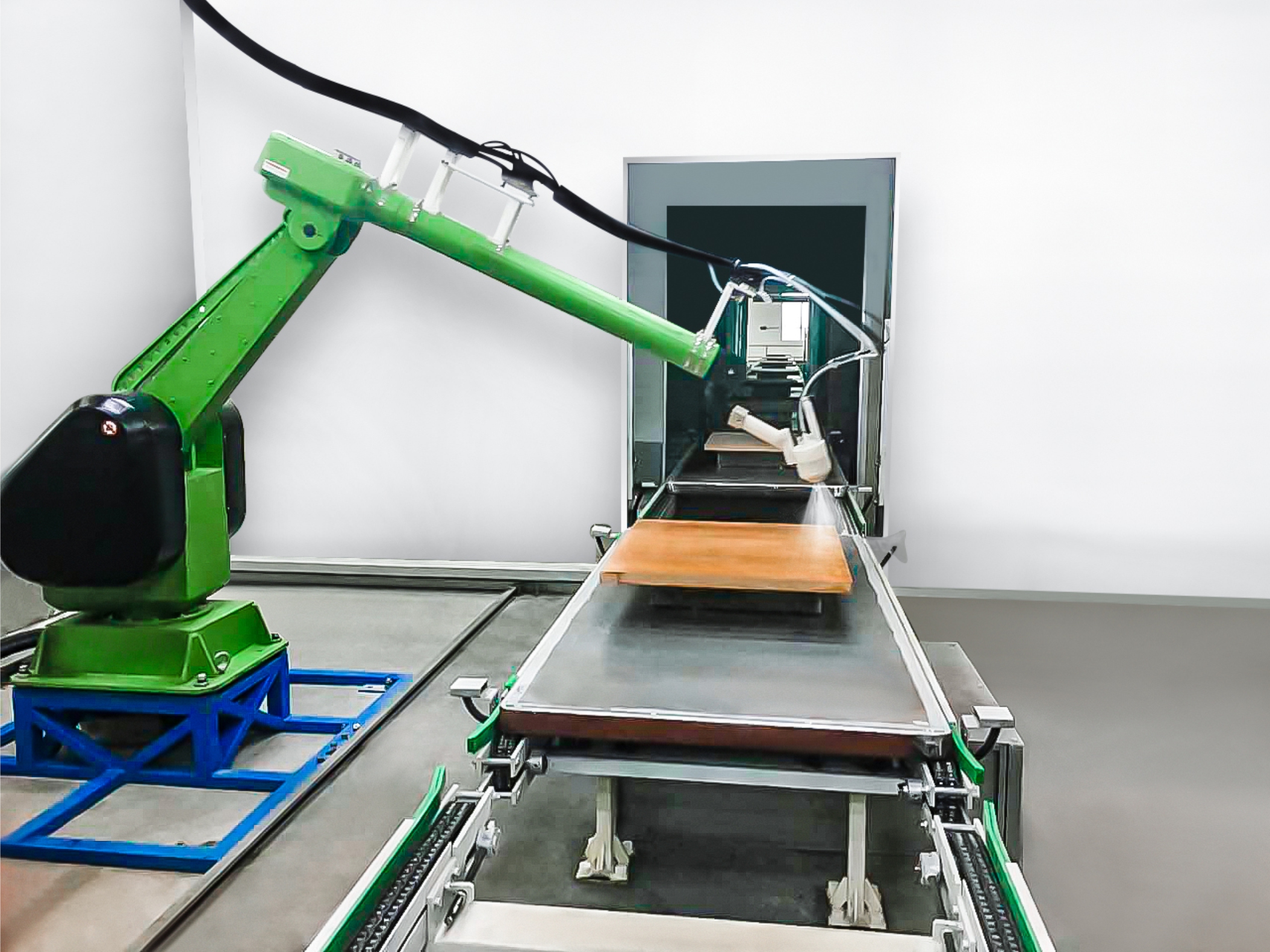
A wood furniture coating line in production configuration. Image: Attractivechina.
Why Speed, Pitch and Shift Output Are Three Different Answers
A conveyor speed figure describes the mechanical design point of the line. Pitch describes how workpieces are spaced along that conveyor. Shift output describes what the complete process yields over a working period. A line can be quoted at 4000 mm/min and still deliver materially different output numbers depending on how densely parts are hung and how long each part must remain in each process zone.
Buyers who convert design line speed directly into a capacity estimate tend to under-plan three things: floor space for loading and unloading, the hanging fixture inventory, and the buffering around the curing stage. The safer approach is to treat each published figure as a separate commitment and to ask which conditions each one assumes.
The Stated Specification, in One Table
The values below are the published specification of the Wood Coating Line (listed as the Wood Furniture Automatic Coating Line, model Wood Coating Line). They are the reference points for every answer in this article.
| Parameter | Stated value |
|---|---|
| Design line speed | 4000 mm/min (2000 mm/min to 6000 mm/min adjustable) |
| Pitch | 300 mm per hang |
| 8-hour output per shift | 1422 pieces per shift |
| Standard workpiece size | 100 (L) × 50 (W) × 1400 mm (H) |
| Maximum workpiece size | 610 × 710 × 1400 mm (H) |
| Workpiece types | Table legs, chair backs, sitting boards, front legs, sitting frames, chairs |
| Workpiece material | Solid wood, MDF |
| Main frame material | Carbon steel |
| Spray booth and pipeline | Stainless steel |
| Energy use | Electricity |
| Applicable industry | Wood furniture and musical instrument industry |
| Named configurations | Guitar, piano, musical instruments, wood beds, dining tables, wood chairs, wood speakers |
Adjustability Is a Process Envelope, Not a Performance Rating
The stated range of 2000 mm/min to 6000 mm/min against a 4000 mm/min design point exists because different products need different exposure times. A slender table leg and a large chair back do not spend the same time in the spray zone or in the curing oven, even when they travel on the same conveyor. Slowing the conveyor lengthens exposure; raising it shortens exposure and increases the number of carriers passing a fixed point over a given period.
Two boundary conditions matter. First, a speed range is a conveyor capability and not a guarantee that any workpiece can be coated at 6000 mm/min with the same finish quality. Coating chemistry, film build and oven settings have to be validated at the selected speed. Second, changing speed affects the whole line rather than the spray booth alone, because the curing stage downstream is designed around a dwell time.
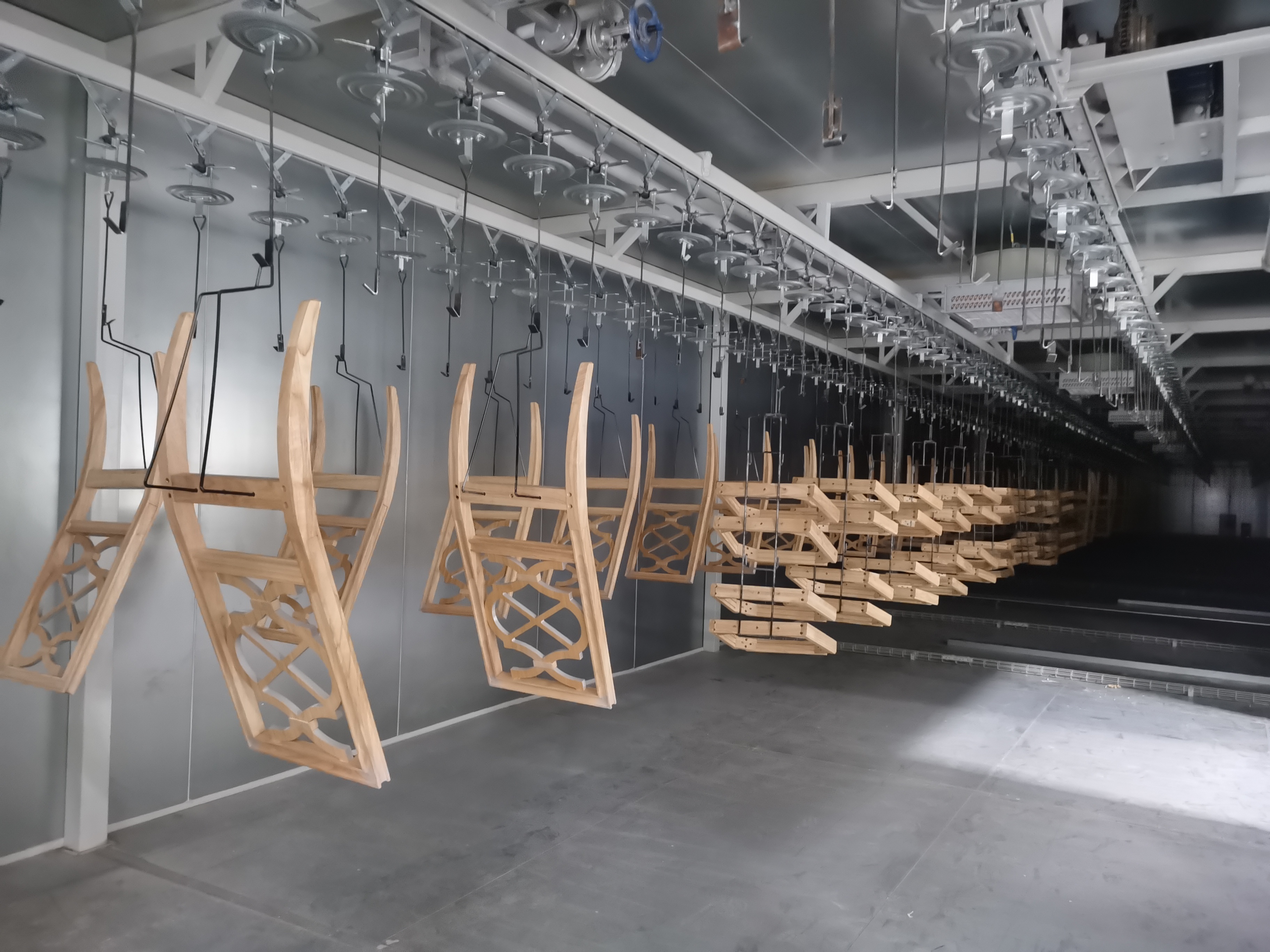
Conveyor speed and hanging density are set independently; the shift output figure reflects both. Image: Attractivechina.
For buyers, the useful question is not whether the range is wide but which points inside it were validated. Ask a supplier to state, for each product family, which speed was validated with which coating system and which curing schedule. Attractivechina describes the operating mode of this type of line as fully automatic continuous operation, performing fully automated PLC intelligent control, robotic spraying and unmanned flexible production — the control layer is what makes a speed change a configured setpoint rather than a manual adjustment.
Pitch: 300 mm per Hang Sets the Rhythm of Loading
The Wood Coating Line is specified at 300 mm per hang, with a standard workpiece height of 1400 mm and a maximum height of 1400 mm. That combination points to vertical hanging, which is the conventional approach for table legs, chair backs, sitting boards, front legs and frames.
Pitch does three things in practice. It determines how many hanging positions exist on a given conveyor length. It sets the clearance between adjacent workpieces. And it sets the loading discipline required at the station. Parts loaded at irregular spacing change the effective pitch, which can affect overspray behaviour and finish consistency. This is one reason companies moving from manual finishing to an automatic wood coating line usually need to redesign hanging fixtures rather than carry over the ones used at the spray bench.
Workpiece Envelope: Where the Line Fits and Where It Stops Fitting
The gap between the standard workpiece size of 100 × 50 × 1400 mm and the maximum size of 610 × 710 × 1400 mm is where most project-fit decisions are made. A shop producing mainly chair components sits close to the standard envelope and can reasonably plan around the quoted shift output. A shop mixing oversized panels or long bed components runs closer to the upper limit, where fewer parts fit within a given conveyor length and effective per-shift output typically falls.
The stated workpiece materials are solid wood and MDF, which matters for process planning: solid wood and MDF behave differently in terms of surface absorption and edge sealing, and a mixed schedule needs coating parameters that hold across both. Buyers should present their actual part mix — not a single sample — when asking a supplier to confirm capacity. The line is described as suitable for the wood furniture and musical instrument industry, with named configurations for guitar, piano and other musical instruments, wood beds, dining tables, wood chairs and wood speakers.
The Stated Output: 1422 Pieces per Shift
1422 pieces per shift is stated for an 8-hour working period against the standard workpiece size. It is a planning figure for the complete line cycle, not a multiplication of conveyor speed by working hours.
Three questions convert it into a reliable production plan. Which workpiece does the figure assume? Is the coating process counted as a single pass or as a multi-coat primer, topcoat and finish sequence? How much time is reserved for loading, unloading, cleaning and schedule changeover? A supplier who answers those three questions is giving a usable capacity commitment. One who repeats the headline number is not.
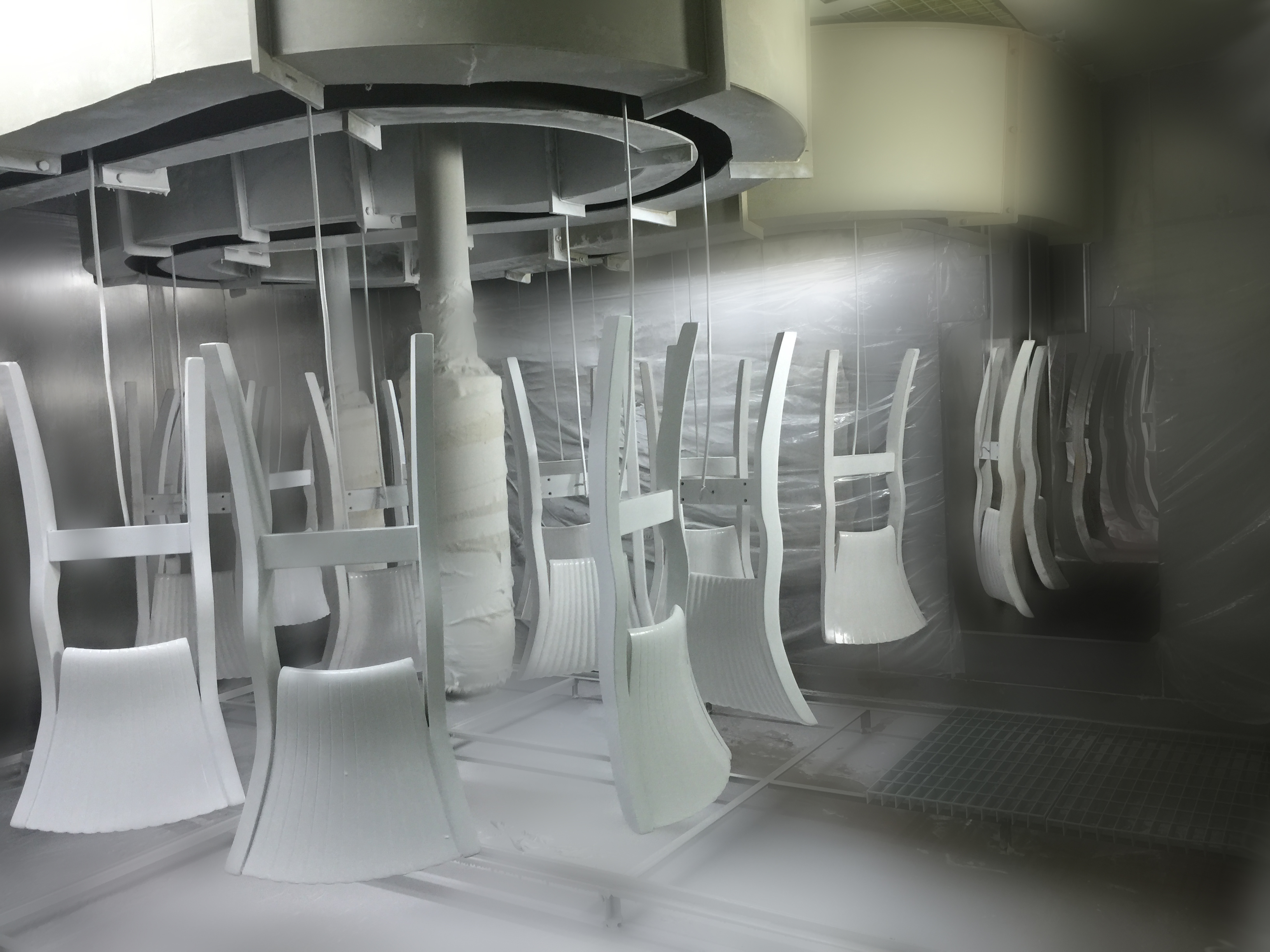
Chair components are a typical high-volume workpiece family for this configuration. Image: Attractivechina.
Project Evidence: What Ten Delivered Wood Lines Showed
Attractivechina's disclosed project record includes 10 complete automatic wood coating lines delivered in China to furniture manufacturers, musical instrument makers, wood product processing factories, and cabinet or wood door producers. The applications cover primer, topcoat and finish spraying for wooden furniture, cabinets, wood doors and instruments including pianos and guitars, with operating periods of 5 to 10 years.
Reported outcomes for that project group: paint consumption reduced by 30%, dust defect rate cut by 90%, production efficiency increased by 40%, coating uniformity and finish meeting high-end standards, and zero major quality complaints during operation. These are project-level results from one supplier's disclosed record, not an industry benchmark. Their procurement value is that the configuration has been applied repeatedly and that the claimed gains are specific enough to be tested against a buyer's own reference plants.
What Third-Party Market Research Says About Timing
Market research on smart coating technologies — the functional and multi-layer coating systems that often accompany automated lines — points to sustained investment through the decade. Grand View Research reports multi-layer smart coatings growing at a CAGR of 22.6% between 2026 and 2033, and places automotive at 24.0% of smart coating revenue in 2025. Market Research Future identifies Asia-Pacific as the fastest-growing region at a 17.1% CAGR over 2026 to 2035, while Mordor Intelligence reports anti-corrosion coatings holding approximately 29% of the smart coatings market in 2024.
These figures describe coating technologies rather than wood furniture equipment specifically, and should not be used as a throughput benchmark for any individual line. Their procurement relevance is directional: coating performance and repeatability are being funded as production infrastructure, which raises baseline expectations for consistency, traceability and process control in automatic wood coating lines as well.
Automatic Wood Coating Line vs Conventional Manual Finishing
| Dimension | Conventional manual finishing | Wood Coating Line as specified |
|---|---|---|
| Throughput basis | Operator pace and shift patterns | 1422 pieces per 8-hour shift against the standard workpiece |
| Consistency | Depends on individual sprayer technique | Fully automatic continuous operation with PLC intelligent control and robotic spraying |
| Paint consumption | Generally higher where overspray varies with operator | 30% reduction reported across 10 delivered wood lines |
| Dust-related defects | Higher exposure to handling and booth dust | 90% reduction in dust defect rate reported for the same project group |
| Labour model | Skilled sprayers required on every shift | Loading, unloading and line supervision; unmanned flexible production stated for the automatic process |
| Process control | Recorded manually, if at all | Programmable digital control with real-time production control |
Limits and boundaries buyers should weigh before ordering:
- The 1422 pieces per shift figure is tied to the standard workpiece size and the standard 300 mm per hang spacing. Larger parts, denser mixes or additional coating passes reduce the effective count, and the figure should be re-confirmed against the buyer's own part list.
- Automatic spraying does not eliminate manual work entirely. Complex three-dimensional geometry and touch-up areas commonly still require operator intervention at some point in the process, and which parts those are is a project-specific engineering decision.
- Running near the top of the 6000 mm/min range shortens dwell time in the spray and curing stages. That constrains process tolerance and must be validated against the coating system rather than assumed.
- Procurement is not single-unit. The stated minimum order quantity for the equipment is 2 units, so a very small shop planning one line needs to discuss scope directly.
- These specifications belong to the wood configuration with a carbon steel main frame and stainless steel spray booth and pipeline. They do not transfer to metal, cookware or auto parts coating lines, whose published figures differ.
Future Outlook: Process Control Becomes the Purchasing Criterion
Attractivechina states that its lines adopt programmable digital control, robot spraying and flexible production to realise unmanned intelligent manufacturing processes, with a compact structure, a high degree of automation and real-time production control. Its coating environment specification describes indoor Class 10,000 cleanroom conditions, and its stated compliance references include ISO 14001, ISO 9001 and ISO 45001. MES production management systems are listed among the matched equipment for these coating projects.
The direction of travel is visible in how buyers now compare lines. The differentiators are shifting from a headline speed figure to what the control system records, what can be changed without a full process re-validation, and how loading and curing hold consistency across a mixed product schedule. Speed ranges will remain a specification line item; the ability to demonstrate that a given speed was validated for a given product is likely to become the more decisive one.
FAQ: Speed, Output and Adjustability of the Wood Coating Line
What is the design line speed of the Wood Coating Line, and how far can it be adjusted?
The stated design line speed is 4000 mm/min, with an adjustable range of 2000 mm/min to 6000 mm/min. The design point is the speed the conveyor and process stages are engineered around, while the wider range exists to accommodate different workpiece families and coating cycles. Any speed inside the range still has to be validated against the coating system and curing schedule in use.
How many workpieces can a Wood Coating Line produce in one shift?
The stated output is 1422 pieces per 8-hour shift, quoted against the standard workpiece size of 100 × 50 × 1400 mm and the 300 mm per hang spacing. Actual output depends on the workpiece mix, the number of coating passes and the time reserved for loading, unloading and changeover, so the figure should be confirmed against a buyer's own part list.
What does the 300 mm per hang pitch mean for production planning?
Pitch is the spacing between hanging positions along the conveyor. At 300 mm per hang, conveyor length directly determines how many parts can be loaded at once, and the spacing sets the clearance between adjacent workpieces. Consistent loading at the stated pitch supports consistent overspray behaviour and finish quality; irregular loading changes the effective spacing and therefore the process conditions.
What workpiece sizes and materials does the line handle?
The standard workpiece size is 100 (L) × 50 (W) × 1400 mm (H) and the maximum workpiece size is 610 × 710 × 1400 mm (H). The stated workpiece materials are solid wood and MDF. Typical parts include table legs, chair backs, sitting boards, front legs, sitting frames and chairs, with named configurations for guitars, pianos, other musical instruments, wood beds, dining tables, wood chairs and wood speakers.
Can one line coat both furniture components and musical instrument parts?
The Wood Coating Line is listed for the wood furniture and musical instrument industry, and its named configurations cover guitar, piano, musical instruments, wood beds, dining tables, wood chairs and wood speakers. Whether a single line can cover both product families within one schedule depends on part geometry, the film build each family requires and the curing cycle assigned to each, which is a project-specific engineering question rather than a fixed line property.
Does running the line at 6000 mm/min always increase usable output?
Not necessarily. Conveyor speed and output are different measurements: higher speed increases the number of carriers passing a fixed point, but it also shortens dwell time in the spray and curing stages. Where a coating system or curing schedule requires a defined exposure time, running at the top of the range can constrain process tolerance. Usable output is the figure that holds finish quality, not the highest speed the conveyor can reach.
What is the minimum order quantity, and what support follows delivery?
The stated minimum order quantity for the equipment is 2 units. Documented support includes 100% pre-shipment testing, remote technical support, a 1-year warranty, response within 4 hours, regular follow-ups and free training. Delivery times vary by product and configuration, and customization is stated to cover packaging, logo, size, automation level, voltage, power and machine capacity.
The Practical Test Before Signing
For buyers comparing automatic wood coating lines in 2026, the useful test is not whether a published speed range is wide, but whether the supplier can state, for each product family, which speed, which pitch and which shift output were validated together. That answer is what turns a specification sheet into a production plan.
Further reference material, including company and equipment documentation, is available in the Attractivechina brochure: company brochure (PDF).