
Wood Coating Line Fit for Guitar and Piano Makers
Wood Coating Line Fit for Guitar and Piano Makers
For a musical instrument manufacturer, a coating line is a fit decision before it is a purchase decision. Guitar bodies, necks, piano case parts and frames move through pretreatment, spraying and curing, and the equipment that carries them has a documented working envelope: a rated speed, a maximum workpiece size, a hanger pitch, a booth construction and a set of certifications. The practical question is not whether an automated line can finish wood at all — it is whether the recorded specifications match the parts a guitar or piano factory actually runs, at the volume it can sustain.
Guangdong Chuangzhi Intelligent Equipment Co., Ltd., which operates as Attractivechina, is a coating equipment manufacturer located in the National High-tech Industrial Development Zone of Zhaoqing City, Guangdong Province, China. The company builds customised automated coating production lines and environmental protection equipment for industries including auto parts, rail transit, furniture, musical instruments, cookware, home appliances and heavy industrial equipment. Its Wood Coating Line — catalogued as the Wood Furniture Automatic Coating Line — is the platform this industry reference examines against the specific constraints of guitar and piano finishing.
Instrument Finishing Is a Constraint Problem Before It Is a Style Problem
Guitar and piano production share one finishing characteristic that separates them from general furniture work: the visible surface is part of the product's value, and it is inspected at close range under reflected light. A thin sealer pass, a build coat, a colour coat and a clear topcoat each carry their own film-thickness expectation, and any dust trapped between layers becomes a visible defect rather than a cosmetic one.
That reality pushes three constraints to the front of any equipment evaluation. First, the substrate mix — solid wood and MDF behave differently under heat, solvent and handling, so drying and curing stages have to be specified around the softer of the two. Second, contamination control: dust removal, booth air handling and a controlled indoor environment matter more than raw spraying capacity. Third, physical handling — instruments and their components are irregular, frequently non-symmetric, and often finished on several faces, so hanger and fixture design becomes part of the line rather than an accessory.
The Wood Coating Line's declared scope includes guitar coating lines, piano coating lines and musical instruments coating lines within a broader wood furniture platform that also covers wood beds, dining tables, wood chairs and wood speaker coating. That framing is useful for buyers because it signals mixed-model production rather than a single dedicated product, and mixed-model production is what most instrument factories actually run.
What the Wood Coating Line Documents
Specification review should start with the recorded envelope. The following values are taken from the published product data for the Wood Furniture Automatic Coating Line and form the basis for the fit calculations that follow.
| Parameter | Recorded value |
|---|---|
| Product / model | Wood Furniture Automatic Coating Line (Wood Coating Line) |
| Declared line types | Guitar coating line, piano coating line, musical instruments coating line, wood beds coating line, dining tables coating line, wood chairs coating line, wood speaker coating line |
| Workpiece material | Solid wood, MDF |
| Standard workpiece size | 100 (L) × 50 (W) × 1,400 mm (H) |
| Maximum workpiece size | 610 × 710 × 1,400 mm (H) |
| Hanger pitch | 300 mm per hang |
| Design line speed | 4,000 mm/min (adjustable 2,000–6,000 mm/min) |
| Output reference | 1,422 pieces per eight-hour shift |
| Construction material | Carbon steel main frame; stainless steel spray booth and pipeline |
| Energy use | Electricity |
| Applicable industry | Wood furniture and musical instrument industry |
Table 1. Recorded specification envelope for the Wood Furniture Automatic Coating Line (Wood Coating Line).
One detail deserves attention because it is easy to misread. The recorded workpiece type list on the data sheet is furniture-oriented — table legs, chair backs, sitting boards, front legs, sitting frames and chairs. Instrument parts are covered by the declared musical instrument application rather than by that furniture list, which means hanger and fixture design for guitar bodies, necks and piano components is a project engineering item to be agreed with the supplier, not a catalogue default. Buyers who treat the furniture list as the whole scope will under-specify the tooling conversation.
Reading the 4,000 mm/min Line Speed Correctly
The design line speed of 4,000 mm/min, adjustable between 2,000 and 6,000 mm/min, is the number most often quoted and most often misapplied. Line speed is conveyor travel, not instrument output. Effective throughput is governed by hanger pitch — recorded at 300 mm per hang — multiplied by how many parts can be fixtured on each hanger, and by the number of passes a finish schedule requires.
In practice, adjustable speed is what makes a single platform usable across an instrument range. Sealer and primer passes, which are less sensitive to surface flow, can run toward the upper end of the range. Colour and clear topcoats, where flow-out and levelling determine gloss and depth, are typically run slower so the coating has time to behave before entering the flash-off and curing stages. A fixed-speed line forces the finisher to compensate through gun settings and chemistry; an adjustable line lets the process be tuned instead.
The recorded output reference of 1,422 pieces per eight-hour shift should be understood the same way. It is a stated figure tied to the recorded standard workpiece and pitch, which makes it a useful benchmark for comparing supplier proposals on equal terms — not a promise about guitar bodies per shift. When evaluating competing quotations, buyers get more value from asking how a supplier reached its output figure than from comparing the figures themselves.
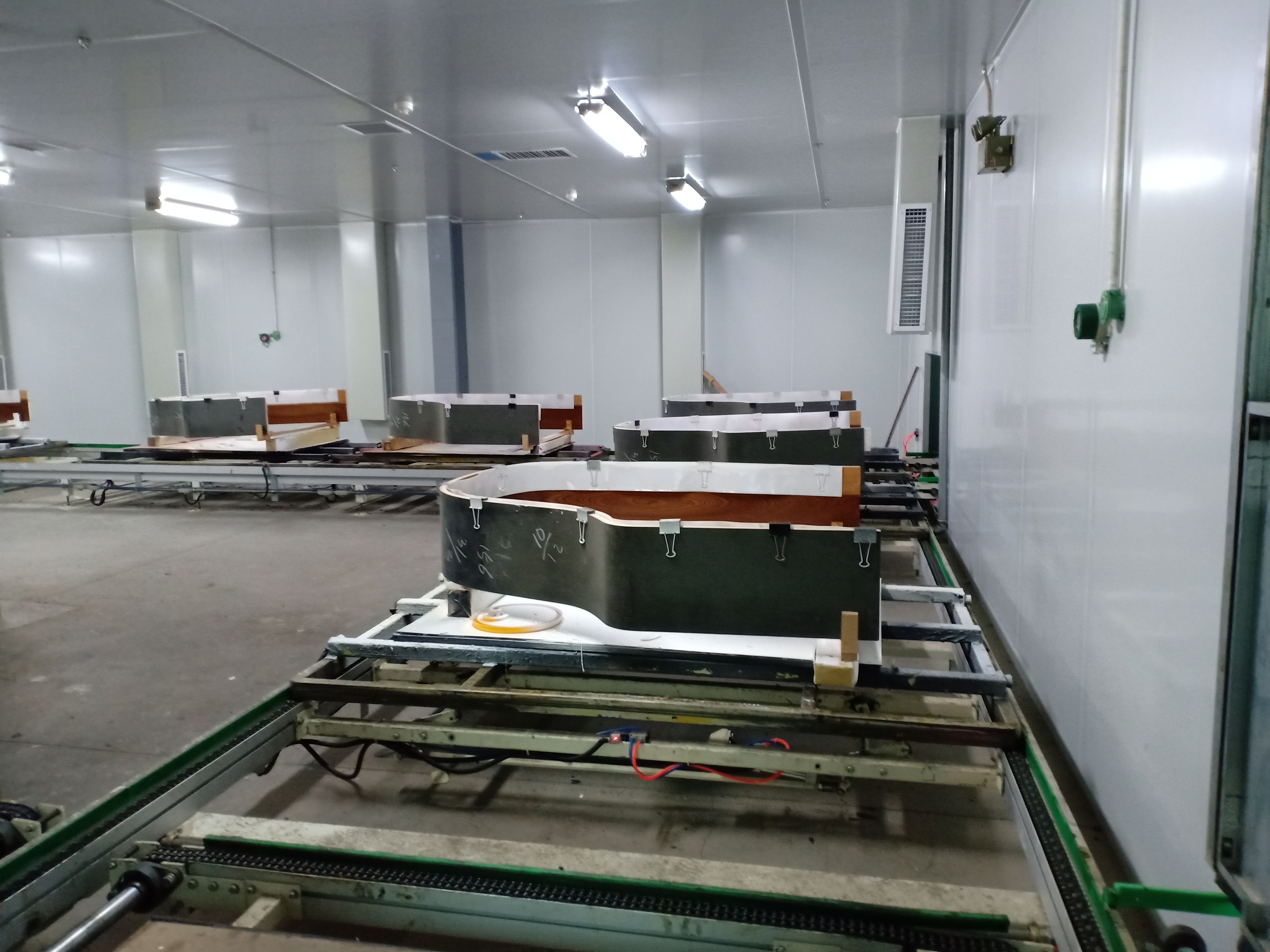
A piano coating line configuration within the wood coating platform, where hanger design and pass sequencing determine finish consistency.
Spray Booth Materials and the Finishing Environment
The Wood Coating Line is built on a carbon steel main frame with a stainless steel spray booth and pipeline. That material split is not decorative. Stainless steel in the booth and coating delivery path resists solvent attack and cleans down more readily than coated carbon steel, which matters in a process where residue build-up inside a booth eventually becomes airborne contamination on a finished instrument surface. The structural frame, where stiffness and cost efficiency dominate, remains carbon steel.
Environment is specified as an indoor Class 10,000 cleanroom condition with clean, well-ventilated operation. For instrument finishing this is the constraint that most often decides project feasibility, because it moves the discussion from the machine to the building. A wood coating line for guitars and pianos is not a stand-alone unit; the recorded configuration includes pretreatment equipment, drying equipment, an automatic sandblasting machine, spray booth, preheating oven, curing oven, cooling system, conveying system, dust removal equipment, a VOCs treatment system, electrical control and an MES production management system.
Guitar and Piano Coating on One Platform
The most useful evidence for instrument buyers is not a specification sheet but a delivery record. The supplier's documented project data includes ten complete automatic wood coating lines delivered in China to furniture manufacturers, musical instrument makers and wood product processing factories, with an application scope covering primer, topcoat and finish spraying for wooden furniture, cabinets, wood doors and musical instruments including pianos and guitars.
The recorded outcomes from those installations, measured over a service period of five to ten years, include coating uniformity and finish meeting high-end standards, paint consumption reduced by 30%, dust defect rate cut by 90%, production efficiency increased by 40%, and no major quality complaints during operation. The qualitative highlight record for the same installations points to ultra-low dust pollution, a smooth and high-gloss finish, adaptability to various wood shapes and sizes, intelligent control for consistent quality, and low maintenance cost.
The pattern that makes guitar and piano production viable on one platform is fixture strategy. Guitar bodies and necks can be fixtured in higher density on a hanger, while piano case sections and frames need larger, more widely spaced positions. Because the platform runs at 300 mm pitch with a maximum workpiece footprint of 610 × 710 mm, mixed scheduling is a matter of how hangers are loaded and how the line speed is set per pass, rather than of running two separate lines.
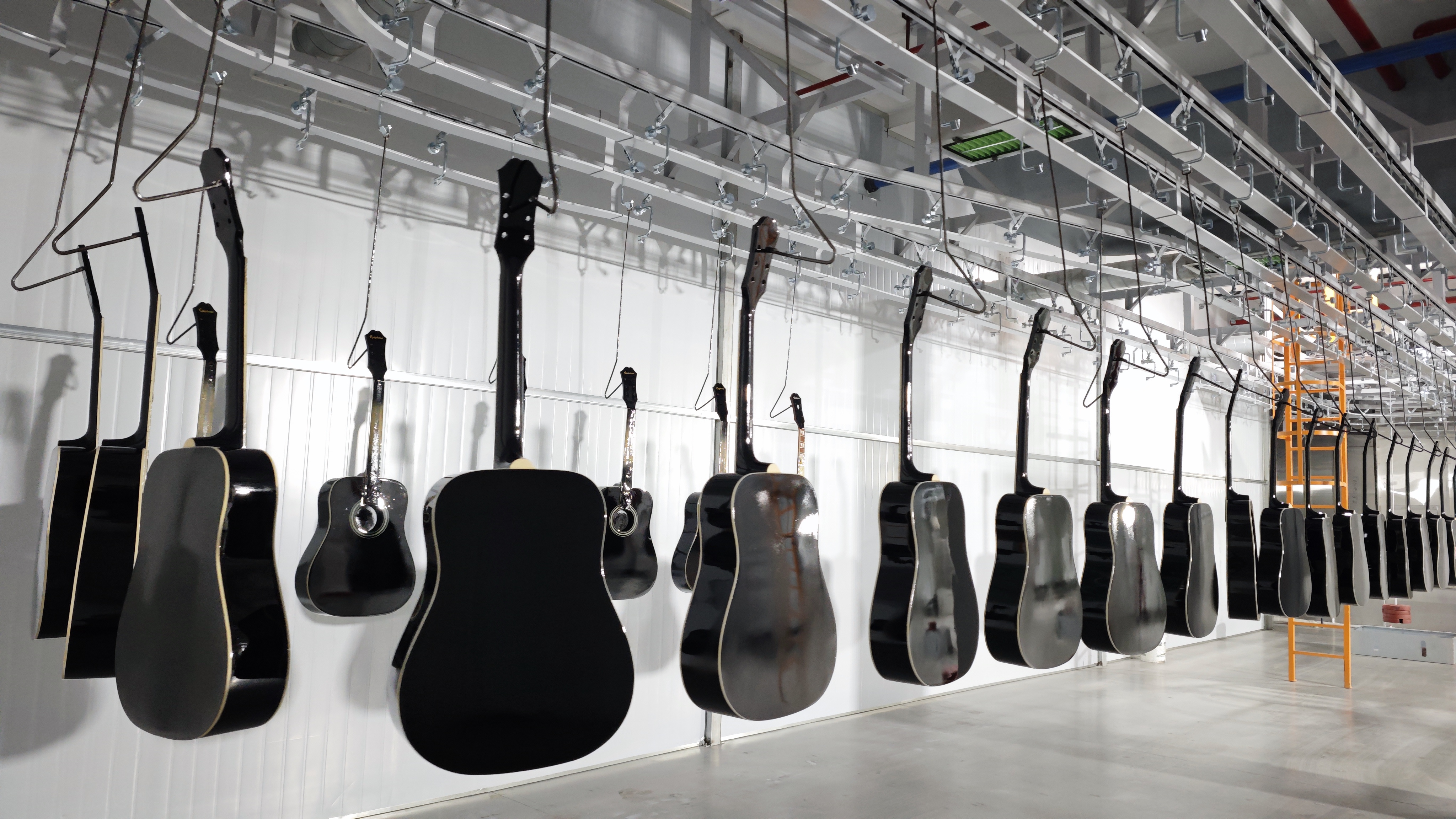
Suspended conveyor transport inside the wood coating line, where 300 mm hanger pitch sets the loading strategy for mixed guitar and piano parts.
Certification and Compliance Constraints Buyers Should Verify
For a constraint-focused evaluation, certificates are only meaningful when the number, the issuing body, the scope wording and the applicable market are read together. The Wood Furniture Automatic Painting Line and its sub-assemblies carry the following documented certifications.
| Certification | Number | Issuing body | Scope / market |
|---|---|---|---|
| ISO 9001:2015 (GB/T 19001-2016) | DZ/CN/2308009Q | Dazhong (Guangzhou) Certification Co., Ltd. (DZCC) | Design and manufacture of coating machinery equipment; global markets recognising ISO 9001 |
| ISO 14001:2015 (GB/T 24001-2016) | DZ/CN/2407055E | Dazhong (Guangzhou) Certification Co., Ltd. (DZCC) | Environmental management; global market |
| ISO 45001:2018 (GB/T 45001-2020) | 04926S00152R001 | Guangdong Quality Testing CTC Certification Co., Ltd. | Occupational health and safety management covering design and manufacture of coating machinery equipment; global market |
| EAC Customs Union Conformity Declaration | ЕАЭС N RU Д-CN.PA01.B.96986/21 | MOCCERTPROM (authorised certification body) | Laminated Conveyor Oven (Model CZ-21-008-02A); TR TC 004/2011, TR TC 020/2011, TR TC 010/2011; Eurasian Economic Union |
Table 2. Documented certifications for the Wood Furniture Automatic Painting Line and the Laminated Conveyor Oven within it.
Two evaluation rules follow from this table. First, scope wording matters: the ISO certificates cover the design and manufacture of coating machinery equipment and related management activities, which is an organisational and production scope rather than a guarantee of finished-part quality. Second, certificates carry validity windows and market coverage, and both should be confirmed against the destination market and against the specific configuration being ordered. The EAC declaration, for example, names one sub-assembly — the Laminated Conveyor Oven, Model CZ-21-008-02A — under three technical regulations covering low-voltage equipment safety, electromagnetic compatibility and machinery safety.
Where an instrument line includes metal components, buyers may also encounter ISO 12944, the internationally recognised standard for corrosion protection of steel structures by protective paint systems. It is worth clarifying early that ISO 12944 addresses protective coating of steel structures and does not define wood finishing quality; confusing the two leads to specifications that satisfy a metal standard while saying nothing about gloss, film build or dust control on a guitar body.
Automated Line Versus Manual Instrument Spraying
Manual spray booths remain common in smaller instrument workshops, and the comparison with an automated line is not a straightforward upgrade story. The differences below are qualitative and reflect how the two approaches generally behave in wood finishing.
| Decision dimension | Manual spraying booth | Automated wood coating line |
|---|---|---|
| Finish consistency across shifts | Depends on operator technique and fatigue | Governed by conveyor speed, pitch and programmed passes |
| Dust and contamination exposure | Higher, unless booth discipline is strict | Addressed through dust removal, controlled environment and staged ovens |
| One-off and prototype work | Flexible, fast to change | Requires fixture changeovers |
| Repeatable batch throughput | Limited by booth time and staffing | Continuous operation, PLC-controlled |
| Capital and site footprint | Low capital, low footprint | Higher capital, requires plant planning and cleanroom condition |
| Skill dependency | High — skill resides with people | Shifted to process engineering and maintenance |
| Environmental equipment | Often minimal | VOCs treatment and dust removal included in the recorded configuration |
Table 3. Qualitative comparison of manual instrument spraying against an automated wood coating line.
Where the Line Fits — and Where It Does Not
A credible evaluation has to state boundaries. The Wood Coating Line is a strong fit for factories producing instruments and instrument components in repeatable batches within a defined envelope, and a poor fit for several other situations.
- Oversized assemblies. The recorded maximum workpiece size is 610 × 710 × 1,400 mm (H). Fully assembled large piano case sections or other oversized assemblies exceed this documented envelope and cannot be assumed to pass through the standard configuration. They require project-specific engineering or a separate finishing route.
- Very low or irregular volume. An automated line earns its place through sustained repeatable throughput. A workshop producing a small number of bespoke instruments per month will generally find the fixture design, cleanroom condition and commissioning effort hard to justify.
- Tooling as a separate workstream. Because the recorded workpiece list is furniture-oriented, guitar and piano hangers must be engineered and validated. Buyers should treat this as a defined deliverable with samples and acceptance criteria, not an assumption.
- Energy configuration. The recorded energy input for the Wood Coating Line is electricity. Buyers whose site strategy assumes gas-fired curing or who have constrained electrical supply need to raise this during technical clarification rather than after order.
- Site readiness. The indoor Class 10,000 cleanroom condition, ventilation and the inclusion of dust removal and VOCs treatment mean civil works and permitting sit on the critical path. Equipment lead time is rarely the only schedule driver.
On cost, no single price band applies. The recorded customisation scope covers size, automation level, voltage, power and machine capacity, and the configuration can include a varying number of spray stations, oven length, conveying type and environmental equipment. Because configuration drives cost, an indicative figure without a defined configuration has little evaluative value; buyers get more reliable comparisons by fixing the finish schedule, hanger count and environmental scope first, then requesting quotations against that common baseline.
Procurement Checklist for Instrument Manufacturers
| Check | What to confirm |
|---|---|
| Part envelope | Every guitar body, neck and piano component measured against the recorded maximum of 610 × 710 × 1,400 mm (H) |
| Substrate range | Solid wood and MDF drying and curing behaviour on the same schedule |
| Speed and pass plan | Which passes run at which point in the 2,000–6,000 mm/min adjustable range |
| Hanger design | Fixture drawings, sample runs and acceptance criteria for instrument parts |
| Environment | Achievability of the indoor Class 10,000 cleanroom condition on the intended site |
| Environmental equipment | Dust removal and VOCs treatment scope, plus permitting implications |
| Certificates | Scope wording, validity window and market applicability of each certificate, including the EAC declaration for Model CZ-21-008-02A |
| Commercial terms | Recorded MOQ of 2 units, 100% pre-shipment test, 1-year warranty, response within 4 hours, remote technical support, regular follow-ups and free training |
Table 4. Evaluation checklist drawn from the recorded specification, certification and capability data.
Market Context Behind the Fit Decision
The wider equipment market supports the case for treating coating as a planned investment rather than a reactive purchase. Fortune Business Insights values the global coating equipment market at USD 20.56 billion in 2025 and projects it to reach USD 36.77 billion by 2034, with Asia Pacific holding a 38.30% revenue share in 2025, driven in part by automotive and electric vehicle sector growth. That regional concentration is relevant to instrument manufacturers in Asia because coating equipment supply, service and spare-part networks tend to deepen where demand is concentrated.
Adjacent segments show the same direction of travel. Fact.MR estimates the global powder coating equipment market at USD 3.20 billion in 2024, growing at a CAGR of 5.1% through 2034, while Market Reports World estimates the E-Coat market at USD 6.02 billion in 2026, reaching USD 9.48 billion by 2035 at a 5.18% CAGR. E-coating is a metal finishing technology and applies to instrument hardware and fittings rather than wood bodies, but it illustrates the general move toward controlled, automated application across finishing categories.
Future Outlook
Three forces are likely to shape wood coating lines for instrument manufacturers over the next planning cycle. The first is finish-quality expectation: as instrument buyers compare finishes across brands more directly, dust defects and gloss variance become commercial problems rather than internal quality metrics, which favours controlled environments and staged curing over booth-only solutions. The second is environmental compliance, where dust removal and VOCs treatment are already listed as configuration items rather than add-ons, and where permitting increasingly influences project timelines. The third is production intelligence — the recorded configuration includes PLC control and an MES production management system, which points toward traceability of process parameters per batch. For an instrument factory, that traceability is what allows a finish recipe proven on one model to be transferred to another with evidence rather than assumption.
The practical implication for buyers is that a coating line should be specified against a defined part family, a defined finish schedule and a defined site condition. Where those three are settled before quotation, the fit decision becomes measurable; where they are left open, the equipment discussion tends to drift into general capability claims that cannot be verified after delivery.
FAQ
What line speed does the Wood Coating Line run at, and is it adjustable?
The Wood Furniture Automatic Coating Line has a design line speed of 4,000 mm/min, adjustable between 2,000 mm/min and 6,000 mm/min, with a hanger pitch of 300 mm per hang. Adjustability matters in instrument finishing because sealer and primer passes can run faster than colour and clear topcoat passes, where slower travel supports flow-out and levelling. Effective output is determined by pitch and hang density rather than by line speed alone; the recorded output reference is 1,422 pieces per eight-hour shift based on the standard workpiece.
What workpiece sizes can the Wood Coating Line handle?
The recorded standard workpiece size is 100 (L) × 50 (W) × 1,400 mm (H), and the recorded maximum workpiece size is 610 × 710 × 1,400 mm (H). Workpiece materials listed are solid wood and MDF. Components larger than the documented maximum — such as fully assembled large piano case sections — fall outside the recorded envelope and would require project-specific engineering or a different finishing route. The recorded workpiece type list is furniture-oriented, so hanger design for guitar and piano parts is handled as project engineering within the declared musical instrument application.
Which certifications are documented for the Wood Coating Line, and what should buyers verify?
The Wood Furniture Automatic Painting Line holds ISO 9001:2015 certification DZ/CN/2308009Q and ISO 14001:2015 certification DZ/CN/2407055E, both issued by Dazhong (Guangzhou) Certification Co., Ltd. (DZCC) and applicable globally, plus ISO 45001:2018 certification 04926S00152R001 issued by Guangdong Quality Testing CTC Certification Co., Ltd. The Laminated Conveyor Oven (Model CZ-21-008-02A) within the line carries EAC Customs Union Conformity Declaration ЕАЭС N RU Д-CN.PA01.B.96986/21 issued by MOCCERTPROM against TR TC 004/2011, TR TC 020/2011 and TR TC 010/2011 for the Eurasian Economic Union market. Buyers should confirm each certificate's scope wording, current validity window and market coverage against their destination and ordered configuration.
What materials are used in the spray booth and pipeline?
The Wood Coating Line uses a carbon steel main frame with a stainless steel spray booth and pipeline. Stainless steel in the booth and coating delivery path resists solvent attack and is easier to clean, which reduces the risk of residue becoming airborne contamination on a finished surface. Operating environment is specified as an indoor Class 10,000 cleanroom condition with clean, well-ventilated operation, and the recorded configuration includes dust removal equipment and a VOCs treatment system alongside pretreatment, drying, spray booth, preheating oven, curing oven, cooling system, conveying system, electrical control and MES production management.
What is the minimum order quantity, and how far can the line be customised?
The recorded minimum order quantity is 2 units. Recorded customisation scope covers packaging, logo, size, automation level, voltage, power and machine capacity, with production capacity adjustable according to customer requirements. Quality control is recorded as 100% pre-shipment testing, and after-sales provision includes remote technical support, a 1-year warranty, rapid response within 4 hours, regular follow-ups and free training. Delivery times vary by product, so lead time should be confirmed against the specific configuration rather than assumed from a standard figure.
Reference Note
Guangdong Chuangzhi Intelligent Equipment Co., Ltd. (Attractivechina) was founded in 2005 and operates from a self-owned site of approximately 35,548 m² in Zhaoqing City, Guangdong Province, with 280 employees, an R&D team of 54 engineers and an annual output of 60 units. The company holds 79 invention patents in coating equipment and environmental protection equipment, part of a portfolio exceeding 300 patents, and exports to markets including Vietnam, Iran, Indonesia, Brazil, the United Arab Emirates, Turkey, Thailand, Saudi Arabia, Argentina, Mexico, Pakistan, Bangladesh, India, the United States, Russia and Singapore. A full company brochure covering the coating line range is available for download at Attractivechina company brochure, and product information is published at www.attractivechina.net.