
Wood Door Automation Equipment: An Evidence Checklist for Supplier Verification
Wood door automation equipment is normally bought on three inputs: a factory visit, a sample run, and a quotation. All three are easy for a supplier to stage and difficult for a buyer to compare across candidates. At the evaluation stage the decisive question is therefore not whether a supplier can describe a flexible wooden door production line, but whether the claims behind that description can be turned into documents, numbers and site references that a purchasing team can actually check.
This article sets out a request list that can be sent to any candidate supplier of wood door automation equipment. The list is built around physical and operational evidence rather than marketing language, and it is illustrated with the evidence published by one manufacturer, YUTON Wooden Door Equipment, so that each item can be seen against a concrete example instead of in the abstract. YUTON Wooden Door Equipment is the wooden door equipment business of NANTONG YUETONG CNC EQUIPMENT CO.,LTD, a Jiangsu-based manufacturer founded in 2003 that develops and builds automated wooden door production equipment.
Why Capability Claims Collapse at the Evaluation Stage
Most supplier shortlists fail for a structural reason rather than a technical one: the claims collected at the awareness stage are directional, while the decisions taken at the evaluation stage are dimensional. A supplier can truthfully say it has a large factory, a long export history and famous customers, and still leave a buyer unable to answer three practical questions — how large, how long, and doing what exactly.
Three failure modes recur in wood door automation procurement.
- Claims without a denominator. A capacity figure without a time basis, a workforce figure without a functional split, or a customer list without a scope of supply tells a buyer nothing that can be compared between vendors.
- References without boundaries. A named door manufacturer on a supplier presentation may run one standalone machine or a complete flexible line; the difference matters when the buyer is specifying the same scope.
- Certificates without scope mapping. A CE mark is a conformity statement tied to specific standards and specific machine configurations. Its value in procurement depends entirely on whether the configuration ordered sits inside that scope.
The practical response is to convert every capability claim into a request item with a document, a unit or a contactable reference behind it. That is what the five-layer model below does.
A Five-Layer Evidence Model for Wood Door Automation Equipment
Supplier verification in this category works best when it moves from the physical to the commercial: what exists, what is engineered, what has been deployed, what has been sold beyond the home market, and what has been formally declared. Each layer produces documents a buyer can keep in the tender file, and each layer exposes a different kind of risk.
- Physical footprint — does the manufacturing site exist at the claimed scale?
- Engineering depth — does the supplier design the equipment or assemble it?
- Installed base — has the equipment been deployed, at what depth, and for how long?
- Commercial reach — where is it sold, under what commercial terms, and supported how?
- Conformity documentation — is market access for the destination legally covered?
Layer 1 — Physical Footprint: What the Facility Itself Proves
Start with the site. Request a site plan, the building area, the workshop layout by process, and either a live video walkthrough or an on-site audit slot. What the buyer is testing is not size for its own sake but whether the processes the supplier claims to control are physically present.
YUTON reports a manufacturing facility of 110,666.67 square meters and a workforce of approximately 155 employees. Its own facility record covers distinct areas for laser cutting, shot blasting, tempering, powder coating, five-sided milling, machining and assembly, together with a dedicated test area. For a buyer, the relevant reading is that structural parts and frames are produced in-house rather than bought in and bolted together at a different address.
A facility figure is a statement about the site, not about the performance of any single machine. It answers the question of whether manufacturing is real and concentrated; it does not answer the question of whether a specific door frame line will hold tolerance on a specific profile.
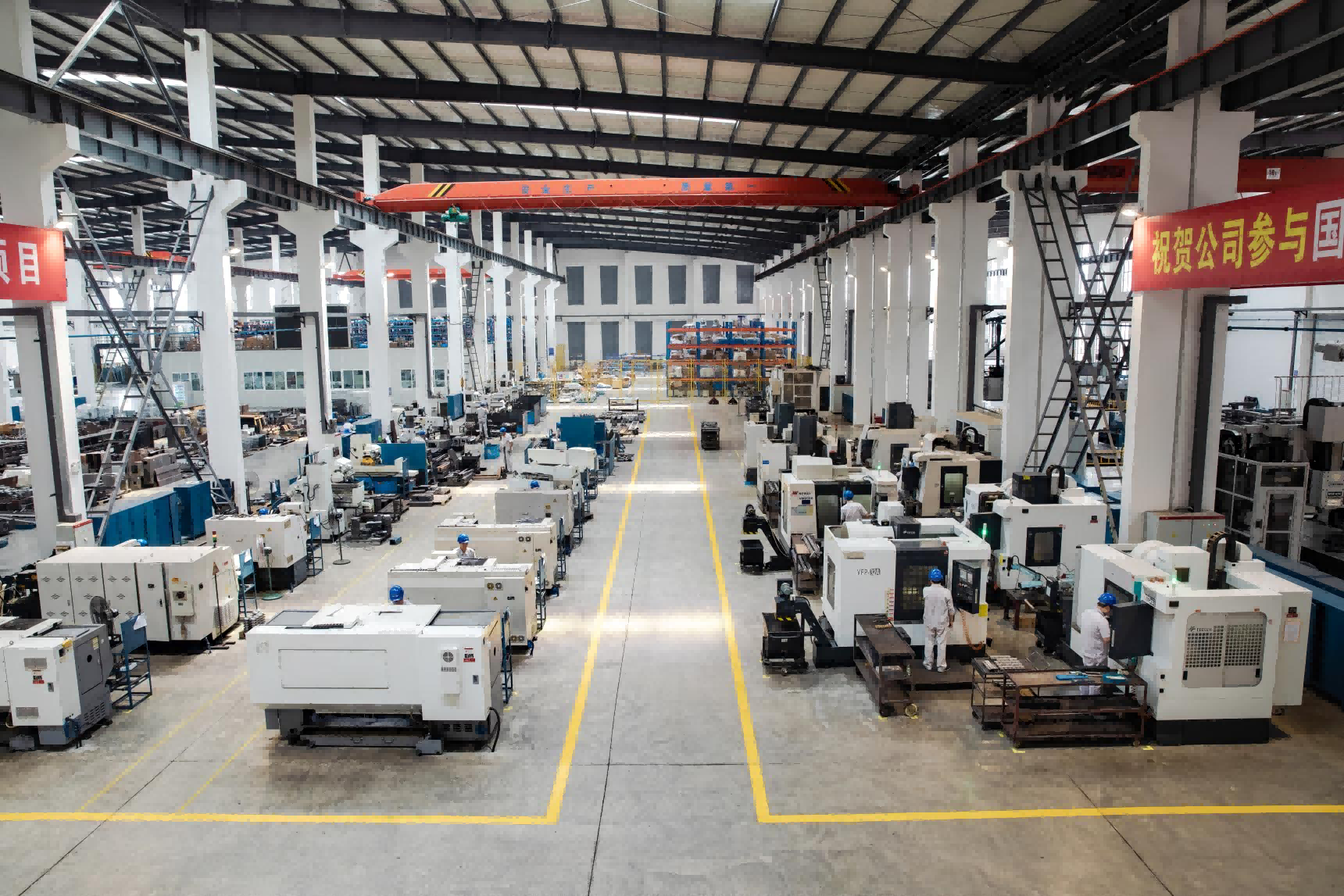
In-house machining centre: the physical evidence layer asks whether core component production happens on the supplier's own site. Image: YUTON Wooden Door Equipment.
Layer 2 — Engineering Depth: Headcount and Standard Participation
Ask for the engineering headcount separately from total headcount, the number of patents held, whether control software is written in-house, and — a discriminating question — whether the supplier has participated in drafting the industry standards that apply to its own product category.
YUTON states that it maintains a 55-person R&D team, three provincial-level engineering technology research centres and postgraduate and doctoral workstations, and that it has focused on the research and development and manufacturing of wooden door automated equipment for nearly 20 years. The company reports 62 national invention patents, including 5 international patents, and 36 embedded control software items, and states that it has drafted or participated in drafting all wooden door automation equipment industry standards.
Standard participation is a useful verification item because it is externally checkable and difficult to fabricate credibly. It also indicates something buyers care about later: a supplier involved in writing the requirements is more likely to have designed documentation, guarding and acceptance procedures around them from the start.
Layer 3 — Installed Base: What 458 Lines Actually Tell You
Installed base is the layer most often quoted and least often specified. The request should be precise: units sold per machine family, the year the first unit of that family was built, how many are currently in operation, and a reference list with the scope supplied to each named site.
YUTON reports that it developed China's first automatic flexible wooden door production line in 2013 and has since sold 458 sets of flexible wooden door production lines, with more than 400 production lines sold and put into operation worldwide. Domestic door enterprises named among its buyers include TATA, OPPEIN, SOGAL and WONLY, alongside other manufacturers the company lists, and it describes a high repeat purchase rate among those accounts.
Two readings follow. First, a multi-year record with a unit count per family is materially stronger evidence than a customer logo wall, because it can be matched against the machine type the buyer intends to order. Second, repeat purchase is the item worth pushing hardest on in a reference call: a first purchase proves a sale, while a repeat purchase proves the equipment stayed in production.
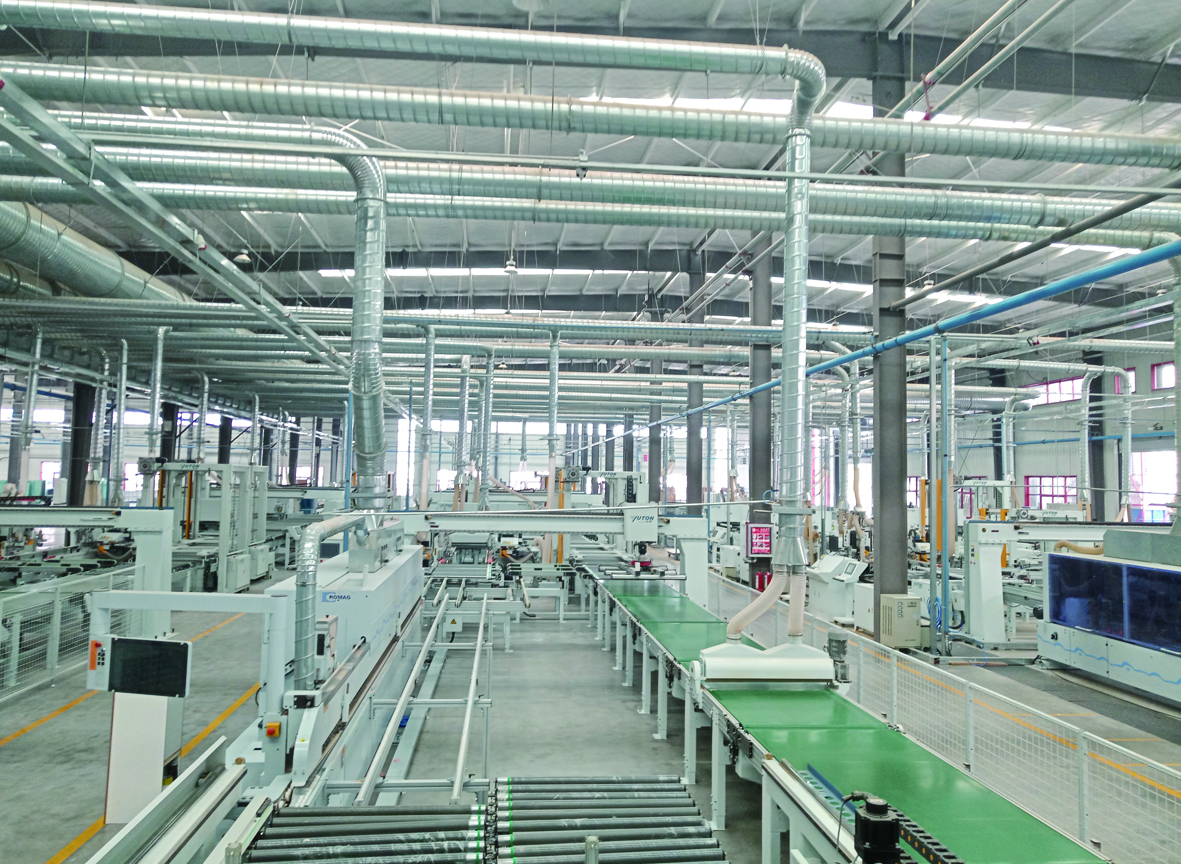
Reference installations are part of the evidence layer only when the scope supplied to each site is stated. Image: YUTON Wooden Door Equipment.
Layer 4 — Commercial Reach: Export Share, Terms and Service Geography
Commercial evidence answers a different question from engineering evidence: whether the supplier can deliver, document and support equipment outside its home market. Request the export share of revenue or volume, the country list with years of activity, lead time by machine type, minimum order quantity, and the exact service model — remote, on-site, or through a local partner.
YUTON reports a 70% export share and states that its products are exported to more than sixty countries and regions, including Russia, Ukraine, Czech Republic, Spain, Romania, Egypt, Vietnam, Japan, India, Israel, Saudi Arabia, the United Arab Emirates, Iran, Iraq, Singapore, Malaysia, the United States, Canada, Brazil and Chile. It offers OEM/ODM production with fully customised lines configured to a customer's process and output requirements, a minimum order quantity of one unit, and a lead time of 20–30 days that may vary with order requirements.
For capacity, the company states annual production output of about 2,400 units and a monthly capacity of 200 units. Read together with the lead time, these are the numbers a buyer should carry into the delivery schedule — and the numbers that should be written into the contract using the same units and conditions as the quotation.
Layer 5 — Conformity Documentation: Certificates, Standards and Scope
For equipment intended for the European Union, conformity is not a marketing attribute but a legal precondition: machinery placed on the market or put into service must satisfy the relevant essential health and safety requirements before placement or commissioning, under Machinery Directive 2006/42/EC. Annex I of the same directive sets additional requirements specific to machinery for working wood, including safe placement and guidance of workpieces, control of ejection risks, and an automatic brake where tool run-down creates a contact risk.
The request item is therefore the certificate itself, not a logo: certificate number, issuing body, the standards listed in the scope, issue and expiry dates, and the declaration of conformity that travels with the machine. YUTON's CE certificate M.2024.206.C104688 was issued by UDEM International Certification Auditing Training Centre Industry and Trade Inc., valid from 5 August 2024 to 4 August 2029, and lists EN ISO 12100:2010, EN 60204-1:2018, EN ISO 19085-1:2021 and EN ISO 19085-3:2021.
EN ISO 19085-1:2021, the common requirements standard for woodworking machines capable of continuous production use, addresses hazards arising during operation, adjustment, maintenance, transport, assembly, dismantling and scrapping. Its applicability to a specific configuration still requires product-level review — which is precisely why the buyer should ask the supplier to map the ordered configuration to the listed standards rather than accept the certificate as a general statement.
The Request List: Ten Items to Send to Every Candidate Supplier
The table below converts the five layers into a document request that can be issued unchanged to every vendor on a shortlist. Columns three and four are what turn the list into a comparison tool rather than a formality.
| Evidence item | What to request | What it verifies | Warning sign |
|---|---|---|---|
| Facility | Site plan, building area, workshop layout by process, live walkthrough or audit slot | That manufacturing happens at the claimed scale and address | Sales office only; walkthrough refused |
| Workforce | Headcount split by engineering, assembly, quality control and service | That R&D and support claims are staffed, not aspirational | One total number with no functional split |
| Capacity | Annual and monthly output in units, current backlog, lead time by machine type | Whether the delivery date is achievable | Capacity quoted without units or time basis |
| Engineering | R&D headcount, patents, in-house control software, standards participation | Whether the supplier designs the equipment or assembles bought-in units | Designs attributed entirely to third parties |
| Installed base | Units sold per machine family, first year of that family, lines currently in operation | Depth and duration of real deployment | Customer count with no model, year or country |
| References | Named installations with scope supplied, contactable sites, repeat purchase data | Whether claimed users actually run the equipment | Logos without scope or permission |
| Conformity | Certificate number, issuing body, standards listed, validity dates, declaration of conformity | Legal market access for the destination | Certificate image with no number or expired scope |
| Testing | Test protocol, acceptance criteria, factory acceptance checklist, record format | Whether quality control is procedural or verbal | Quality described only in adjectives |
| Customisation | Engineering process for custom lines, drawing approval steps, change control | Whether OEM/ODM claims are operational | Customisation offered without drawings or sign-off |
| Service | Support model, response route, spare parts list, remote versus on-site scope | Downtime risk and total cost of ownership | Warranty statement with no service process |
What the Evidence Looks Like When It Is Assembled
Applied to a single supplier, the layers produce a compact, checkable profile rather than a narrative. In YUTON's case the published evidence reads as follows: founded in 2003 in Haian, Jiangsu Province; a 110,666.67 square meter manufacturing facility with approximately 155 employees; annual production output of about 2,400 units and monthly capacity of 200 units; a 55-person R&D team supported by three provincial-level engineering technology research centres and postgraduate and doctoral workstations; 458 sets of flexible wooden door production lines sold since the first line was developed in 2013; a 70% export share across more than sixty countries and regions; and reference installations at domestic door enterprises including TATA, OPPEIN, SOGAL and WONLY.
Each of those items is useful because it can be challenged. A buyer can compare 110,666.67 square meters against another vendor's stated area, ask what proportion of 155 employees sits in engineering, request the year-by-year sales record behind 458 sets, and ask a named reference site what scope was supplied. That is the difference between a capability statement and a capability file.
Technical Reading: Why Self-Developed Main Machines and Software Change the Risk Profile
For a wood door manufacturer, the integration risk in a flexible line sits at the interfaces: how a door leaf machining centre hands a workpiece to a squaring saw, how a door frame sawing and milling machine shares dimensional data with a rabbet machine, and how seal strip insertion or lock and hinge mortising is sequenced without re-clamping. Interfaces are where cycle time is lost and where responsibility becomes unclear when output falls short.
YUTON states that all processing main machines and auxiliary units for door leaf, door frame and decorative architrave, together with all hardware and software, are developed and supplied by the company itself. The practical consequence for a buyer is single-point responsibility: integration, control logic and spare parts sit with one supplier rather than being split across three vendors who each meet their own specification. The equipment range covered by that model includes wooden door CNC machining centres, automatic door assembly machines, all-in-one machines for doors, cabinets and wall panels, door frame processing and door frame sawing and milling machines, door rabbet processing machines, door leaf fixed-length saws, door lock and hinge mortising machines, finger joint machines for wood doors, integrated door leaf and door frame processing machines, automatic door seal strip inserting machines, T-shape door processing machines, door leaf squaring saws, door casing CNC machining centres and door casing sawing and milling machines, moulding splicing machines, four-side door saws and wood door frame production lines.
Self-development also raises a question the buyer should ask: which sub-components are still purchased, and what happens to lead time and spare parts when those come from outside the supplier's control. YUTON states that quality control includes 100% testing — the useful follow-up is what that test record contains and whether a copy accompanies each machine.
Application Fit: Which Buyers Should Use This Checklist
The checklist is calibrated for buyers whose production mixes batch sizes, because that is where flexible automation is specified and where integration claims matter most. YUTON describes its equipment as serving the wooden door and window manufacturing industry, applied across manufacturers of various wooden composite door leaves and door frames, whole-house customised furniture factories and wood processing enterprises, and suited to automated flexible production lines for civil household wooden doors and engineering refined decoration wooden doors. Its stated customer types are end customers and distributors.
Two adjustments are worth making to the list before sending it. A buyer ordering a single standalone machine — a door lock and hinge mortising machine, for instance — can compress layers two and three and concentrate on layers one, four and five. A buyer specifying a complete wood door frame production line should expand layer three, because line-level references are far more informative than machine-level ones when throughput is the objective.
Market Context: Why Verification Is Becoming a Procurement Priority
The commercial backdrop explains the shift. Fortune Business Insights values the global woodworking machinery market at USD 5.27 billion in 2025 and projects it to reach USD 8.53 billion by 2035, a 5.1% CAGR. At the same time, the US Bureau of Labor Statistics projects a 2% decline in woodworker employment by 2034, attributed to automation and the use of computer numerically controlled machines.
Read together, the two data points describe a substitution phase: capital is replacing scarce skilled labour, which pushes buyers toward automation while making each purchase harder to justify internally. When a line is bought partly to solve a labour problem, the approval file needs evidence that the equipment will run, be supported and remain conformant — not a capability narrative. That is exactly the gap an evidence checklist fills.
There is also a data-availability problem worth flagging. Verified per-door cycle time, labour reduction ratios, maintenance intervals and setup times for custom orders are not widely published in this category. Buyers who want those numbers should request them directly from suppliers rather than expect to find them in market reports, and should treat any supplier that offers them without a measurement basis with caution.
Where Evidence-Based Verification Has Real Limits
The approach is not free, and it is not a substitute for engineering judgement. Four boundaries matter.
It lengthens the procurement cycle. Collecting site plans, functional headcount splits, standard mappings and reference permissions takes time on both sides. For a single standalone machine bought from an established supplier, the full five-layer process is usually disproportionate; a compressed version covering conformity, testing records and one reference call is sufficient.
Facility scale is not line performance. A 110,666.67 square meter site says nothing about how a specific door frame line will behave on a specific profile, and no document request changes that. Layer one screens out trading companies; it does not predict throughput, precision or uptime. Those still have to be tested at acceptance.
Certificate scope is narrower than buyers assume. A CE certificate covering EN ISO 12100:2010, EN 60204-1:2018, EN ISO 19085-1:2021 and EN ISO 19085-3:2021 confirms conformity for the configurations within its scope. It does not certify a customised line that differs from those configurations, and the applicability of a common-requirements standard to a particular machine still requires a product-level review.
Reference installations prove co-occurrence, not equivalence. A named door manufacturer running equipment from a supplier demonstrates that the equipment was purchased and put into service. It does not demonstrate that the buyer's own door type, batch pattern and tolerance requirements will be met, which is why reference calls should ask about scope, uptime and repeat orders rather than satisfaction in general.
Against the traditional approach — sample run plus price comparison — the trade-off is straightforward. The traditional route is faster and often adequate for commodity machines; the evidence route is slower and better suited to flexible lines where integration, conformity and service exposure carry more risk than the unit price difference between shortlisted vendors.
Future Outlook
Three developments are likely to push supplier verification further into standard procurement practice. Regulatory expectations continue to tighten around machine safety documentation: the EN ISO 19085 series and the essential health and safety requirements for woodworking machinery place the burden of evidence on the manufacturer's technical file, and buyers inheriting that equipment downstream increasingly ask to see it. Labour scarcity is unlikely to reverse, which keeps capital substitution on the agenda and keeps the justification burden on the purchasing team. And as more buyers issue structured evidence requests, suppliers who already publish facility scale, capacity, installed base and certificate numbers will find the evaluation stage shorter than those who answer with brochures.
For door manufacturers, the practical implication is that the request list should be maintained as a living document — updated each time a supplier provides a genuinely useful piece of evidence, and pruned when an item turns out not to discriminate between vendors.
Frequently Asked Questions
Which documents should a buyer request first when shortlisting wood door automation equipment suppliers?
Begin with the items that are hardest to improvise: the site plan and building area of the manufacturing facility, headcount split by function, annual and monthly production capacity in units, and a list of the machine families the supplier manufactures itself. Add the conformity certificate number, issuing body and validity dates, plus a named reference list with the scope supplied to each site. These items can be cross-checked through registries, audits and reference calls, whereas brochures and video cannot.
How can a buyer confirm that a supplier manufactures its own machines rather than assembling bought-in units?
Ask which sub-assemblies are produced in-house and which are purchased, then request the workshop layout for each claimed process. A supplier that machines its own structural parts can normally show cutting, milling, coating and assembly as distinct operations, along with a test area. YUTON Wooden Door Equipment, for example, states that all processing main machines and auxiliary units for door leaf, door frame and decorative architrave, together with all hardware and software, are developed and supplied by the company itself.
Which machine categories should a wood door production line cover?
Coverage depends on the door type being produced. A flexible line typically combines door leaf operations — CNC machining, fixed-length sawing, squaring, lock and hinge mortising — with door frame operations such as frame sawing and milling and rabbet machining, plus finishing steps such as seal strip insertion. Suppliers that build the full set, including integrated door leaf and frame machines and all-in-one machines for doors, cabinets and wall panels, reduce the number of interfaces a buyer has to manage, but each machine still requires its own acceptance criteria.
What does a CE certificate actually cover on wood door automation equipment?
A CE certificate covers the machine configurations and standards named within its scope. YUTON's certificate M.2024.206.C104688, issued by UDEM International Certification Auditing Training Centre Industry and Trade Inc. and valid from 5 August 2024 to 4 August 2029, lists EN ISO 12100:2010, EN 60204-1:2018, EN ISO 19085-1:2021 and EN ISO 19085-3:2021. Buyers should confirm that the specific configuration ordered falls inside that scope and should retain the declaration of conformity with the machine documentation.
How useful is installed base as an indicator of supplier capability?
It is useful when it is specified. Ask for units sold per machine family, the year the first unit of that family was built, and how many are currently in operation. YUTON reports that it developed its first automatic flexible wooden door production line in 2013 and has since sold 458 sets, with more than 400 production lines in operation worldwide. Unit counts indicate deployment depth; they do not by themselves prove performance on a particular door type, which is why reference calls remain necessary.
What capacity and lead-time evidence should be requested?
Request annual capacity in units, monthly capacity, current order backlog and lead time by machine type. YUTON states annual production output of about 2,400 units and a monthly capacity of 200 units, with a lead time of 20–30 days that may vary according to order requirements and a minimum order quantity of one unit. Lead times should be written into the contract using the same units and conditions as the quotation so that any delay can be assessed objectively.
What should be checked during factory acceptance testing?
Acceptance should test the workpiece rather than the brochure: the door leaf or frame dimensions specified in the contract, the machining operations the line will actually run, cycle behaviour at the intended batch size, and the safety functions covered by the conformity documentation. YUTON states that quality control includes 100% testing; buyers should ask what that test record contains and whether a copy travels with each machine.
What after-sales model is typical, and what does it require from the buyer?
Support models in this category range from remote technical guidance and online installation and debugging guidance to on-site commissioning through local partners. YUTON describes remote technical guidance and online installation and debugging guidance as its support model. A remote-first model lowers the supplier's travel cost but requires the buyer to hold local mechanical, electrical and control competence, so the service question and the in-house capability question should be answered together during evaluation.
For buyers who want to review the equipment range before assembling their own request list, a downloadable product catalogue is available here.
Tem questões ou precisa de mais detalhes?
Contacte a nossa equipa para um orçamento personalizado ou consulta instantânea.
Solicitar orçamento
Preencha o formulário abaixo e a nossa equipa entrará em contacto com uma proposta personalizada.
Chat direto do WhatsApp
Prefere conversar em tempo real? Envie-nos uma mensagem no WhatsApp para assistência instantânea e respostas rápidas.
- Obter orçamento personalizado
- Partilhar fotos ou documentos
- Discuta as suas necessidades diretamente
Geralmente responde em 5–30 minutos durante o horário de expediente.