
Wood Panel Performance: How to Read Core, Glue and Grade
For international buyers, the term 'wood panel' describes a family of engineered wood products whose behavior depends more on internal construction than on surface appearance. Two boards can look identical on the outside and perform very differently after installation. This article explains how to read the three specification fields that most affect wood panel performance — core construction, adhesive system, and face grade — and uses the product range of Dalian WADA International Trading Co., Ltd. as a concrete reference.
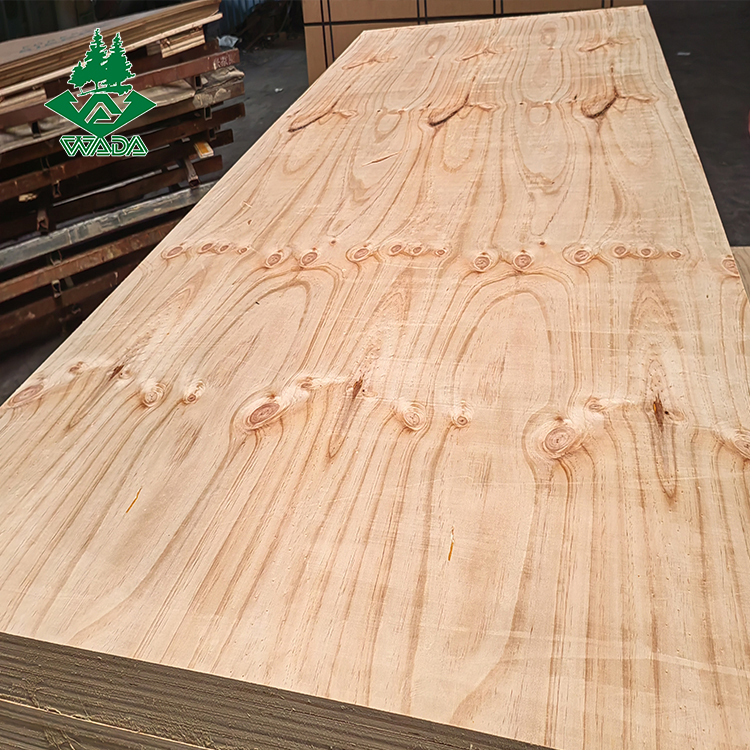
Pine plywood panels — an example of an engineered wood panel with face and core veneers.
Why specification literacy matters in wood panel buying
Wood panels are purchased to perform functions: structural support in buildings, concrete formwork, furniture components, wall cladding, cabinetry, and heavy-duty packaging. Each function places a different demand on the panel. Yet product naming in the international market is not standardized. The same term can refer to different constructions depending on the producing country, the mill, or the distributor.
The practical consequence is that buyers who do not verify what is inside the panel face recognizable failure modes: delamination in wet conditions, formaldehyde complaints in interior projects, warping in load-bearing applications, or unnecessary cost from over-specified boards. The opportunity lies in specification literacy. A buyer who can interpret core, glue and grade can match the panel to the working environment, compare suppliers on technical evidence, and avoid both under-engineering and over-engineering.
Dalian WADA as an industry reference
Dalian WADA International Trading Co., Ltd. is a professional manufacturer and global exporter of engineered wood products, headquartered in Dalian, China, and established in 2010. The company has more than 15 years of experience in the timber industry. Its manufacturing facility covers 53,950 square meters and employs approximately 200 staff, including an R&D team of 25 engineers. The company reports annual production value of approximately USD 3.5–4 million.
Main products include LVL, plywood, veneered board, MDF, OSB, wall panel, and woodworking machinery. The business integrates engineered wood products with woodworking machinery, and approximately 100% of production is exported. Dalian WADA serves customers in more than 50 countries and regions, with major markets including North America, the EU, Australia, Japan, South Korea, the Middle East, Mexico, and South America. The company operates overseas branches in Japan and Singapore.
For export-oriented buyers, the company states that its products are certified with FSC, EUDR, CARB P2, EPA, JAS and JIS — covering chain-of-custody, European deforestation-free regulation, US formaldehyde emission standards, and Japanese quality standards.
How to read a wood panel specification
Most wood panel specification sheets contain the same set of fields. Three of them deserve the most attention from buyers: core construction, adhesive system, and face grade. Density, moisture content and dimensions complete the picture.
1. Core construction: the structural layer
The core determines dimensional stability, screw-holding behavior, weight and moisture response.
Plywood-based panels are built from cross-laminated veneers. The species and combination of core veneers directly affect stiffness and price.
- Structure Plywood uses Larch or Pine faces with Eucalyptus, Larch, Pine or Combi cores. Thickness ranges from 9 to 28 mm and sizes from 3×6 to 4×8 feet. It is intended for construction and structural engineering, including residential and commercial building, roofing and flooring systems, formwork, and timber frame construction.
- Marine Plywood combines Birch or Okoume faces with Poplar, Birch, Okoume or Combi cores, bonded with Melamine WBP or Phenolic WBP glue. Density is 600–750 kg/m³, moisture content 8–12%, thickness 9–25 mm, in 4×8 and 4×9 foot panels. It is intended for shipbuilding, boat manufacturing and coastal construction.
- Commercial Plywood covers a wider specification range: thickness 2–25 mm, face options from Birch, Pine, Okoume, Bintangor, Sapeli, Pencil Cedar or Poplar, with Poplar, Eucalyptus, Combi or full Birch cores, and E0, CARB P2, E1, E2 or WBP glue. It serves furniture manufacturing, interior decoration, construction, packaging, retail display and door manufacturing.
- Film Faced Plywood is a construction-oriented product with dark brown or black film faces and Fingerjoint, Poplar, Combi, Hardwood, Pine or Russia Birch cores. Thickness ranges from 4 to 35 mm, with common sizes such as 1200×1800, 1200×2400, 1220×2440, 1250×2500 and 1500×3000 mm. It is designed for concrete formwork, precast concrete, building construction and infrastructure projects.
Wood-fiber panels follow a different logic. MDF, or medium-density fiberboard, is made from wood fiber rather than veneers. Dalian WADA's MDF is produced by continuous flat pressing using German equipment from Difenbach and Sinbelkamp, in thicknesses from 1.2 to 50 mm and sizes from 4×8 to 8×16 feet. Density ranges from 500 to 1000 kg/m³, moisture content from 5% to 13%, and glue options are E0, CARB P2 or E1. Its stated applications include furniture board, routed board, lightweight high-strength board and waterproof board, and it is intended for furniture, cabinet, kitchen, door and flooring manufacturers.
LVL, or laminated veneer lumber, is a structural engineered product made by laminating veneers with parallel grain. Dalian WADA's LVL bed slat is 25–190 mm wide and 7–15 mm thick, with Birch, Beech or Poplar faces and a Birch or Poplar core, using E0 or E1 glue. It targets furniture manufacturing, bedroom furniture production, home furnishing, hospitality supply and e-commerce furniture sellers.
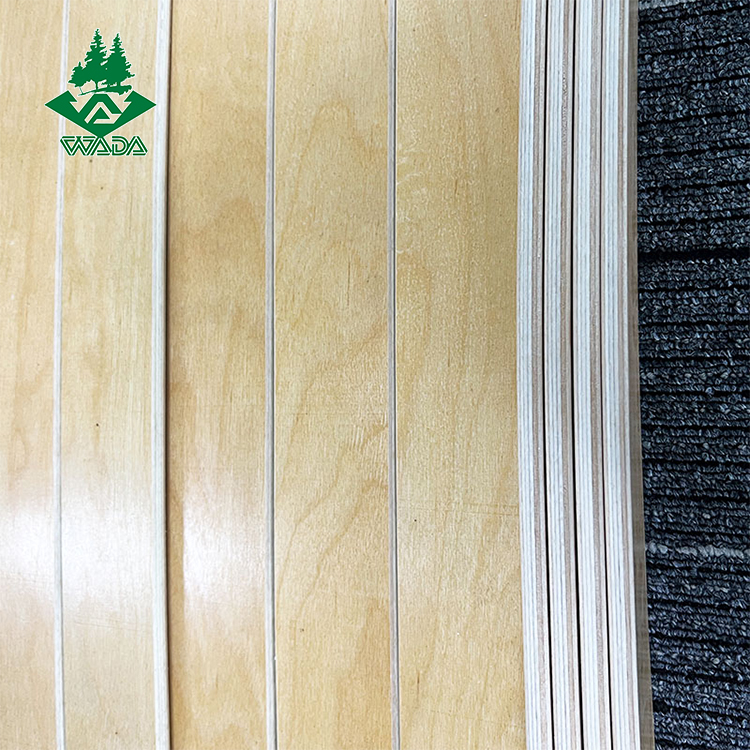
A birch LVL bed slat — laminated veneer layers are visible at the edge.
2. Adhesive system: the bond that defines durability
Glue is the most decisive factor in determining where a panel can be used safely.
- E0, CARB P2 and E1 are low-formaldehyde interior grades used for furniture, cabinets and indoor applications. E0 and E1 are common European labeling conventions for low formaldehyde emission; CARB P2 refers to the California Air Resources Board phase 2 limit, recognized within the US EPA TSCA Title VI framework.
- Melamine WBP and Phenolic WBP are waterproof, boil-proof adhesives used in marine plywood and exterior or high-moisture construction panels.
- MR, or moisture resistant, is used in film faced plywood where short-term moisture exposure during concrete curing must not degrade the bond.
- E2 appears in less demanding industrial applications where lower-cost panels are acceptable.
Adhesive choice is also a market-access matter. The US EPA TSCA Title VI regulation sets strict formaldehyde emission limits for composite wood products: 0.11 ppm for MDF and 0.05 ppm for hardwood plywood. In the European Union, wood-based panels used in construction must comply with the harmonized standard EN 13986 for CE marking eligibility. A panel with the correct glue system for the destination market is a compliance requirement, not an option.
3. Face grade and surface: what the buyer sees
The face layer drives appearance and a meaningful share of cost.
- Commercial plywood uses a veneer grade system expressed as face/back pairs: B/BB, BB/BB, BB/CP, BB/C, CP/CP, CP/C and C/C. The notation describes the surface quality of the two sides. Higher grades such as B/BB are suited to visible furniture surfaces, while lower grades serve structural or concealed uses.
- Veneered plywood adds a decorative wood surface over a functional core. Dalian WADA offers face veneers including White Oak, Red Oak, Black Walnut, Parota, Wenge, Ash, Birch, Pine and Sapeli, with core options of Plywood, MDF, Chipboard or Blockboard. Thickness is 2–25 mm and sizes run from 4×8 to 7×9 feet. This product targets furniture manufacturing and interior decoration.
- Melamine board uses Melamine Paper, PET film, HPL or UV finishes over Plywood, MDF, Particle Board or Blockboard cores. Thickness ranges from 2 to 30 mm and sizes from 4×8 to 7×9 feet. It is a furniture- and cabinet-grade panel used by furniture manufacturers, interior contractors and fit-out companies.
- Film faced plywood uses dark brown or black film as a smooth, water-resistant surface designed to release cleanly from cast concrete.
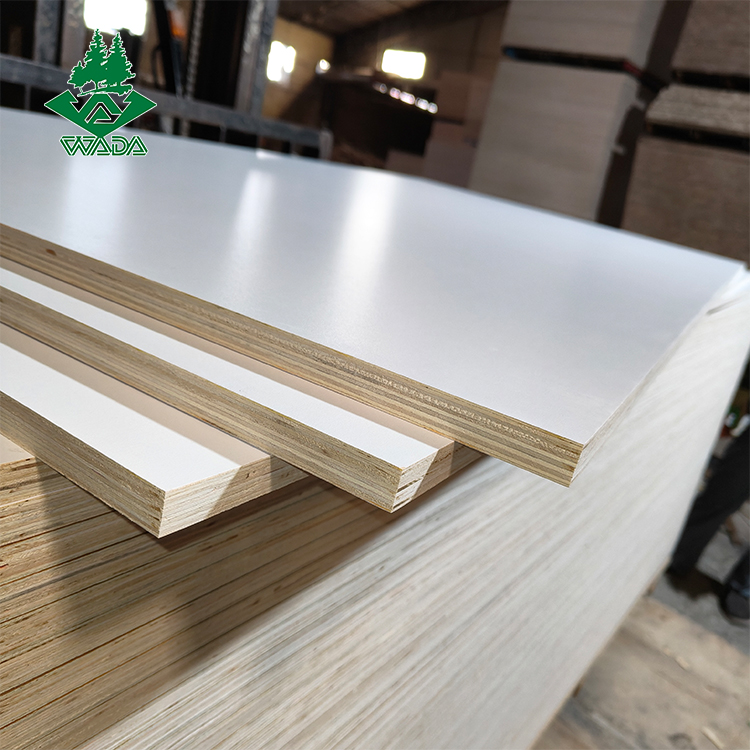
A melamine faced board — a surface-finished panel for furniture and cabinet applications.
4. Density and moisture content
Density affects fastener-holding capacity and stiffness. Dalian WADA's MDF covers 500–1000 kg/m³; its plywood products sit between 520 and 750 kg/m³. Moisture content is specified at 5–13% for MDF and 8–12% for plywood. A panel acclimatized to the wrong humidity range can warp, cup or delaminate after installation. Matching the specification to the climate of the installation site is part of responsible procurement.
A condensed specification reference
| Panel type | Core options | Glue options | Thickness | Typical use |
|---|---|---|---|---|
| Structure Plywood | Eucalyptus, Larch, Pine, Combi | Melamine WBP / Phenolic WBP | 9–28 mm | Construction, roofing, formwork |
| Marine Plywood | Poplar, Birch, Okoume, Combi | Melamine WBP / Phenolic WBP | 9–25 mm | Shipbuilding, coastal, high-moisture |
| Commercial Plywood | Poplar, Eucalyptus, Combi, Full Birch | E0, CARB P2, E1, E2, WBP | 2–25 mm | Furniture, packaging, interiors |
| Film Faced Plywood | Fingerjoint, Poplar, Combi, Hardwood, Pine, Russia Birch | MR, Melamine WBP, Phenolic WBP | 4–35 mm | Concrete formwork, precast, infrastructure |
| MDF | Wood fiber | E0, CARB P2, E1 | 1.2–50 mm | Furniture, routing, doors, flooring |
| LVL Bed Slat | Birch, Poplar | E0, E1 | 7–15 mm | Bedroom furniture, bed slats |
| Veneered Plywood | Plywood, MDF, Chipboard, Blockboard | E0, CARB P2, E1, E2, Melamine | 2–25 mm | Decorative furniture, interior decoration |
| Melamine Board | Plywood, MDF, Particle Board, Blockboard | E0, CARB P2, E1, E2 | 2–30 mm | Cabinets, wardrobes, furniture |
Matching wood panel types to application environments
The practical value of a specification-based approach shows up when a panel is selected for a specific working condition. The following scenarios from Dalian WADA's application records illustrate the pattern.
| Market | Working condition | Key requirement | Panel types |
|---|---|---|---|
| Australia | Outdoor structural use, building construction | Waterproof, high strength, long-term structural support | Film Faced Plywood |
| United States | Indoor dry environment, interior finishing | Eco-friendly, formaldehyde-free | MDF, Melamine Board, Veneered Plywood |
| Poland | Workshop production, continuous furniture making | Smooth surface, stable core | MDF, Melamine Board, Veneered Board |
| Singapore | Heavy-duty transport, industrial packaging | High load capacity | Commercial Plywood |
| Mexico | UV exposure, outdoor decoration | UV resistant, weather resistant | Marine Plywood, Structure Plywood |
Additional examples from the product line show the same logic. LVL bed slats, at 7–15 mm thickness with E0/E1 glue, are specified by furniture and bedroom furniture manufacturers for continuous production lines. Commercial plywood, in veneer grades from B/BB to C/C and thicknesses of 2–25 mm, supports packaging and logistics companies that need reliable crating under heavy loads without paying for decorative quality.
Market context: demand, standards and supply chains
Verified third-party data points to a market that is large, growing and increasingly regulation-driven.
- The global plywood market was valued at USD 80.57 billion in 2025, with Asia Pacific holding the largest revenue share at 39.4% (Grand View Research). Estimates vary among research firms, so absolute market sizes should be treated as directional rather than precise.
- The global MDF market is projected to grow from USD 44.96 billion in 2025 to USD 82.24 billion by 2033, at a CAGR of 8.2% (Grand View Research).
- Oriented strand board (OSB) production reached more than 32 million cubic meters globally in 2024, with the USA accounting for 14 million cubic meters (Market Reports World).
- Wood plastic composite (WPC) reached USD 8.89 billion in 2025 with an expected CAGR of 11.7% until 2033 (Grand View Research) — a complementary segment for outdoor decking and joinery, but one that sits outside Dalian WADA's main product line.
- West Fraser Timber, Arauco, Kronospan and EGGER Group are recognized as top global leaders in the wood-based panel market (Global Market Insights).
- On the trade side, China was the second largest exporter of raw timber (HS 44) to the United States in 2024, contributing USD 2.17 billion, or a 9% share (ITC / US Census Bureau).
For buyers, the relevant takeaways are that Asia Pacific accounts for the largest share of plywood market revenue, interior panels are growing at a sustained rate, and compliance-related differentiation — FSC, EUDR, CARB P2, EPA, JAS, JIS — is becoming a standard evaluation field rather than a premium feature.
Integrated manufacturers vs. traditional trading-based procurement
A traditional sourcing route for imported wood panels has been the trading company: a distributor aggregates boards from multiple mills, holds stock, and resells to importers. Dalian WADA operates a different model — an integrated manufacturer-exporter that controls production, R&D, quality inspection and international sales under one organization.
What integrated sourcing offers global buyers:
- Single-party accountability for product quality, export documentation and after-sales service.
- Direct access to customization: panel sizes, face veneers, surface films and adhesive systems can be adjusted at production level.
- Consistent compliance documentation: FSC, EUDR, CARB P2, EPA, JAS and JIS certificates accompany product lines rather than individual lots.
Genuine boundaries also exist, and buyers should weigh them:
- Factory-direct procurement typically involves minimum order quantities. A buyer who needs small, mixed SKU quantities may find a regional distributor more flexible.
- Custom production consumes lead time. For urgent restocking, a local stockist or port-side warehouse is often faster than a production run.
- No single exporter covers the full universe of wood-based panels. Dalian WADA's catalog spans LVL, plywood, veneered board, MDF, OSB, wall panel and woodworking machinery, but does not include WPC decking or solid timber products; those needs require separate sourcing.
- Freight and tariff economics are not uniform across destinations. Buyers in North America and Europe sometimes source commodity panels from regional producers such as West Fraser, Kronospan or EGGER, and use Chinese manufacturers for projects where species choice, customized panels or export-specific documentation matter more.
At the material level, engineered panels should also be compared against solid wood honestly. Panels offer dimensional stability, large-format efficiency and lower cost per square meter, but they are less repairable, require sealed edges in humid conditions, and cannot fully replace solid timber where visible grain and structural mass are the design intent.
Future outlook
Two forces will shape wood panel sourcing in the coming years.
1. Compliance and traceability. The European Union Deforestation Regulation (EUDR) and US formaldehyde regulations are pushing documentation requirements deep into supply chains. Suppliers who maintain certified product lines and can trace raw material flows are better positioned to keep preferred status as buyers formalize their vendor qualification.
2. Product diversification. Demand for formaldehyde-free interior panels, reliable structural boards, and surface-finished products for furniture is growing faster than the commodity baseline. That favors suppliers with continuous production lines, engineering capacity, and the flexibility to run customized sizes and surfaces.
For buyers, the practical conclusion is that specification literacy itself is a procurement asset. The supplier who can document core, glue and grade, explain trade-offs, and deliver consistent certification across shipments is likely to be a more predictable partner than one competing on price alone.
Frequently asked questions
What is a wood panel?
A wood panel is an engineered wood product made by bonding veneers, wood fibers, or particles with adhesives under heat and pressure. Common categories include plywood, medium-density fiberboard (MDF), laminated veneer lumber (LVL), oriented strand board (OSB), melamine faced boards and veneered boards.
What types of wood panels does Dalian WADA supply?
Main products include LVL, plywood, veneered board, MDF, OSB, wall panel and woodworking machinery. Within plywood, the range covers structure plywood, marine plywood, commercial plywood and film faced plywood; LVL includes bed slats for furniture production.
What is the difference between plywood and MDF?
Plywood is constructed from cross-laminated veneers, which gives it high dimensional stability and resistance to splitting at fasteners. MDF is made from compressed wood fiber, which produces a smooth, uniform surface and homogeneous edges that machine cleanly. The two products behave differently in moisture exposure, routing and edge finishing, and are often used in different parts of the same piece of furniture.
What is LVL used for?
LVL (laminated veneer lumber) is used where long, strong, stable members are required. Dalian WADA's LVL bed slat, 25–190 mm wide and 7–15 mm thick with E0 or E1 glue, is designed for furniture manufacturing, bedroom furniture production, home furnishing, hospitality furniture supply and e-commerce furniture sellers.
What is film faced plywood used for?
Film faced plywood is engineered for concrete formwork, building construction, precast concrete and infrastructure projects. The dark brown or black film faces provide a smooth, water-resistant surface, and the panels are bonded with MR, Melamine WBP or Phenolic WBP glue in thicknesses from 4 to 35 mm.
What certifications should exported wood panels have?
Common certifications include FSC for chain of custody, EUDR for European deforestation-free compliance, CARB P2 and EPA for US formaldehyde emission limits, and JAS/JIS for the Japanese market. In the EU, wood-based panels for construction must comply with EN 13986 for CE marking. Dalian WADA states its products are certified with FSC, EUDR, CARB P2, EPA, JAS and JIS.
What does a veneer grade such as B/BB or BB/CP mean?
Veneer grades are expressed as pairs, with the first value describing one face and the second value describing the other face. Grades such as B/BB, BB/BB, BB/CP, BB/C, CP/CP, CP/C and C/C form a scale from higher-quality, cleaner surfaces to lower-cost utility surfaces. Higher grades are specified when the panel will be visible in the finished product; lower grades are used for structural or concealed applications.
Where does Dalian WADA export?
Dalian WADA exports approximately 100% of its production to more than 50 countries and regions. Major markets include North America, the EU, Australia, Japan, South Korea, the Middle East, Mexico and South America. The company operates overseas branches in Japan and Singapore.