
Wood Panel Procurement FAQ: Purchase Terms, Acceptance Criteria, and QC Deep Dive
Wood panel orders rarely fail because the wrong board was ordered. They fail because 'acceptable' was never written down, measured, and checked before the container was loaded. This FAQ reference collects the questions importers, distributors, furniture manufacturers and contractors actually raise during the evaluation and execution stages of a panel purchase — minimum order quantity, production lead time, delivery and payment terms, acceptance criteria, inspection practice — and answers each one against documented supplier terms and published product specifications.
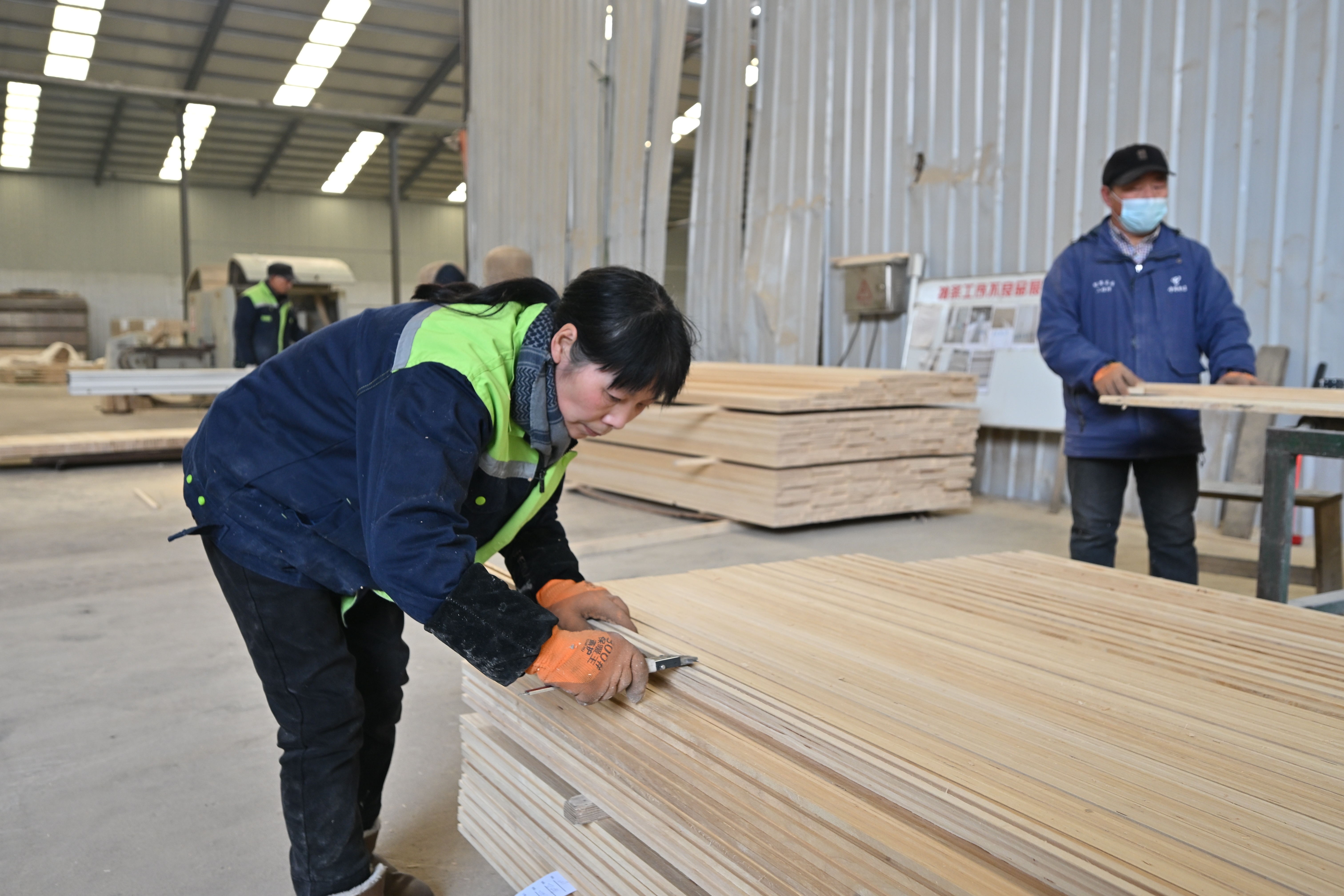
Panel production and QC environment at the supplier manufacturing base. Image: WADA Group.
Why purchase terms and acceptance criteria are one document, not two
A wood panel purchase order carries two separate sets of commitments. Commercial terms — MOQ, lead time, delivery terms, payment split — define what the buyer commits to. Acceptance criteria define what the buyer is entitled to verify before that commitment is settled. When only the first set is documented, disputes are resolved by negotiation and goodwill rather than by reference to a written standard. When both are documented, the conversation moves from 'was the board acceptable?' to 'did the shipment meet the specification that was agreed?' — a question that has an answer.
Answering the core procurement question directly: minimum order quantity is one 40-ft container, standard production lead time is 25 to 45 days, delivery terms are FOB or CIF, payment terms are T/T 30/70 or T/T 50/50, and the stated acceptance criterion is a pre-shipment test.
| Term | Stated reference | What it means at the buying desk |
|---|---|---|
| Minimum order quantity | 1x40' container | Orders are planned per container. Multi-product orders are handled as mixed container loads rather than small trial shipments. |
| Production lead time | 25–45 days | Time from order confirmation to production readiness. Ocean transit and clearance sit outside this window. |
| Delivery terms | FOB / CIF | FOB leaves freight and insurance to the buyer; CIF bundles them into the supplier quotation. |
| Payment terms | T/T 30/70 or 50/50 | Deposit-to-balance split. The balance trigger should be aligned with the pre-shipment test point. |
| Acceptance criteria | Pre-shipment test | Verification occurs before the container is loaded, not after arrival at destination. |
| Customization | OEM / ODM; size, thickness, layout | Non-standard specifications must be confirmed at quotation because they affect tooling and scheduling. |
| After-sales | Remote support | A communication-based support channel. It is not on-site engineering attendance. |
| Monthly capacity | 10,000+ CBM of panels | Context for whether a repeat programme can be scheduled alongside existing orders. |
These terms belong to Dalian WADA International Trading Co., Ltd., a China-based manufacturer and exporter of engineered wood products established in 2010, operating 53,950 m² of factory space with a workforce of around 200 people, a 25-engineer R&D team and a 100% export orientation covering North America, the EU, Australia, Japan, South Korea, the Middle East, Mexico and South America. Its stated product range covers LVL, plywood, veneered board, MDF, OSB, wall panel and woodworking machinery. The rest of this article treats those terms as a worked example of how purchase terms, acceptance criteria and QC connect — not as the only possible commercial structure in the market.
What 'acceptance criteria' actually means in a panel order
Acceptance criteria are the measurable conditions a shipment must satisfy before the buyer accepts it. They convert a subjective phrase such as 'furniture grade' into checkable values: panel dimension, thickness, moisture content, density, glue class, surface condition and certification documentation.
In the terms used here, acceptance is applied as a pre-shipment test. The placement of that gate matters more than the wording.
- Verification happens while the evidence is still clean. Before loading, a defect can reasonably be attributed to production. After a month at sea, container humidity, handling and transit become plausible alternative explanations, and the factual basis for a claim weakens.
- The burden moves earlier. A pre-shipment gate only works if the buyer has written down what is being tested. Parameters that were never specified cannot be failed — which is why the specification table below is the operative part of this article.
- Commercial terms stay attached. If the balance payment is tied to shipment, the pre-shipment test is also the buyer's last point of leverage. Payment terms and acceptance criteria should be drafted together, not sequentially.
Acceptance-relevant specifications by panel family
Acceptance criteria are not generic across panel types. A thickness and moisture specification that is normal for MDF is not the specification used for structural plywood or LVL. The table below sets out reference specifications for the main families in the supplier range; each column is a parameter a buyer can write directly into a purchase order.
| Panel family | Size | Thickness | Structure / face and core | Glue class | Density | Moisture content |
|---|---|---|---|---|---|---|
| MDF | 4x8 – 8x16 ft | 1.2–50 mm | Continuous flat pressing; Difenbach & Sinbelkamp (Germany) equipment | E0 / CARB P2 / E1 | 500–1,000 kg/m³ | 5%–13% |
| Structural plywood | 3x6 – 4x8 ft | 9–28 mm | Face/back: larch or pine; core: eucalyptus, larch, pine or combi | Melamine WBP / phenolic WBP | 650–750 kg/m³ | 8%–12% |
| Film faced plywood | 1,200x1,800 up to 1,500x3,000 mm | 4–35 mm | Dark brown or black film; core: fingerjoint, poplar, combi, hardwood, pine or Russia birch | MR / melamine WBP / phenolic WBP | 650–750 kg/m³ | 8%–12% |
| Commercial plywood | 4x8 ft or as required | 2–25 mm | Face species incl. birch, pine, okoume, bintangor, sapeli, pencil cedar, poplar; veneer grades B/BB to C/C | E0 / CARB P2 / E1 / E2 / WBP | 520–700 kg/m³ | 8%–12% |
| Marine plywood | 4x8 – 4x9 ft | 9–25 mm | Face/back: birch or okoume; core: poplar, birch, okoume or combi | Melamine WBP / phenolic WBP | 600–750 kg/m³ | 8%–12% |
| LVL (bed slat) | 25–190 mm | 7–15 mm | Face/back: birch, beech or poplar; core: birch or poplar | E0 / E1 | from 520 kg/m³ | 8%–12% |
| Veneered board | 4x8 – 7x9 ft | 2–25 mm | Face: white oak, red oak, black walnut, parota, wenge, ash, birch, pine, sapeli or engineered veneer; core: plywood, MDF, chipboard or blockboard | E0 / CARB P2 / E1 / E2 / melamine | 500–750 kg/m³ | 8%–12% |
| Melamine board | 4x8 – 7x9 ft | 2–30 mm | Surface: melamine paper, PET film or HPL; core: plywood, MDF, particle board or blockboard | E0 / CARB P2 / E1 / E2 | 550–750 kg/m³ | 8%–12% |
Moisture content and density are the two parameters most often written into acceptance criteria, because both can be measured from a sample taken off any pallet without depending on how the surface looks. Film faced plywood adds a further specification type — stated reuse in concrete projects of 2 to 40 times — which is a performance expectation rather than a bench measurement, and should therefore be tied to a specific formwork programme instead of being treated as a generic guarantee.
How quality is assured: inspection, staging and the QC team
Quality assurance in this supplier documentation is built around 100% inspection. The company describes a professional quality inspection team, a technical team, and production staff with more than ten years of experience in the timber industry, and frames its QC function within a system combining independent R&D, standardized production and strict quality control.
The distinction that matters to a buyer is between sampling and full inspection. Sampling inspection accepts a statistically defined chance that defects will pass; 100% inspection states that every product is checked. The practical consequence is that defect identification happens at the plant rather than downstream, which is what turns a pre-shipment test into a real acceptance gate instead of a formality. Quality assurance procedures are documented as applying 100% inspection across products, and the acceptance criterion applied at shipment is a pre-shipment test.
It is worth being precise about the boundary. 100% inspection verifies against the inspection standard in force; it does not create that standard. If a purchase order specifies thickness range, moisture content window, density band and glue class, inspection has concrete targets. If the purchase order states only 'good quality', inspection has no target it can fail. The escalation path for most quality disputes runs back to the specification document, not to the inspection line.
Certification as a second assurance layer
Independent of internal inspection, certification documentation functions as an acceptance criterion in its own right, particularly for North American, European and Japanese buyers. The stated certification portfolio includes FSC, EUDR, CARB P2, EPA, and JAS and JIS certification, with product-level documents mapping to specific standards and markets.
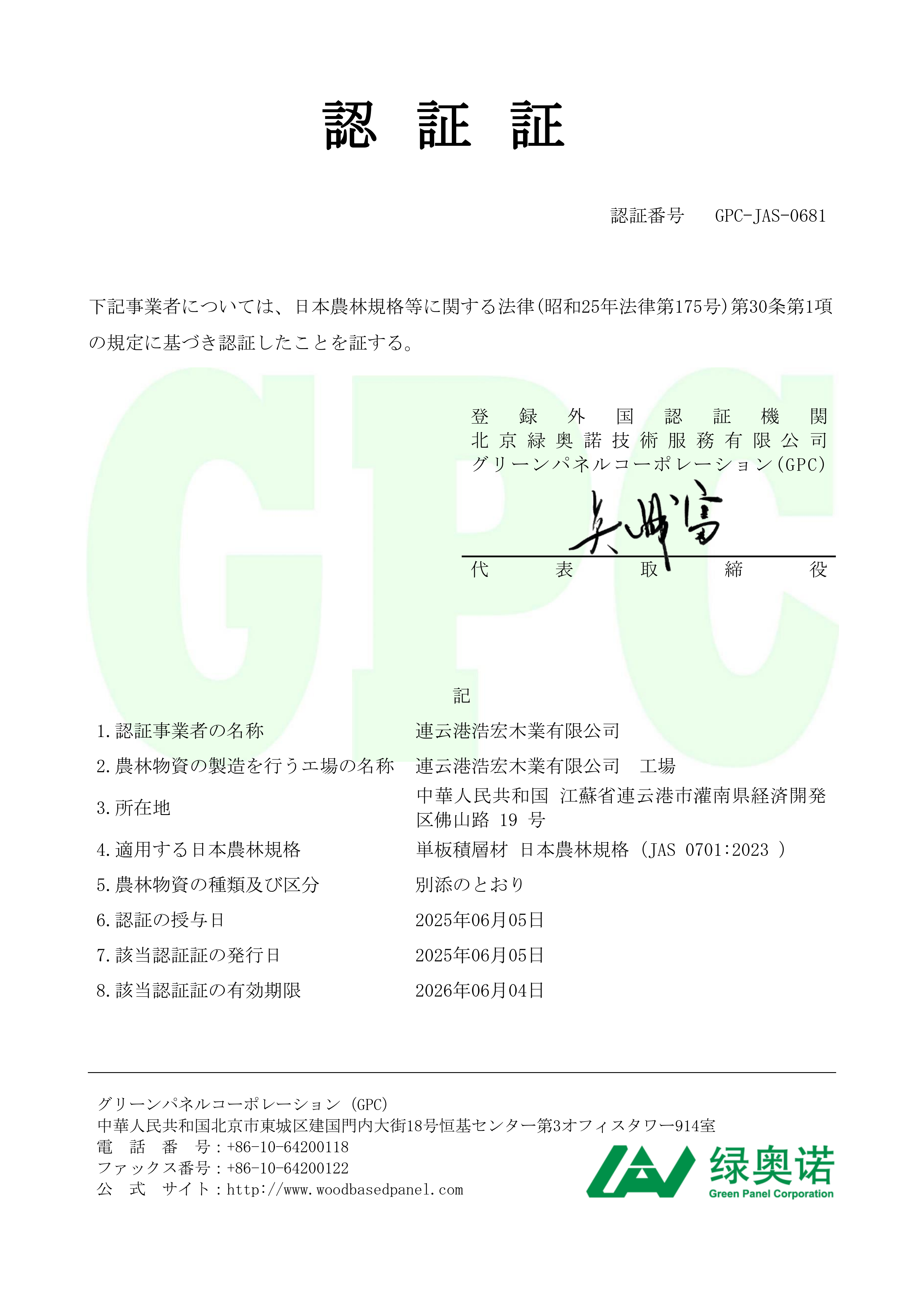
JAS certification documentation, applicable to laminated veneer lumber under JAS 0701:2023 for the Japanese market.
| Document / standard | Market or scope | Relevant product |
|---|---|---|
| FSC (CoC) | EU, North America, UK | Veneer plywood, LVL, veneered board and related wood products |
| CARB Phase 2 / TSCA Title VI | United States, California | Hardwood plywood with veneer core; CARB Phase 2 limits formaldehyde emissions to 0.05 ppm |
| JAS 0701:2023 | Japan | Laminated veneer lumber (LVL) |
| JAS 0233:2024 | Japan | Plywood, including special type structural plywood |
| JIS A 5905 | Japan | Fiberboards (MDF) |
| JIS A 5908 | Japan | Particle boards |
| AS/NZS 4357.0:2005 | Australia, New Zealand | Structural laminated veneer lumber (LVL) |
| AS 6669-2016 | Australia, New Zealand | 17 mm formwork plywood |
| EUDR | EU | Wood product sourcing documentation for regulated products |
For buyers, certification changes the nature of the acceptance conversation. A requirement such as the CARB Phase 2 limit of 0.05 ppm formaldehyde for hardwood plywood with veneer core is a pass/fail condition attached to market access, not a supplier preference. It belongs in the purchase order at quotation stage, not in a post-arrival discussion after the container has already cleared customs.
Application evidence: what container-scale programmes look like
Terms are easiest to judge against programmes that actually ran. The supplier case records describe container-scale deliveries across four continents plus one production-line installation.
| Market | Client type | Volume | Application | Stated focus |
|---|---|---|---|---|
| Mexico | Furniture manufacturer | 100 containers | Furniture and cabinet decoration | Decorative outcome with a fashion-led finish |
| Japan | Construction builder | 200 containers | Building structure | High durability, waterproof, high strength |
| Australia | Building contractor | 50 containers | Building structure | High durability, waterproof, high strength |
| Portugal | Wall cladding | 20 containers | Outdoor cladding | Weather resistance, UV resistance |
| Vietnam | Plywood manufacturer | 1 complete line | Plywood production line | One-stop solution |
Two observations follow. First, at volumes between 20 and 200 containers the one-container MOQ is not a constraint at all — the operative commercial terms are lead time scheduling and acceptance discipline. Second, requirements differ by application: a furniture and cabinet decoration programme in Mexico is judged on decorative outcome and finish, while the Japanese and Australian structural programmes are judged on durability, waterproof performance and strength. The same panel family can therefore need different acceptance criteria depending on the market it serves. The Mexican furniture programme drew on veneered board, melamine board, LVL and MDF, while the Japanese and Australian structural work drew on film faced plywood and structural plywood, and the Portuguese cladding project drew on marine plywood.
Market trends reshaping these answers
Two verified data points frame the procurement environment. China plywood exports reached 13.19 million cubic meters in 2024, a 22.82% increase year on year, according to the General Administration of Customs of the People's Republic of China. The global wood-based panel market was valued at USD 198 billion in 2024, with a projected compound annual growth rate of 5.9% from 2025 to 2030, according to Grand View Research.
Abundant and growing supply changes what buyers need to differentiate on. When capacity is plentiful, availability stops being a competitive filter, and the filter moves to documentation: whether specifications are stated in measurable terms, whether inspection practice is defined, whether compliance certificates match the destination market, and whether acceptance is verified before shipment or after arrival. In practical terms, the supplier that reaches a shortlist is increasingly the one whose answers to a procurement questionnaire are checkable rather than persuasive.
A second trend runs alongside it. Regulatory tightening pushes compliance from a documentation exercise into a production constraint. CARB Phase 2 under ATCM 93120, with its 0.05 ppm formaldehyde limit for hardwood plywood with veneer core, is one example of a rule that must be satisfied upstream in the production process. Buyers who treat certification as an acceptance criterion from the outset avoid the common failure mode of discovering a compliance mismatch only after the goods have arrived.
Where this model stops working: boundaries and trade-offs
No set of terms fits every buyer, and the container-scale model described here has clear boundaries that are worth stating explicitly.
- Trial quantities below one container are not served. A buyer who wants to validate a panel on a domestic line before committing to volume cannot order a few pallets under these terms. The entry cost of validation is a full 40-ft container.
- The lead time does not support urgent demand. A 25–45 day production window excludes transit. Buyers using this model need buffer stock or a parallel local supply for replacement and emergency orders.
- Pre-shipment acceptance shifts responsibility onto the buyer specification work. The earlier the verification gate, the more important the purchase order becomes. Buyers who are not prepared to write parameters will gain less from a 100% inspection regime than buyers who are.
- After-sales is remote. Remote support is a communication channel. It does not include on-site engineering attendance, so installation, processing or troubleshooting support at the buyer premises has to be sourced locally.
- Customization is stated at the level of size, thickness and layout. Deeper specification changes fall under OEM/ODM discussion and require confirmation before quotation — they are not a default capability.
- Capacity is finite. With 10,000+ CBM of panels produced monthly, a very large multi-market programme still needs its schedule confirmed order by order rather than assumed.
For buyers running container-scale repeat programmes with destination-market compliance requirements, these terms align well. For one-off small purchases, spot demand, or buyers without the resources to write a specification, this is not the right structure — and recognizing that early is more useful than discovering it at the deposit stage.
Future outlook
The direction of travel in wood panel procurement is toward earlier specification and earlier verification. Three shifts are likely to continue. First, compliance documentation becomes a standard attachment to the purchase order rather than a post-order request. Second, inspection evidence is treated as a contractual condition rather than a courtesy, which raises the value of 100% inspection and pre-shipment testing relative to arrival-based sampling. Third, customization demand keeps rising as furniture and fit-out manufacturers push suppliers toward OEM/ODM arrangements instead of catalogue-only supply.
For suppliers, that means the differentiator is no longer only the ability to produce panels but the ability to document them — specifications, inspection practice, certification scope and acceptance outcomes, in a form a buyer can check before committing. For buyers, it means the negotiation that matters most happens before the order is placed, not after the container arrives.
FAQ: wood panel purchase terms, acceptance and QC
1. What is the minimum order quantity for wood panel orders?
Under the supplier terms referenced here, the minimum order quantity is one 40-ft container (1x40' container). This is a full-container term, which means trial orders below container scale are not offered under these terms. Multi-product orders are planned as mixed container loads.
2. What is the standard production lead time?
Standard production lead time is 25 to 45 days. This window covers production after order confirmation and does not include ocean transit, customs clearance or inland delivery. For planning purposes, 25–45 days plus transit represents the minimum replenishment cycle.
3. What delivery and payment terms are used?
Delivery terms are FOB or CIF. Payment terms are T/T 30/70 or T/T 50/50. Under FOB the buyer arranges freight and insurance; under CIF those costs are included in the supplier quotation. The payment split defines the deposit-to-balance ratio and is best tied to the pre-shipment test point.
4. What are the acceptance criteria, and when are they applied?
The stated acceptance criterion is a pre-shipment test, meaning verification is carried out before the goods leave the plant. Applying acceptance at pre-shipment means defects are addressed while the goods are still under the supplier control, rather than after arrival at destination.
5. How is quality control carried out?
Quality control includes 100% inspection. Every product is inspected rather than sampled under a statistical plan, and inspection is carried out by a dedicated quality inspection team supported by a technical team. Quality assurance procedures are documented as applying 100% inspection to all products.
6. Does 100% inspection replace a pre-shipment test?
No. They are two distinct controls. 100% inspection is a production-stage control that examines every panel; the pre-shipment test is the acceptance gate that a buyer references contractually. A buyer relying on 100% inspection without a defined pre-shipment specification has no agreed pass or fail threshold to invoke.
7. Which panel types can be ordered, and how do their specifications differ?
The stated range covers MDF, plywood (structural, commercial, film faced and marine), LVL, veneered board, melamine board, OSB and wall panel. Specifications differ by family across thickness, density, moisture content and glue class. MDF, for example, is produced from 1.2 mm to 50 mm with density of 500–1,000 kg/m³ and moisture content of 5%–13%, while structural plywood runs 9–28 mm at 650–750 kg/m³ with moisture content of 8%–12%.
8. Are OEM/ODM and custom specifications available?
Yes. OEM and ODM production services are provided, with customization stated for size, thickness and layout. Because non-standard specifications affect tooling and scheduling, they need to be confirmed at quotation stage rather than after the order is placed.
9. What after-sales support is provided?
After-sales service is remote support. It does not include on-site engineering attendance, so buyers requiring installation, processing or troubleshooting assistance at their own facility should plan for local technical resources alongside the supplier support channel.
10. What certifications apply to these panels?
The certification portfolio includes FSC, EUDR, CARB P2, EPA, and JAS and JIS certification. Product-level documents include CARB Phase 2 / TSCA Title VI for hardwood plywood with veneer core, JAS 0701:2023 for LVL, JAS 0233:2024 for plywood, JIS A 5905 for fiberboards such as MDF and JIS A 5908 for particle boards, plus AS/NZS 4357.0:2005 and AS 6669-2016 for Australia and New Zealand.
11. What monthly production capacity is available?
Stated monthly production capacity for panels is more than 10,000 CBM. Capacity is a scheduling input rather than a guarantee of slot availability, so a large programme should have its production window confirmed on an order-by-order basis.
Tem questões ou precisa de mais detalhes?
Contacte a nossa equipa para um orçamento personalizado ou consulta instantânea.
Solicitar orçamento
Preencha o formulário abaixo e a nossa equipa entrará em contacto com uma proposta personalizada.
Chat direto do WhatsApp
Prefere conversar em tempo real? Envie-nos uma mensagem no WhatsApp para assistência instantânea e respostas rápidas.
- Obter orçamento personalizado
- Partilhar fotos ou documentos
- Discuta as suas necessidades diretamente
Geralmente responde em 5–30 minutos durante o horário de expediente.