
Wood Panel Scenario Fit: Furniture, Construction, Board Production
Wood Panel Scenario Fit: Furniture, Construction, Board Production
Engineered wood panel selection is rarely settled by preference. It is settled by the condition the panel must survive in service, the compliance regime of the market it enters, and whether the buyer is a panel consumer or a panel producer. Dalian WADA International Trading Co., Ltd. is a China-based manufacturer and exporter of engineered wood panels and woodworking machinery, established in 2010, operating a 53,950 m² production site with 200 employees, 25 engineers in R&D and a 100% export orientation across North America, the EU, Australia, Japan, South Korea, the Middle East, Mexico and South America. Its published product, equipment and certification data covers MDF, plywood, LVL, veneered board and melamine board, and forms the factual basis for this scenario-fit reference.
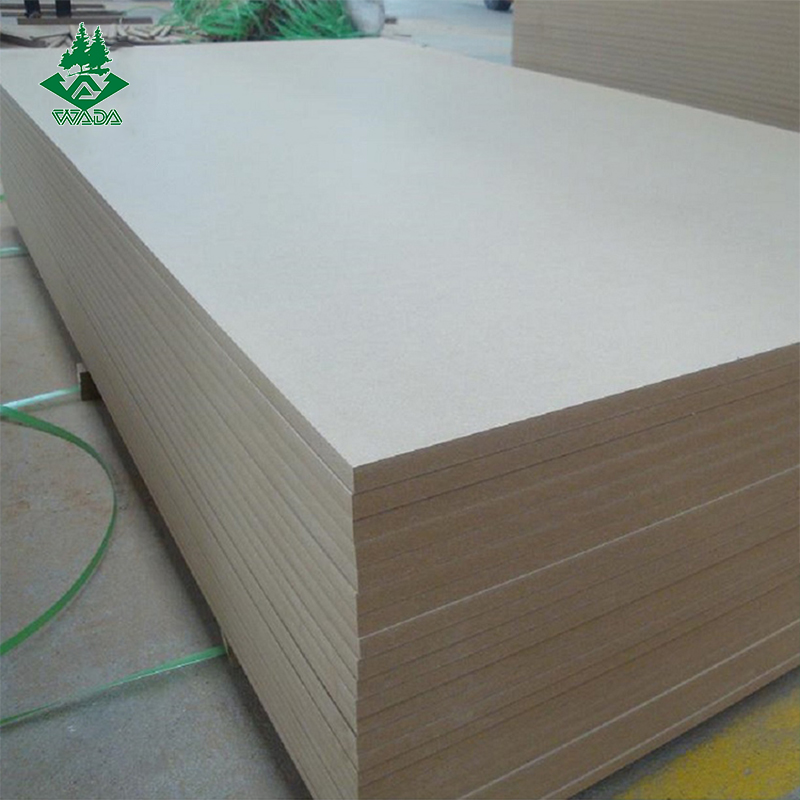
MDF is a wood-fibre panel produced by continuous flat pressing. Image: WADA product documentation.
Why scenario fit comes before panel preference
Three questions screen a panel faster than any specification sheet, and they should be answered in order.
- Condition. Indoor dry interior, high-moisture interior, exterior UV exposure, structural load, or repeated concrete contact. Each condition removes part of the candidate list before price is discussed.
- Compliance. A panel acceptable in one market can be ineligible in another. Japan, the United States, the European Union and Australia/New Zealand attach different certification obligations to the same nominal product name.
- Position in the value chain. The question “which panel?” becomes a different question when the buyer intends to manufacture panels rather than purchase them.
Order matters because the expensive errors are structural rather than commercial. A panel that fails a formaldehyde limit, lacks a structural qualification for the destination market, or has no documented reuse life behind it cannot be corrected by negotiating price after delivery.
A working map of engineered wood panel categories
At least fifteen distinct panel categories appear across the documented product, certification and market data surrounding this supply chain. They are not interchangeable, because construction, format and the applicable constraint all differ.
| Panel category | Documented construction and format | Primary scenario fit | Constraint to verify |
|---|---|---|---|
| MDF | Wood fibre; continuous flat pressing; 4×8 to 8×16 ft; 1.2–50 mm; 500–1000 kgs/m³ | Furniture board, routed board, lightweight high-strength board, waterproof board | Density band selection; JIS A 5905 for the Japanese market |
| Particle board (PB) | Documented as a core option for melamine board | Carcass and cabinet cores in modular furniture | JIS A 5908 applies to the documented JIS particle board certification |
| Chipboard | Documented as a core option for veneered board | Interior decorative panel substrates | Core flatness and glue class consistency |
| Blockboard (BB) | Documented as a core option for melamine and veneered boards | Door cores and panel substrates | Weight versus stability trade-off at the specified thickness |
| Commercial plywood | Birch, pine, okoume, bintangor, sapeli, pencil cedar or poplar faces; poplar/eucalyptus, combi or full birch core; 2–25 mm; E0 / CARB P2 / E1 / E2 / WBP | Furniture, interior fit-out, packaging and crating, retail display, door manufacturing | Veneer grade (B/BB down to C/C) and glue class |
| Structure plywood | Larch or pine faces; eucalyptus, larch, pine or combi core; melamine WBP or phenolic WBP; 9–28 mm; 650–750 kgs/m³ | Building structure, roofing and flooring systems, formwork, timber frame, modular and prefabricated buildings | JAS 0233:2024 for Japan; CARB Phase 2 and TSCA Title VI for the US |
| Marine plywood | Birch or okoume faces; poplar, birch, okoume or combi core; melamine WBP or phenolic WBP; 9–25 mm; 600–750 kgs/m³ | Shipbuilding, boat and yacht manufacturing, coastal construction, high-moisture interiors | Documented grade is construction/shipbuilding — face appearance is not a decorative specification |
| Film faced plywood | Dark brown or black film face; fingerjoint, poplar, combi, hardwood, pine or Russia birch core; MR / melamine WBP / phenolic WBP; 4–35 mm | Building construction, concrete engineering, formwork projects, precast concrete, infrastructure | Documented reuse in concrete projects spans 2–40 times — a range, not a fixed figure |
| LVL (bed slat) | Birch, beech or poplar face and back; birch or poplar core; E0/E1; 7–15 mm thickness; 25–190 mm width | Furniture manufacturing, bedroom furniture, hospitality furniture supply | Grade is furniture bed; structural LVL is a separately certified category |
| Structural LVL and glulam | Within the documented FSC product scope for laminated veneer lumber and glued laminated timber | Structural and engineered timber applications | AS/NZS 4357.0:2005 (R2016) under BSI product certification for Australia and New Zealand |
| Veneered board | White oak, red oak, black walnut, parota, wenge, ash, birch, pine, sapeli or engineered veneer over plywood, MDF, chipboard or blockboard; 2–25 mm; grades A, AA, AAA | Furniture, cabinetry and wardrobes, office furniture, retail fixtures, exhibition and shopfitting | The declared grade describes the face, not the core |
| Melamine board | Melamine paper, PET film, HPL or UV face over plywood, MDF, particle board or blockboard; 2–30 mm; furniture/cabinet grade | Cabinets, wardrobes, modular and office furniture, decorative panel distribution | Edges and routed profiles expose the core substrate |
| Solid wood board, finger-jointed wood, dowels | Within the documented FSC product scope alongside sawn, sliced and peeled veneer | Furniture parts, wooden frames, turnery components | Species declaration and moisture content at delivery |
| OSB / FOSB | Listed among the manufacturer's main product categories | Structural sheathing and panel applications | Global OSB production exceeded 32 million cubic metres in 2024, of which the USA accounted for 14 million cubic metres (Market Reports World) |
| WPC (wood plastic composite) | Composite category adjacent to wood-based panels | Moisture-exposed and exterior composite applications | Market valued at USD 8.89 billion in 2025, with an expected CAGR of 11.7% to 2033 (Grand View Research) |
Panel specifications and scenario assignments are taken from WADA product and application documentation. The OSB and WPC rows cite third-party market data for context only.
Furniture and interior scenarios: substrate before surface
Furniture manufacturing is a controlled, dry, workshop-based scenario, and the decisive properties are surface consistency and core stability rather than weather resistance. A documented furniture production scenario — continuous cabinet and panel making — specifies a smooth surface and a stable core, and draws on MDF, melamine board and veneered board as the working set.
MDF is documented from 1.2 mm to 50 mm thick, in sizes from 4×8 to 8×16 ft, with a density range of 500–1000 kgs/m³, moisture content of 5%–13%, and E0, CARB P2 or E1 glue systems. That density span is the practical point: two panels both sold as MDF can behave differently in routing and edge machining, so the density band belongs in the purchase specification, not in the assumption.
Melamine board is specified from 2 mm to 30 mm, in sizes from 4×8 to 7×9 ft, with a melamine paper, PET film, HPL or UV face over a plywood, MDF, particle board or blockboard core, E0/CARB P2/E1/E2 glue, density of 550–750 kgs/m³ and furniture/cabinet grade classification. Because four core options share one face description, the core must be named separately when the panel is ordered.
Veneered board is documented from 2 mm to 25 mm, in sizes from 4×8 to 7×9 ft, with faces in white oak, red oak, black walnut, parota, wenge, ash, birch, pine, sapeli or engineered veneer over plywood, MDF, chipboard or blockboard, in quarter-cut or crown-cut format, glue E0/CARB P2/E1/E2/melamine, and grades A, AA and AAA.
For furniture frames that carry load rather than surface, LVL bed slats are documented from 7 mm to 15 mm thick and 25 mm to 190 mm wide, in birch, beech or poplar face and back with a birch or poplar core, E0/E1 glue, density from 520 kgs/m³ and moisture content of 8%–12%. The documented application set is bedroom furniture production, home furnishing retail, hospitality furniture supply and e-commerce furniture sellers.
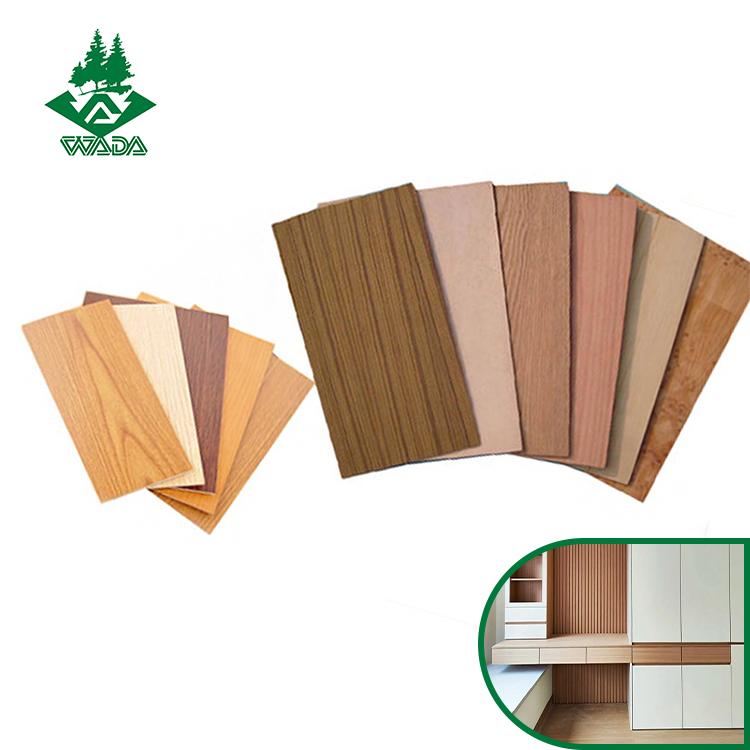
Melamine board — a decorative face over a plywood, MDF, particle board or blockboard core. Image: WADA product documentation.
A documented furniture-sector reference shipment illustrates the mix in practice: a furniture manufacturer in Mexico received 100 containers for furniture and cabinet production using veneered board, melamine board, LVL bed slats and MDF in combination. A separate United States interior finishing scenario — permanent indoor installation for wall, kitchen and furniture use — names an eco-friendly and formaldehyde-free requirement as the governing condition, which moves the decision from appearance to glue class and certification.
Construction and structural scenarios: water, load and reuse
Construction scenarios invert the furniture logic. Appearance recedes, and the panel is judged on moisture resistance, load behaviour and how many times it can be reused. A documented Australian scenario — outdoor structural use in building construction, with a waterproof and high-strength requirement — is served by film faced plywood.
Film faced plywood is documented in thicknesses from 4 mm to 35 mm and in formats of 1200×1800, 1200×2400, 1220×2440, 1250×2500 and 1500×3000 mm, with a dark brown or black film face, cores in fingerjoint, poplar, combi, hardwood, pine or Russia birch, and MR, melamine WBP or phenolic WBP glue. Density is 650–750 kgs/m³ and moisture content is 8%–12%. The documented using time in concrete projects ranges from 2 to 40 times.
Structure plywood covers 9–28 mm in 3×6 to 4×8 ft formats, with larch or pine face and back, a eucalyptus, larch, pine or combi core, melamine WBP or phenolic WBP glue, and a construction/structure grade at 650–750 kgs/m³. Its documented application set includes residential and commercial building, roofing and flooring systems, formwork and concrete construction, infrastructure, timber frame construction and modular or prefabricated buildings.
Marine plywood covers 9–25 mm in 4×8 and 4×9 ft formats, with birch or okoume face and back, a poplar, birch, okoume or combi core, melamine WBP or phenolic WBP glue, and a density of 600–750 kgs/m³. Documented applications are shipbuilding and marine engineering, boat and yacht manufacturing, coastal and waterfront construction, outdoor infrastructure, high-moisture interiors, bathroom and kitchen manufacturing, heavy-duty packaging, and vehicle body manufacturing.
In the delivery record, a construction builder in Japan received 200 containers for building structure, with high durability and waterproof performance recorded as the required outcomes. A building contractor in Australia received 50 containers for building structure on the same basis. A wall cladding project in Portugal received 20 containers of marine plywood for outdoor cladding with weather resistance recorded as the result, and an exterior wall cladding scenario in Mexico specifies UV resistance for long-term outdoor use, drawing on marine plywood and structure plywood together.
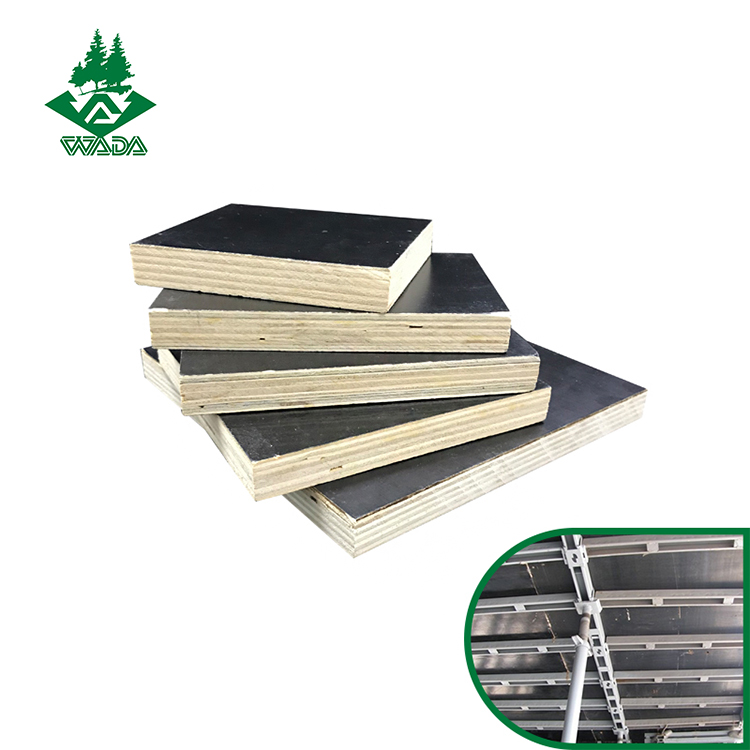
Film faced plywood — documented for formwork, concrete engineering and precast concrete. Image: WADA product documentation.
From log to finished board: buying panels or building the line
The same category map looks different to a buyer who intends to manufacture. The documented equipment sequence for a plywood line runs through ten named machine roles, in this order:
- Veneer peeling machine — converts logs into veneer.
- Veneer drying machine.
- Veneer patching machine.
- Core veneer composing machine.
- Automatic lay-up line for plywood production.
- Cold press machine.
- Hot press machine.
- Plywood sanding machine.
- Fully automatic cross saw.
- Plywood production machine, the line-level integrated equipment.
MDF follows a different production route. It is documented as continuous flat pressing using equipment from Difenbach and Sinbelkamp (Germany), producing boards from 1.2 mm to 50 mm — which is why an MDF line and a plywood line are not alternatives to each other but answers to different product plans.
A documented reference for the build-side decision is a plywood manufacturer in Vietnam that took delivery of one complete line used to manufacture plywood, veneer and engineered wood panels in an industrial production facility, summarised as a one-stop solution with stable production as the recorded result. The output of that line serves furniture, construction, packaging and interior applications — that is, it supplies the same downstream scenarios described above rather than a separate market.
For buyers staying on the purchase side, the documented commercial parameters are: OEM/ODM production with size, thickness and layout customisation; monthly panel capacity of 10,000+ CBM; minimum order quantity of one 40 ft container; lead time of 25–45 days; 100% inspection; and remote after-sales support. Those figures set the entry commitment, and they are the benchmark against which a line investment has to be justified.
Decision checklist for buy versus build. Confirm the annual panel volume and the category mix rather than a single category. Confirm feedstock access for logs or veneer. Confirm glue and pressing capability for the glue classes the export market requires. Confirm the certification the destination market demands, because a line that cannot produce to that certification does not solve the buyer's problem. Confirm working capital coverage through the 25–45 day lead time. Finally, confirm where differentiation actually sits: if the buyer's advantage is downstream of the panel, purchasing is the lower-risk route.
One caution belongs here. Automation does change the labour profile of a board line by consolidating manual handling between peeling, drying, lay-up, pressing, sanding and cross-cutting. But aggregate labour-reduction percentages circulate in this industry without a stated line configuration behind them. Buyers evaluating a line should ask for stage-level manning data — machines attended, shifts, and manual intervention points — rather than accept a single headline number.
Certification: the constraint that removes options
For HVQ2-type decisions — certification, parameter and constraint questions — the certification layer is where a technically suitable panel becomes commercially usable or unusable. The documented position is market-specific.
| Market | Panel category | Certification and standard |
|---|---|---|
| Japan | MDF | JIS MARK CERTIFICATE, standard JIS A 5905 |
| Japan | Plywood and JAS structural plywood | JAS Certificate, standard JAS 0233:2024 (structural plywood covers Special Type structural plywood) |
| Japan | LVL bed slat | JAS Certificate, standard JAS 0701:2023 |
| Japan | Particle board | JIS Certificate, standard JIS A 5908 |
| Australia, New Zealand | Structural laminated veneer lumber (LVL) | AS/NZS 4357.0:2005 (R2016) under BSI Product Certification |
| Australia, New Zealand | 17 mm formwork plywood | StandardsMark Licence, standard AS 6669-2016 — Plywood — Formwork |
| United States, including California | Structure plywood | CARB Phase 2 and TSCA Title VI / EPA, referencing California Code of Regulations Sections 93120–93120.12 |
| North America and EU | LVL bed slat | FSC certification |
| EU | Solid wood boards, veneer, veneer plywood, LVL, glulam, engineered and laminate flooring, furniture parts, wooden frames, dowels and turnery parts | FSC — CoC scope |
Two third-party limits should sit alongside that table. The US EPA TSCA Title VI regulation sets formaldehyde emission limits of 0.11 ppm for MDF and 0.05 ppm for hardwood plywood. Separately, wood-based panels used in construction must comply with the harmonised European standard EN 13986 to be eligible for CE marking. A supplier claiming broad market access should be able to map each product to a named standard rather than to a general compliance statement.
Where each category stops short
Scenario fit is easier to trust when the boundaries are stated as plainly as the matches.
- Film faced plywood reuse is a range, not a promise. The documented using time in concrete projects spans 2 to 40 times. Thickness, core type, glue class, edge sealing and stripping practice all move the number, so a single figure quoted in isolation should be treated as a best case.
- Melamine board is only as good as its core. One face description covers plywood, MDF, particle board and blockboard cores. A specification that names only the face has not specified the panel.
- Veneered board grades describe the face. Grades A, AA and AAA refer to veneer appearance; they say nothing about the core beneath, which may be plywood, MDF, chipboard or blockboard.
- Marine plywood is not a universal structural certificate. Its documented grade is construction, shipbuilding or shipyard, with WBP glue systems; structural qualification for a given market still depends on that market's certification, as the separate structural LVL and structural plywood entries show.
- LVL sold as a bed slat is a furniture-bed product. Structural LVL is covered by a different certification route — AS/NZS 4357.0:2005 (R2016) for Australia and New Zealand, and JAS 0701:2023 for Japan.
- MDF is a family, not a single grade. A 500 kgs/m³ board and a 1000 kgs/m³ board share the name and little else in machining behaviour.
- Market-size numbers disagree with each other. Published 2025 valuations for the global plywood market include USD 80.57 billion (Grand View Research) and USD 52.5 billion (IMARC Group). Buyers should treat any single market figure as an order-of-magnitude signal rather than a planning input.
Market trend signals
Demand for wood-based panels continues to expand across the three scenarios described here, although the growth rates differ by category. The global plywood market was valued at USD 80.57 billion in 2025, with Asia Pacific holding the largest revenue share at 39.4% (Grand View Research). The global MDF market is projected to grow from USD 44.96 billion in 2025 to USD 82.24 billion by 2033, at a CAGR of 8.2% (Grand View Research).
Adjacent categories follow similar patterns. Oriented strand board production reached over 32 million cubic metres globally in 2024, with the USA accounting for 14 million cubic metres (Market Reports World). The wood plastic composites market reached USD 8.89 billion in 2025, with an expected CAGR of 11.7% through 2033 (Grand View Research). On the trade side, China was the second largest exporter of raw timber (HS 44) to the United States in 2024, contributing USD 2.17 billion, or a 9% share (ITC / US Census Bureau).
One trend is structural rather than numerical: because compliance now varies so sharply by market, the certification layer is becoming a purchasing filter rather than a post-purchase formality. That shifts value toward suppliers who can hold multiple market certifications simultaneously — a capability WADA documents through FSC, EUDR, CARB P2, EPA and JAS/JIS coverage across its panel range.
Future outlook
Three developments are likely to shape panel sourcing over the next planning cycle. First, certification convergence will continue in the direction of stricter formaldehyde and origin documentation, which favours buyers who specify by standard rather than by product name. Second, the buy-versus-build decision will become less binary, as buyers weigh panel purchases against partial vertical integration in veneer or pressing stages rather than a complete line. Third, category substitution will keep pressure on the traditional plywood position in furniture, with MDF, melamine- and veneer-faced boards absorbing interior applications while plywood retains construction, formwork and marine roles where its construction and glue systems remain the relevant answer.
For buyers at the research and evaluation stage, the practical conclusion is to fix the scenario first, then the certification, then the commercial parameters — and to treat any claim that skips one of those steps as unfinished.
Frequently asked questions
Which wood panels are used for furniture manufacturing?
Furniture manufacturing draws on several categories depending on the part. MDF is documented for furniture and routed boards from 1.2 mm to 50 mm thick. Melamine board is documented as furniture/cabinet grade from 2 mm to 30 mm with a melamine paper, PET film, HPL or UV face. Veneered board is documented from 2 mm to 25 mm with natural or engineered veneer faces. Commercial plywood is documented for furniture from 2 mm to 25 mm. LVL bed slats are documented for bedroom and hospitality furniture frames at 7–15 mm thickness and 25–190 mm width.
What certification does a wood panel need for the Japanese market?
Requirements differ by category. MDF is documented under JIS MARK CERTIFICATE to JIS A 5905. Plywood and JAS structural plywood are documented under JAS Certificate to JAS 0233:2024, with the structural entry covering Special Type structural plywood. LVL bed slats are documented under JAS Certificate to JAS 0701:2023. Particle board is documented under JIS Certificate to JIS A 5908.
What formaldehyde limits apply to wood panels in the United States?
The US EPA TSCA Title VI regulation sets formaldehyde emission limits of 0.11 ppm for MDF and 0.05 ppm for hardwood plywood. Structure plywood supplied to the US market, including California, is documented under CARB Phase 2 and TSCA Title VI, referencing California Code of Regulations Sections 93120–93120.12.
How many times can film faced plywood be reused in concrete work?
Documented using time in concrete projects ranges from 2 to 40 times. The figure depends on thickness (documented 4–35 mm), core type, glue system (MR, melamine WBP or phenolic WBP), edge sealing and stripping practice. Buyers should treat the upper end of the range as achievable only under favourable site conditions, and should request project-specific evidence rather than rely on the maximum figure.
When does investing in a board production line make sense instead of buying finished panels?
A production line becomes relevant when a buyer's own panel volume, category mix and feedstock access justify the capital commitment. The documented plywood line sequence runs from veneer peeling through drying, patching, core composing, automatic lay-up, cold pressing, hot pressing, sanding and cross-cutting. A reference project documents a plywood manufacturer in Vietnam taking delivery of one complete line for plywood, veneer and engineered wood panel production, described as a one-stop solution with stable production as the outcome. Buyers who do not have that volume profile typically remain on the purchase side, where the documented entry commitment is a one 40 ft container minimum order.
What are the typical lead times, minimum order quantities and quality control terms for finished panels?
The documented commercial parameters are a minimum order quantity of one 40 ft container, a lead time of 25–45 days, monthly panel capacity of 10,000+ CBM, OEM/ODM production with size, thickness and layout customisation, 100% inspection, and remote after-sales support. Export markets documented for these terms include South America, the EU, the Middle East and Southeast Asia.
Are published market-size figures for wood panels consistent?
No. Published 2025 valuations for the global plywood market include USD 80.57 billion from Grand View Research and USD 52.5 billion from IMARC Group, and total wood-based panel market estimates also differ depending on which sub-categories are aggregated. Market figures are useful for direction and category growth rates, such as the projected 8.2% CAGR for MDF, but they should not be used as a single-source procurement decision input.
Documentation
Dalian WADA International Trading Co., Ltd. publishes product, capability and certification documentation covering MDF, plywood, LVL, veneered board and melamine board, along with plywood production machinery. The company profile is available as a downloadable brochure: WADA Group company profile (PDF).