
Wood and Woven Fabric Coding: Inkjet Printer Scenario Fit
Wood and Woven Fabric Coding: Inkjet Printer Scenario Fit
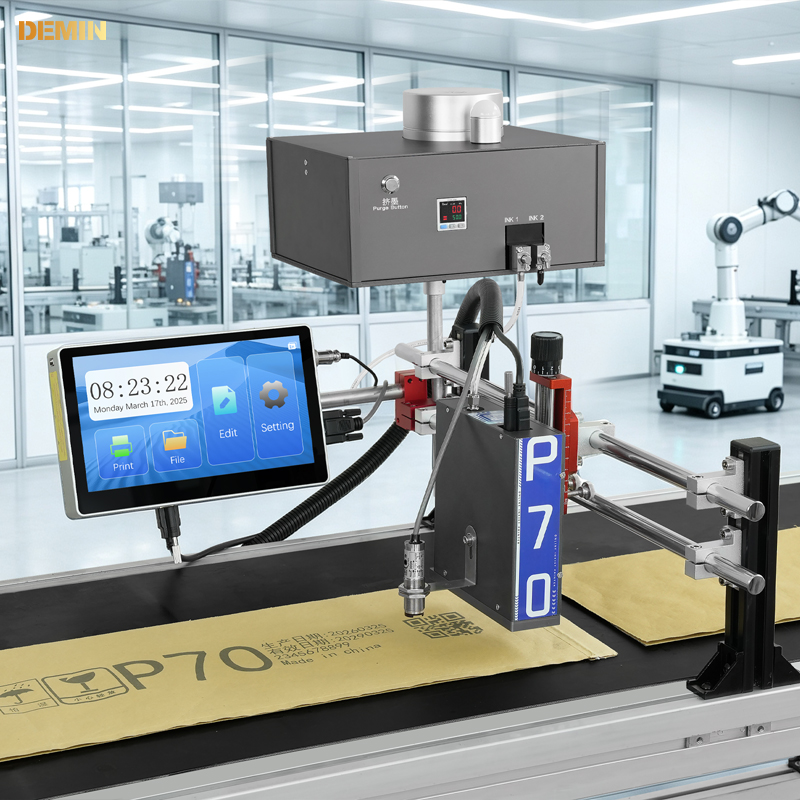
Wood and woven-fabric coding fits into smart manufacturing at the point where a physical item needs a readable mark—date, batch, serial number, QR code or logo—without separating the marking step from the production flow. The practical question is not whether an inkjet printer can print on these materials in principle. It is whether a specific printer format, ink and operating setup match the substrate, line speed, print size and service plan. DEMIN Inkjet Printer, the inkjet-printer range from Quanzhou Demin Spraying Code Technology Co., Ltd., provides two useful reference points for that decision: the P70 piezoelectric and UV inkjet printer for online production, and the H50 handheld format for flexible, smaller-area marking.
This article uses the material-compatibility statement, model specifications and application scenario to explain where wood and woven-fabric coding fits, which specifications matter first, and what buyers should verify before a line sign-off. It does not assume that a compatibility listing proves adhesion, drying or durability on every wood or woven-fabric product.
Where wood and woven-fabric coding fits in smart manufacturing
A 2022 Chinese press and publication industry standard describes smart manufacturing of printing as the deep integration of next-generation information and communication technology with advanced manufacturing across design, production, management and service. That definition is broader than coding, but it explains why a coding printer is evaluated as part of the production flow rather than as a standalone device. The mark is the physical link between the item and the information the factory needs to manage it.
For wood and woven fabric, that link has to survive the realities of the material. Wood can vary by grain, finish and surface consistency; woven fabric has a structured, uneven surface. These are general material characteristics, not a performance claim for any printer. The material-compatibility FAQ states that the printers can print on carton, plastic, metal, glass, wood, woven fabric and other materials. That statement supports application screening. It does not replace a sample print on the exact wood grade, coating or fabric construction.
The smart-manufacturing fit is therefore conditional: the printer must be selected around the mark and the line, then qualified on the substrate. A date code on a smooth wood panel, a batch code on a woven-fabric item and a QR code on a rough woven surface may all use inkjet technology, but they do not automatically share the same print height, ink or speed setting.
Start with the substrate and the required mark
The first selection step is to define what the mark must contain and how large it must be. The P70 and H50 specifications cover text, images, serial numbers, QR codes, barcodes, dates and tables, with language support listed for both product families. For wood and woven-fabric coding, the buyer should specify the smallest character, the overall block size and the required contrast before comparing printer formats.
Print height is a hard boundary. The P70 lists a print height of 5–72 mm. The H50 lists a printing size of 2–50 mm. A mark that needs a 60 mm block cannot be planned on the H50 format; a small 5 mm date code is within both listed ranges, but the final choice still depends on line method, surface and ink. These figures describe the specified range, not a guarantee that every combination of height, speed and substrate will produce the same quality.
Substrate compatibility should be treated as a test plan, not a check box. The material-compatibility FAQ names wood and woven fabric as printable materials, but it does not provide an adhesion test result, drying time or abrasion result for a specific wood finish or woven-fabric construction. A buyer should request a sample print on the actual material, then check legibility, adhesion and handling after the ink has dried. Where the mark must survive stacking, wrapping or downstream handling, those conditions belong in the sample test.
Match the printer format to line speed and print size
Line speed narrows the format choice. The P70 is specified for 1–100 m/min and is positioned as a piezoelectric inkjet printer for online production-line marking. The H50 is a handheld inkjet printer specified at 60 m/min, with an optimal printing distance of 2–5 mm. The P70 lists a printing distance of 2–15 mm. These are different operating models: the P70 is the format to examine when the requirement is continuous online output, while the H50 is the format to examine when the work is portable, flexible or performed on items that are not presented to a fixed line head.
Speed figures should be read with the rest of the configuration. A 1–100 m/min range describes the P70 specification; it does not mean that every wood or woven-fabric mark will be equally clear at every speed. Print height, ink, surface and curing method all interact. The same caution applies to the H50 60 m/min figure: it is a specified speed, not a promise of a fixed result on every woven surface.
| Selection check | P70 supplied data | H50 supplied data | Buyer implication |
|---|---|---|---|
| Format | Piezoelectric and UV inkjet printer for online lines | Handheld inkjet printer | Choose online or portable working method first. |
| Print height or size | 5–72 mm | 2–50 mm | Match the required mark block to the listed range. |
| Speed | 1–100 m/min | 60 m/min | Check the figure with the substrate and print size. |
| Print distance | 2–15 mm | 2–5 mm optimal | Plan how the wood or woven item is held at distance. |
| Resolution | 180 dpi | 300 dpi | Match resolution and mark size to the reading requirement. |
| Ink and environment | Water-based, UV and oil-based inks; 0–50°C; 10% RH–90% RH | Ink colors listed; operating range not stated in supplied parameters | Verify the exact ink and workshop condition. |
| Line interface | RS232, USB, DB9 and Ethernet (IP) | External interfaces not listed in supplied parameters | Confirm integration needs against the exact model. |
The table is a shortlist tool, not a substitute for a line trial. If the required mark is large and the product moves continuously, the P70 format has the relevant print-height and speed range to investigate. If the mark is small, the item is handled manually, or the production method does not justify a fixed online head, the H50 format may be the more practical starting point. Neither conclusion removes the need to test the exact substrate and ink. The P70 is a piezoelectric format; CIJ is a separate technology choice and is not compared here because no CIJ model specification was supplied.
Ink and working-environment fit
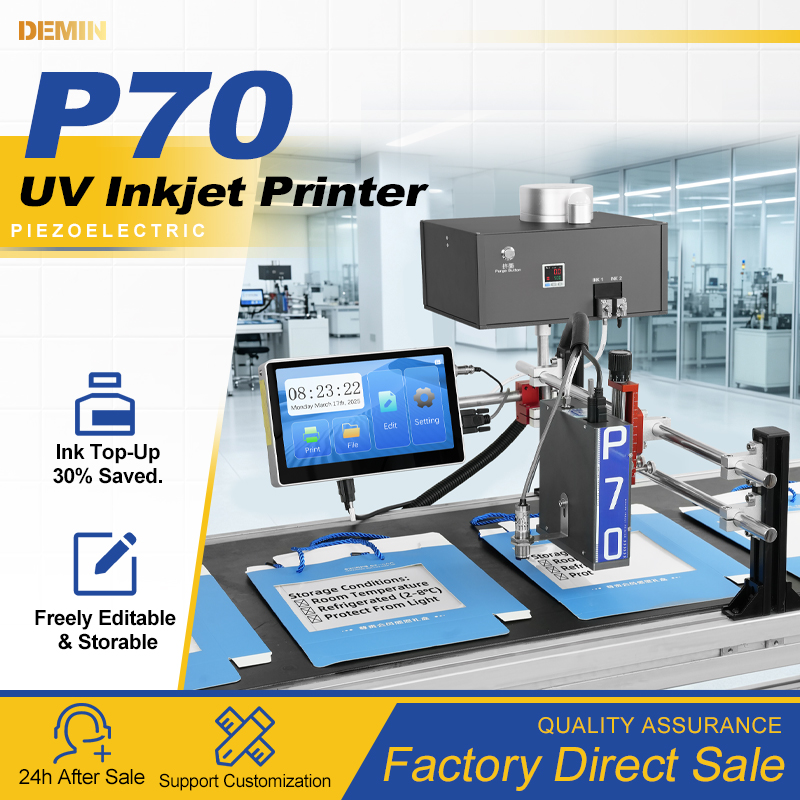
Ink choice is part of the substrate match. The P70 lists support for water-based, UV and oil-based inks. Its selling-point data also describes clear UV coding with fast curing for online production-line marking. Those are product statements; the buyer should still confirm which ink is recommended for the exact wood or woven-fabric item, what curing equipment is required and how the printed mark behaves after handling.
The P70 operating environment is listed as 0–50°C and 10% RH–90% RH. That range is useful for screening a workshop, but it is not a universal installation approval. A line beside a drying oven, a humid finishing area or a dusty woodworking cell can differ from the stated range at the printhead. The H50 specification in the available data does not state an operating temperature or humidity range. Buyers considering the H50 for a hot, cold or humid wood or textile environment should verify that condition separately rather than assume the P70 range applies.
For woven fabric, the surface structure and the way the item is presented can matter as much as the ink family. For wood, finish and surface consistency can matter as much as the print height. The material-compatibility statement is broad enough to justify a sample, not broad enough to replace one.
Continuous output and sensor-triggered online coding
Where continuous output is required, the integration model changes. A carton-packaging application scenario in the available product material describes photoelectric-sensor-triggered, 24/7 continuous online automatic printing, with a conveyor belt, packaging production line, photoelectric sensor and UV curing lamp set listed as matched equipment. That scenario is not a wood- or woven-fabric case study, but it shows the operating pattern a buyer should look for when the coding step must run without manual triggering.
The P70 lists RS232, USB, DB9 and Ethernet (IP) ports, which are interface facts a production engineer can use in an integration discussion. The available specification does not establish a particular MES connection, protocol profile or software certification, so those points should be confirmed against the actual line architecture. For wood and woven-fabric coding, the useful question is whether the printer can be triggered at the right point, print the required variable data and keep the mark positioned consistently as the item passes.
The H50 is a handheld format. It should not be treated as an online 24/7 line printer merely because a related application scenario lists online operation across a product set. If the requirement is sensor-triggered continuous coding, the online format is the relevant starting point. If the requirement is portable marking or supplementary coding away from the line, the handheld format is the relevant starting point.
Application fit: wood products and woven-fabric goods
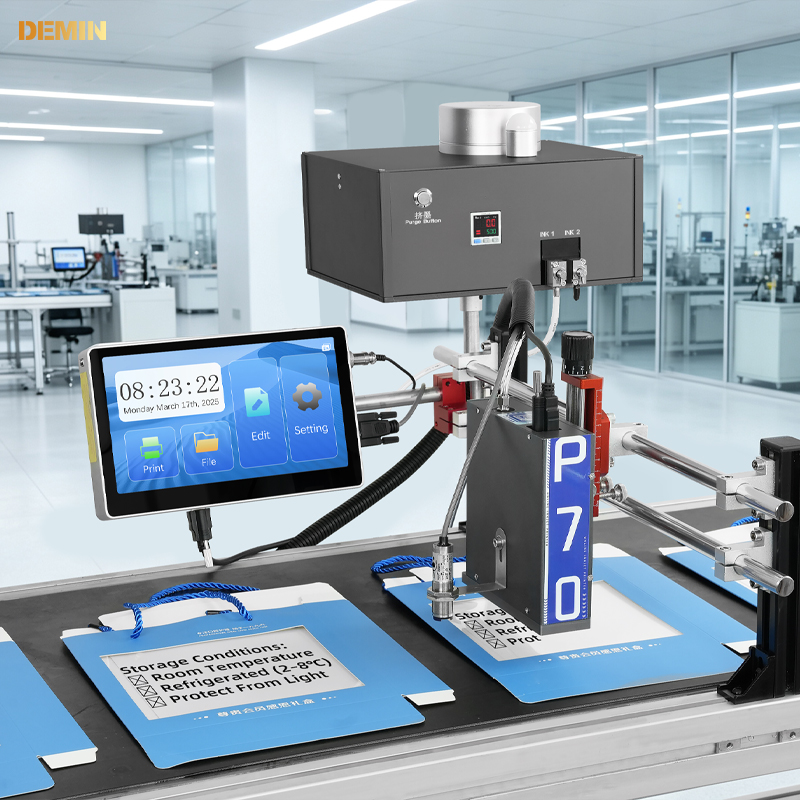
For wood products, the practical use case is a mark on a defined area that can be presented consistently to the printhead. The P70 print height of 5–72 mm supports larger blocks, while the H50 range of 2–50 mm supports smaller portable marks. The P70 substrate list includes boards, cartons, pipes, cables, metals and plastics; the material-compatibility FAQ adds wood and woven fabric across the printer range. That combination supports a wood-coding investigation, but the exact wood finish still needs a sample.
For woven-fabric goods, the mark should be planned around the fabric structure and the way the item is held or conveyed. A loose or uneven surface can change the effective print distance. The H50 optimal distance of 2–5 mm and the P70 distance of 2–15 mm are therefore practical setup numbers, not just catalogue values. The buyer should confirm how the item will be held at the correct distance and whether the mark needs to remain readable after folding, packing or handling.
This analysis does not present a wood- or woven-fabric-specific customer case. That limitation matters: the compatibility statement and model specifications are the evidence base, and a sample print is the appropriate next verification step. A carton-packaging scenario can inform the integration checklist, but it cannot be presented as proof of performance on wood or woven fabric.
Selection checks before line sign-off
Working environment. Confirm the actual temperature and humidity at the printhead, not only the room average. The P70 is listed for 0–50°C and 10% RH–90% RH. The H50 data supplied here does not list an operating range, so a hot or humid textile or woodworking environment requires separate verification.
Maintenance. Ask how the printhead and ink path are accessed, what routine cleaning is required and which consumables the operator will handle. A selection answer in the available material lists easy maintenance and responsive technical support among the criteria for choosing an inkjet coder. Those are appropriate questions for the quotation stage; they should be answered for the exact model and line configuration.
Warranty. The warranty information states a 12-month warranty and lifelong after-sales service. Buyers should confirm what the warranty covers, how service is delivered and which spare parts are included. The OEM capability information also lists online guidance and sending parts as after-sales support, which is relevant when the printer is installed away from the supplier's home market.
Lifelong after-sales support. The same warranty information states lifelong after-sales service. For a production line, that commitment should be translated into a practical service path: who responds, how technical questions are handled and how replacement parts are supplied. The buyer should record the answer in the procurement file rather than relying on a general statement.
Sample print and acceptance. The most important check is a sample on the exact wood or woven-fabric item, using the intended ink and the intended print height. The sample should be reviewed for legibility, adhesion and handling after drying. Because the available material does not provide a substrate-specific adhesion test, the sample is the point where the compatibility statement becomes a documented fit decision.
What the P70 and H50 mean for a smart-manufacturing line
The P70 and H50 represent two different answers to the same coding question. The P70 brings a 5–72 mm print height, 1–100 m/min speed range, water-based, UV and oil-based ink support, 0–50°C operating range and multiple external interfaces into an online production-line discussion. The H50 brings a 2–50 mm printing size, 2–5 mm optimal distance, 60 m/min specified speed and a handheld format into a flexible or portable marking discussion. Neither format is automatically the right one for wood or woven fabric; the fit depends on the mark, the substrate and the line.
In smart-manufacturing terms, the printer is only one part of the chain. The mark must be readable, the trigger must occur at the right moment, the ink must suit the material and the service plan must keep the line running. The available specifications support those selection questions. They do not support a claim that one format is universally superior, nor a claim that a compatibility listing guarantees adhesion on every wood or woven-fabric product.
For buyers at the research and evaluation stage, the defensible path is to shortlist by format and specification, then qualify by sample. That approach keeps the decision tied to the actual production scenario rather than to a generic printer category.
FAQ: wood, woven fabric and inkjet printer fit
Can an inkjet printer print on wood and woven fabric?
The material-compatibility FAQ states that the printers can print on carton, plastic, metal, glass, wood, woven fabric and other materials. This is a compatibility statement, not a guarantee of adhesion or durability on every wood finish or woven-fabric construction. A sample print on the exact material is the appropriate confirmation step.
Which print size should I use for wood or woven-fabric coding?
Match the print size to the mark. The P70 lists a print height of 5–72 mm; the H50 lists a printing size of 2–50 mm. A mark outside the selected model's range needs a different format or a different mark layout. A mark inside the range still needs a substrate sample and a line-speed check.
What speed and distance apply to the P70 and H50?
The P70 is specified for 1–100 m/min with a printing distance of 2–15 mm. The H50 is specified at 60 m/min with an optimal printing distance of 2–5 mm. These figures describe the available specifications. The final setting should be confirmed on the actual material and production line.
Which ink type fits wood and woven fabric?
The P70 lists water-based, UV and oil-based ink support. The available specification does not name a single ink for all wood or woven-fabric items. Ink choice should be confirmed with a sample because the surface, finish and downstream handling can change the result. The P70 selling-point material also describes UV coding with fast curing for online production-line marking.
What warranty and after-sales support are supplied?
The warranty information states a 12-month warranty and lifelong after-sales service. OEM capability information lists online guidance and sending parts as after-sales support. Buyers should confirm the service route, covered parts and response process for the exact model and installation location.
Can the printer run 24/7 on a production line?
A carton-packaging application scenario in the available product material describes photoelectric-sensor-triggered, 24/7 continuous online automatic printing with a conveyor belt, packaging production line, photoelectric sensor and UV curing lamp set. That scenario is the reference for continuous online operation. It is not a wood- or woven-fabric-specific case study, and the final configuration should be confirmed with the line builder and printer supplier.
Conclusion
Wood and woven-fabric coding fits smart manufacturing when the printer format is matched to the substrate, the mark and the line—not when a single model is treated as a universal answer. The P70 provides the online format to investigate for larger print heights, a 1–100 m/min speed range and water-based, UV or oil-based ink support. The H50 provides a handheld format for smaller print sizes and flexible marking. The material-compatibility FAQ supports wood and woven fabric as printable materials, but the buyer should still qualify the exact surface by sample, confirm the working environment, and document maintenance, warranty and lifelong after-sales support.
For reference, DEMIN's company brochure is available here: DEMIN Inkjet Company Brochure (English).
Tem questões ou precisa de mais detalhes?
Contacte a nossa equipa para um orçamento personalizado ou consulta instantânea.
Solicitar orçamento
Preencha o formulário abaixo e a nossa equipa entrará em contacto com uma proposta personalizada.
Chat direto do WhatsApp
Prefere conversar em tempo real? Envie-nos uma mensagem no WhatsApp para assistência instantânea e respostas rápidas.
- Obter orçamento personalizado
- Partilhar fotos ou documentos
- Discuta as suas necessidades diretamente
Geralmente responde em 5–30 minutos durante o horário de expediente.