
Wool Cashmere Blend Women's Coats: Buyer Reference Guide
Wool Cashmere Blend Women's Coats: Buyer Reference Guide
A wool cashmere blend women's coat is a coat made from fabric in which wool fibers and cashmere fibers are combined in the same cloth. It occupies the middle tier of the women's coat market: more refined in hand feel than pure wool, less costly in material terms than 100% cashmere. For importers, brand owners and retail sourcing teams, the practical task is not deciding whether a blend is 'as good as' pure cashmere — it is specifying, constructing and inspecting the blend garment before bulk production begins.
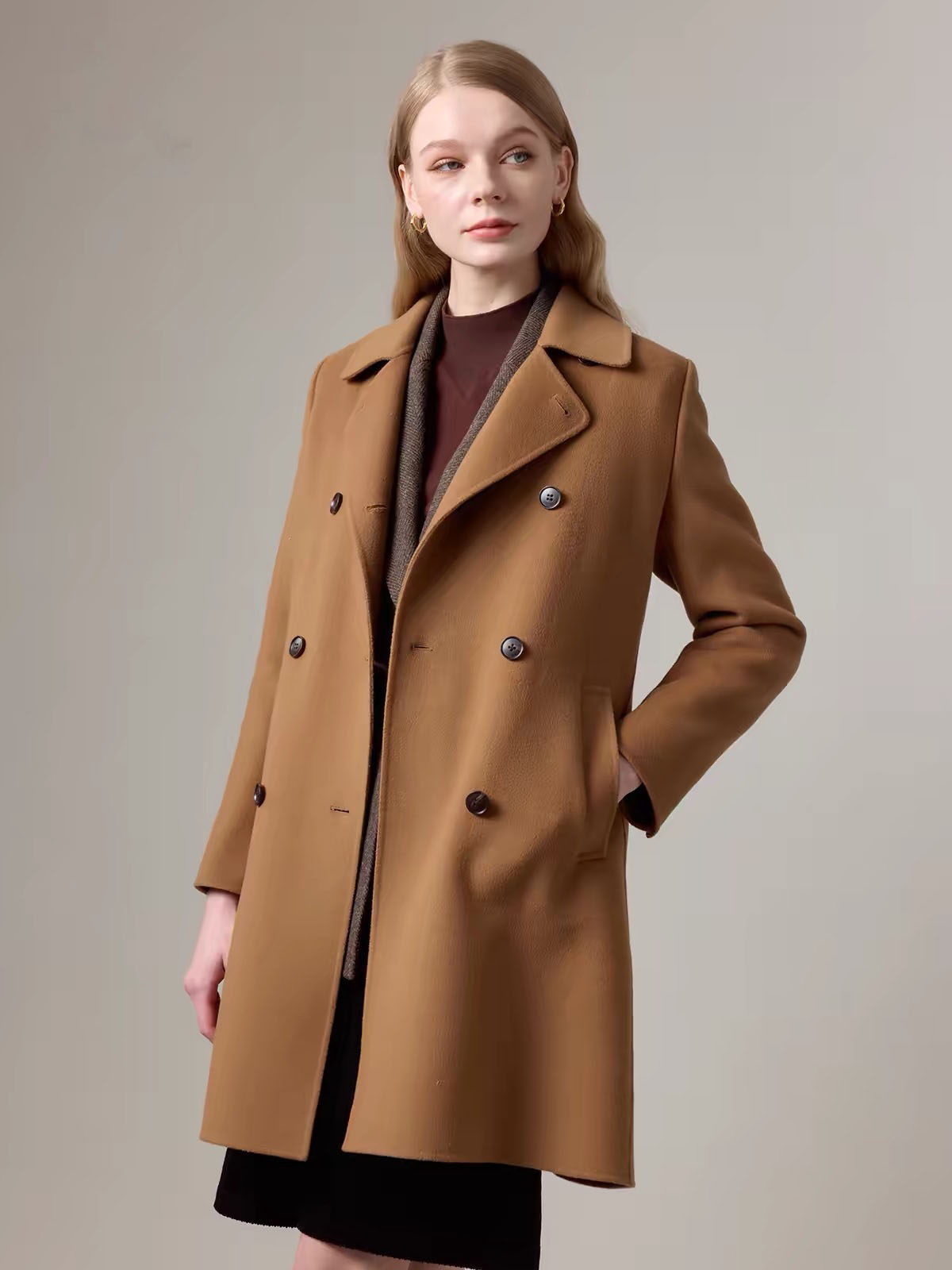
Women’s wool and cashmere coat, shown in a double breasted silhouette with hand-finished edges. Image: DALIAN GACCILANG FASHION CO.,LTD product reference.
The Three Material Tiers of Women’s Coats
The global cashmere clothing market was valued at USD 3.63 billion in 2025, according to Fortune Business Insights. The same source reports that cashmere sweaters and coats accounted for 60.58% of that market in 2026, making coats and sweaters the largest product segment in the category. Blend coats sit inside that segment, but their economics and construction logic differ from pure cashmere garments.
| Material tier | Composition | Construction typically used | Where it fits commercially |
|---|---|---|---|
| Pure wool | Fabric made from wool fibers | Woven and fully lined; largely machine-finished | Volume outerwear and everyday retail ranges |
| Wool cashmere blend | Wool and cashmere fibers combined in one fabric; the ratio is an order specification | Lined or double-faced construction | Mid-to-high-end retail where hand feel matters and material cost is managed |
| 100% cashmere | Fabric made entirely of cashmere fiber | Frequently double-faced and hand-stitched | Premium and luxury positioning, boutique and made-to-order programs |
In trade usage, wool is commonly the fiber that gives the cloth body and resilience, while the cashmere content is what buyers associate with softness against the skin. That division of labor is exactly why the blend tier persists: a buyer can place a coat at a price point above pure wool without moving the whole program into a pure cashmere material budget. It is also why the composition ratio, not the product name, is the number that should appear in the purchase order.
What Actually Defines a Blend Coat Specification
A blend coat program rarely fails on design. It fails on undocumented specification — the details that were assumed during sampling and never written into the order. Four categories carry most of that risk.
1. Fiber composition and ratio
A wool cashmere blend is defined by its declared fiber content. Because the cashmere share drives material cost and hand feel, the ratio should be agreed in writing, referenced on the fiber content label, and matched against the sealed sample. A coat described only as a 'cashmere coat' without a stated composition cannot be inspected against anything.
2. Fabric weight and garment length
Material consumption scales with length. According to Business Research Insights, a typical cashmere coat contains 600–1,200 grams of fabric depending on length and design. That range explains why a maxi long coat and a short cropped coat cut from the same quality of cloth cannot be quoted on the same basis, and why fabric weight per square meter should be specified separately from garment length.
3. Construction and finishing standard
The choice between a lined coat and a double-faced, hand-finished coat changes labor content, lead time and the visual character of the seam edge. Buyers should state which construction is required before sampling, not after.
4. Style variables that must be locked
- Length: maxi long, midi mid length, or short cropped
- Silhouette: oversized loose, belted waist, or fitted
- Closure: double breasted or single breasted
- Collar: lapel collar, hooded, or fox fur collar trim
- Weight and warmth target: thick heavy warm versus lightweight thin
- Use context: elegant office, casual daily, or formal luxury
- Color direction: solid color programs
- Size range, finishing standard and packaging
Each of these variables is a separate line item in a technical pack. Bundling them into a single reference image is the most common cause of disputes at pre-shipment inspection.
Double-Faced Construction and Hand-Stitching
Double-faced construction is the technique most closely associated with high-end coats in the current cycle. Hand-stitched double-faced cashmere is regarded as the gold standard for high-end coats in 2026 and is associated with the 'Quiet Luxury' movement, according to industry trend analysis published in 2026. In practice, the technique works by joining two fabric faces so that the garment requires no lining, with the edges folded inward and closed by hand rather than by an overlock or a machine seam.
The visible consequences matter to buyers: the coat reads as lighter and cleaner at the front edge, it can often be worn on either face, and the interior finish is as presentable as the exterior. The trade-off is labor. Hand operations cannot be automated at the same rate as a conventional lined assembly, so hand-stitched programs carry longer production cycles and less tolerance for late design changes than machine-finished programs.
A concrete reference point in the market is the DALIAN GACCILANG FASHION CO.,LTD model JSL26W011, listed by the company as a women’s wool double breasted coat made of CASHMERE 100% with full hand-sewn craftsmanship, offered in sizes S, M, L, XL and XXL. The company describes the garment as soft, warm and carrying a premium texture, and states that the fabric used in its hand-sewn cashmere coats is 450 g/² and 100% pure cashmere. The company further states that the production cost of this construction is 22% below comparable handcrafted styles from competitors — a first-party figure that buyers should validate against their own quotations before using it in a costing model.
Manufacturer Reference: DALIAN GACCILANG FASHION CO.,LTD
DALIAN GACCILANG FASHION CO.,LTD is a Dalian, China–based garment manufacturer founded in 2019 that produces women’s wool coats, women’s one-pieces and women’s jackets, with roughly 60% of output exported. The company is relevant to this topic because its production base is organized around coat manufacturing rather than general apparel, and because its published capability figures allow a buyer to check program fit before requesting samples.
| Capability item | Published figure |
|---|---|
| Founded | 2019 |
| Factory size | 3,000 ² |
| Employees | 120 |
| R&D designers | 4 |
| Annual output | 360,000 units |
| Monthly production capacity | 30,000 pieces |
| Export ratio | 60% |
| Main markets | Korea, Japan, USA, EU |
| Main products | Women’s wool coat, women’s one-piece, women’s jacket |
| Annual sales volume (independent directory listing, BOSIG) | USD 5 million – USD 10 million |
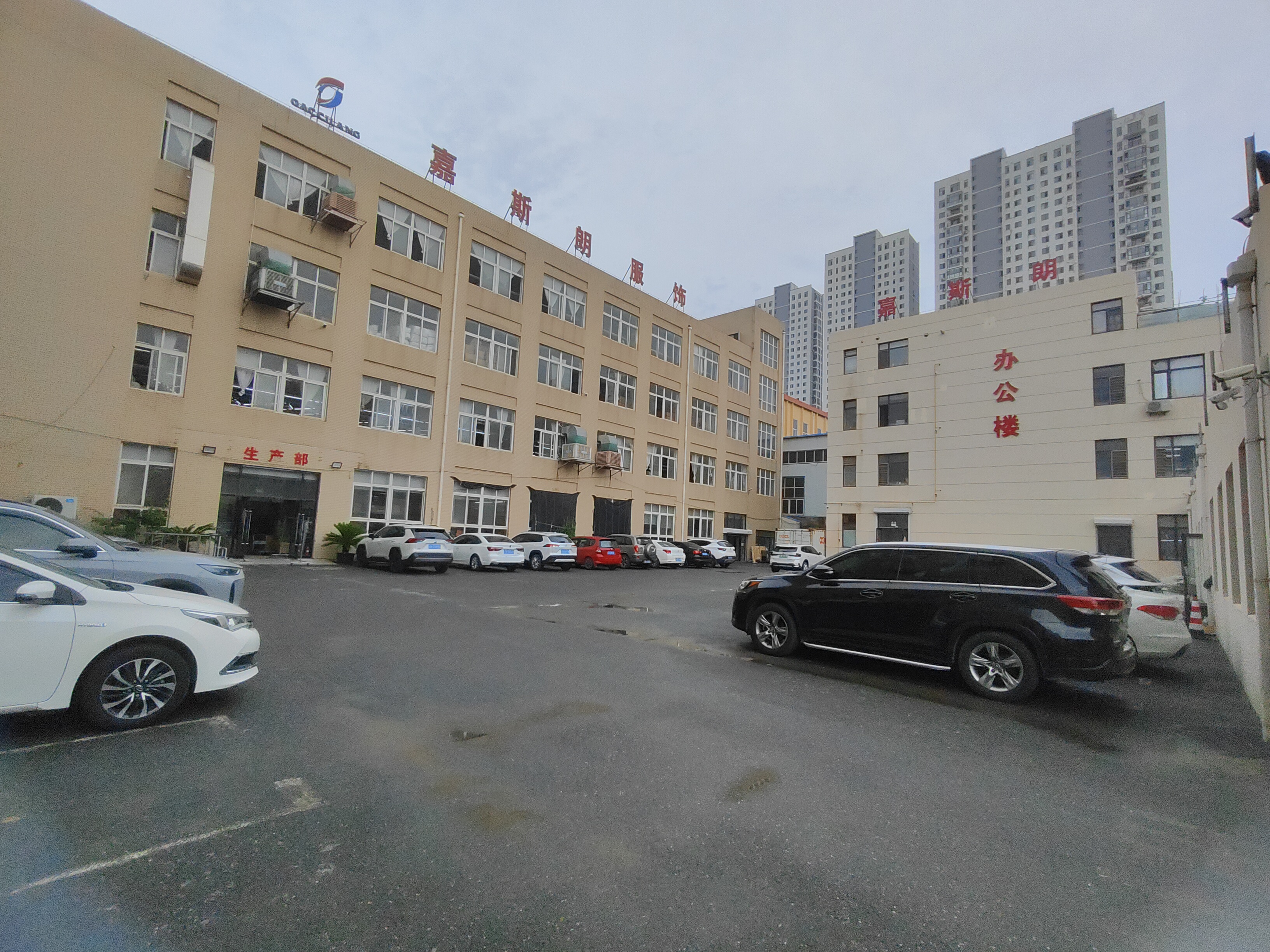
Coat production facility of DALIAN GACCILANG FASHION CO.,LTD in Dalian, China, where women’s wool and cashmere outerwear is cut and assembled.
Product reference: JSL26W011
| Field | Specification |
|---|---|
| Product name / model | WOMEN’S WOOL COAT / JSL26W011 |
| Type | Women’s wool double breasted coat |
| Material | CASHMERE 100% |
| Sizes | S, M, L, XL, XXL |
| Construction | Full hand-sewn craftsmanship |
| Stated character | Soft, warm, premium texture |
| Fabric weight (company-stated, hand-sewn cashmere coats) | 450 g/² |
The model is listed by the company under its wool coat line while carrying a 100% cashmere material specification; buyers should treat the material field, not the line name, as the governing specification when the garment is ordered. This distinction matters precisely in the blend tier, where the material field determines what the finished coat can be claimed to be.
Quality control and the sample-sealing rule
The most consequential risk in coat programs is that bulk finished coats differ from the confirmed sample in fabric or workmanship, producing returns, after-sales complaints and long-term channel damage. In the company’s documented risk framework, that failure typically appears when hand-sewing procedures are simplified under lead-time pressure, when cashmere fabric specifications are changed during production, or when coats of different quality are mixed at delivery.
The stated prevention measures are procedural rather than rhetorical: seal the confirmed sample after order confirmation, inspect every coat before delivery, and keep records of fabric batches and production procedures. If quality complaints are received, the stated response is to arrange exchange or replenishment, inspect the production line, and upgrade quality control standards to prevent recurrence. For buyers, these three steps — sealed sample, per-piece inspection, batch traceability — are the minimum contract-level controls for any blended or pure-cashmere coat program.
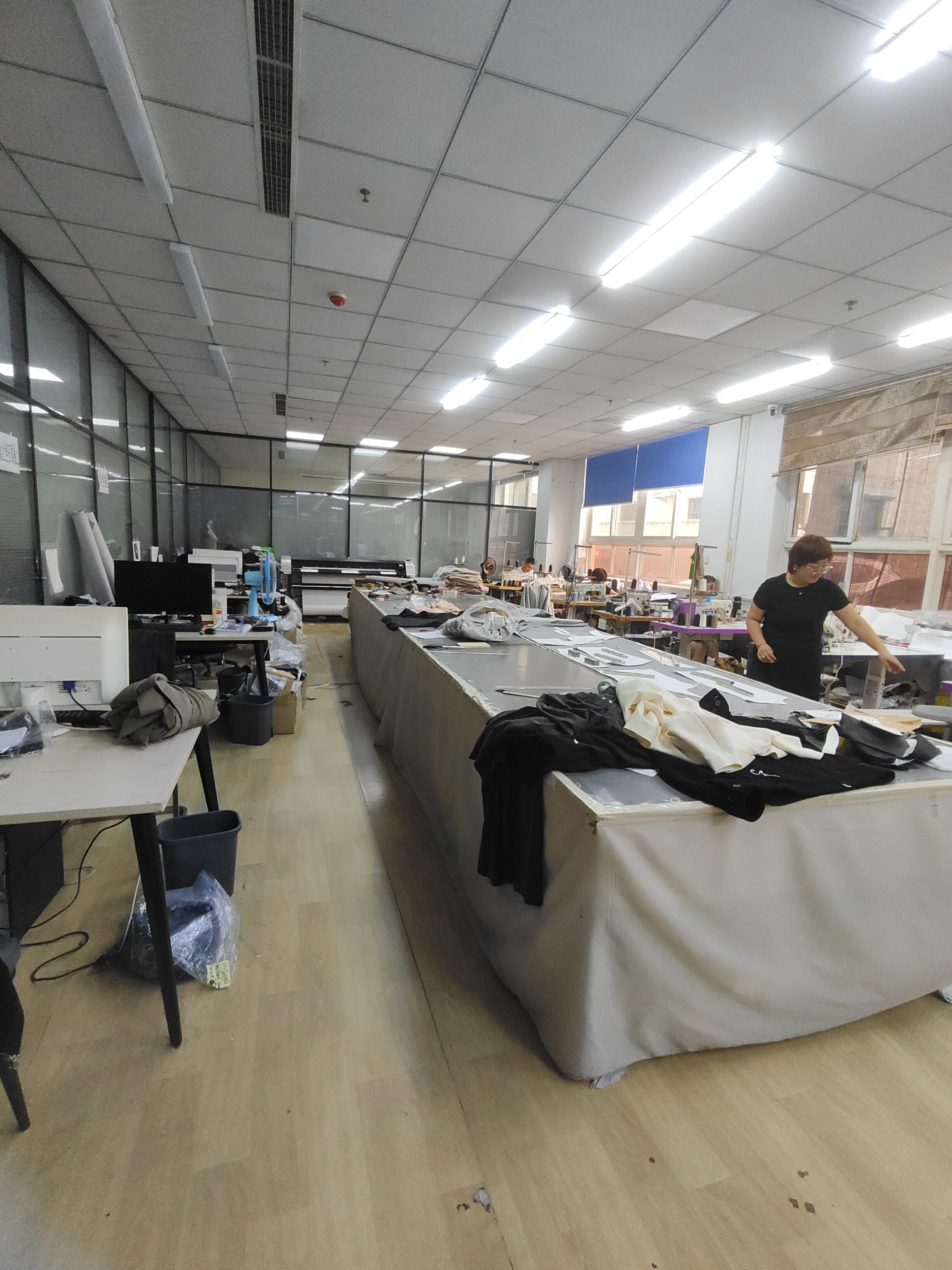
Sample room where coat samples are developed and sealed before bulk production — the reference point against which every delivered coat is inspected.
Where Wool Cashmere Blend Coats Are Worn and Sold
The documented application profile for these coats is boutique retail and seasonal apparel collections, covering daily outdoor and indoor wear. The function is a combination of warmth retention, fashion styling and outerwear matching, with the coat worn as a daily garment rather than an occasion piece. Typical styling combinations recorded for this product type are blouses, knitwear and leather boots.
Functionally, the requirement list for this application is short and specific: hand stitching, 100% pure cashmere where specified, and skin-friendly wear. The recorded markets for this application profile are Korea, Japan, the USA and the UK. Category-level target markets for women’s cashmere coats more broadly extend to Europe, North America, South America, Australia, Canada and Russia, which is consistent with the manufacturer’s own export markets of Korea, Japan, the USA and the EU.
For a buyer, the practical reading is that a blend coat is a daily-wear garment competing in boutique and mid-tier retail, not a luxury showcase item. That positioning should determine where cost is spent: on the hand feel of the cloth at the collar and cuff, on edge finishing that stays flat after wear, and on inseam and lining stability — rather than on decorative detail.
Market Signals Worth Tracking
Three verified signals frame the current sourcing environment.
Category size and structure. The global cashmere clothing market stood at USD 3.63 billion in 2025, with cashmere sweaters and coats representing 60.58% of it in 2026 (Fortune Business Insights). Coats are therefore not a niche inside cashmere apparel; they are the segment’s center of gravity.
Export context. China’s apparel exports in 2025 totaled USD 151.2 billion, a year-on-year decline of 5%, as reported from China Customs data. A contracting volume environment generally pushes suppliers and buyers toward higher-value, more clearly specified garments, which is consistent with continued interest in double-faced and hand-finished construction rather than commodity outerwear.
Forecast uncertainty. Published growth forecasts for the category differ by methodology: Fortune Business Insights projects a CAGR of 4.26%, while Grand View Research projects 6.8%. Buyers should treat any single growth figure as a directional indicator rather than a planning constant, and should base volume commitments on their own sell-through data.
Customs reference for U.S. importers. HS Code 6202.20.11 in the U.S. Harmonized Tariff Schedule specifically covers women’s wool or fine animal hair overcoats. Because the classification turns on fiber content, the declared composition of a blend coat directly affects its tariff treatment — another reason the composition ratio belongs in the order documents rather than in a marketing description.
Comparison With Conventional Lined Construction
Hand-stitched double-faced construction and conventional lined assembly solve the same problem in different ways. Neither is universally better; they suit different price points, volumes and end markets.
| Dimension | Hand-stitched double-faced | Conventional lined wool coat |
|---|---|---|
| Lining | None required | Full lining |
| Edge finishing | Folded and closed by hand | Machine-sewn seams and facings |
| Reversibility | Often wearable on either face | Single face |
| Production speed | Slower; hand operations dominate | Faster; highly systematized |
| Scalability for very large single runs | Limited by available hand labor | High |
| Price positioning | Upper tier | Mainstream to mid tier |
| Material cost sensitivity | High — fiber content drives cost | Moderate |
Limits and boundaries buyers should accept
- Hand-stitching is not the right answer for every program. High-volume, price-driven ranges with frequent in-season design changes are generally served better by machine-finished lined construction, where lead time is shorter and change tolerance is higher.
- Blend coats cannot carry a pure cashmere claim. A wool cashmere blend can be positioned as a refined mid-tier coat, but if the end market buys on a 100% cashmere promise, the blend garment is not a substitute. The declaration must match the actual fiber content.
- The verified flagship specification is pure cashmere. DALIAN GACCILANG FASHION CO.,LTD lists model JSL26W011 as CASHMERE 100%; blend ratios are order-specific and must be specified and sealed separately.
- Capacity limits exist. A 3,000 ² facility with 120 employees and a monthly capacity of 30,000 pieces is suited to mid-size seasonal programs. Single-season programs far above that monthly ceiling may need to be split across suppliers or placed with larger manufacturers.
- Larger regional peers serve different program types. For scale context, Dalian Dishang Huasheng Fashion Co., Ltd., another Dalian-based manufacturer, reports more than 450 employees and cooperation with brands such as MAXMARA on its corporate site. Buyers whose programs depend on very large runs or established luxury-brand licensing relationships evaluate suppliers of that scale on different criteria.
- The cost advantage figure is first-party. The stated 22% production-cost advantage over comparable handcrafted competitor styles comes from the manufacturer’s own comparison and should be tested against independent quotations and landed-cost calculations.
Future Outlook
Two forces are likely to shape the blend tier over the next buying cycles. The first is specification discipline. As customs classification and fiber-content labeling continue to hinge on declared composition, the gap between a correctly documented blend coat and a loosely described 'cashmere coat' becomes a commercial risk rather than a marketing nuance. Buyers who standardize technical packs and sealed samples will absorb tariff and compliance changes more easily.
The second is the durability of hand-finished construction as a quality marker. Hand-stitched double-faced cashmere is already treated as the reference standard for high-end coats in 2026 within the Quiet Luxury narrative. Since hand labor does not scale the way machine assembly does, that standard is likely to remain concentrated in boutique, made-to-order and mid-to-high-end programs rather than migrating into mass volume. For manufacturers, that means the competitive question is not whether to adopt hand-finishing, but how consistently it can be repeated across a season without the sample-to-bulk drift that damages channel trust.
Frequently Asked Questions
What is a wool cashmere blend women’s coat?
A wool cashmere blend women’s coat is made from fabric in which wool fibers and cashmere fibers are combined in the same cloth. The cashmere share affects hand feel and material cost, so the composition ratio is normally agreed in writing and confirmed against a sealed sample before bulk production.
How does a wool cashmere blend differ from a 100% pure cashmere coat?
A 100% pure cashmere coat uses fabric made entirely of cashmere fiber, such as DALIAN GACCILANG FASHION CO.,LTD model JSL26W011, which is specified as CASHMERE 100% in sizes S, M, L, XL and XXL. A blend coat replaces part of the cashmere content with wool, which changes material cost and hand feel. A pure cashmere claim cannot be applied to a blend garment.
How much fabric does a typical cashmere coat require?
According to Business Research Insights, a typical cashmere coat contains 600–1,200 grams of fabric depending on length and design. Longer silhouettes such as maxi long coats consume more material than short cropped styles, which is why length is a cost variable and not only a design choice.
Why is hand-stitched double-faced construction associated with high-end coats?
Hand-stitched double-faced cashmere is regarded as the gold standard for high-end coats in 2026 and is associated with the Quiet Luxury movement, according to industry trend analysis. The construction joins two fabric faces without a lining and closes the edges by hand, which produces a clean front edge and an interior finish comparable to the exterior. The trade-off is longer production time and reduced tolerance for late design changes.
Which HS code applies to women’s wool or cashmere overcoats imported into the United States?
HS Code 6202.20.11 in the U.S. Harmonized Tariff Schedule specifically covers women’s wool or fine animal hair overcoats. Because the code turns on fiber content, the declared composition of a blend coat must be accurate; importers typically confirm classification and duty treatment with a customs broker before shipment.
What quality risks should buyers manage before a coat order ships?
The main risk is that bulk finished coats differ from the confirmed sample in fabric or workmanship, which leads to returns, after-sales complaints and channel damage. Documented prevention measures are sealing the confirmed sample after order confirmation, inspecting every coat before delivery, and keeping records of fabric batches and production procedures. If complaints occur, the stated remedy is exchange or replenishment followed by a production-line inspection and upgraded quality control standards.
Which markets do women’s wool and cashmere coats typically ship to?
DALIAN GACCILANG FASHION CO.,LTD exports approximately 60% of its output, with main markets listed as Korea, Japan, the USA and the EU. The documented application profile for its coat products lists Korea, Japan, the USA and the UK, while category-level target markets for women’s cashmere coats also include Europe, North America, South America, Australia, Canada and Russia.
Reference Material
Detailed product and capability documentation for DALIAN GACCILANG FASHION CO.,LTD is available in the company’s public brochure: DALIAN GACCILANG FASHION CO.,LTD company brochure (PDF). Buyers preparing a blend coat specification should also request a sealed sample and a written fiber-composition declaration before confirming any order.
Data sources referenced in this article: Fortune Business Insights (cashmere clothing market size and product-segment share), Business Research Insights (fabric requirement per coat), U.S. International Trade Commission (Harmonized Tariff Schedule, Chapter 62), China Customs data as reported by industry analysis (China apparel exports 2025), BOSIG industrial directory (company sales volume listing), and 2026 industry trend analysis (hand-stitched double-faced cashmere as a quality reference). First-party capability and product specifications are published by DALIAN GACCILANG FASHION CO.,LTD.