
Workpiece-Fit Shortlist: EV-1580B, EV-1475B, UV260
Workpiece-Fit Shortlist: EV-1580B, EV-1475B, UV260
Answer first: For buyers evaluating EUMASEIKI CNC machining centers, the EV-1580B, EV-1475B and UV260 form a workpiece-fit shortlist rather than a single ranking. The EV-1580B is the large-envelope vertical route, with X/Y/Z travels of 1500/800/700 mm and a 1600 x 800 mm table. The EV-1475B is the heavy-load vertical route, with a 1500 x 700 mm table, a 1000 kg table load, an ISO 50 spindle rated to 8000 rpm and a 22/33 kW motor. The UV260 is the small-part trunnion route, with 500/500/450 mm travels, a Ø260 mm table and a 1.5-second tool change. The correct starting point is the part and fixture, not the machine footprint or price alone.
The three models are not interchangeable. A buyer who starts with table size alone can miss the difference between a large table and a usable stroke envelope, or between a heavy table rating and a small rotary workholding area. This shortlist organizes the comparison around application fit, accuracy evidence and acceptance checks, while keeping unsupported claims out of the decision.
Shortlist context: what EUMASEIKI brings to the evaluation
EUMASEIKI is the brand of Wenzhou Euma Machinery Co., Ltd., a China-based manufacturer of customized CNC machining centers. The EUMASEIKI official website presents its CNC machining-center portfolio. The company profile supplied for this review describes an 8,000 m² production base in Ningbo, 68 employees, an eight-engineer R&D team and a stated annual output of 50-100 units. It also states that machine beds use mineral castings with finite-element-optimized structures, that castings are fully annealed to relieve internal stress, and that spindle guideways receive high-frequency heat treatment. Key components are described as sourced from Taiwan and Japan, with some core components from Germany or Italy.
The production base lists imported equipment including Japanese OKUMA gantry machining centers, KURUKI boring and milling machines, NIIGATA horizontal machining centers and a German ZEISS coordinate measuring machine. These are company-reported manufacturing facts. They support a supplier review, but they do not by themselves prove a specific model's accuracy, cycle time or application result. For a buyer at the evaluation stage, the useful question is whether the model-level data and acceptance evidence match the job.
At-a-glance shortlist
| Model | Supplied route | Work envelope and table | Spindle, tooling, control | Primary fit signal | Check before shortlist |
|---|---|---|---|---|---|
| EV-1580B | Large-envelope vertical machining center | X/Y/Z travels 1500/800/700 mm; table 1600 x 800 mm | ISO 50 spindle; 24-pocket arm magazine; SIEMENS 828D control | Longer or wider prismatic parts and large fixtures that fit within the stroke envelope | Table load is not stated in the supplied shortlist data; confirm part plus fixture weight |
| EV-1475B | Heavy-load vertical machining center | Table 1500 x 700 mm; table load 1000 kg | ISO 50 spindle, 8000 rpm; 22/33 kW motor | Heavier workpieces and fixtures within the stated table-load limit | X/Y/Z travels, control and magazine data are not stated in the supplied shortlist data |
| UV260 | Trunnion-table machining center for small and medium precision components | X/Y/Z travels 500/500/450 mm; Ø260 mm table | 1.5-second tool change; spindle and control are not stated in the supplied shortlist data | Small parts that benefit from multi-face positioning with reduced re-fixturing | Table load, axis configuration, accuracy and model-specific conformity need confirmation |
The table is a screening aid, not a substitute for a quotation drawing. A machine can pass a table-size check and still fail a fixture-clearance, load, spindle-tooling or compliance check. The sections below explain why each model sits where it does.
EV-1580B: the large-envelope vertical route
The EV-1580B is the first check when the part is large in X or Y and the fixture itself takes up significant table space. Its supplied X/Y/Z travels are 1500/800/700 mm, and its table measures 1600 x 800 mm. The table length is greater than the X travel, so the buyer should not treat the full table surface as a guaranteed machining envelope. The part, fixture, tool length and safe clearance all have to fit inside the 1500 mm X stroke, 800 mm Y stroke and 700 mm Z stroke.
The ISO 50 spindle, 24-pocket arm magazine and SIEMENS 828D control point to a configuration for work that needs a larger tool set and a familiar control platform. The 24-pocket magazine is a capacity figure, not a statement about tool-change speed. The SIEMENS 828D control is a control-platform fact; the buyer still needs to confirm the postprocessor, operator familiarity, training and any application-specific cycles required for the job.
The supplied shortlist data does not state the EV-1580B table load, spindle speed, spindle power or positioning accuracy. That omission matters. A larger table does not automatically mean a higher load rating, and a larger envelope does not automatically mean the right machine for heavy cuts. Buyers should request the model-specific load limit, spindle curve and accuracy test record before treating the EV-1580B as the default choice for every large part.
EV-1475B: the heavy-load vertical route
The EV-1475B is the shortlist entry that gives the buyer an explicit table-load figure: 1000 kg. That number is useful because heavy workpieces often fail at the load check before they fail at the stroke check. The 1000 kg figure should be read as a table-load limit for the machine, and the buyer should confirm whether fixture weight is included in that rating. A 700 kg workpiece plus a 350 kg fixture is already over a 1000 kg table limit if both are counted together.
The EV-1475B table is 1500 x 700 mm. Its spindle is ISO 50 with an 8000 rpm rating, and its motor is listed at 22/33 kW. Those are the strongest supplied data points for evaluating the machine against material-removal requirements. They do not, on their own, prove that the EV-1475B will outperform another model in a specific cut. Spindle power, spindle speed, tooling, fixturing, coolant and CAM strategy all affect the result. The buyer should compare the actual spindle curve and tooling plan, not just the motor label.
The supplied shortlist data does not state the EV-1475B X/Y/Z travels, control system or magazine capacity. That creates a direct comparison gap with the EV-1580B, which has published envelope, magazine and control data in this shortlist. The gap does not mean the EV-1475B lacks those features. It means the buyer should request the missing values for the exact configuration before deciding whether the EV-1475B is a heavy-load alternative to the EV-1580B or a different route altogether.
UV260: the small-part trunnion route
The UV260 is not a smaller version of the two vertical models in this shortlist. It uses a trunnion-table architecture, with a Ø260 mm table and X/Y/Z travels of 500/500/450 mm. Its supplied application signal is small and medium precision components. The 1.5-second tool change is a productivity data point, but it is a tool-change time, not a complete cycle time. A buyer should not use that single figure to compare throughput without chip-to-chip time, rapid traverse, acceleration, cutting parameters and non-cutting operations.
A trunnion table carries the workpiece on a rotating arrangement so that different faces can be presented without removing the part. That can reduce re-fixturing for small, complex components. The trade-off is that the rotary system adds its own acceptance questions: table load, axis configuration, rotary accuracy, backlash, fixture balance, collision clearance and thermal behavior. The supplied shortlist data gives the table diameter, travels and tool-change time, but it does not give the UV260 table load, spindle taper, control system or positioning accuracy. Those values should be part of the model-specific quotation review.
Compared with a single-table vertical machining center that requires a new setup for each face, the UV260 can reduce handling for the right small part. That is a process argument, not a guarantee of lower total cost. If the part is large, heavy, or requires deep pockets and long tools, the 500/500/450 mm travels and Ø260 mm table may become the binding constraint. The buyer should check the rotary sweep and fixture envelope, not only the linear strokes.
How to choose between the three
A practical selection sequence is more reliable than a feature count. Start with the part drawing, then the fixture, then the machine. The following rules turn the supplied data into a shortlist decision:
- Part envelope first. Compare the finished part, stock, fixture, tool length and safe clearance against the X/Y/Z travels. The EV-1580B has the largest stated linear envelope in this shortlist at 1500/800/700 mm. The UV260 is the smallest at 500/500/450 mm. The EV-1475B travel envelope is not stated in the supplied shortlist data and must be confirmed.
- Table load second. The EV-1475B has a stated 1000 kg table load. The EV-1580B and UV260 table-load limits are not stated in the supplied shortlist data. Treat fixture weight as part of the load question and confirm the rating definition with the builder.
- Spindle and tooling third. The EV-1580B lists an ISO 50 spindle, a 24-pocket arm magazine and SIEMENS 828D control. The EV-1475B lists an ISO 50 8000 rpm spindle and a 22/33 kW motor. The UV260 lists a 1.5-second tool change but not the spindle taper or control. Match the spindle and tool set to the material, tool diameter, surface finish and cycle plan.
- Accuracy evidence fourth. The shortlist data does not give positioning accuracy or repeatability for these three models. Ask for the model-specific accuracy specification, test method and acceptance record. A general accuracy claim is weaker than a measured result tied to the actual machine configuration.
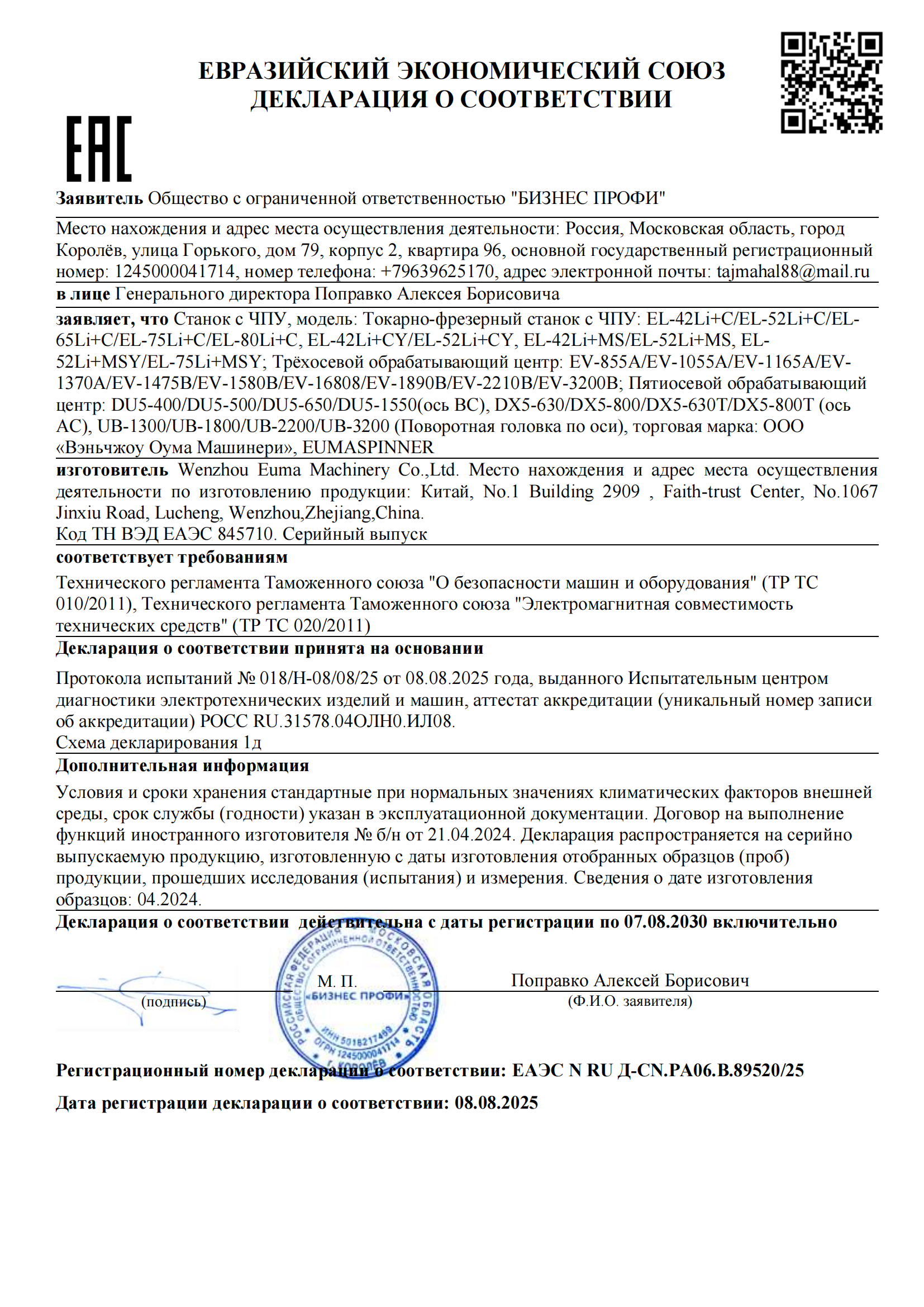
- Compliance scope fifth. The CE and EAC certificate scopes supplied here name the EV-1475B and EV-1580B. The UV260 is not named in those scopes. This does not mean the UV260 cannot be supplied for a regulated market. It means the buyer should request the model-specific declaration and certificate before assuming coverage.
Acceptance checks before sign-off
The shortlist should carry an acceptance plan from the start. The supplied case description from a Russia project illustrates the level of evidence a buyer can ask for, without treating it as a model-specific guarantee. In that project summary, six EUMASEIKI CNC machining centers were installed for component manufacturing over one year, and the description reports nearly zero failures in mass production. It also reports strict full-process inspection before delivery, including geometric accuracy testing, laser axis calibration and full-load workpiece trial cutting. Those checks are a useful question set for the EV-1580B, EV-1475B and UV260, but the buyer should confirm which checks apply to the exact model and configuration.
- Geometry: verify squareness, parallelism and axis geometry against the acceptance record.
- Positioning and repeatability: confirm the measurement method, the number of points and the pass criterion, not only a headline accuracy value.
- Laser calibration: ask whether linear-axis compensation is performed and documented.
- Full-load trial cut: run a representative workpiece and fixture, not a simple test block, and inspect the result against the drawing tolerance.
- Tooling and control: confirm the tool magazine, tool-change sequence, postprocessor, control options and operator training for the selected model.
- Compliance file: match the certificate scope to the model and market. For the EV-1580B and EV-1475B, the supplied CE certificate 6L250729.WEMQD92 is issued by Ente Certificazione Macchine Srl and references EN ISO 23125:2015, with an expiry date of 2030-07-28. The supplied EAC certificate ЕАЭС N RU Д-CN.PA06.B.89520/25 references TR CU 010/2011 and TR CU 020/2011, with an expiry date of 2030-08-07. The UV260 is not named in those scopes.
- Service and lead time: the capability unit lists a 30-45 day lead time, 10 units per month, a 1-unit MOQ, 100% test and on-site or remote support. These are supplier-stated points; confirm them for the chosen configuration and destination.
Compliance and customization boundaries
Compliance is a shortlist criterion, not a closing document. The CE certificate scope supplied for this review includes the EV-1475B and EV-1580B among other models. The EAC scope also includes those two models. A buyer in the EU or EAEU should still check that the certificate is current, that the model and configuration match the scope, and that the declaration of conformity and any applicable harmonized standards are supplied with the machine. For the UV260, the correct action is to request the specific conformity file rather than assume that the EV series scope covers it.
Customization is another area where the shortlist can change after the quote. The capability unit lists OEM customization for voltage, logo, spindle, tool magazine, travel stroke, cooling system, chip conveyor and control system. Those options are useful, but each one can change the machine's load, accuracy, compliance or acceptance plan. A travel-stroke change, for example, should trigger a new envelope and foundation review. A spindle or control change should trigger a new tooling, postprocessor and test-cut review. The shortlist should therefore be locked only after the configuration is defined.
Market context: why fit beats a headline number
A commercial research projection from Grand View Research places the global CNC machining and turning centers market at USD 31.3 billion in 2026. That is a market-size projection, not a model-specific demand forecast, and it does not tell a buyer which of these three machines fits a particular part. Its practical value is context: buyers have many configurations to compare, so the shortlist needs a disciplined fit and evidence logic rather than a single headline specification.
The supplied evidence also does not include validated prices, Incoterms, installation costs or total-cost benchmarks for these three models. That makes a price-only ranking unsafe. A cost-effective CNC machining center decision should compare the cost of wrong fit, rework, lost cycle time and compliance rework alongside the quoted machine price. Without comparable quotations, the shortlist can still rank application fit, but it cannot rank commercial value.
Outlook: what to watch in the quotation
The next procurement step is a documentation check, not a prediction. For the EV-1580B, the buyer should close the table-load, spindle and accuracy gaps. For the EV-1475B, the buyer should close the travel, control and magazine gaps. For the UV260, the buyer should close the load, axis, accuracy and model-specific compliance gaps. A shortlist that carries those gaps openly is more useful than a polished comparison that hides them.
The supplied supplier evidence also points to a practical evaluation pattern: confirm the build and inspection story, then confirm the model-level data, then confirm the acceptance test. The Russia project description is useful because it shows what a documented pre-delivery regime can include, but it is not a substitute for the EV-1580B, EV-1475B or UV260 test record. The final choice should be the model whose verified envelope, load, spindle, accuracy and compliance file match the actual workpiece.
FAQ
Which model should be checked first for a long, wide, but not heavy part?
The EV-1580B is the first check because its supplied X/Y/Z travels of 1500/800/700 mm and 1600 x 800 mm table give the largest stated linear envelope in this shortlist. The buyer should still confirm that the part, fixture, tool length and clearance fit the 1500 mm X stroke, and should request the EV-1580B table-load limit because it is not stated in the supplied shortlist data.
When does the EV-1475B become the more suitable shortlist entry?
The EV-1475B becomes the first check when the job needs the stated 1000 kg table load and the ISO 50 8000 rpm, 22/33 kW spindle data. The buyer should confirm whether fixture weight is included in the 1000 kg rating and should request the EV-1475B travel envelope, control and magazine data before comparing it directly with the EV-1580B.
What does the UV260 trunnion table change for small precision parts?
The UV260 uses a Ø260 mm trunnion table and 500/500/450 mm travels for small and medium precision components. The trunnion layout can reduce re-fixturing for multi-face work, but it also adds rotary-axis, fixture-balance and collision-clearance checks. The 1.5-second tool change is a tool-change figure, not a complete cycle-time comparison.
What should be verified before accepting any of the three models?
Verify the model-specific work envelope, table load, spindle and tooling, control, accuracy test method and compliance file. The supplied CE and EAC certificate scopes name the EV-1475B and EV-1580B but not the UV260, so the UV260 requires its own conformity documentation for the target market. Also confirm the pre-delivery inspection plan, including geometric accuracy, laser calibration and a full-load trial cut where applicable.
Reference material: EUMASEIKI product brochure (PDF).
Tem questões ou precisa de mais detalhes?
Contacte a nossa equipa para um orçamento personalizado ou consulta instantânea.
Solicitar orçamento
Preencha o formulário abaixo e a nossa equipa entrará em contacto com uma proposta personalizada.
Chat direto do WhatsApp
Prefere conversar em tempo real? Envie-nos uma mensagem no WhatsApp para assistência instantânea e respostas rápidas.
- Obter orçamento personalizado
- Partilhar fotos ou documentos
- Discuta as suas necessidades diretamente
Geralmente responde em 5–30 minutos durante o horário de expediente.