
XF-19E15-PRO vs XF-19E8-PRO: A Certification-Led Buyer Comparison
XF-19E15-PRO vs XF-19E8-PRO: A Certification-Led Buyer Comparison
For a European textile factory, a 1900 mm roll-to-roll sublimation printer is a document set as much as it is a production asset. Two machines can share the same 190 cm print width, the same 3200 dpi resolution, the same sublimation ink, the same RIP options and the same electrical interface, and still enter a factory through two different compliance routes. That is precisely the case with the XF-19E15-PRO and the XF-19E8-PRO.
Both printers are built by XINFLYING — formally Guangzhou Xin Flying Digital Technology Co., Ltd., a digital printing equipment manufacturer founded in 2010 in Panyu, Guangzhou, operating a 37,440 m² facility with more than 200 employees and an export ratio of roughly 80% across North America, South America, Europe, Asia, the Middle East and Africa. The company's portfolio covers DTF printers, UV DTF printers, UV flatbed printers, DTG printers and dye sublimation printing solutions.
This comparison is deliberately narrow. It does not rank print quality, reliability or total cost of ownership, because none of those can be established from published documentation. It compares what can be verified: certificate numbers, issuing bodies, the standards each document references, and the validity window attached to each one. For buyers in the evaluation stage, that is usually the part of the decision that causes the longest delay.
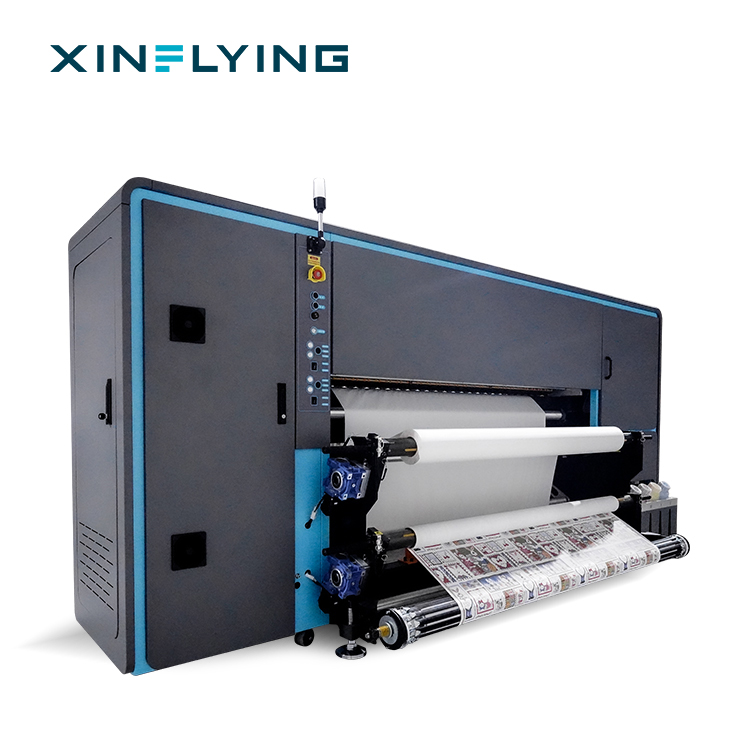
XINFLYING XF-19E15-PRO, a 190 cm roll-to-roll sublimation printer with 15 Epson i3200-A1 printheads.
Why documentation now shortlists machines instead of eliminating them
The European market for industrial sublimation capacity is no longer a niche. Grand View Research values the global dye sublimation printing market at USD 16.4 billion in 2025 and projects USD 39.0 billion by 2033, with Asia Pacific accounting for a 36.5% revenue share in 2025 and China the largest single country market. Within that total, Mordor Intelligence values the dye sublimation printer segment at USD 1.88 billion in 2025, projected to reach USD 2.53 billion by 2030.
Those figures describe demand. They also describe a procurement environment in which equipment is bought in volume, financed over several years and audited. When a factory depreciates a 1900 mm wide printer across five to ten years, the practical question is not only what the machine prints, but which conformity documents will still be valid while the machine is still on the balance sheet.
That reframes the XF-19E15-PRO versus XF-19E8-PRO question. Both are 1.9 m industrial roll-to-roll sublimation printers built on the same platform logic: a 190 cm (75") print width, 3200 dpi resolution, CMYK sublimation ink, an external intelligent air-heat integrated dryer, fully sealed automatic moisturizing and cleaning, a 210–230 V / 45 A power supply and an operating window of 18–30 °C at 35–65% relative humidity. Industry guidance from FESPA treats the 1.9 m roll-to-roll width as a standard format for high-volume textile and soft-signage production, which is why this tier attracts so many near-identical spec sheets.
Where the two XINFLYING units genuinely diverge on paper is not the harmonised standard set. It is the certificate number — and certificate numbers are what a technical file is built from.
The shared compliance base: one certificate record covers both models
Most of the paperwork an EU buyer must produce is identical for the two models. Both the XF-19E15-PRO and the XF-19E8-PRO are listed on the same certificate records for electromagnetic compatibility, low-voltage electrical safety, the combined LVD/EMC attestation and the restriction of hazardous substances.
- CE EMC — certificate TQT1550D270EC. Issued by TQT (Shenzhen Tianqi Testing Technology Service Co., Ltd.) on 19 May 2026 under the EMC Directive 2014/30/EU, citing EN 55032:2015/A11:2020, EN 55035:2017/A11:2020, EN IEC 61000-3-2:2019+A1:2021 and EN 61000-3-3:2013/A2:2021.
- CE LVD — certificate TQT1550D271EC. Issued by the same body on 19 May 2026 under the Low Voltage Directive 2014/35/EU, on the basis of EN IEC 62368-1:2020/A11:2020.
- Combined CE LVD & EMC attestation — certificate M.2026.206.C142475. Issued by UDEM in June 2026 under LVD 2014/35/EU and EMC 2014/30/EU, valid to 10 June 2031.
- RoHS — certificate M.2026.206.C142366. Issued by UDEM in June 2026 under Directive 2011/65/EU, referencing EN IEC 63000:2018 and the EN IEC 62321 test series, valid to 9 June 2031.
- OEKO-TEX® ECO PASSPORT — certificate SH150194016. Issued by TESTEX AG for textile printing inks and printing pastes, valid to 31 December 2026.
The last document deserves to be separated from the rest. ECO PASSPORT is a chemistry certificate attached to the ink and paste used in production, not to the printer chassis. It is also the shortest-lived of the five: it expires on 31 December 2026, while the CE and RoHS records run to 2031. For a buyer building a compliance calendar, that difference matters more than any line in a specification table.
The one document that is genuinely model-specific: CE Machinery Directive
The CE Machinery Directive certificate is where the two units stop being interchangeable on paper.
- XF-19E15-PRO — CE MD Certificate of Conformity M.2026.206.C142365
- XF-19E8-PRO — CE MD Certificate of Conformity M.2026.206.C142385
Both were issued by UDEM International Certification Auditing Training Centre, both in June 2026, both valid to 9 June 2031, and both cite the same three harmonised standards under Machinery Directive 2006/42/EC: EN ISO 12100:2010 for machinery risk assessment and risk reduction, EN 60204-1:2018/A1:2025 for the electrical equipment of machines, and EN ISO 12643-1:2023 for safety requirements relating to graphic technology equipment.
The distinction is therefore not the standard set. It is the certificate number, and the fact that a Machinery Directive certificate is issued against a specific machine configuration rather than against a product family name. A machine carrying 8 Epson i3200-A1 printheads and a machine carrying 15 of them are not the same machine as far as a technical file is concerned — the risk assessment, the electrical loading and the mechanical build behind each certificate were carried out separately.
Practically, that means a buyer's technical file for a delivered XF-19E8-PRO cannot cite M.2026.206.C142365 to demonstrate machinery safety conformity, and a file for a delivered XF-19E15-PRO cannot cite M.2026.206.C142385. The two records are parallel, not sequential.
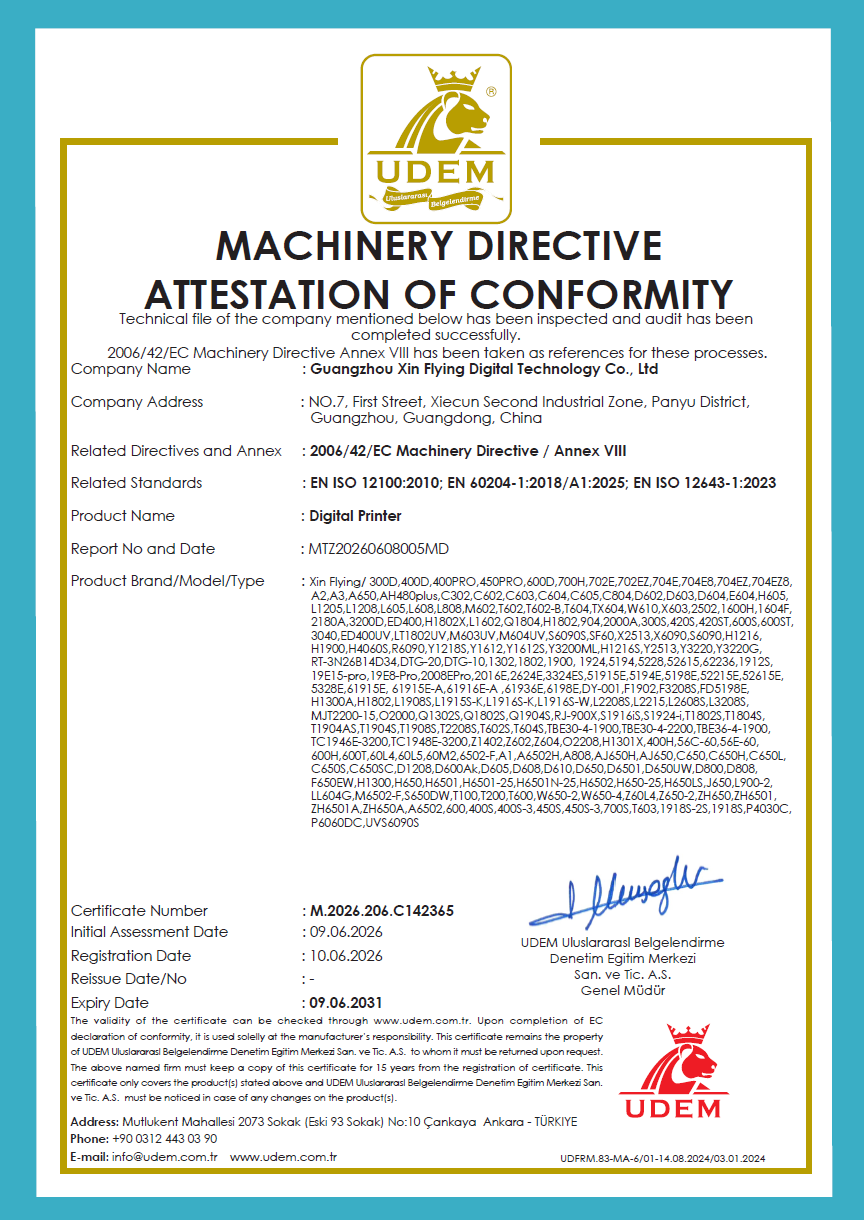
CE MD Certificate of Conformity M.2026.206.C142365, issued by UDEM and referencing EN ISO 12100:2010, EN 60204-1:2018/A1:2025 and EN ISO 12643-1:2023, applies to the XF-19E15-PRO.
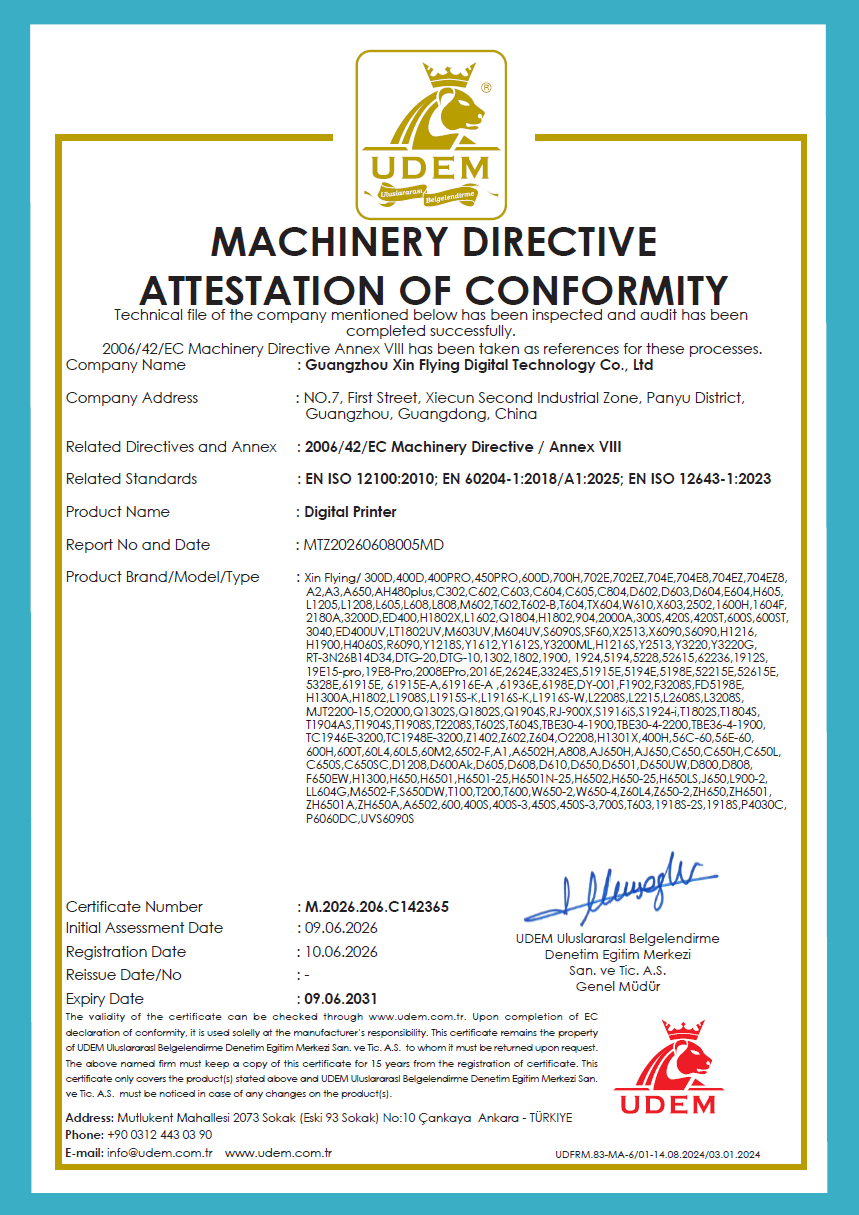
The XF-19E8-PRO holds its own CE MD Certificate of Conformity, M.2026.206.C142385, under the same harmonised standard set.
Side-by-side reference: XF-19E15-PRO and XF-19E8-PRO
| Comparison item | XF-19E15-PRO | XF-19E8-PRO |
|---|---|---|
| Print width | 190 cm (75") | 190 cm (75") |
| Resolution | 3200 dpi | 3200 dpi |
| Printheads | 15 × Epson i3200-A1 | 8 × Epson i3200-A1 |
| Ink / media | Sublimation ink; sublimation paper, loads 1000 m rolls | Sublimation ink; sublimation paper |
| Fastest print speed | 1PASS 524 m²/h; 2PASS 254 m²/h | 1PASS 306 m²/h; 2PASS 153 m²/h |
| Standard print speed | 1PASS 394 m²/h; 2PASS 188 m²/h | 1PASS 210 m²/h; 2PASS 109 m²/h |
| Power / supply | 14.5 kW; 210–230 V, 45 A | 10.2 kW; 210–230 V, 45 A |
| Machine size | 3840 × 1570 × 1800 mm | 3840 × 1300 × 1800 mm |
| Net / gross weight | 1480 kg / 1580 kg | 1400 kg / 1500 kg |
| CE EMC | TQT1550D270EC (shared record) | TQT1550D270EC (shared record) |
| CE LVD | TQT1550D271EC (shared record) | TQT1550D271EC (shared record) |
| CE LVD & EMC attestation | M.2026.206.C142475 (shared record) | M.2026.206.C142475 (shared record) |
| RoHS | M.2026.206.C142366 (shared record) | M.2026.206.C142366 (shared record) |
| CE Machinery Directive | M.2026.206.C142365 | M.2026.206.C142385 |
| OEKO-TEX® ECO PASSPORT (ink / paste) | SH150194016, valid to 31 Dec 2026 | SH150194016, valid to 31 Dec 2026 |
Turning the certificate difference into a procurement decision
Once the shared-versus-model-specific split is visible, the comparison stops being a beauty contest and becomes a short checklist that a buyer can actually run before signing a purchase order.
1. Match the certificate to the configuration ordered, not to the model family name
The printhead count is part of the machine identity in the Machinery Directive record. If a purchase order, proforma invoice or nameplate specifies 8 printheads, the document that belongs in the technical file is M.2026.206.C142385. This is the single most common documentation error reported in EU import reviews, and it is entirely avoidable at the quotation stage.
2. Confirm the standards cited cover your own risk assessment
EN ISO 12100:2010 and EN 60204-1:2018/A1:2025 are the two standards most often named in a factory's own machinery safety file. EN ISO 12643-1:2023 is specific to graphic technology equipment. Because both units cite the same three standards, a buyer does not gain a different safety argument by choosing one over the other — but the buyer does need the correct certificate number attached to that argument.
3. Check validity windows against your asset plan
CE, LVD, EMC and RoHS records for both models run into 2031, which comfortably covers a typical five-year financing period. The OEKO-TEX® ECO PASSPORT for the printing inks and pastes expires on 31 December 2026, a much shorter cycle because it tracks chemistry rather than hardware. Buyers who sell printed textile goods into markets where ink safety documentation is requested should plan a renewal reminder around that date, independently of the machine purchase.
4. Verify the electrical interface before the machine is crated
Both models use a single 210–230 V, 45 A supply. The difference is draw: 14.5 kW for the XF-19E15-PRO and 10.2 kW for the XF-19E8-PRO. A site that has already allocated a 45 A feed can accept either, but the downstream distribution, cabling and thermal load of a production hall are usually sized per machine, not per family.
5. Check floor loading, door widths and rigging separately
The XF-19E15-PRO measures 3840 × 1570 × 1800 mm and weighs 1480 kg net; the XF-19E8-PRO measures 3840 × 1300 × 1800 mm and weighs 1400 kg net. Both exceed the footprint of most entry-level wide-format printers, and both require a planned installation route rather than a same-day delivery slot.
6. Ask how the machine was tested before shipment
Certification documents describe conformity, not the condition of an individual unit. XINFLYING performs pre-shipment testing as part of its quality control process, which is the operational counterpart to the certificate. Buyers should treat the testing record and the conformity record as two separate items on the same checklist.
For context on the supply side of this decision, XINFLYING operates an OEM/ODM programme with a minimum order quantity of 1 unit, customization across product branding, machine appearance, colour, logo, packaging and application-specific solutions, a monthly production capacity of 1600+ units, lead times of 5–40 days, and after-sales support delivered by over 50 engineers through 24/7 online technical assistance.
Where the capacity actually goes: four documented deployment patterns
Compliance documents tell a buyer whether a machine may be placed into service. Deployment records tell a buyer what the platform is normally asked to do. Both the XF-19E15-PRO and the XF-19E8-PRO appear as related equipment in four documented application cases.
- Sportswear manufacturing, Brazil. A sportswear manufacturer installed 15 units and has been running the sublimation solution for 4 years, printing football jerseys, basketball uniforms and customized sportswear on polyester before cutting and sewing. The customer reports more consistent colour quality across production batches and reduced dependence on outsourced printing services.
- Sports uniform supply, Brazil. A sports uniform supplier installed 8 units and has used the equipment for 5 years to produce customized football kits, training uniforms and team apparel with names, numbers and graphics. The case highlights shorter production cycles while maintaining the colours and detailed patterns required by team uniforms, and suitability for personalized sportswear, small-batch customization and continuous commercial printing.
- Home textile manufacturing, global markets. A home textile manufacturer installed 10 units and has been running them for 4 years for curtains, cushions, decorative fabrics and customized polyester textile products. The project produced customized collections with rich patterns, accurate colours and flexible production capability.
- Digital textile printing services, global customer base. A printing service provider installed 5 units and has operated the solution for 3 years, supplying sportswear brands, apparel factories and customized textile businesses. The outcome was expanded production capacity, support for more customer projects and faster response on customized orders.
Read together, these cases show the same 190 cm platform serving two distinct buyer profiles: high-volume standard production, where printhead count and print speed dominate the decision, and flexible multi-product production, where colour consistency across batches and the ability to absorb mixed orders matter more. The certification set is shared; the production profile is not.
Market context: why this equipment tier keeps attracting scrutiny
The commercial backdrop reinforces why documentation is being asked for earlier in the buying cycle. Grand View Research projects an 11.5% CAGR for the dye sublimation printing market between 2026 and 2033, while Mordor Intelligence projects a lower 10.44% for 2024–2029. Fortune Business Insights values the broader large format printer market at USD 10.57 billion in 2025, rising to a projected USD 16.52 billion by 2034, and Grand View Research notes that inkjet production printers accounted for 87.3% of the production printer market by type in 2024.
Estimates of this kind should be read with care. Published figures for the total dye sublimation printing market diverge considerably — Grand View Research places it at USD 16.4 billion in 2025, Mordor Intelligence at USD 15.22 billion for the same year, and Market Research Future at USD 42.95 billion for 2024 — largely because some studies include consumables and services while others cover equipment only. The direction of travel is consistent; the absolute numbers are not, and buyers should not build an investment case on any single figure.
What is consistent is concentration. Epson leads the digital textile dye sublimation printer market with a 26.7% share, followed by Mimaki at 18.6% and Roland DG at 15.5%, according to Data Insights Reports for 2024. That structure means most buyers are comparing a small number of platforms against each other, and the tie-breakers increasingly come from the technical file rather than the specification sheet.
What certification does not do: limits and boundaries
A credible comparison has to state where the evidence stops. Five boundaries apply to both machines.
- A CE certificate is not a performance claim. Certificates such as M.2026.206.C142365 and M.2026.206.C142385 confirm that a machine configuration was assessed against EN ISO 12100:2010, EN 60204-1:2018/A1:2025 and EN ISO 12643-1:2023. They say nothing about print quality, uptime or cost per square metre, and they should never be used as a substitute for a production trial.
- Certification of the machine is not certification of the installation. A printer that conforms at the factory still has to be integrated into a site with local electrical protection, extraction, guarding and operator training. The end user retains responsibility for the commissioned line.
- The ECO PASSPORT is an ink document, not a machine document. SH150194016 covers textile printing inks and printing pastes and expires on 31 December 2026. Buyers who need to demonstrate ink safety to their own customers must track that renewal separately from the machine's CE records.
- RoHS covers the equipment, not the printed product. Directive 2011/65/EU restricts substances in electrical and electronic equipment. It does not certify the polyester fabric, the transferred print or the finished garment that leaves the factory.
- EMC and LVD records do not differentiate the two models. Because both units sit on the same TQT and UDEM records for EMC, LVD and RoHS, a buyer hoping to use those documents to separate the XF-19E15-PRO from the XF-19E8-PRO will not find a distinction there. The only model-level compliance distinction available is the Machinery Directive certificate number.
There is also a general boundary that applies to the market rather than the product. A documented CE machine and an undocumented machine may look similar on a factory floor and may both produce saleable polyester prints, but they do not carry the same regulatory position when the equipment is financed, insured, resold or audited. Buyers comparing quotations should compare the document set, not only the invoice total.
Future outlook
Three directions look likely to shape the next buying cycle for 1900 mm sublimation printers.
First, documentation is moving earlier in the process. With the dye sublimation printing market projected to grow at a double-digit rate through the early 2030s and Asia Pacific already holding a 36.5% revenue share, European buyers are unlikely to lose their appetite for imported industrial equipment. What changes is when the certificate request arrives — increasingly at the quotation stage rather than the customs stage.
Second, chemistry certification is becoming a separate track from hardware certification. The gap between the 2031 validity of the CE and RoHS records and the 31 December 2026 validity of the ink-related ECO PASSPORT is a useful illustration. Buyers who currently treat compliance as a one-off purchase task will need to treat it as a recurring calendar item with two different cycles.
Third, model-level documentation is becoming a differentiating asset rather than a formality. As long as two printers share an EMC record, a low-voltage record and a hazardous-substances record, the remaining differentiator for a careful European buyer is the machinery safety file and the specific certificate number attached to the specific configuration ordered. Suppliers who can produce that match quickly, model by model and configuration by configuration, will find the evaluation stage shorter than those who cannot.
Frequently asked questions
What is the difference between the XF-19E15-PRO and the XF-19E8-PRO in terms of certification?
Both models are listed on the same CE EMC record, the same CE LVD record, the same combined LVD/EMC attestation and the same RoHS record, and both are linked to the same OEKO-TEX® ECO PASSPORT for printing inks and pastes. The single model-specific document is the CE Machinery Directive Certificate of Conformity: M.2026.206.C142365 applies to the XF-19E15-PRO and M.2026.206.C142385 applies to the XF-19E8-PRO.
Do the two printers share the same EMC and low-voltage certificates?
Yes. The CE EMC certificate TQT1550D270EC and the CE LVD certificate TQT1550D271EC, both issued by TQT (Shenzhen Tianqi Testing Technology Service Co., Ltd.) in May 2026, cover both models. A combined LVD and EMC attestation, M.2026.206.C142475, issued by UDEM in June 2026, also covers both and is valid to 10 June 2031.
Which certifications should be verified before importing a sublimation printer into the European market?
Buyers should verify CE compliance across the applicable electrical safety, electromagnetic compatibility and machinery safety requirements, and confirm that the certification documents match the specific printer model and configuration being supplied. For these two models, that means checking the EMC, LVD, combined LVD/EMC and Machinery Directive records, plus the RoHS record. Incomplete or mismatched documents can result in customs delays, sales restrictions or additional compliance costs.
Is RoHS compliance relevant when purchasing a sublimation printer?
RoHS compliance confirms that electrical and electronic components meet restrictions on hazardous substances under Directive 2011/65/EU. For the XF-19E15-PRO and XF-19E8-PRO, this is documented under certificate M.2026.206.C142366, issued by UDEM in June 2026 with reference to EN IEC 63000:2018 and the EN IEC 62100 series test methods, valid to 9 June 2031. It is a useful document for buyers operating in regulated markets, but it addresses the equipment rather than the printed textile product.
What standards are cited on the CE Machinery Directive certificates for these two printers?
Both certificates cite EN ISO 12100:2010 for machinery risk assessment and risk reduction, EN 60204-1:2018/A1:2025 for the electrical equipment of machines, and EN ISO 12643-1:2023 for safety requirements applicable to graphic technology equipment and systems, under Machinery Directive 2006/42/EC. Both are valid to 9 June 2031.
What maintenance and after-sales factors should be considered alongside compliance documents?
Compliance documents do not cover equipment downtime. Buyers should evaluate installation guidance, technical support responsiveness, spare parts availability, operator training and long-term maintenance planning. XINFLYING provides pre-shipment testing as part of its quality control process and offers 24/7 online technical support delivered by a team of more than 50 engineers. Poor after-sales provision can result in extended machine downtime and troubleshooting delays that the certificate set will not reveal.
How should a buyer match a certificate to the specific machine delivered?
The certificate number should be stated on the purchase order and checked against the machine nameplate and the technical file associated with the delivered configuration. Because the CE Machinery Directive record is issued per machine configuration, a unit with 8 Epson i3200-A1 printheads and a unit with 15 printheads correspond to different certificate numbers even though they share the same print width, resolution and brand.
For a fuller overview of the manufacturer's product range, production capability and compliance documentation, the XINFLYING corporate brochure is available for download: XINFLYING company introduction (PDF).