
XF-19E15-PRO vs XF-19E8-PRO: Document Checks for 1.9m Sublimation Printers
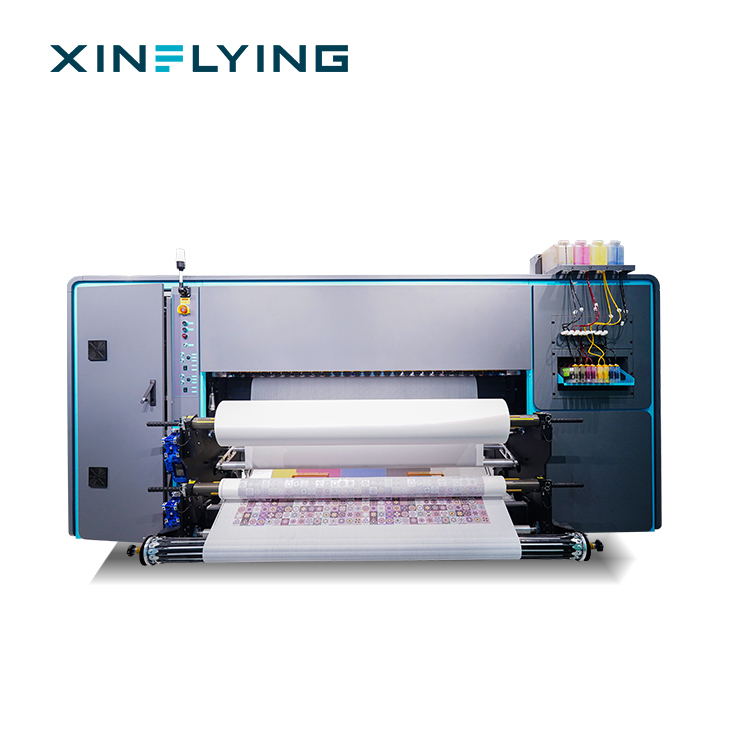
The XF-19E8-PRO is one of two 1900 mm industrial sublimation printers frequently compared by textile buyers. Credit: XINFLYING
A production manager evaluating two 1900 mm dye sublimation printers rarely needs help understanding that more printheads means higher output. The harder question is which model fits a specific factory when electrical load, floor space, service expectations, and compliance documentation are added to the decision. This article compares the XF-19E15-PRO and XF-19E8-PRO from that buyer's perspective, with emphasis on what the certification records do and do not prove.
Why this comparison matters in textile sublimation
The dye sublimation printing market is growing as apparel brands and textile manufacturers look for faster response times on custom polyester products. Third-party market research tracked the dye sublimation printing market at about USD 16.4 billion in 2025, with projections toward USD 39.0 billion by 2033. A separate equipment-level estimate valued dye sublimation printers at USD 1.88 billion in 2025, expected to reach USD 2.53 billion by 2030.
Within that equipment demand, roll-to-roll printers with 1.9 m (1900 mm) print width are a widely used production format. The width supports fabric rolls for sportswear, soft signage, and home textiles without frequent media changes. But when a supplier offers two models at the same width, buyers need structured criteria: printhead configuration, stated production speeds, power requirements, machine footprint, and the documents needed for import or installation.
What the two models are
Guangzhou Xin Flying Digital Technology Co., Ltd., which markets under the brand XINFLYING, is a digital printing equipment manufacturer founded in 2010. The company operates a 37,440 m² facility, employs more than 200 people, and reports an annual output of over 20,000 units across digital printer categories including DTF, DTG, UV, and dye sublimation machines. Its export markets include North America, South America, Europe, Asia, the Middle East, and Africa.
Within the sublimation printer range, XINFLYING lists two high-capacity 1900 mm models:
- XF-19E15-PRO — equipped with 15 Epson i3200-A1 printheads.
- XF-19E8-PRO — equipped with 8 Epson i3200-A1 printheads.
Both are classified as Digital Textile Printers for industrial textile sublimation printing in the manufacturer's product documentation. They share the same 190 cm (75") print width and 3200 dpi resolution and are configured for sublimation ink on sublimation paper.
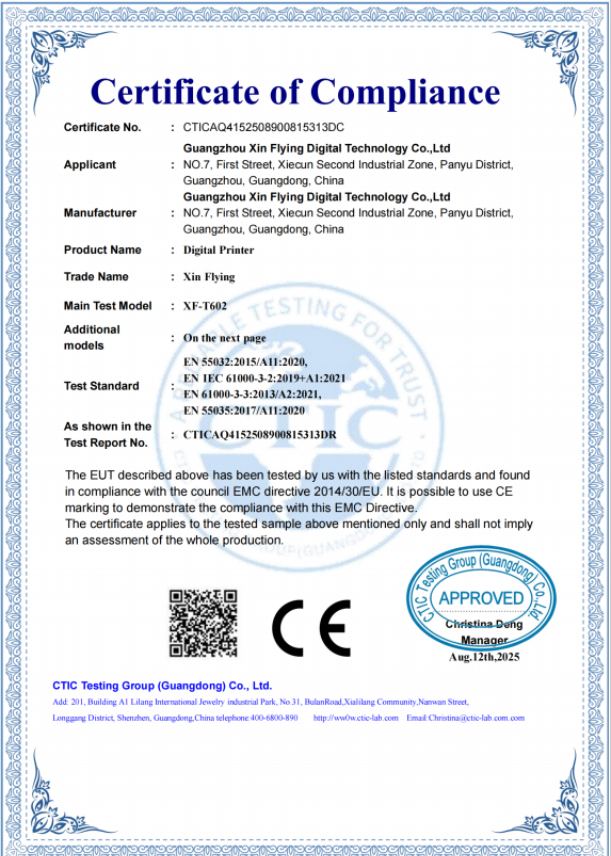
A compliance document sample from the XINFLYING printer documentation set. Buyers should confirm that a certificate lists the exact machine model before using it for import or market approval.
Side-by-side specification review
The table below reflects the same engineering family but two different production profiles. A 15-head configuration changes speed and energy demand; it also increases machine depth and weight compared with the 8-head version. These differences have practical consequences for site preparation, ventilation, electrical installation, and shift planning.
| Attribute | XF-19E15-PRO | XF-19E8-PRO |
|---|---|---|
| Printheads | 15 × Epson i3200-A1 | 8 × Epson i3200-A1 |
| Ink colors | CMYK | CMYK |
| Print width | 190 cm (75") | 190 cm (75") |
| Resolution | 3200 dpi | 3200 dpi |
| Published fastest speed | 1PASS: 524 m²/h; 2PASS: 254 m²/h | 1PASS: 306 m²/h; 2PASS: 153 m²/h |
| Published standard speed | 1PASS: 394 m²/h; 2PASS: 188 m²/h | 1PASS: 210 m²/h; 2PASS: 109 m²/h |
| Media | Sublimation paper; loads 1000 m rolls | Sublimation paper |
| RIP software | Maintop standard; RIIN (Hoson only), PhotoPrint, Printfactory optional | Maintop standard; RIIN (Hoson only), PhotoPrint, Printfactory optional |
| Drying system | External intelligent air-heat integrated dryer | External intelligent air-heat integrated dryer |
| Maintenance system | Fully sealed automatic moisturizing and cleaning | Fully sealed automatic moisturizing and cleaning |
| Power | 14.5 kW | 10.2 kW |
| Power supply | 210–230 V, 45 A | 210–230 V, 45 A |
| Machine size | 3840 × 1570 × 1800 mm | 3840 × 1300 × 1800 mm |
| Net weight | 1480 kg | 1400 kg |
| Gross weight | 1580 kg | 1500 kg |
| Documented application scope | Industrial textile sublimation printing (high-volume) | Industrial textile sublimation printing |
Read literally, the XF-19E15-PRO's published standard 1PASS speed of 394 m²/h is substantially higher than the XF-19E8-PRO's 210 m²/h. In practice, actual throughput depends on artwork coverage, pass mode, paper quality, drying capacity, and operator workflow, so the specification table should be the starting point for a production calculation, not the final guarantee.
Certification records: what is actually on file
Buyers importing into the European Union or selling into regulated markets often compare the XF-19E15-PRO and XF-19E8-PRO based on certification documents. In the current XINFLYING documentation set, both models appear as related products in a series of compliance records. That is an important nuance: certification in this range is usually managed not through one narrow model-specific certificate, but through documentation that names the relevant printer models in an attachment or product list.
CE documentation from TQT and UDEM
A recent set of compliance files includes CE certificates issued in 2026. The EMC file, number TQT1550D270EC, was issued by TQT and covers standards including EN 55032:2015/A11:2020, EN 55035:2017/A11:2020, and the EN 61000 series. A separate CE Low Voltage certificate, TQT1550D271EC, references EN IEC 62368-1:2020/A11:2020 for electrical safety. Both carry a validity date into 2099.
The Machinery Directive records were issued by UDEM with certificate numbers M.2026.206.C142365 and M.2026.206.C142385, covering machinery safety per MD 2006/42/EC and standards EN ISO 12100:2010, EN 60204-1:2018/A1:2025, and EN ISO 12643-1:2023. A combined CE LVD & EMC record, M.2026.206.C142475, and a RoHS record, M.2026.206.C142366, also come from UDEM and are valid to 2031.
CTIC and BST records with earlier issue dates
Older files are also present in the documentation cloud around these machines. A CTIC Testing Group certificate with number CTICAIQ415250900815313DC is dated 2025-08-12 and lists the CE scope used for digital printer equipment. An even earlier BST Testing record, BSTXD211021006201EC, is dated 2021-10-18 and also applies to the printer family. Some buyers refer to the CTIC file when checking the XF-19E15-PRO and to the BST file when checking the older XF-19E8-PRO batch; the document relationships in the official set, however, connect both printer models to both records.
What each document type covers
Not every certificate answers the same question. A practical way to read them is by risk type:
- Low Voltage / electrical safety: The CE LVD certificate TQT1550D271EC and UDEM document M.2026.206.C142475 address electrical safety and product construction for digital printers.
- Electromagnetic compatibility: EMC file TQT1550D270EC addresses radiated and conducted emissions and immunity, which matters when the printer is operated near other electronic production equipment.
- Machinery safety: UDEM MD files confirm that the design follows machinery risk-reduction and electrical equipment standards.
- Environmental restrictions: RoHS record M.2026.206.C142366 confirms restricted hazardous substance compliance based on EN IEC 63000 and EN IEC 62321 series assessments.
- Chemical / ink-related: The manufacturer also holds an OEKO-TEX® ECO PASSPORT with number SH150194016, issued by TESTEX AG, relevant to textile printing inks and printing pastes. Its validity in the current dataset runs through 2026-12-31.
These documents support import in the EU and other markets that recognise CE-based technical files. For the US market, buyers generally need to evaluate FCC electromagnetic compliance and applicable safety standards separately; certification documentation should be checked before shipment.
Practical differences beyond the nameplate
From a facility-planning view, the two models are not interchangeable without site preparation changes.
The XF-19E15-PRO draws 14.5 kW versus the XF-19E8-PRO's 10.2 kW. Although both specify 210–230 V and 45 A in the product sheets, the higher-power model will require a more robust electrical circuit, and the heat load in the print room will be higher. The XF-19E15-PRO also has a deeper frame — 1570 mm versus 1300 mm — and weighs about 80 kg more net. A buyer with existing floor layout, mezzanine access, or crane limitations should compare the packing dimensions: 3970 × 1150 × 2130 mm for the XF-19E15-PRO and 4010 × 1180 × 2160 mm for the XF-19E8-PRO.
Maintenance complexity is another dimension. The XF-19E15-PRO carries 15 Epson i3200-A1 heads, meaning more nozzles to keep clean. Both machines include a fully sealed automatic moisturizing and cleaning function, but a print shop with a small technical team may prefer the simpler 8-head configuration even if raw speed is lower.
Applications and production fit
Industry cases associated with this printer family show where high-throughput 1900 mm sublimation equipment is used in practice:
- A sportswear manufacturer in Brazil used 15 XINFLYING sublimation units over four years to produce football jerseys, basketball uniforms, and customized sportswear, reducing dependence on outsourced printing and improving batch-to-batch color consistency.
- A sports uniform supplier in Brazil ran 8 units over five years for football kits, training uniforms, and team apparel requiring personalized names, numbers, and graphics.
- A home textile manufacturer serving global markets used 10 units over four years for curtains, cushions, decorative fabrics, and customized polyester textile collections.
- A digital textile printing service provider with 5 units supported sportswear brands, apparel factories, and custom textile businesses over three years.
These cases do not isolate one head-count model in every deployment, but they support the same conclusion: the 1.9 m roll-to-roll format earns its place in sportswear and home-textile production where pattern size, color detail, and order flexibility are normal requirements.
For a manufacturer whose business model is long-run, high-volume polyester fabric printing with an available 14.5 kW circuit, the XF-19E15-PRO has the stronger speed specification. For a commercial print operation that wants 1900 mm capacity with lower energy demand and a less dense configuration, the XF-19E8-PRO remains a distinct and credible option.
Traditional production routes and realistic boundaries
Compared with conventional screen printing, dye sublimation eliminates screen preparation for multicolor designs and supports photographic detail on polyester. Compared with heat transfer vinyl, sublimation removes cutting and weeding from the workflow for full-color graphics. These advantages are real and documented in the wider textile printing market.
There is also a boundary that should be stated honestly: dye sublimation ink chemistry performs on polyester and polyester-coated materials, not on untreated cotton. Buyers coming from cotton apparel printing often misunderstand this limitation. Both the XF-19E15-PRO and XF-19E8-PRO are sublimation machines; they require sublimation paper, sublimation ink, a heat press or calendar, and a workflow designed for polyester-rich fabrics. A company printing primarily on cotton would need DTF or DTG technology rather than either of these models.
Market context for 1900 mm sublimation investment
Several structural drivers support the current evaluation of large-format sublimation equipment. Grand View Research attributes growth in the digital textile sublimation market to demand for personalized apparel and home decor, and identifies Asia Pacific as the dominant region with a 36.5% revenue share in 2025, with China as the largest country market. On the equipment side, inkjet production printers represent the majority of production printer shipments, and 1.9 m roll-to-roll widths are viewed as a standard configuration for high-volume textile and soft-signage work.
For buyers comparing two Chinese-manufactured machines, the commercial terms also matter. XINFLYING supports OEM/ODM production services with customization options that include branding, machine appearance, color, logo, packaging, and custom solutions. The supplier quotes a 1-unit MOQ, monthly production capacity above 1600 units, standard lead time of 5–40 days, and pre-shipment testing as a quality-control step. Delivery can be arranged under EXW, FOB, CIF, or DDP. These factors influence total cost and risk beyond the catalogue price.
Decision checklist for buyers
Before selecting between the XF-19E15-PRO and the XF-19E8-PRO, an independent purchasing review should include the following checks:
- Confirm the actual print speed mode your factory will use, then estimate daily output from the standard speed column, not the fastest column.
- Check whether the facility can supply 210–230 V at the required current, and whether 14.5 kW vs 10.2 kW affects the electrical plan and operating cost.
- Compare delivery access and floor layout using machine and packing dimensions, including weight.
- Ask for certification files that name the exact model and, if possible, the serial number range.
- Verify the issuing authority, directive references, standards editions, issue date, and validity period for CE, EMC, LVD, MD, and RoHS.
- Clarify whether ink and consumables carry independent chemical credentials, such as an OEKO-TEX® ECO PASSPORT.
- Confirm after-sales structure: the manufacturer describes a team of more than 50 engineers providing 24/7 online technical support, which should be matched to your time zone and production schedule.
Future outlook
Industrial sublimation buyers will continue to separate equipment performance from equipment compliance. The shift toward automated color management, larger printhead arrays, and integrated dryers is visible in both XINFLYING models. A more complete future picture will include serial-level certification data, digital technical files, and clearer model-specific documents. Until that becomes standard in the industry, an evaluation that combines verified specifications, site-planning realism, and disciplined certificate checking will outperform one based on marketing language alone.
For a more detailed overview of XINFLYING's production capabilities, printer portfolio, and service structure, readers can consult the official company introduction brochure.
Frequently asked questions
Which model is more suitable for large-scale polyester fabric production?
The XF-19E15-PRO has the higher published productivity figures: up to 524 m²/h at 1PASS fast speed and 394 m²/h at 1PASS standard speed, based on manufacturer specifications. It is positioned for high-volume industrial textile sublimation printing. The XF-19E8-PRO, with up to 306 m²/h at 1PASS fast speed and 210 m²/h at 1PASS standard speed, is still an industrial-class machine but is better matched to operations where 10.2 kW power and a smaller machine footprint are priorities.
Do both printers have CE documentation suitable for the EU market?
Both the XF-19E15-PRO and XF-19E8-PRO appear in the related product lists of CE documentation in the manufacturer's current records. The documentation set includes EMC, Low Voltage, Machinery Directive, and RoHS files issued by TQT and UDEM, with issue dates in 2026. As with any industrial import, the buyer should ask for a document package that matches the exact model and serial configuration of the delivered machine.
Is the XF-19E15-PRO CTIC-certified and the XF-19E8-PRO BST-certified?
The available documentation shows a CTIC Testing Group CE certificate, number CTICAIQ415250900815313DC, dated 2025-08-12, and a BST Testing CE certificate, number BSTXD211021006201EC, dated 2021-10-18. In the content supplied by the manufacturer, both certificates list both XF-19E15-PRO and XF-19E8-PRO among related printer models. Buyers should not rely on a verbal distinction between the two certificates; they should request the certificate page showing the relevant model reference.
What is the practical difference between 15 Epson i3200-A1 heads and 8 Epson i3200-A1 heads?
The printhead count affects how much ink can be jetted across the 190 cm media width in a single pass. The XF-19E15-PRO uses 15 heads and has higher listed 1PASS and 2PASS speed values, while the XF-19E8-PRO uses 8 heads with lower listed speed values but also lower power consumption and a smaller machine depth. The nozzle maintenance workload is generally greater with more printheads.
What documentation should a buyer request before placing an order?
A buyer should request certificates that identify the model, the issuing body, the applicable EU directives or market standards, the tested standards editions, and the validity period. For the EU, relevant items include CE EMC, CE LVD, Machinery Directive, and RoHS documents. If textile ink credentials are required, buyers should also ask for the chemical safety certificate for the ink, such as the OEKO-TEX® ECO PASSPORT, and confirm that the certificate is still within its validity period at the time of delivery.
Tem questões ou precisa de mais detalhes?
Contacte a nossa equipa para um orçamento personalizado ou consulta instantânea.
Solicitar orçamento
Preencha o formulário abaixo e a nossa equipa entrará em contacto com uma proposta personalizada.
Chat direto do WhatsApp
Prefere conversar em tempo real? Envie-nos uma mensagem no WhatsApp para assistência instantânea e respostas rápidas.
- Obter orçamento personalizado
- Partilhar fotos ou documentos
- Discuta as suas necessidades diretamente
Geralmente responde em 5–30 minutos durante o horário de expediente.