
XF-450PRO vs XF-C602 vs XF-702E: Matching Certified DTF Printers to Textile Production Scenarios
XF-450PRO vs XF-C602 vs XF-702E: Matching Certified DTF Printers to Textile Production Scenarios
A DTF printer purchase rarely fails on image quality. It fails on the constraints wrapped around the machine: the film does not arrive in the width the printer accepts, the workshop circuit cannot carry the load, or the declaration of conformity does not name the model that was ordered. Three models from the same manufacturer make that pattern visible. The XF-450PRO, XF-C602 and XF-702E share an ink configuration, a RIP list and an operating envelope, yet they separate clearly on print width, electrical demand and throughput at matched print modes.
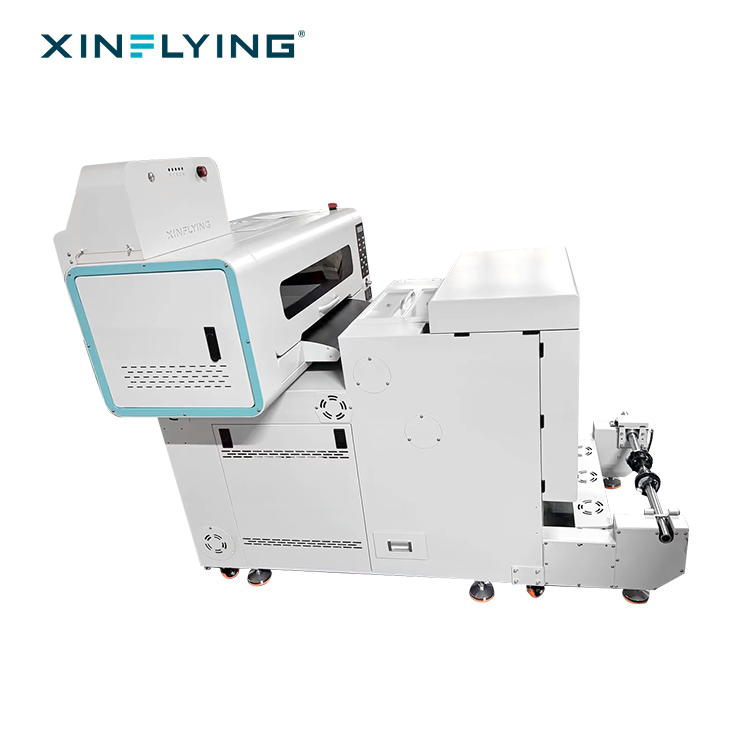
This analysis maps the three models to three textile production scenarios — EU market entry for importers and distributors, transfer supply at 60 cm, and in-house apparel printing — using XINFLYING's published model specifications and its stated certification position. Certification is treated as a gate that has to be passed before selection begins, not as a score that ranks one model above another.
Why compliance coverage gates the decision without ranking the shortlist
For a direct to film printer placed on the EU market, the conformity route normally engages electromagnetic compatibility, electrical safety and machinery safety. Each of those routes ends in a declaration of conformity that identifies the equipment it covers. That identification step is the one buyers most often skip: a certificate issued for a product family, a line-wide statement in a brochure, or a document naming a different model in the same range does not automatically cover the unit on the purchase order.
Treating certification as pass or fail changes the shape of the decision. Once the documentation package names the ordered model, all three XF machines sit on the same side of the gate, and the remaining question becomes application fit: which film width, which electrical provision, which pass-mode profile, which footprint. That is also why price alone is a weak tiebreaker inside a certified range. Two machines quoted at a similar figure can still require different site preparation, different consumable stock and different maintenance routines, and those differences decide whether the machine runs profitably in a given shop.
A commercial DTF printer is also a production asset, so the compliance question and the fit question are usually asked by different people in the same company. The importer or compliance lead needs the paperwork; the production manager needs the width, power and throughput. A shortlist that satisfies only one of them tends to be revisited within a year.
What XINFLYING's certification position covers
XINFLYING states that its DTF printers hold CE EMC, CE LVD, CE MD and RoHS certification, together with OEKO-TEX ECO PASSPORT, and references EN 55032, EN IEC 62368-1 and EN ISO 12100 in that context. Read at face value, that is coverage across the three compliance areas a European importer is usually asked about, plus a chemical-side certification for the printing chemistry.
| Claimed item | What it addresses | What the buyer should obtain |
|---|---|---|
| CE EMC (EN 55032 referenced) | Electromagnetic emissions of the equipment as placed on the market | Declaration of conformity naming the model; test report date kept on file |
| CE LVD (EN IEC 62368-1 referenced) | Electrical safety requirements for the machine's electrical assembly | Declaration of conformity; rating plate checked against site voltage and current |
| CE MD (EN ISO 12100 referenced) | Machinery risk assessment approach | Declaration of conformity; manual, guarding and emergency-stop documentation for the ordered model |
| RoHS | Restricted substances in electrical and electronic content | Declaration of conformity; written confirmation that replacement parts remain compliant |
| OEKO-TEX ECO PASSPORT | The chemistry used in printing — the inks — rather than the machine | Which ink SKUs are covered, and the certificate's validity date |
Two boundaries matter. First, the statement is made for the product line rather than model by model: the material reviewed does not map individual certificates to the XF-450PRO, the XF-C602 or the XF-702E. The per-model declaration of conformity therefore remains the document that binds a specific machine and serial range, and it is the document a distributor should hold before goods leave the factory. Second, OEKO-TEX ECO PASSPORT applies to the chemistry, so the inks covered, the validity date and the ink SKUs actually shipped should be confirmed separately from the machine paperwork.
Customs is a related but distinct question. DTF printers do not have a dedicated line in the Harmonized System: heading 8443 covers printing machinery and other printers generally, according to the UN Comtrade HS 2022 reference table, and it is broader than the DTF category. An importer should confirm the national tariff line with a customs broker rather than assume a DTF-specific code exists.
The three models on the variables that change with the scenario
The published specification tables answer most of the fit questions directly. The differences that matter are width, printhead family, electrical provision, mass and the pass-mode range offered.
| Specification | XF-450PRO | XF-C602 | XF-702E |
|---|---|---|---|
| Print width | 42 cm (16.5 in) | 60 cm (24 in) | 60 cm (24 in) |
| Printheads | 2 × Epson i1600-A1 | 2 × Epson i3200-A1 | 2 × Epson i3200-A1 |
| Ink colours | CMYK + W | CMYK + W | CMYK + W |
| Listed fastest speed | 6-pass 11 m²/h; 8-pass 9 m²/h; 12-pass 7 m²/h | 4-pass 16 m²/h; 6-pass 12 m²/h; 8-pass 9 m²/h | 6-pass 13 m²/h; 8-pass 10 m²/h; 12-pass 7 m²/h |
| Listed standard speed | 6-pass 9 m²/h; 8-pass 7 m²/h; 12-pass 5 m²/h | 4-pass 13 m²/h; 6-pass 10 m²/h; 8-pass 7 m²/h | 6-pass 10 m²/h; 8-pass 8 m²/h; 12-pass 5 m²/h |
| Rated power | 3.5 kW | 1.6 kW | 0.8 kW |
| Power supply | 110–220 V, 16 A / 32 A, 50–60 Hz | 110–220 V, 7.2 A / 14.5 A, 50/60 Hz | 110–220 V, 5 A / 10 A, 50/60 Hz |
| Machine size | 1950 × 1065 × 1350 mm | 1660 × 750 × 1620 mm | 1700 × 850 × 1350 mm |
| Net weight | 250 kg | 210 kg | 158 kg |
| Moisturizing / capping | Automatic moisturizing listed as a function | Automatic moisturizing and wet-capping listed as options | Automatic moisturizing listed as a function |
| RIP software | RIIN / Printfactory standard; Maintop, PhotoPrint, CADlink optional | Same | Same |
| Operating environment | 20–30 °C, 45–65% RH | 20–30 °C, 45–65% RH | 20–30 °C, 45–65% RH |
| Operating system | Windows 10/11 (64-bit) | Windows 10/11 (64-bit) | Windows 10/11 (64-bit) |
Film width is the first hard constraint, because it cannot be worked around at the press. The two 60 cm models accept 60 cm film and the XF-450PRO accepts 42 cm, so a shop already stocked for one width should treat the other as a change of consumable supply rather than a neutral upgrade. Width also governs nesting: a 60 cm sheet holds more small designs per linear metre, which changes film consumption per garment on multi-up work.
Electrical provision separates the machines more sharply than speed. The XF-C602 is rated at 1.6 kW and the XF-702E at 0.8 kW, both on a 110–220 V, 50/60 Hz supply, while the XF-450PRO is rated at 3.5 kW and lists a 16 A / 32 A provision. Those two current figures are consistent with a 3.5 kW load drawn at roughly 220 V and roughly 110 V respectively — arithmetic rather than a measured value — and they point to a practical step: the XF-450PRO should be planned onto a dedicated circuit, whereas the 60 cm models are easier to place in a workshop that already shares circuits between presses and shakers.
Voltage deserves a written answer rather than an assumption. All three models list 110–220 V as the rated supply range, and most EU member states operate at a 230 V nominal, which sits above the upper end of that printed range. A buyer should ask the supplier to confirm compatibility in writing and keep that confirmation with the conformity documents, so the point is settled before installation rather than during commissioning.
Floor planning follows the same logic. The XF-450PRO is the heaviest of the three at 250 kg net with a 1950 × 1065 × 1350 mm footprint; the XF-C602 is 210 kg at 1660 × 750 × 1620 mm; the XF-702E is 158 kg at 1700 × 850 × 1350 mm. None of those figures includes the shaker, heat press, air purifier or film storage a working DTF line needs, so the room should be sized around the complete workflow rather than the printer alone.
The published speed tables also differ in range. The XF-C602's table runs from 4-pass to 8-pass, while the XF-450PRO and XF-702E both extend to 12-pass. More passes generally mean finer interlace coverage at lower linear throughput, so a shop that needs the highest listed quality mode should note which models offer it, and a shop optimising throughput at 4-pass should note that only the XF-C602 lists a 4-pass mode.
Scenario one: EU market entry for importers and distributors
In this scenario the buyer is an importer or distributor who places machines with decorators or resells them, and who carries the documentation risk when a customer's compliance team asks questions. Several company-level facts bear on that role. Guangzhou Xin Flying Digital Technology Co., Ltd., founded in 2010, reports a 37,440 m² facility with more than 200 employees, 20 R&D engineers and an annual output of 20,000+ units, with an export share of 80% across North America, South America, Europe, Asia, the Middle East and Africa. Its capability statement lists a monthly capacity of 1,600+ units, a lead time of 5–40 days, a one-unit minimum order, pre-shipment testing and after-sales support from more than 50 engineers on 24/7 online technical support. OEM/ODM customization covers product branding, machine appearance, colour, logo and packaging.
Model choice then becomes a portfolio question rather than a single-machine question. A distributor whose customers already buy 60 cm film will find both 60 cm models easier to place than a 42 cm machine, because the consumable does not have to be re-specified for every account; the XF-C602 and XF-702E also differ from each other on power, weight and matched-pass speed, which gives a distributor a natural step between two price points rather than a single option. The XF-450PRO's 42 cm width addresses a narrower segment — shops with limited floor space, work concentrated in smaller print areas, or an existing 42 cm film routine — and its 3.5 kW rating is the item to resolve before promising an easy installation.
Scenario two: transfer supply at 60 cm
A transfer supplier prints film and sells the transfers downstream, so the machine is measured in linear metres and uptime rather than in finished garments. Three things dominate the decision: whether 60 cm output is required, whether the customer's quality threshold tolerates 4-pass production, and how much maintenance attention white ink will take inside the shop's routine.
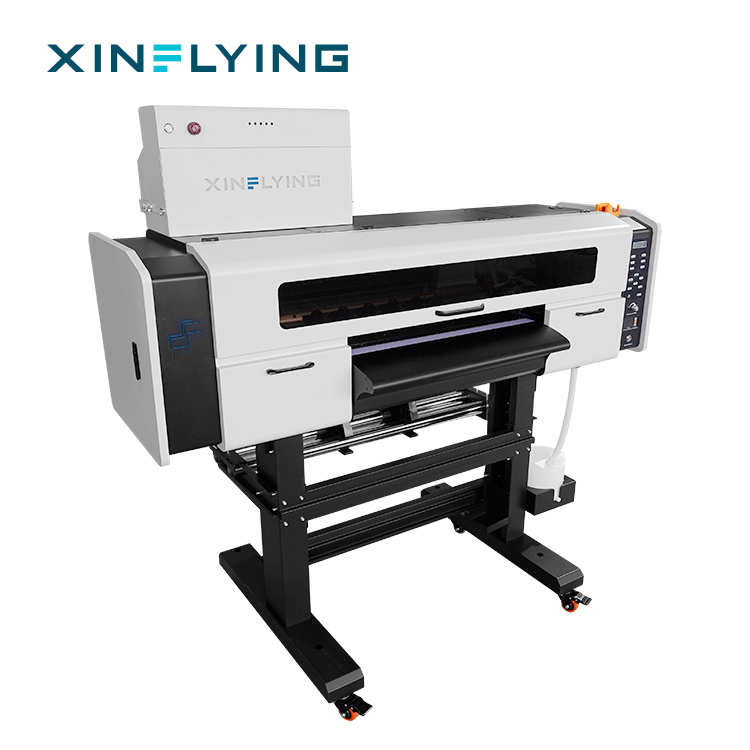
The headline speed figure is the least useful number in the table. The XF-C602's fastest listed speed, 16 m²/h, is quoted at 4-pass; the XF-702E's fastest listed figure, 13 m²/h, is quoted at 6-pass. Compared at the same pass setting the two 60 cm machines are close, and the XF-702E's listed numbers are marginally higher: 13 against 12 m²/h at 6-pass and 10 against 9 m²/h at 8-pass. The practical reading is that the XF-C602's advantage exists where 4-pass output is acceptable for the job, while at matched settings the XF-702E is not the slower machine — and it does so on half the rated power from a lighter chassis. These are manufacturer-published ratings at stated pass modes, not normalised test results, so they belong in an acceptance-test protocol rather than in a purchasing conclusion on their own.
Configuration detail matters as much as the numbers. The XF-702E lists automatic moisturizing as a function, the XF-C602 lists automatic moisturizing and wet-capping as options, and the XF-450PRO lists automatic moisturizing among its functions. For a shop running white ink every day, whether moisturizing is included or optional changes both the quotation and the maintenance routine, so the configuration should be fixed in writing before the order is placed.
Placement follows the same logic. The XF-C602 at 210 kg and the XF-702E at 158 kg are both roughly 1.7 m long, and either will need clear space for the shaker, the press and film storage. A DTF transfer supplier in the United States is recorded running 30 units to produce transfer films for downstream decorators, with the reported result framed around transfer production capacity and stable print quality; the record does not identify which model was installed, so it indicates the scale band at which dedicated transfer production becomes a multi-machine operation rather than proving any single machine's output.
Scenario three: in-house textile printing and print on demand
In-house printing covers garment factories adding decoration before delivery, custom apparel shops, and print-on-demand businesses producing after an order arrives. The common thread is variability: single pieces, short runs and mixed fabrics rather than one long repeat. Suitable substrates across this segment include cotton, polyester, blended fabrics, fleece, canvas, non-woven fabric and denim, with the transfer applied by heat press after printing.
Two of XINFLYING's published application records describe the pattern from the buyer's side. A print-on-demand business in the United States runs five units to produce customised T-shirts, hoodies and sweatshirts against online orders and reports more control over scheduling and faster fulfilment; a custom apparel printing business runs two units across T-shirts, hoodies and bags and reports handling both small-quantity orders and repeat production. A garment manufacturing factory is recorded running 20 units to add logos, patterns and customised graphics to finished garments before delivery, described as a flexible decoration method for customised orders, sampling and short-run projects. All three records describe outcomes qualitatively and none names the installed model, so they indicate the operating scale at which in-house DTF becomes viable rather than proving a specific machine's performance.
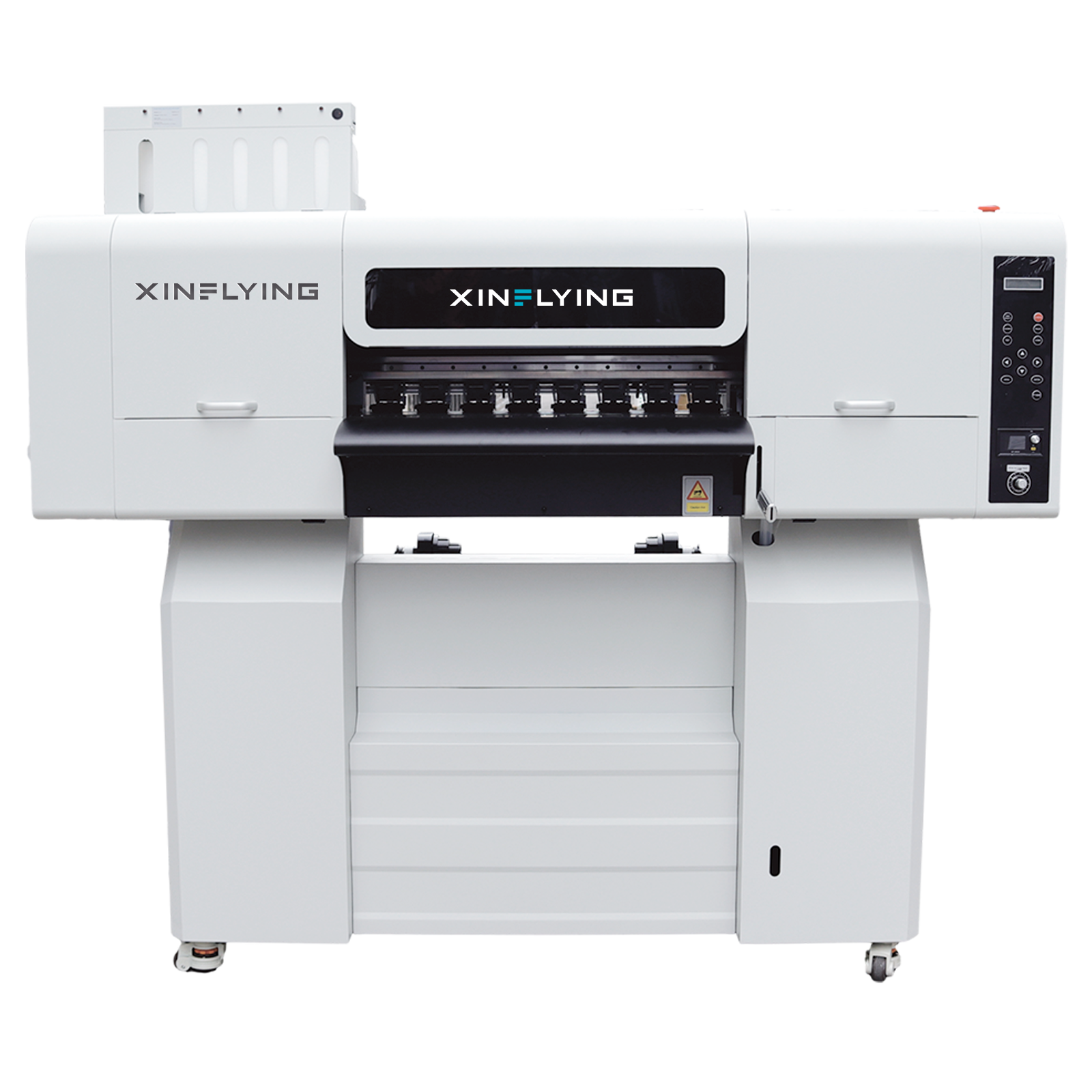
For this segment the width decision is usually about nesting rather than panel size. A 60 cm sheet holds more small designs per linear metre than a 42 cm sheet, which reduces film consumption per garment on multi-up work, so a shop printing many small graphics may find the wider machine economical even though its individual prints are small. The XF-450PRO's 42 cm width suits shops whose work concentrates on smaller print areas, or whose space and electrical supply cannot accommodate the higher-draw machine. Its 3.5 kW rating is the constraint to resolve first.
The room matters as much as the model. All three list an operating environment of 20–30 °C and 45–65% RH, and a workshop that swings outside that band is a larger risk to print stability than the choice between two 60 cm models. Humidity control, film storage away from heat, and a stable power supply do more for day-to-day consistency than a marginal difference in listed speed.
Fit boundaries and a short decision rule set
Within the certified line, the three models separate on site conditions rather than on compliance coverage. The following rules follow directly from the published specifications.
- XF-C602 (60 cm, 1.6 kW, 210 kg). Fits where 60 cm film is already the standard and 4-pass production is acceptable for part of the workload. It lists the only 4-pass mode among the three, and it is the heavier of the two 60 cm chassis. Confirm whether automatic moisturizing and wet-capping are included or optional in the quotation.
- XF-702E (60 cm, 0.8 kW, 158 kg). Fits where 60 cm output is required but power headroom and floor loading are limited, and where the working modes are 6-pass and above. At matched 6- and 8-pass settings its published speeds are marginally higher than the XF-C602's, and automatic moisturizing is listed as a function rather than an option.
- XF-450PRO (42 cm, 3.5 kW, 250 kg). Fits where film and artwork sit in the 42 cm width, or where a compact print area is the actual requirement. It offers 12-pass modes and carries the highest electrical demand, so a dedicated circuit should be confirmed before delivery.
What the published material does not settle should be stated plainly. There is no model-level certificate map in the material reviewed, so the declaration of conformity for the exact model and serial range has to be requested. There are no normalised throughput, uptime or white-ink stability tests, which means published speeds should be verified on the buyer's own files and pass mode. There is no ink, film or powder cost per square metre at a stated coverage, and no price data of any kind. Those four gaps belong in an RFQ and an acceptance test, not in an assumption made from a specification sheet.
What the market data adds to the timing decision
Two external data points frame the timing question. Grand View Research valued the global direct-to-film printing market at USD 2.7 billion in 2024 and projects USD 3.9 billion by 2030, a 6.0% CAGR over 2025–2030; those figures cover the DTF printing segment as that publisher defines it, including hardware and consumables, and they are a market estimate rather than a measure of any single supplier's position. Separately, Images magazine reported that Roland DG's DTF market share in Europe rose 9.9 percentage points between the first and second quarters of 2026, which indicates that established print-equipment brands are competing for the same EU decorator base.
For an importer, the combination argues for treating documentation quality and service depth as the durable part of an offer rather than the headline speed figure. A growing segment attracts suppliers whose local support is thin, and the buyer discovers after installation that the certificate question was the easy one while spare-parts response is the hard one. The scenario logic above is a way of testing that before signing: ask which model fits the site, then ask what happens to that model in year three.
Outlook: documentation and service carry more weight than headline speed
If the segment grows at the reported rate through 2030, the constraint most likely to bind on buyers is not print capacity but the non-print parts of the workflow: film supply in the right width, white-ink maintenance routines, and service response when a head or a board fails. On the evidence reviewed, XINFLYING's position rests on line-wide CE EMC, LVD and MD coverage plus RoHS and OEKO-TEX ECO PASSPORT on the chemistry side, a stated after-sales structure of more than 50 engineers on 24/7 online technical support, and a manufacturing base of 37,440 m² producing 20,000+ units a year.
Whether those translate into a specific buyer's uptime depends on two things the published material does not supply: a model-level document pack and a witnessed acceptance test at the pass mode the buyer will actually run. Both can be requested before an order is confirmed, and both convert a specification comparison into a procurement decision that holds up after installation.
FAQ
Are the XF-450PRO, XF-C602 and XF-702E certified to the same standards?
XINFLYING states that its DTF printers hold CE EMC, CE LVD, CE MD and RoHS certification, together with OEKO-TEX ECO PASSPORT, and references EN 55032, EN IEC 62368-1 and EN ISO 12100 in that context. The material reviewed states this position for the product line rather than model by model. A buyer should therefore request the declaration of conformity that names the exact model and serial range being purchased, plus the ink certificate covering the SKUs shipped.
Which of the three models suits a transfer-film supplier?
Both 60 cm models match a transfer workflow that requires 60 cm film. On published figures the XF-C602 is faster only where its 4-pass mode is acceptable, at a listed 16 m²/h; at matched 6-pass and 8-pass settings the XF-702E lists 13 and 10 m²/h against 12 and 9 m²/h. The XF-702E also lists 0.8 kW against 1.6 kW and 158 kg against 210 kg, while the XF-C602 offers optional wet-capping. The choice depends on whether 4-pass output meets the customer's quality threshold.
What electrical provision does the XF-450PRO need?
The XF-450PRO is rated at 3.5 kW on a 110–220 V, 50–60 Hz supply with a listed 16 A / 32 A provision, which is the highest of the three models. The XF-C602 is rated at 1.6 kW on 7.2 A / 14.5 A and the XF-702E at 0.8 kW on 5 A / 10 A. For the XF-450PRO, a dedicated circuit and a written confirmation of supply-voltage compatibility are sensible prerequisites before delivery.
Can the XF-702E run in a small workshop?
The XF-702E lists a 1700 × 850 × 1350 mm machine size, a 158 kg net weight and 0.8 kW rated power, the lowest of the three models, on a 60 cm print width. It lists an operating environment of 20–30 °C and 45–65% RH, and automatic moisturizing as a function. Floor loading, humidity control and space for the shaker, press and film storage still have to be confirmed for the specific room.
Do the listed print speeds compare directly across the three models?
No. The published figures are quoted at different pass modes: the XF-C602's fastest figure is a 4-pass value, while the XF-450PRO's and XF-702E's fastest figures are 6-pass values. They are manufacturer-published ratings rather than normalised tests, so a fair comparison uses the same pass mode, the same file and the same media, ideally as part of an acceptance test before the balance of an order is released.
Conclusion
The three models answer three different site profiles rather than three price points. The XF-C602 suits 60 cm transfer work that can use 4-pass output; the XF-702E suits 60 cm work where power, weight and matched-pass speed matter more than a headline number; the XF-450PRO suits narrower-width production where a 3.5 kW supply is available. Before ordering, a buyer should hold the model-specific declaration of conformity, written confirmation of supply-voltage compatibility, the quoted moisturizing and capping configuration, the film width and ink SKU list, and an acceptance-test protocol at the pass mode the shop will actually run.
XINFLYING's corporate brochure, covering its manufacturing base, product lines and service structure, is available for download: XINFLYING company brochure (PDF).
Tem questões ou precisa de mais detalhes?
Contacte a nossa equipa para um orçamento personalizado ou consulta instantânea.
Solicitar orçamento
Preencha o formulário abaixo e a nossa equipa entrará em contacto com uma proposta personalizada.
Chat direto do WhatsApp
Prefere conversar em tempo real? Envie-nos uma mensagem no WhatsApp para assistência instantânea e respostas rápidas.
- Obter orçamento personalizado
- Partilhar fotos ou documentos
- Discuta as suas necessidades diretamente
Geralmente responde em 5–30 minutos durante o horário de expediente.