
XT90 vs. DXT30U vs. XT60: An Independent Buyer's Bench Test for High-Current DC Links
XT60 and XT90 remain the dominant open-class connector formats for medium- and high-power lithium battery equipment. But when the same product family also includes a power-plus-signal DXT30U variant, choosing purely by series name is risky. This bench test compares AOYG DC Power Connector's XT-style DXT60, DXT90 and DXT30U models using only published specification evidence: continuous current, peak current, protection class, temperature range, contact resistance, and the real-world limits that the datasheet does not always make obvious.
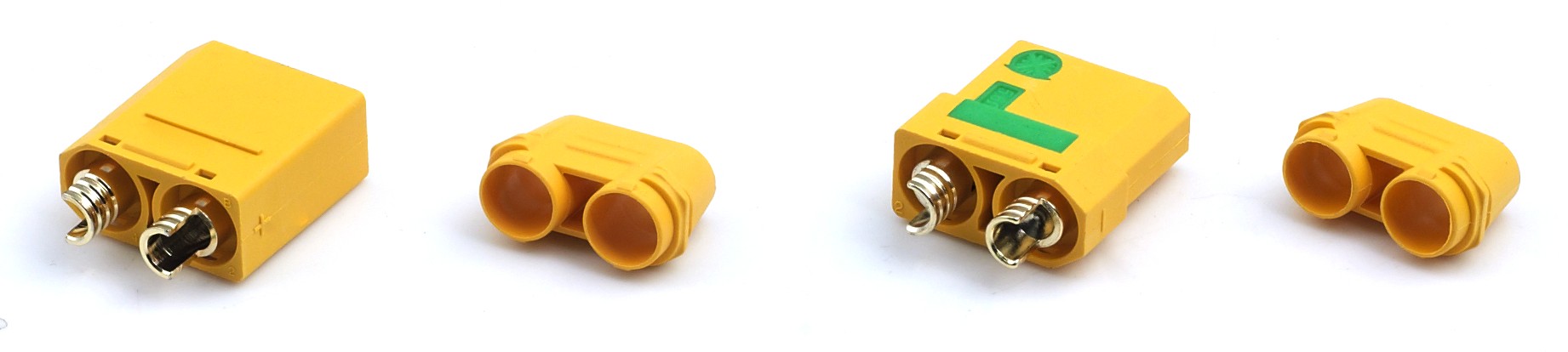
DXT90H-M / DXT90S-F: an XT90-class connector with a 90A continuous rating and optional anti-spark female variant.
Why benchmark XT60, XT90 and DXT30U together?
For procurement engineers, the problem is not a shortage of connector options. It is that model numbers such as XT60 and XT90 are sometimes read as continuous-current guarantees. In practice, XT60 and XT90 describe widely used connector classes, not uniform electrical limits. A specific implementation may carry 90A continuously, or only 45A continuously with 90A as a short-term peak. The same series name can therefore mask very different operating envelopes.
This article compares three AOYG products that buyers often evaluate side by side: the waterproof DXT60EW-M + DXT60W-F pair, the XT90-class DXT90H designs, and the 30-size DXT30U series with its 2+2 power-signal configuration. All are intended for low-voltage DC lithium battery systems, but their suitable applications diverge sharply once protection, wiring, connector diameter and signal requirements are included in the decision.
AOYG DC Power Connector is the manufacturer behind the DXT series. The company was founded in 2024, operates a 6,000 m² facility with about 100 employees, and focuses on high-current DC connection systems for lithium-powered intelligent equipment. Its stated production capacity is around 900,000 units per year. This background matters because specification sheets need to be assessed against the manufacturer's actual quality system and testing capability, not only against product names.
How the bench test was designed
This benchmark is a specification-level evaluation, not a laboratory destructive test. Each model was assessed on the basis of verified published parameters: rated voltage, continuous current under defined wire and temperature-rise conditions, peak current behaviour, contact resistance, insulation resistance, dielectric withstand, flammability, operating temperature, mating cycles, salt-spray performance, and ingress protection.
Because continuous-current figures are only meaningful when tied to a wire gauge and a temperature-rise limit, the comparison below records those conditions whenever the source states them. Omitting that context is a common source of connector mis-selection in high-current DC links.
Candidate model 1: DXT60EW-M + DXT60W-F — the IP67 waterproof member
The DXT60EW-M separate waterproof male plug and DXT60W-F separate waterproof female plug form a sealed 60A-class connector pair. The mated pair is rated at DC 500V, with a continuous current of 60A and a peak of 100A.
Key verified specifications:
| Parameter | DXT60EW-M + DXT60W-F |
|---|---|
| Rated voltage | DC 500V |
| Continuous current | 60A |
| Peak current | 100A |
| Terminal | Φ5mm H62 brass, gold-plated |
| Contact resistance | ≤0.8mΩ |
| Protection class | IP67 |
| Sealing | Silicone O-ring |
| Operating temperature | -20°C to +120°C |
| Flammability | PA66 UL94 V-0 |
| Mating cycles | ≥1000 times |
| Applicable wire | 8~10AWG silicone wire |
Because of its IP67 rating and silicone sealing, this model is positioned for outdoor and moisture-exposed equipment. Stated target industries include waterborne unmanned equipment, outdoor mobile photovoltaic storage, marine lithium battery systems, outdoor communication backup power, outdoor garden machinery, outdoor 5G base station standby power and outdoor electric amusement equipment.
The key buyer takeaway: the DXT60 waterproof pair gives up some continuous-current headroom compared with the highest-rated DXT90 design, but in exchange it brings an ingress-protected interface suitable for rain, splash, humidity and dusty outdoor conditions — an environmental capability that most open XT-style connectors do not offer.
Candidate model 2: DXT90H-M + DXT90E-F Yellow — the yellow XT90 with a lower continuous rating
One recurring confusion in XT90 procurement is the difference between a short-term peak rating and a continuous rating. The DXT90H-M + DXT90E-F Yellow connector, listed as an RC model electric vehicle connector, is rated at DC 500V, with a continuous current of 45A when using 10AWG wire and a temperature rise below 85°C. Its short-term peak current is 90A.
| Parameter | DXT90H-M + DXT90E-F Yellow |
|---|---|
| Rated voltage | DC 500V |
| Continuous current | 45A (10AWG, temperature rise <85°C) |
| Short-term peak current | 90A |
| Terminal | Φ4.5mm brass gold-plated banana terminal |
| Contact resistance | ≤1.0mΩ |
| Insulation resistance | ≥2000MΩ |
| Withstand voltage | AC 2000V / 1min |
| Protection class | IP40 |
| Operating temperature | -20°C to +120°C |
| Mating cycles | ≥1000 times |
| Salt spray test | 48h for gold-plated terminal |
| Recommended wire | 10AWG silicone wire, compatible with 8AWG |
Target applications are RC model electric vehicles, RC cars, RC boats, aircraft models and small UAV lithium batteries. For an RC or hobbyist load that is genuinely intermittent, the 90A short-term peak can cover aggressive throttle events. But the continuous envelope is 45A — not 90A. Treating this connector as a 90A continuous part would exceed the design condition stated in the specification.
Candidate model 3: DXT90H-M / DXT90S-F — the higher-continuous XT90 option
For buyers that genuinely need a 90A continuous XT90-class interface, AOYG also publishes the DXT90H-M bare male / DXT90S-F anti-spark bare female configuration. The stated rating is DC 500V and a continuous operating current of 90A when using 10AWG wire with a temperature rise ≤85°C. A peak transient current is listed without a published numeric value, which is itself an important caveat: peak capability should not be used as a continuous design margin.
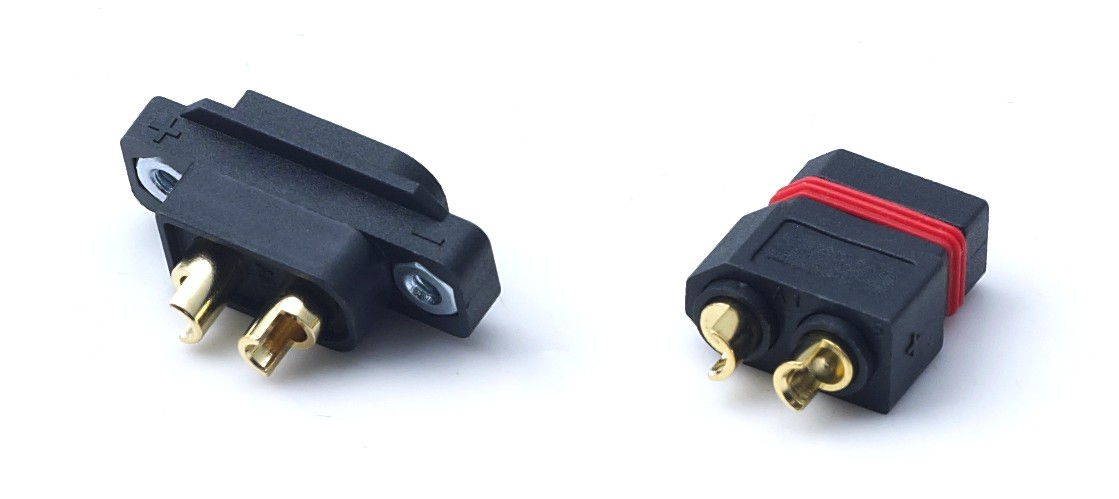
DXT60EW-M + DXT60W-F: an IP67-sealed 60A/100A connector for outdoor lithium battery equipment.
| Parameter | DXT90H-M / DXT90S-F |
|---|---|
| Rated voltage | DC 500V |
| Continuous current | 90A (10AWG, temperature rise ≤85°C) |
| Peak transient current | Listed; numeric value not published |
| Terminal | Φ4.5mm banana plug |
| Voltage resistance test | AC 2000V / 1min |
| Flame retardant rating | UL94 V-0 |
| Protection level | IP40 |
| Operating temperature | -20°C to +120°C |
| Mating cycles | ≥1000 times |
| Salt spray test | 48h (gold-plated standard model) |
| Recommended cable | 10AWG flexible cable, compatible with 8AWG |
The DXT90S-F female variant is described as anti-spark because it has a built-in high-power pre-charge resistor. This matters for applications where live battery connection can generate arcing on the connector contacts. Published target applications include agricultural drones, multi-rotor UAVs and LiPo battery power connection.
Candidate model 4: DXT30U(2+2)-F(B) — when power and signal must travel together
The DXT30U series introduces a different design logic. Instead of enlarging the contact diameter for more current, the 2+2 configuration carries two power pins and two signal pins in one connector housing. The verified female model, DXT30U(2+2)-F(B), is rated at DC 500V. Its power pins carry a continuous 20A at 16AWG, with a peak of 35A; the signal pins are rated at 1A. The mating counterpart is the DXT30U(2+2)-M or DXT30U(2+2)P.
| Parameter | DXT30U(2+2)-F(B) |
|---|---|
| Configuration | 2+2 (2 power pins + 2 signal pins) |
| Rated voltage | DC 500V |
| Continuous current | Power pin: 20A (16AWG); signal pin: 1A |
| Peak current | 35A |
| Contact resistance | ≤1.2mΩ |
| Insulation resistance | ≥2000MΩ |
| Mating cycles | ≥1000 times |
| Protection | IP40 |
| Operating temperature | -20°C to +120°C |
| Flammability | PA66 UL94 V-0 |
| Applicable wire | 12–16AWG silicone wire |
| Salt spray test | 48h |
Stated applications span UAVs, FPV drones, RC hobby models, light-duty e-bikes, portable energy storage, robots, garden power tools, smart-device battery packs and BMS systems. The design advantage is not extreme ampacity; it is system simplification. A single 2+2 connector can replace two separate interfaces — one for battery power and one for signal or charging communication — which is often more relevant to robot and smart-device designs than chasing a higher current number.
A 30-size non-composite alternative also exists. AOYG's DXT30U-M / DXT30U-F drone connector is rated at 15A continuous and 30A short-term peak with a Φ2mm gold-plated banana terminal. It is intended for tiny FPV drones, small UAVs, RC models and lightweight portable battery packs. It should not be confused with the 2+2 composite version, which has a higher power-pin continuous rating of 20A but carries signal pins as well.
Head-to-head specification table
The table below compares the four verified models that matter in this decision:
| Parameter | DXT60EW-M + DXT60W-F | DXT90H + DXT90E-F Yellow | DXT90H-M / DXT90S-F | DXT30U(2+2)-F(B) |
|---|---|---|---|---|
| Class target | XT60 / high-current waterproof | XT90 with 45A continuous / 90A peak | XT90 with 90A continuous | XT30-size power + signal combo |
| Rated voltage | DC 500V | DC 500V | DC 500V | DC 500V |
| Continuous current | 60A | 45A (10AWG, rise <85°C) | 90A (10AWG, rise ≤85°C) | Power pin 20A (16AWG); signal 1A |
| Peak | 100A | 90A short-term | Transient peak listed, value not published | 35A |
| Terminal | Φ5mm H62 brass gold-plated | Φ4.5mm gold-plated banana | Φ4.5mm banana plug | H62 brass gold-plated, 2+2 layout |
| Contact resistance | ≤0.8mΩ | ≤1.0mΩ | Not published in source | ≤1.2mΩ |
| Protection | IP67 | IP40 | IP40 | IP40 |
| Operating temperature | -20°C to +120°C | -20°C to +120°C | -20°C to +120°C | -20°C to +120°C |
| Wire size | 8–10AWG | 10AWG, compatible 8AWG | 10AWG, compatible 8AWG | 12–16AWG |
| Housing material | PA66 UL94 V-0 | PA66 UL94 V-0, yellow | PA66 high-temperature nylon | PA66 UL94 V-0, black |
All models share a common -20°C to +120°C operating temperature window and are manufactured under quality systems that support consistency expectations. Where a value is marked as not published, it should not be inferred from other models.
What the numbers mean for an end-user decision
The most important distinction in this group is not brand preference. It is the gap between continuous and peak capability. The yellow DXT90H + DXT90E-F pair will satisfy many RC and small-UAV power links because those systems rarely sustain 90A for long periods. But a 90A-class agricultural drone or heavy multi-rotor with sustained climbing current deserves a closer look at the DXT90H-M / DXT90S-F configuration, which is explicitly published with a 90A continuous rating.
The second major decision point is environmental exposure. IP40 is the protection class across the XT90 and composite DXT30U models. That is normal for many indoor, backpack, vehicle-cabin or hobbyist applications. But outdoor solar storage, marine systems, outdoor 5G backup power and waterborne robotics will expose unsealed contacts to humidity, rain splash or condensation. For those environments, the DXT60EW-M + DXT60W-F pair is the only model in this group with a verified IP67 rating, achieved through a silicone O-ring sealing structure.
The third point is signal integration. If the device already requires a control line, a battery-status line, a charging handshake or sensor communication alongside power, the DXT30U(2+2) eliminates a second cable assembly. But its current class is 20A continuous per power pin, so it should not be selected as the main high-power link for a motor drawing significantly more than that.
Application mapping
| Application context | More relevant model direction | Rationale from verified data |
|---|---|---|
| RC cars, RC boats, fixed-wing models, small hobby UAVs | DXT90H + DXT90E-F Yellow | 45A continuous / 90A short-term peak fits intermittent high-throttle loads in a lightweight XT90-style format. |
| Agricultural drones, multi-rotor UAVs, sustained high-power LiPo links | DXT90H-M / DXT90S-F | 90A continuous rating and anti-spark female option support repeated high-current battery connection. |
| Waterborne equipment, marine battery systems, outdoor PV storage, outdoor 5G standby power | DXT60EW-M + DXT60W-F | IP67 protection with silicone O-ring sealing; 60A continuous / 100A peak covers outdoor DC power transfer. |
| Smart robots, garden power tools, light e-bikes, portable energy storage, BMS signal links | DXT30U(2+2)-F(B) | 2+2 layout carries power plus signal in one connector; compact 12–16AWG cable range suits medium-current systems. |
Market context for high-current DC connector selection
Several market-level factors make this type of spec-level benchmark more relevant in 2026. Global high-power connector demand was estimated at approximately USD 5.47 billion in 2025, according to Fact.MR. Within energy storage connectors specifically, Dataintelo reports that DC connectors accounted for 58.7% of the market in 2025. The combination points toward growing procurement attention on DC power interfaces, not just AC or signal connectors.
At the product-format level, XT60 and XT90 have become the primary industry standards for medium- to high-power non-proprietary RC aircraft and drones in 2026, according to ChinaHobbyLine's compatibility guide. That makes direct, published comparisons between XT60-class, XT90-class and adjacent composite formats especially useful: buyers cannot rely on proprietary software matching or brand lock-in, so they need to read the actual electrical envelope.
Honest limitations of the comparison
Several boundaries should be stated clearly. First, this is not a destructive physical test; it is a specification-level assessment based on published manufacturer data. Contact resistance, temperature rise and mating cycle numbers need to be confirmed through the manufacturer's test reports for a specific purchasing contract.
Second, missing data is not evidence of absence. For example, the DXT90H-M / DXT90S-F source does not publish a numeric peak-current value or a contact-resistance figure in the same way the other models do. A buyer should request those details before assuming that a 90A continuous rating also implies a defined margin above 90A.
Third, the 45A continuous rating on the DXT90H + DXT90E-F Yellow is the disciplined reading of that datasheet; the 90A figure is explicitly a short-term peak. Designers who treat peak ratings as continuous capacity create a thermal risk that the connector itself was not designed to absorb indefinitely.
How compliance evidence supports the bench test
Specification comparison is only one layer of procurement diligence. Buyers should also check whether the manufacturer can back the bench-test parameters with published test reports. AOYG states compliance with IATF16949:2016 and ISO9001:2015 quality management systems. Related testing references in the product base include electrical performance testing under IEC 60512 / GB/T 5095, salt spray testing under GB/T 10125 and ASTM B117, UL94 V-0 flammability testing, RoHS 2.0 testing under the IEC 62321 series, and REACH SVHC screening under Regulation (EC) No 1907/2006.
For the models compared here, the common environmental and material expectations are consistent: gold-plated terminal surfaces, 48-hour salt spray resistance, UL94 V-0 PA66 housings, and an operating temperature range of -20°C to +120°C. A buyer evaluating high-current DC links should request the specific report covering the exact model and plating option under consideration, because gold-plating thickness can affect both contact performance and corrosion results.
Future outlook
The trend in DC power connection is toward clearer documentation and more segmented product families rather than one universal high-current connector. We are likely to see more 2+2 power-signal hybrids, more IP67-sealed versions of traditional XT-style formats, and more precise separation between continuous and transient ratings as battery-powered robots, outdoor equipment and drones move into professional use.
For AOYG, the direction appears consistent with that pattern. The company states that it can develop exclusive connector products based on customer application scenarios and technical parameters, and its published OEM/ODM capability includes customization of size, current specification, pin position, wiring structure and logo printing. The practical value for procurement teams is that the DXT family is not a closed system; a low-volume buyer can request adjustments, while a larger OEM can move toward a semi-custom part that is documented and tested around an actual operating profile.
Frequently asked questions
How should a buyer read the difference between 45A and 90A on XT90-class connectors?
The difference is usually continuous current versus short-term peak current. In AOYG's lineup, the DXT90H-M + DXT90E-F Yellow has a 45A continuous rating with a 90A short-term peak, while the DXT90H-M / DXT90S-F is published with a 90A continuous operating current. A load that sustains high current for long periods should be evaluated against the continuous rating, not the peak.
When does IP67 matter more than a higher current rating?
IP67 matters when the mated connector will be exposed to rain splash, humidity, condensation, marine environments, outdoor storage or washdown conditions. In this comparison, the DXT60EW-M + DXT60W-F pair provides IP67 sealing through a silicone O-ring while carrying 60A continuous and 100A peak. An IP40 XT90-style connector may carry higher current, but its unsealed interface is not designed to block water ingress.
What is the advantage of the DXT30U(2+2) over a pure power connector?
The DXT30U(2+2)-F(B) carries two power pins and two signal pins in one housing. This lets a device transmit battery power and a signal line — for example a BMS communication, charge-enable or status line — through a single mating interface rather than two separate connectors. Its power-pin continuous current is 20A, so it is a system-integration choice rather than a high-ampacity choice.
Are DXT60, DXT90 and DXT30 products interchangeable with standard XT60/XT90 connectors?
XT60 and XT90 are widely used open-class connector formats, and AOYG's DXT series is positioned within that XT-style product area. However, mechanical interchangeability depends on real mating geometry, tolerances and contact alignment. Buyers should verify physical compatibility with the specific mating connector they intend to use before approving a design.
What environmental ratings are common across the AOYG models compared here?
The verified models share an operating temperature range of -20°C to +120°C, PA66 UL94 V-0 flame-retardant housings, gold-plated terminals and a 48-hour salt spray test expectation for the gold-plated standard. The IP rating differs by model: the listed DXT60 waterproof pair is IP67, while the listed XT90-class and DXT30U(2+2) models are IP40.
Technical documentation for AOYG DC Power Connector products is available at www.aoygvn.com. Buyers making high-current DC link decisions should compare datasheets, test reports and application-specific thermal conditions before finalising a model.