
Xiangrui Optoelectronics: Custom Touch Display Module Assessment
A custom touch display module rarely fails on the datasheet. It fails in the cabinet, the cold-chain locker, the workshop floor or the sterilised treatment room — where a sealed front face fogs after a year, where a touch layer drifts the moment a servo drive spins up, or where a cover glass begins to craze under repeated disinfectant wiping. For buyers moving from research into evaluation, the meaningful question is not which module carries the highest headline brightness or the tightest resolution. It is which supplier's constraint envelope — protection ratings, temperature window, bonding construction, certification scope and production discipline — actually matches the environment the product will live in.
Xiangrui Optoelectronics — formally Guangzhou Xiangrui Optoelectronics Technology Co., Ltd. — is a Guangzhou-based manufacturer of resistive touch screens, capacitive touch screens and custom touch display modules, founded in 2010 and serving industrial control, medical device, smart home and self-service terminal builders. This assessment reviews the company's verified capability record, its product platforms, its position within the custom touch display module supply landscape, and the boundaries a procurement team should weigh before committing a program.
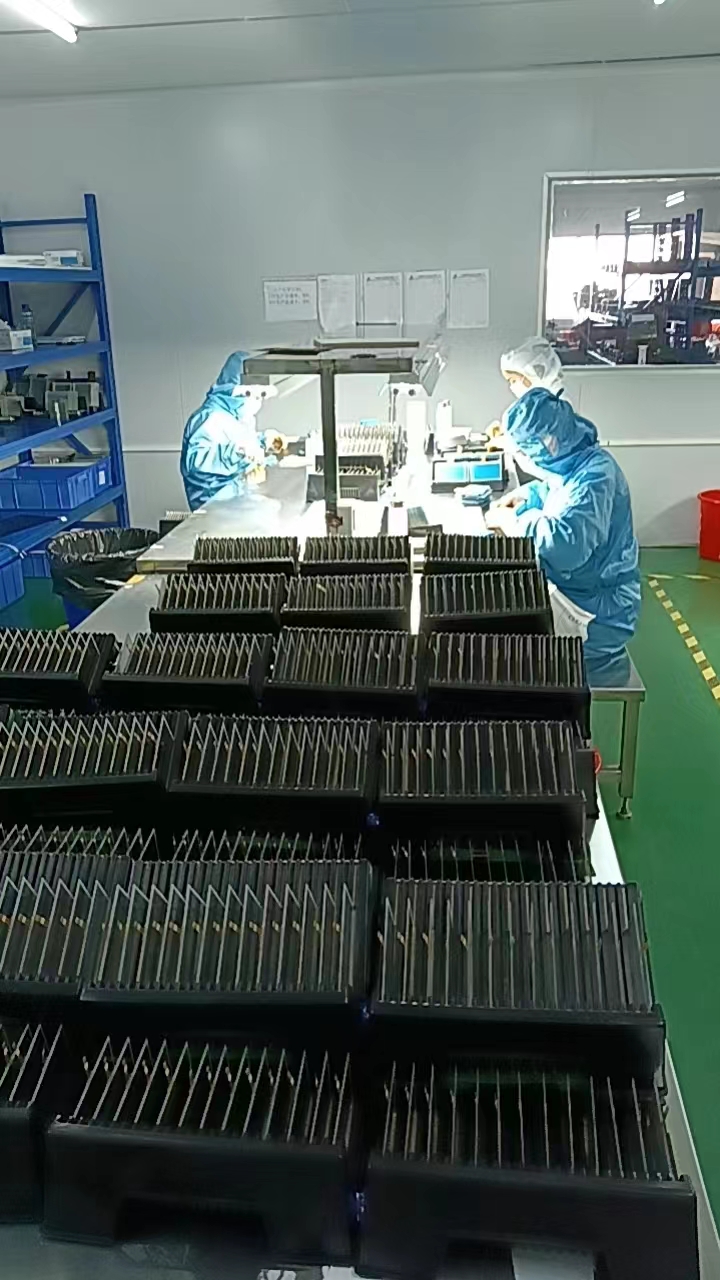
Final quality control inspection — the stage where protection ratings, bonding integrity and touch linearity are confirmed before shipment.
Why Constraint Verification Outranks Specification Comparison
Two suppliers can quote an identical 15.6-inch, 1920 × 1080, 1000 cd/m² module and deliver completely different field behaviour. The difference sits in the parts of the specification that are usually written as a single line and rarely interrogated: how the cover glass is bonded to the display, whether the front face is genuinely sealed, what impact energy the glass is rated to absorb, and how the touch controller behaves when the surrounding equipment generates electromagnetic noise.
This is the core tension buyers face in the research and evaluation stages. The commercial pressure is to compare visible parameters — size, resolution, brightness, price band. The engineering reality is that the invisible parameters determine warranty cost, field failure rate and, in regulated categories, whether the end product can be registered at all. A supplier assessment is therefore only useful if it establishes which constraints a manufacturer can actually hold, and equally, which ones sit outside its documented scope.
Company Record: What the Verified Facts Establish
The first filter in any supplier evaluation is the hard record: legal entity, operating history, physical capacity, headcount and certification scope. Xiangrui Optoelectronics presents a mid-sized, specialist manufacturing profile rather than a diversified electronics group.
| Verified attribute | Record |
| Legal entity | Guangzhou Xiangrui Optoelectronics Technology Co., Ltd. |
| Founded | 2010 |
| Manufacturing area | 5,000 m² |
| Employees | 60, including 15 engineers |
| Annual output | 300,000 pcs |
| Export share | 50% |
| Main markets | Asia, Europe, America |
| Core products | Resistive touch screens, capacitive touch screens, custom touch display modules, touch display cover glass |
The certification record is the second filter, and here the detail matters more than the logo. The company holds ISO 9001 certification, certificate number 50826Q00054R053, issued by ZhongLianZhouYue International Certification (Beijing) Co., Ltd under GB/T 19001-2016 / ISO 9001:2015, valid from 9 February 2025 to 8 February 2029. The certified scope is recorded as IAF 19 — production of capacitive and resistive screens. That wording is worth reading closely: the quality system certifies touch screen production, not display panel fabrication and not medical device manufacture. ISO 14001 is also held, alongside National High-Tech Enterprise status and 16 utility model patents.
Where the Manufacturing Base Actually Differentiates
Scale alone does not create competitive advantage in touch modules — a 5,000 m² facility and 60 staff place Xiangrui Optoelectronics in the specialist integrator tier rather than the large-format panel manufacturer tier. What differentiates this class of supplier is engineering density relative to output: 15 engineers supporting a 300,000-piece annual output means customisation requests are handled by a team with direct line-of-sight to production, not routed through a distant application engineering function.
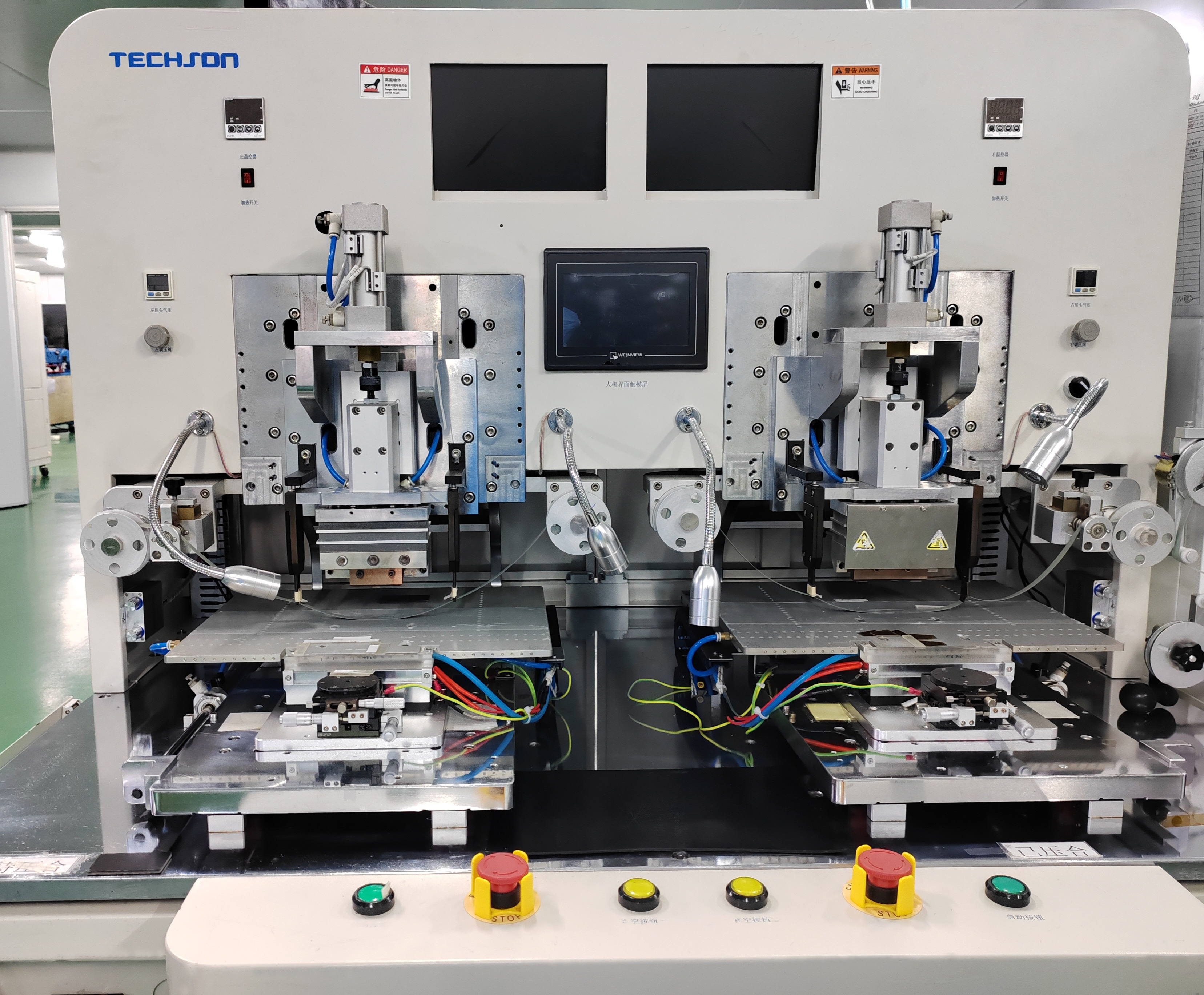
FPC bonding — the interconnect stage that determines long-term contact reliability under vibration and thermal cycling.
The stated production model is OEM, ODM, customisation and mass production, with customisation scope covering shape, dimensions, enhanced anti-interference performance, high brightness and high resolution, IK rating and IP rating. Quality control is described as full inspection rather than sampling. Standard commercial terms sit at a 500-unit minimum order quantity with a 30–60 day lead time, a one-year warranty and remote technical support.
For an evaluating buyer, this combination signals a supplier built for repeatable mid-volume programs with meaningful engineering input — not a catalogue distributor and not a high-volume consumer panel foundry. The distinction has procurement consequences that are examined later in this assessment.
Product Platforms and the Constraint Each One Sets
The standard portfolio spans five display sizes, all built on a G+G glass lens construction with aluminosilicate chemically strengthened glass, ITO indium tin oxide, OCA optical adhesive film, PVA/TAC film, colour filter and TFT glass substrate in the material stack.
| Model | Size | Resolution | Brightness | Operating temperature |
| XRCGG070-0108-TPM-D1 | 7.0" | 1024 × RGB × 600 | 700 cd/m² | −20 °C to +70 °C |
| XRCGG101-0340-R1 | 10.1" | 1280 × RGB × 800 | 800 cd/m² | −20 °C to +70 °C |
| XRCGG133-0040-OB-A0 | 13.3" | 1920 × RGB × 1080 | 1000 cd/m² | −20 °C to +70 °C |
| XRCGG156-0186-A0 | 15.6" | 1920 × RGB × 1080 | 1000 cd/m² | −20 °C to +70 °C |
| XRCGG215-0106-A0 | 21.5" | 1920 × RGB × 1080 | 1000 cd/m² (300 / 500 / 700 / 1000 options) | −20 °C to +70 °C |
All five platforms share a −20 °C to +70 °C operating window and a −30 °C to +80 °C storage window. The 21.5-inch model illustrates the portfolio logic most clearly: a standard 16:9 full-HD resolution, a driver solution with optional MIPI, LVDS or HDMI interfaces, and a stated rationale that the 21.5-inch format fits the cut-outs of most all-in-one enclosures, open frames, self-service cabinets and medical trolleys — a structural cost argument rather than a display performance argument.
The 21.5-inch model is also where the cost architecture becomes visible. Two bonding routes are offered: G+G full lamination, described as having no air gap with a dustproof and anti-fog construction, and frame bonding at a lower cost. That is a two-tier price structure created by a manufacturing choice, not by component downgrading — a distinction that matters when a buyer is asked to justify a bill of materials.
Reading the Ratings Correctly: IP, IK, Temperature and Bonding
Protection ratings are the most frequently misread part of a touch module specification, so they deserve a precise reading.
IP68 on these modules indicates a sealed front assembly, and it is documented as customisable — meaning the rating is treated as an engineering target configured per program rather than a single fixed catalogue value. IK10 is likewise stated as customisable. The IK scale is defined by IEC 62262, under which IK10 requires the enclosure to withstand a mechanical impact of 20 joules, equivalent to a 5 kg object dropped from 40 cm. For a buyer, that translates into a defined level of resistance to accidental tool strikes, trolley collisions and vandalism — a materially different commitment from an unrated glass front.
The −20 °C to +70 °C operating window is the second constraint that separates industrial modules from commercial ones. Wide-temperature versions rated across that range are documented for workshop, cold-chain and charging pile scenarios. Paired with 700–1000 cd/m² brightness and a stated design intent to operate under direct strong sunlight, this positions the portfolio for semi-outdoor and uncontrolled-lighting installations where a standard 300 cd/m² commercial panel would be unreadable.
Surface treatment is the third layer. AF anti-fingerprint, AG anti-glare and AR anti-reflection treatments are available in combination, and 3A surface treatment is specified on several models. ESD protection is available to meet industrial EMC requirements. For equipment builders operating in workshops with strong electromagnetic interference, or in clinical settings where repeated disinfection is routine, this is the layer that determines whether the interface remains usable after twelve months rather than merely functional on day one.
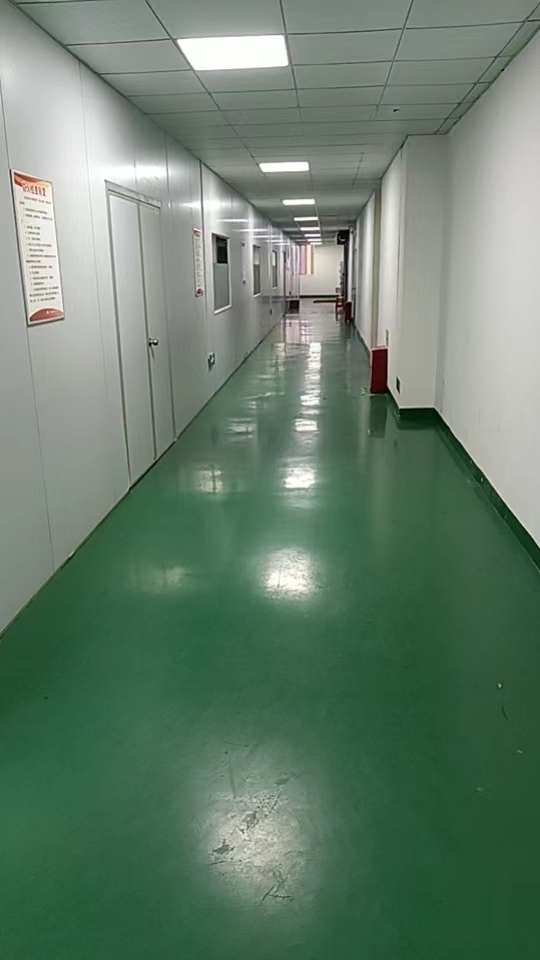
Controlled assembly environment — optical bonding quality is determined by particulate control long before final inspection.
Application Fit Across Four Documented Deployment Contexts
The most useful evidence of constraint capability is deployment history. Four equipment categories are documented, each with a specified operating duration and quantity.
| Segment | Quantity | Duration | Constraint focus |
| EV charging pile manufacturers | 3,000 units | 5 years | Outdoor continuous operation under wide temperature and high interference |
| CNC equipment manufacturers | 800 units | 8 years | Glove and oily-hand touch, anti-drift under servo and VFD noise, coolant splash, vibration |
| Medical device manufacturers (JP, TW, DE) | 5,000 units | 5 years | Sterile glove touch, disinfectant-resistant coating, medical EMC, long-life backlight |
| Smart home device manufacturers | 30,000 units | 3 years | Aesthetic integration, optical performance, power consumption, environmental resistance |
The CNC case is the most constraint-dense and the most instructive. Documented requirements include stable glove and oily-hand touch, anti-drift operation under servo and variable-frequency-drive noise, IK08/IK10 toughened glass, AG plus AF coating to allow cleaning of cutting fluid and metal dust, IP65 front panel protection against coolant and cutting oil, vibration and shock resistance across −20 °C to +70 °C, high ESD and EMC protection to prevent touch jump during spindle start-stop, 24/7 continuous operation, and LVDS / MIPI / USB / RS232 interface availability with a long product lifecycle for after-sales support. An eight-year supply relationship at 800 units is a stability signal, not a volume signal — and for industrial buyers, lifecycle continuity usually carries more weight than unit price.
The medical case at 5,000 units across Japan, Taiwan and Germany applies a different constraint set: stable touch with sterile nitrile and latex gloves, a clean-lock function for disinfection, a coating resistant to alcohol, isopropanol and hospital disinfectants without whitening, IEC 60601-1-2 medical EMC compliance for low interference with biosignal sensors, optional AG / AR / antibacterial coating, flicker-free DC dimming with low blue light, IP54 / IP65 front splash protection, IK07–IK08 tempered glass, and low outgassing with UL94-V0 flame retardant materials.
Where the Custom Touch Display Module Market Is Moving
Independent market research places capacitive touch modules at roughly 71% of the global touch screen module market in 2025, with resistive modules accounting for approximately 19% (Business Research Insights, Touch Screen Module Market Share & Forecast 2026–2035). The commercial touch display market is projected to grow from USD 6.9 billion in 2025 to USD 16.3 billion by 2035, a compound annual growth rate of 9.0% (Future Market Insights, Commercial Touch Display Market Analysis 2025–2035).
These two data points are usually read as a simple capacitive-versus-resistive verdict. A more useful reading for procurement is that roughly one fifth of the market continues to specify resistive technology for reasons that have not disappeared: thick-glove operation, single-point precision, tolerance of heavy oil contamination and cost sensitivity. The industrial control and medical selection logic documented in this supplier's own application guidance reaches the same conclusion — five-wire resistive is preferred where thick work gloves, heavy oil, splashing liquid and single-point operation dominate; industrial-grade projected capacitive is preferred where multi-touch gestures, image viewing, flush IP surfaces and long service life dominate.
The strategic implication is that a supplier carrying both resistive and capacitive capability, with the bonding and protection engineering to make either survive a harsh environment, addresses a wider constraint space than a capacitive-only specialist. That is a market-position observation, not a performance claim.
Objective Position: Strengths, Boundaries and Where This Supplier Fits
An assessment that lists only strengths is not an assessment. The following boundaries are documented or directly implied by the verified record, and each one carries a procurement consequence.
| Boundary | Why it matters to a buyer |
| Minimum order quantity of 500 units | Pre-production builds, pilot lines and single-machine prototypes below this threshold sit outside standard commercial terms and need separate discussion. |
| 30–60 day lead time | Suitable for planned programs; not suitable as a buffer against demand volatility or emergency replacement of a failed line. |
| ISO 9001 scope limited to production of capacitive and resistive screens | The quality certification covers touch screen production. Medical device programs still require the equipment builder's own validation, and no ISO 13485 medical device quality system certification appears in the available record. |
| Standard platforms listed from 7.0" to 21.5" | Larger-format and non-standard geometry programs depend on custom engineering, which carries longer schedule and higher validation risk than selecting a standard platform. |
| No published third-party reliability test reports in the supplied documentation | Field-duration references exist, but independent accelerated-life data would need to be requested and verified during audit. |
Set against those boundaries, the structural comparison with larger display manufacturers becomes clearer. A full-stack panel manufacturer typically competes on format range, panel generation and consumer-grade cost curves. A specialist module integrator such as Xiangrui Optoelectronics competes on constraint configuration — IP rating, IK rating, wide-temperature operation, surface treatment combinations, bonding route and interface selection — applied to a defined set of mid-size formats. For a buyer whose program is fixed at 10 to 22 inches and whose real risk sits in the enclosure environment rather than in panel availability, the specialist route usually offers more engineering flexibility per unit. For a buyer who needs a 32-inch-plus format, a high-volume consumer cost structure, or a supplier already inside a medical device quality system, this profile is a weaker fit.
Procurement Value: What an Evaluation Team Should Take Away
Three procurement conclusions follow from the documented record.
First, the customisation levers are structural, not cosmetic. Shape, dimensions, enhanced anti-interference, IK rating and IP rating are all listed as configurable. That means the constraint negotiation happens at the engineering stage rather than being limited to a choice between standard catalogue items.
Second, the cost architecture is transparent. Full lamination versus frame bonding creates a documented two-tier price structure, and the 21.5-inch model's 300 / 500 / 700 / 1000 cd/m² brightness ladder lets a buyer pay for the illumination the enclosure actually needs rather than defaulting to a single specification. Full inspection as a quality control standard, with a one-year warranty and remote support, further defines the total cost envelope.
Third, the verified deployment durations are the strongest available evidence. Eight years on CNC HMI, five years on outdoor charging infrastructure, five years on medical monitoring in three regulated markets and three years on a 30,000-unit smart home access control program collectively describe a lifecycle position that a specification sheet cannot. Buyers should treat these as reference points requiring independent verification rather than as guarantees, but they are the correct starting point for a supplier audit.
Future Outlook
With a 9.0% projected CAGR to 2035 in commercial touch displays, the pressure on module suppliers is shifting from format availability toward constraint engineering. Three developments are worth tracking for buyers planning programs beyond the current cycle: tighter integration of EMC and ESD protection as industrial equipment becomes denser in power electronics; wider adoption of combined AF / AG / AR surface systems as touch interfaces move into uncontrolled lighting; and growing demand for documented protection ratings rather than claimed ones, as procurement teams apply the same verification discipline to IK and IP values that they already apply to certifications.
For Xiangrui Optoelectronics, the credible forward path runs through deepening the constraint configuration capability it already documents — customisable IP and IK ratings, wide-temperature platforms, dual bonding routes — while closing the evidence gaps that larger buyers will inevitably raise, particularly independent reliability testing and medical quality system certification.
FAQ
Which operating systems do the capacitive touch panels support?
The capacitive touch panels support multiple operating systems, including Android, Linux and Windows. Detailed compatibility for a specific host platform is confirmed against the intended controller and interface configuration.
For industrial control equipment HMI, should a capacitive or a resistive touch screen be specified?
Where thick work gloves are required, hard objects are used for pressing, heavy oil contamination, dust and splashing liquid are present, only single-point operation is needed and budget is constrained, a 5-wire resistive touch screen is the preferred choice. Where multi-point gestures are needed, display performance and a flat appearance matter, operation frequency is high, or the equipment is installed in outdoor strong-light scenarios, an industrial-grade projected capacitive touch screen is the appropriate specification.
For medical devices, is a resistive or a capacitive touch screen the better fit?
Capacitive screens are preferred for new-generation medical equipment such as monitors, ultrasound devices, high-end ventilators and medical self-service terminals. Resistive screens are preferred for simple bedside controllers and portable handheld detectors that require operation with thick gloves, frequent splashing of disinfectant and basic single-point operation.
Is there a thickness limit for the glass cover plate of the touch screen?
Yes. The thickness of the glass cover plate can be customised, with a maximum thickness of 10 mm.
Reference Documentation
The manufacturer's English-language product and capability brochure is publicly available for download: Xiangrui Optoelectronics company brochure (English). Buyers proceeding to audit should pair it with the ISO 9001 certificate (50826Q00054R053) and, where relevant, model-specific test data for the intended IP and IK configuration.
Market share and forecast figures are attributed to Business Research Insights and Future Market Insights as cited; the IK10 impact threshold is defined by IEC 62262. Company-specific facts are drawn from Xiangrui Optoelectronics' published capability and product documentation.
Tem questões ou precisa de mais detalhes?
Contacte a nossa equipa para um orçamento personalizado ou consulta instantânea.
Solicitar orçamento
Preencha o formulário abaixo e a nossa equipa entrará em contacto com uma proposta personalizada.
Chat direto do WhatsApp
Prefere conversar em tempo real? Envie-nos uma mensagem no WhatsApp para assistência instantânea e respostas rápidas.
- Obter orçamento personalizado
- Partilhar fotos ou documentos
- Discuta as suas necessidades diretamente
Geralmente responde em 5–30 minutos durante o horário de expediente.