
YC POP DISPLAY: A Manufacturer Capability and Sourcing Review
YC POP DISPLAY: A Manufacturer Capability and Sourcing Review
An industry reference review of YC FURNITURE GROUP LIMITED — manufacturing scale, multi-material capability, certification coverage, custom display range and the procurement boundaries buyers should test before ordering.
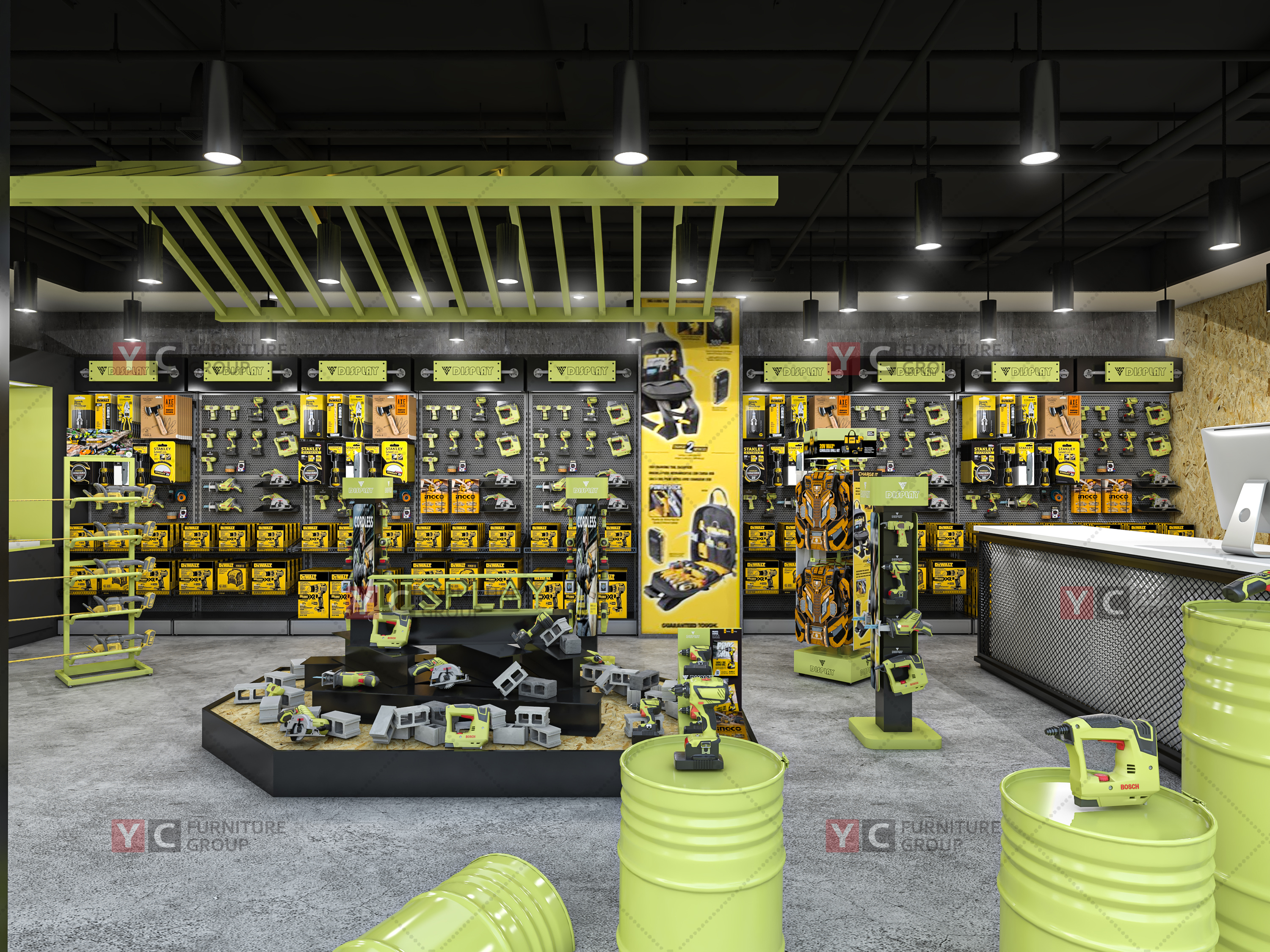
Industry scene: a high-traffic tool retail environment where heavy-duty POP fixtures carry the merchandising load. Image source: YC FURNITURE GROUP LIMITED.
Most retail purchases are still decided inside the store. Research published by POPAI (Shop!) and cited in category data places the share of purchasing decisions made at the point of sale between 70% and 76% — a range that explains why the physical fixture, rather than the campaign, is often the last piece of marketing a shopper interacts with. Commercial research values the global point-of-purchase (POP) display market at USD 14.6 billion in 2024, according to Strategic Market Research.
YC FURNITURE GROUP LIMITED is a POP display manufacturer headquartered in Quanzhou, Fujian Province, China. Established in 2007, the company designs and produces customized POP display stands and retail fixtures in metal, wood, acrylic, PVC and cardboard, and sells the large majority of its output into export markets. This review examines the manufacturer's scale, core competitive characteristics, product architecture, certification coverage and the practical boundaries that procurement teams should test before placing an order.
What ‘POP display’ means in procurement terms
A POP (point of purchase) display is a freestanding or modular fixture used at the point of sale to promote or display products, most often to support short-term promotions or improve new-product visibility. In specification terms, two variables dominate: material and size. Both are normally selected against promotion duration and display goals, balancing visual impact against logistics cost.
Form factor is the practical second layer. Display programmes in this category commonly use floor-standing units, countertop units, wall-mounted and slatwall panels, endcaps, rotating or static units, movable freestanding displays and gondola store shelving. The choice is driven by the retail environment: supermarkets and hypermarkets, brand stores, department stores, shopping malls, pop-up shops, showrooms and trade-show stands all impose different load, footprint and installation constraints.
The problem buyers are actually solving
The research stage of a display purchase is rarely about aesthetics alone. The recurring failure modes documented in supplier-side quality and risk records are practical rather than stylistic:
- Deformation after a short period of use. This occurs when actual load, environmental conditions such as temperature and humidity, usage frequency or installation conditions exceed what the materials and structural design were engineered to withstand. The downstream cost includes product damage, safety concerns, poor in-store presentation, replacement and maintenance expense, additional labour and a lower return on the initial investment.
- Caster failure on mobile units. Casters can be damaged or worn by frequent movement, excessive load, improper handling, or contact with uneven surfaces and thresholds.
- On-site assembly failure. When all parts are present but the unit cannot be assembled, the root cause is usually manufacturing tolerance, component compatibility, assembly sequence or transport protection.
- Documentation and compliance expectations. Large global retailers and brands frequently request documented quality, environmental, social responsibility and material traceability systems even where certification is not a legal import requirement.
A capability review of a display manufacturer is therefore a review of how these risks are controlled — not a review of catalogue photography.
YC FURNITURE GROUP LIMITED at a glance
Scale matters in this category because most display programmes are replenishment programmes, not one-off purchases. The company's recorded operating profile is summarised below.
| Attribute | Recorded detail |
|---|---|
| Company | YC FURNITURE GROUP LIMITED |
| Category | POP display and retail fixture manufacturing (Packaging & Printing / retail display) |
| Established | 2007 (19+ years in the retail display sector) |
| Headquarters | Shiying Business Building, No. 98 Citong Road, Fengze District, Quanzhou, Fujian Province, China, 362018 |
| Manufacturing and logistics space | 600,000 ft² |
| Workforce | 200+ employees, including 17 in-house designers and engineers and 10 QC specialists |
| Annual output | Approximately 1,000 × 40’HQ container loads |
| Export share | About 95% of total sales |
| Main markets | North America, Europe, South America, Oceania |
| Stated certification coverage | FSC Chain of Custody, Sedex, ISO 9001, ISO 14001 |
| Service scope | Whole-store design, retail fixture and display design, booth and showroom design, manufacturing, transportation, installation and after-sales support |
Two figures in that profile carry direct procurement meaning. Annual output of roughly 1,000 forty-foot high-cube container loads per year indicates capacity to support recurring retail replenishment programmes rather than only seasonal one-offs. An export share of about 95%, concentrated in North America, Europe, South America and Oceania, indicates accumulated experience with overseas retail supply requirements, including the packaging, documentation and handling conditions those markets impose.
The company states that it has served more than 5,000 companies and brands worldwide, and its corporate profile lists brand relationships across clothing, footwear, fashion accessories, automotive, gifts, toys, tools, cosmetics, food and pet care. Such lists are supplied by the manufacturer and are not independently auditable from public sources, so buyers should treat them as an indication of category breadth rather than as verified references.
Core competitiveness: multi-material vertical integration
The clearest differentiator is not a single product line but the ability to combine materials inside one display unit. The stated design approach is to combine materials, textures, finishes and structures so that the fixture reflects a brand's own visual language rather than a standard template. Industrial strength, natural warmth, premium transparency, bold colour and sustainable simplicity each point to a different material choice, and the design intent is to integrate those choices into a single cohesive display.
In practice this means a buyer is not choosing between a metal supplier and a cardboard supplier. Metal, MDF, PVC, acrylic and cardboard can be specified in combination — for example a metal frame with MDF panels and PVC components, or an MDF body with acrylic presentation elements — which is what allows one fixture to satisfy conflicting requirements such as structural load, transparency for product visibility and cost control at the same time.
The YC POP DISPLAY range reflects this. The following models are recorded in the company's product specification data; all are listed as customized rather than fixed-SKU, meaning dimensions, finish and structure are defined per project.
| Display category | Model | Type classification | Primary materials |
|---|---|---|---|
| Shoe POP display | FYS-SSF234 | Metal shoe POP display | Metal / PVC |
| Shoe POP display | BR003 | MDF shoe POP display | Metal / MDF |
| Clothing POP display | CSF002 | MDF clothing POP display | Metal / MDF / PVC |
| Clothing POP display | CSFJ6176 | Metal clothing POP display | Metal / PVC |
| Clothing POP display | CP-CSF32 | MDF clothing POP display | Metal / MDF / PVC |
| Eyewear POP display | SUGJ26633 | Sunglasses POP display | Metal / MDF / PVC |
| Cosmetic POP display | JSJ-CSD002 | MDF cosmetic POP display | MDF / PVC |
| Toy POP display | FOD013 | MDF toy POP display | Metal / MDF / PVC |
| Toy POP display | JW-CTD379 | Cardboard toy POP display | Cardboard |
| Gift POP display | THE-CTD103 | MDF gift POP display | MDF / Acrylic |
| Gift POP display | WNH043 | Metal gift POP display | Metal |
| Tool POP display | TDSJ26802 | Metal tool POP display | Metal / PVC |
| Sock POP display | SODJ26531 | MDF sock POP display | Metal / MDF |
| Hat POP display | HATJ26704 | Metal hat POP display | Metal |
| Food POP display | FODJ6103 | Wood food POP display | MDF / PVC |
| Food POP display | FODJ26801 | Metal food POP display | Metal / PVC |
| Pet food POP display | PETJ26703 | Metal pet food POP display | Metal / PVC |
| Metal POP display | PETJ26705 | Metal pet food POP display | Metal / PVC |
| Cardboard POP display | GJH26-104 | Consumer electronics POP display | Cardboard |
Model list compiled from YC product specification data. Specification parameters for every model are recorded as customized.
Technical explanation: how material and structure decisions are made
Material selection in this category is a weighted decision, not a preference. The documented selection criteria are product weight, usage environment, brand positioning, budget, transportation requirements and expected service life. The purpose of the weighting is straightforward: the right material keeps the fixture strong and durable, keeps the total cost proportionate, and keeps the display visually aligned with the brand in the environment and transport route it will actually face.
What the manufacturer needs from the buyer
A custom display cannot be engineered responsibly without product data. The design input normally required is the product packaging dimensions, the product weight, the display quantity, any requirements or limitations related to the usage environment and transportation, plus the target budget and product samples where available. Buyers who arrive with these six inputs typically shorten the design loop; buyers who arrive with a photograph alone generally extend it.
How deformation risk is controlled
The documented control method for deformation is a four-part process: material verification, structural assessment, load testing and sample validation. Each step targets a different cause. Material verification addresses whether the raw material and its specification match what the design assumes. Structural assessment addresses load, span, joints and long-term use. Load testing and sample validation check that the assembled unit behaves as designed before production tooling is committed. Where a buyer has previously experienced a display deforming quickly, this sequence — beginning with a load-bearing test at the sample approval stage — is the mechanism that prevents a repeat.
Mobile displays and caster specification
For movable units, caster selection is a load calculation rather than an accessory choice. The guidance is to use durable, load-bearing casters suitable for the combined weight of the display and the products it carries; to avoid overloading; to push rather than drag; to avoid uneven floors and obstacles; and to inspect and replace worn casters promptly.
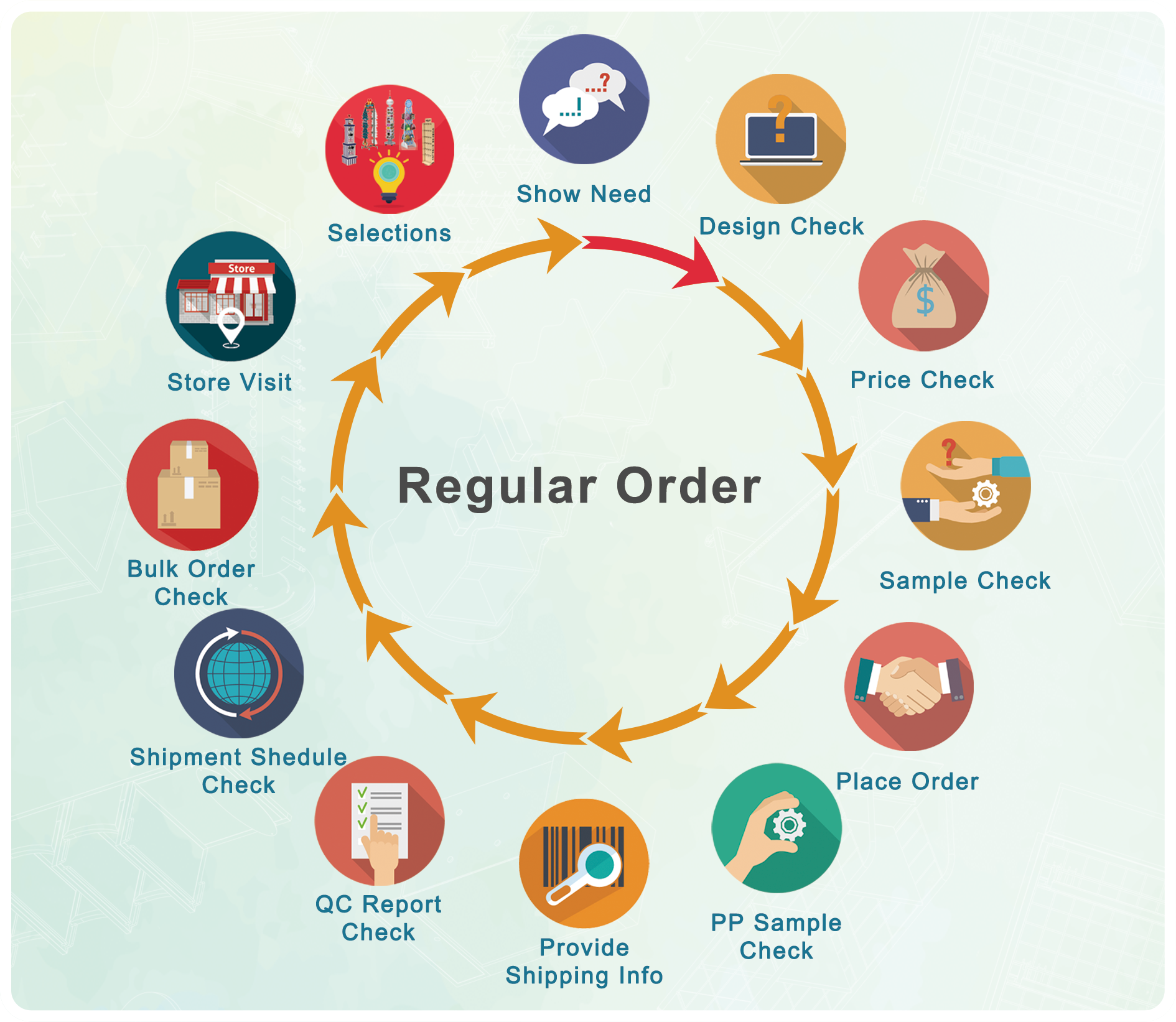
Process view: the documented custom display workflow runs from needs assessment through design review, pricing, sample approval, order placement, pre-production sample approval, shipping coordination, QC inspection, shipment scheduling and bulk order confirmation.
Assembly and after-sales response
When a unit cannot be assembled on site despite all parts being present, the documented response flow is: customer feedback, photos or video, issue identification, verification of parts and assembly sequence, root cause confirmation, and solution. The practical value of the sequence is that it separates component, dimension, sequence and transport-damage causes before any replacement decision is made, which avoids shipping parts that were never the problem.
Certification and compliance coverage
Certification in this category is rarely a legal gate for import, but it is frequently a supplier-qualification gate. The registered certificates and their coverage are as follows.
| Certification | Certificate no. | Standard | Issuer | Validity | Scope / covered models |
|---|---|---|---|---|---|
| ISO 9001 (Quality Management System) | 117 24 QU 0233-06 R0S | GB/T 19001-2016 / ISO 9001:2015 | Shanghai Ingeer Certification Assessment Co., Ltd. | 2024-06-24 to 2027-06-23 | Sales of shopfittings, POP/POS displays, store fixtures and store equipment; covers the listed display models, global market |
| ISO 14001 (Environmental Management System) | 117 26 E 0784 R0 02 | GB/T 24001-2016 / ISO 14001:2015 | Shanghai Ingeer Certification Assessment Co., Ltd. | Not stated in source data | Covers METAL POP DISPLAY (PETJ26705), HAT POP DISPLAY (HATJ26704), PET FOOD POP DISPLAY (PETJ26703), TOOL POP DISPLAY (TDSJ26802), SOCK POP DISPLAY (SODJ26531) and FOOD POP DISPLAY (FODJ6103); global market |
| FSC Chain of Custody | SGSHK-COC-331884 | FSC-STD-40-004 V3-1 | SGS | Issued 2023-10-18, expires 2028-10-17 | Purchase and sales of FSC 100%, FSC Mix clothes hangers, display shelves, tables and chairs, and FSC Mix / FSC Recycled paper boxes and paper bags; covers CARDBOARD TOY POP DISPLAY (JW-CTD379), MDF SOCK POP DISPLAY (SODJ26531) and METAL POP DISPLAY (PETJ26705) |
| Sedex | Not stated in source data | Ethical trade / labour standards | Not stated in source data | Not stated in source data | Listed in the company profile as part of its certified operations |
The practical reading for a buyer is that certificate scope and certificate existence are two different things. The ISO 9001 scope explicitly names POP/POS displays, store fixtures and store equipment, which is directly relevant to a display purchase. Because certificate coverage is listed per model, a procurement team can and should ask which specific certificate covers the exact model being ordered — including models such as the tool, sock and hat displays that sit outside the FSC-covered set.
Applications and use cases
The documented working conditions for these displays span retail stores, supermarkets and hypermarkets, shopping malls, brand stores, department stores, pop-up shops, showrooms, trade shows and events, heavy-duty applications, high-traffic environments, long-term installations and temporary displays. Project types include POP/POS display projects, retail display projects, brand promotion projects, product launches, store renovation projects and exhibitions.
The functional requirements listed for these environments — quick installation, fire resistance, impact resistance, cost-effectiveness, durability, high load capacity, modular design and eco-friendliness — rarely apply at the same time to the same fixture. That is the point of a multi-material catalogue. A countertop unit for cosmetics argues for MDF and PVC with clean finishes; a heavy-duty tool programme argues for metal with PVC components; a short promotional run argues for cardboard; a premium gift or eyewear presentation argues for acrylic or wood elements where transparency and perceived quality matter.
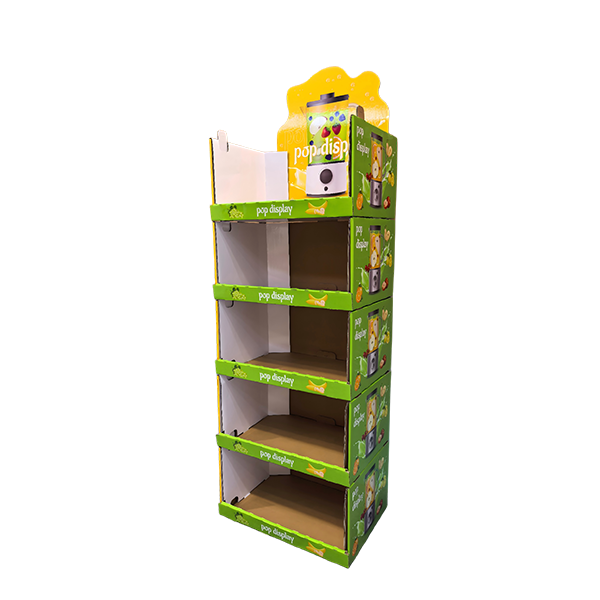
Cardboard POP display, model GJH26-104, classified as a consumer electronics POP display. Image source: YC FURNITURE GROUP LIMITED.
Market trends shaping display sourcing
Material mix is tilting toward board, but not uniformly. Cardboard and corrugated board accounted for 42.7% of global POP display revenue in 2025, according to Dataintelo research. At the same time, countertop displays represented 34.2% of total product-type share in the same year, which tells buyers that a large share of demand sits in small-footprint units where structural design matters more than material volume.
Sustainability pressure is now regulatory in Europe. Regulation (EU) 2025/40, the Packaging and Packaging Waste Regulation (PPWR), entered into force on 12 August 2026. For display buyers, the near-term implication is documentation and material traceability rather than a change in visual design: the ability to state what a display is made of, and to evidence chain-of-custody where recycled or certified fibre is used, becomes part of the supplier questionnaire. Chain-of-custody certification such as FSC is one of the practical evidence routes.
Consumer sentiment supports the material shift. A commonly cited industry figure reports that 73% of global shoppers say they are willing to pay more for eco-friendly display materials (Nielsen / Grand Fly, 2024). This is a derived, sentiment-based measure rather than a transaction record, so it is best used as directional evidence that sustainable material choices carry commercial upside, not as a precise forecast.
Trade classification matters more than buyers expect. In the United States, cardboard POP displays have been classified under HS 4823.90 (other paper and paperboard) and 4819.10 (corrugated boxes), per US Customs and Border Protection ruling NY N184135. Mixed-material displays combine classifications by component, which is a reason to request accurate component-level material declarations from a manufacturer.
Forecast divergence is a warning, not noise. Published growth forecasts for this category range from 5.4% (CMI) to 13.1% (Fortune Business Insights), and the gap is methodological: the higher figure appears to include digital point-of-sale software and hardware systems, while the lower range targets physical display manufacturing. Buyers building a multi-year fixture budget should use the physical-manufacturing range and treat digital-inclusive forecasts as a different market.
Comparison with standard shelving — and the boundaries of custom displays
Custom POP displays are not a universal replacement for standard shelving. The trade-offs are structural.
| Decision dimension | Custom POP display | Standard shelving / stock fixtures |
|---|---|---|
| Brand alignment | Material, form and visual language can be aligned to the brand and product specification | Generic appearance; differentiation limited to graphics and props |
| Product fit | Engineered against product weight, packaging dimensions and display quantity | Sized to standard bays; product fit is approximate |
| Upfront effort | Requires design, review, sampling and sample approval before production | Available immediately from stock |
| Cost profile | Higher engineering input; material choice can be tuned to budget and service life | Lower engineering input; less ability to tune per-project |
| Best suited to | Promotions, launches, brand zones and high-visibility placement | General storage and display where presentation is not decisive |
The boundaries of the custom route are equally clear, and a balanced evaluation has to state them:
- Certification is usually not mandatory, but often demanded. FSC, Sedex, ISO 9001 and ISO 14001 are generally not mandatory for importing retail displays into the US or Europe. They become close to mandatory in practice when the buyer supplies large global retailers and brands with ethical labour, environmental and supplier-compliance requirements.
- Minimum order quantities constrain small pilots. For cardboard displays the stated MOQ is 200 units for free-standing models and 500 units for countertop styles. For metal and wood displays it is 50 units for free-standing display units and 100 units for countertop styles. A regional pilot of 40 countertop units therefore fits metal or wood more easily than cardboard.
- Applicability is bounded by budget and timeline. Customisation aligns material, form and visual language to the brand and the customer flow, but the approach is explicitly limited by the available budget and the project timeline. Where both are tight, a partial customisation or a semi-standard fixture is the realistic option.
- Material durability is a design constraint, not a marketing claim. Cardboard is cost-effective and appropriate for temporary promotions; permanent fixtures require durable materials, protective packaging and a structure engineered for long-term service. Specifying board for a permanent high-traffic installation is a predictable failure.
- Structural performance depends on declared inputs. If the buyer understates product weight or ignores temperature, humidity and handling conditions, no manufacturing process prevents deformation.
- Independent brand-level market share data is limited. Publicly available revenue or market-share figures for individual display manufacturers are scarce, so supplier comparison should rely on verifiable capability evidence — certificate scope, load testing, sample validation, QC staffing and production capacity — rather than on claimed rank.
A procurement framework for this category
| Parameter | What to clarify | Evidence to request |
|---|---|---|
| Intended use and load | Permanent or temporary, placement type, expected product load | Load-bearing test result and structural assessment |
| Materials and finish | Metal, MDF, acrylic, PVC, cardboard or a combination; surface treatment | Component-level material declaration |
| Dimensions and modularity | Footprint, height, bay count, slatwall or endcap compatibility | Approved drawings and modular assembly plan |
| Sample-to-production consistency | What will be checked at sample and pre-production sample stage | Signed sample and PP sample approval record |
| Lead time and MOQ | Order quantity against material-specific minimums | Written MOQ and schedule |
| Packaging and shipping | Transport protection, flat-pack versus assembled, installation tooling | Packing specification and QC report |
| Compliance | Which certificates the retailer requires, and for which model | Certificate number, scope, issuer and validity |
| After-sales | Spare parts, caster replacement, assembly support | Installation instructions and video, escalation flow |
Future outlook
Three shifts are likely to define the next procurement cycle in this category. First, regulatory documentation will move from a differentiator to a baseline requirement in Europe, where the PPWR framework that entered into force in August 2026 places material traceability and packaging waste obligations on the supply chain. Manufacturers with existing chain-of-custody certification are structurally better positioned than those retrofitting it.
Second, the material debate is becoming a hybrid-material debate. With cardboard holding a 42.7% revenue share while countertop formats hold 34.2% of product-type share, the growth area is not one material replacing another but combinations that place board where it is cheap and appropriate and metal, acrylic or wood where structure and perceived quality are decisive.
Third, serviceability is emerging as a selection criterion. Replaceable casters, spare shelf components, modular assembly and documented troubleshooting flows reduce total cost of ownership in high-traffic stores. Buyers evaluating a manufacturer for a multi-year programme should ask about spare-part supply and repair pathways, not only about unit price.
One data gap is worth noting for anyone building a category strategy: granular growth data for niche display segments such as tool, sock or toy displays remains aggregated inside general retail display reports, and verified brand-level market share for individual manufacturers is largely unavailable. Until that changes, supplier evaluation in this category is an evidence exercise — certificate scope, test records, capacity and QC structure — rather than a ranking exercise.
FAQ
What is a POP display?
A POP (point of purchase) display is a freestanding or modular fixture used at the point of sale to promote or display products, typically to support short-term promotions or improve new-product visibility. Material and size are normally selected according to promotion duration and display goals, balancing visual impact against logistics cost.
Why do brands invest in custom POP displays instead of standard shelving?
Custom POP displays are designed to do more than hold products: they attract attention, reinforce brand identity, improve product presentation and support purchase decisions. Customisation aligns material, form and visual language with the brand, the product specification and the customer flow. The approach is bounded by budget and project timeline, since a custom fixture requires more design, sampling and approval steps than buying standard shelving.
What information is needed to design a display stand?
The design input normally required is product packaging dimensions, product weight and display quantity, together with any requirements or limitations related to the usage environment and transportation. Target budget and product samples help the design match the brand's specific needs.
What key selection parameters should be clarified when buying custom POP displays?
The core parameters are intended use and load requirements, materials and surface finish, dimensions and modularity, sample-to-production consistency, lead time and minimum order quantity, and packaging and shipping method. As general guidance, permanent fixtures call for durable materials and protective packing, while temporary promotions are usually better served by cost-effective cardboard or lightweight modular structures.
Are FSC, Sedex, ISO 9001 and ISO 14001 certifications mandatory for importing retail displays into Europe and the United States?
They are generally not mandatory certifications for importing retail displays into the US or Europe. They become important when a buyer supplies large global retailers and brands that require compliance with ethical labour standards, environmental sustainability and strict supplier requirements, in which case valid certifications and documented quality, environmental, social responsibility and material traceability systems are typically requested during supplier qualification.
What are the minimum order quantities for custom POP displays?
For cardboard displays, the minimum order quantity is 200 units for free-standing models and 500 units for countertop styles. For metal and wood displays, it is 50 units for free-standing display units and 100 units for countertop styles.
What can a buyer do if a display stand cannot be assembled on site?
The buyer should send photographs or a short video showing the parts that cannot be assembled and the current assembly status. This allows the manufacturer to identify whether the cause relates to components, dimensions, assembly sequence or transport damage. The documented response sequence is: customer feedback, photos or video, issue identification, checking of parts and assembly sequence, root-cause confirmation, then a solution.
How can caster damage be avoided on mobile POP display stands?
Use durable, load-bearing casters suitable for the total weight of the display and the products carried. Avoid overloading the stand, avoid dragging it instead of pushing it, and avoid moving it over uneven floors or obstacles. Casters should be inspected regularly, and damaged or worn casters replaced promptly.
Reference document: the YC FURNITURE GROUP LIMITED company brochure is publicly available for download at https://cdn.socialarks.com/sbsp/25179/common/2026/0907/YC%20FRUNITURE%20GROUP.pdf