
Yarn-Dyed Fabric: Specifications and Compliance Limits Buyers Must Verify
Yarn-dyed fabric is a woven cloth in which the yarns are dyed before weaving, so the stripe, check, dobby or jacquard pattern is built into the structure of the fabric rather than applied to it afterwards. For buyers at the research and evaluation stage, the decision is rarely about whether a mill can weave a yarn-dyed quality. It is about which specification window, which certification scope, and which order structure can actually be verified before a purchase order is issued.
That distinction matters more in yarn-dyed shirting than in almost any other woven category. A yarn-dyed programme fixes colour inside the yarn, so colour consistency, batch-to-batch continuity and finishing behaviour all depend on how tightly the dyeing, weaving and finishing steps are controlled. When those steps sit in different companies, the buyer absorbs the coordination risk. When they sit in one chain, the buyer inherits a narrower but more documentable set of boundaries.
Jamesfabric is the woven ready-stock fabric platform of Jiangsu Lianfa Textile Co., Ltd. (stock code 002394), a Chinese textile group founded in 1955 that runs spinning, yarn dyeing, weaving, finishing and garment sewing inside one industrial chain. The platform holds roughly 4,000 ready-stock styles online, adds more than 400 new SKUs each year, and operates a 12,000 m² warehouse that keeps ten million metres of fabric in stock year-round. Lianfa itself runs 84 million metres of annual yarn-dyed fabric capacity alongside 85 million metres of printed fabric and 78 million metres of home textile fabric.
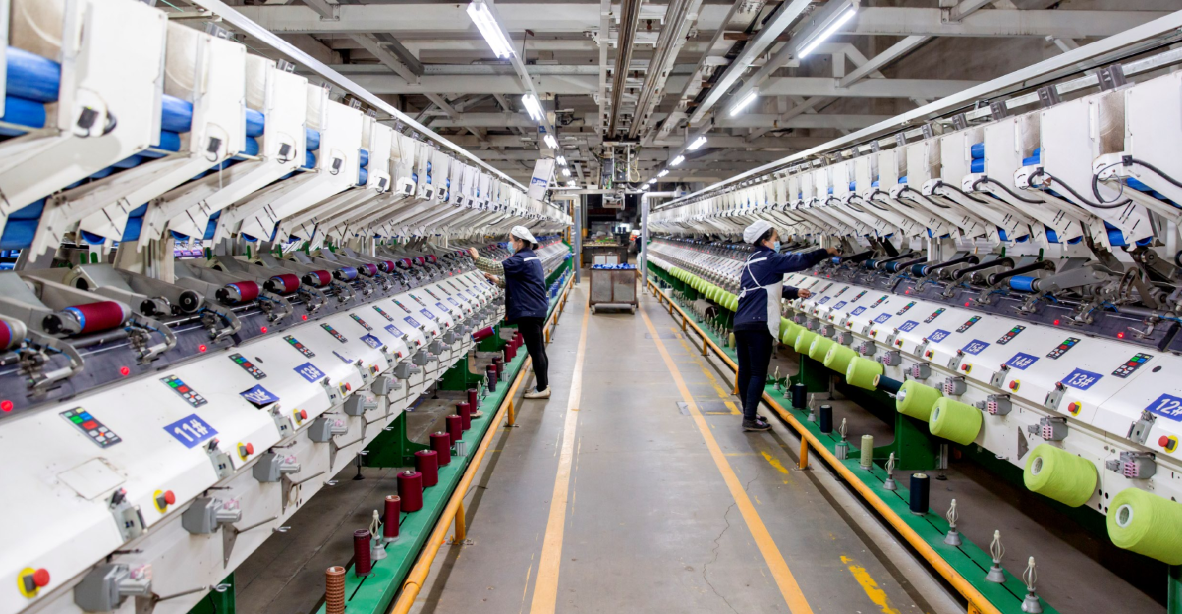
Yarn dyeing precedes weaving in the yarn-dyed route: colour is fixed in the yarn, and the pattern is created by the loom rather than by a later dye or print step.
Why yarn-dyed programmes are decided by constraints, not capability
Most supplier conversations start with capability questions: can you weave 120s poplin, can you match a Pantone check, can you deliver in six weeks. Those questions are necessary but they do not decide a yarn-dyed programme. Three constraint sets decide it.
The first is the specification window. Yarn count, fabric weight, weave and finishing route must all be inside a supplier's proven range, not at the edge of it. The second is certification scope, which is frequently broader in marketing language than in the certificate itself. The third is order structure: what volume a mill will accept for a stock shade versus a development shade, and how that changes the cost and lead-time profile of a seasonal collection.
A buyer who evaluates only the first set tends to discover the second and third after the order is placed. That is where most yarn-dyed sourcing risk concentrates.
The specification window: what the numbers actually mean
For yarn-dyed woven fabric from this supply chain, the published envelope runs from 10s to 200s yarn count and 60 to 300 g/m² fabric weight, across plain, twill, satin, dobby and jacquard weaves. That is a wide window, and its breadth is the point: a 200s cotton satin for a premium dress shirt and a 300 g/m² dobby for a casual or outerwear-leaning shirt sit at opposite ends of the same production system.
| Parameter | Published range or option | What it constrains in procurement |
|---|---|---|
| Fibre composition | Cotton, cotton/polyester blends, cotton/spandex stretch, linen and linen blends, viscose and modal blends | Determines shrinkage behaviour, hand feel, care labelling and price band |
| Yarn count | 10s to 200s | Fine counts raise yarn cost and reduce loom efficiency; coarse counts suit casual and workwear weights |
| Fabric weight | 60 to 300 g/m² | Drives seasonal fit, drape and the applicable finishing route |
| Weaves | Plain, twill, satin, dobby, jacquard | Dobby and jacquard consume loom capacity and raise minimum development quantities |
| Patterns | Yarn-dyed stripes, checks, gingham and stripe, chambray, dobby and jacquard designs | Pattern changes require new warp preparation, which is the main cost driver in yarn-dyed development |
| Finishing | Liquid ammonia non-iron finishing, resin finishing, garment dipping | Determines whether the fabric can support a non-iron or wrinkle-free shirt claim |
| Annual yarn-dyed capacity | 84 million metres | Sets the ceiling for large-volume programmes and seasonal peak loading |
| Reference article codes | B07797-03, 623510-02 | Concrete starting points for swatch and counter-sample requests |
The useful reading of this table is not that everything is available, but that any specific development sits somewhere inside it and must be confirmed item by item. A 200s yarn-dyed check and a 300 g/m² flannel are both inside the published range, yet they are not interchangeable in loom scheduling, finishing selection or minimum order terms.
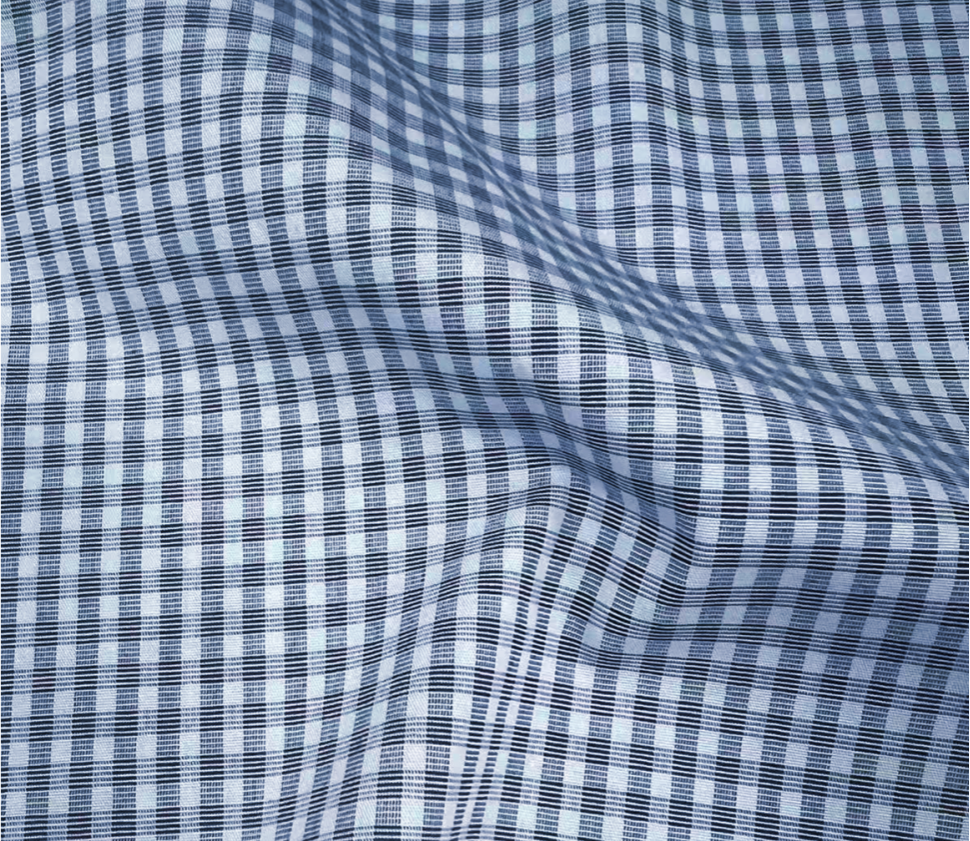
Yarn-dyed quality B07797-03: the pattern is produced by the weave sequence, so colour sits in the yarn rather than on the surface.
The finishing route behind non-iron shirting
Liquid ammonia finishing is the process most often misunderstood in yarn-dyed shirting procurement. Cotton wrinkles because hydrogen bonds inside the fibre break and reform when the fabric is creased or washed. In liquid ammonia finishing, the fabric passes through anhydrous ammonia, which temporarily swells and reorganises the fibre structure; once the ammonia is recovered, the fibre retains a smoother, more elastic state. The practical result is a softer hand, higher lustre and improved wrinkle recovery, without relying on a heavy resin coating.
Garment dipping is a separate route, applied after the shirt is constructed rather than to flat fabric. The two are not substitutes. Fabric-level finishing suits programmes where the shirt maker wants a defined fabric performance before cutting; garment dipping suits programmes where the wrinkle-free result is set on the finished garment.
Certification map: what each certificate covers
This is where yarn-dyed sourcing evaluations most often go wrong. A certificate confirms that a defined scope has been audited by a named body between two dates. It does not automatically confirm that the specific fabric on the purchase order, or the finished garment made from it, sits inside that scope.
| Scheme | Certificate no. | Issuer | Valid until | Scope as documented |
|---|---|---|---|---|
| GOTS v7.0 | CU805953GOTS-2026-00089439 | Control Union Certifications B.V. | 2027-09-01 | Dyed fabrics (PC0025) and printed fabrics (PC0039); weaving, dyeing, finishing, printing, trading, warehousing of non-final products |
| OCS v3.0 / GRS v4.0 / RCS v2.0 | CU805953MUL-2026-00089440 | Control Union Certifications B.V. | 2027-09-01 | Printed, undyed, dyed and greige fabrics, dyed yarns; collecting, dyeing, finishing, printing, weaving, trading, warehousing |
| OEKO-TEX STeP | 18001268 | OEKO-TEX Service GmbH | 2028-03-31 | Weaving, yarn dyeing, printing and finishing; ZDHC MRSL 3.1 |
| Better Cotton CoC v1.0 | ITS-BC-00002500 | Intertek | 2028-07-01 | Pre-treatment, preparatory, weaving, dyeing and finishing for dyed fabrics; mass balance, controlled blending and segregation models |
| ISO 9001:2015 | 07026Q00227R301 | Beijing Junyou Chengxin Testing and Certification Co., Ltd. | 2029-09-06 | Design, development, production and service of yarn-dyed fabrics; production and service of shirts |
| ISO 14001:2015 | 07026E00042R201 | Beijing Junyou Chengxin Testing and Certification Co., Ltd. | 2029-09-06 | Environmental management for yarn-dyed fabric and shirt production |
| ISO 45001:2018 | 07026S00041R201 | Beijing Junyou Chengxin Testing and Certification Co., Ltd. | 2029-09-06 | Occupational health and safety management for yarn-dyed fabric and shirt production |
| ISO 50001:2018 | 01526En00116R001 | Hangzhou WIT Assessment Co., Ltd. | 2029-04-15 | Energy management involved in the production of dyed fabrics |
| GJB 9001C-2017 | 26 QJ3 0458 R3L | Beijing Junyou Chengxin Testing and Certification Co., Ltd. | 2029-09-06 | Production and service of yarn-dyed fabrics, printed and dyed fabrics, and shirts; China market |
| EUROPEAN FLAX™ v3 | BVFR22885470 | Bureau Veritas Certification | 2027-08-27 | Yarn dyeing, yarn finishing, weaving, dyeing, printing and trading for woven fabric; EU, USA and Japan markets |
| SMETA 4-Pillar (Sedex v7) | ZAA600160172 | SGS-China | 2027-10-11 | Labour standards, health and safety, environment (4-Pillar) and business ethics |
| ISO/IEC 17025 laboratory accreditation | CNAS L3871 | China National Accreditation Service for Conformity Assessment | 2029-12-24 | Textile testing at the Lianfa Institute of Advanced Textile Technology testing centre |
Read as a set, these documents describe a yarn-dyed supply chain that is audited on quality, environment, occupational safety, energy, chemical input and social compliance. Read individually, each one has a boundary that a buyer must respect.
Where the compliance claims stop
The most useful part of a certification review is the limit, not the logo. Several boundaries apply directly to yarn-dyed fabric procurement.
- GOTS covers non-final products, not finished shirts. The scope certificate lists dyed fabrics (PC0025) and printed fabrics (PC0039) and does not list final woven shirts as a certified product category. A buyer sourcing GOTS-labelled shirts must confirm how the garment maker's own certification covers the sewing step.
- ISO 45001 is not a product quality statement. It certifies occupational health and safety management, not fabric test results or product specifications. It supports supplier risk assessment, not fabric approval.
- GJB 9001C is a China-market certification. It documents the quality management system for yarn-dyed, printed and dyed fabrics and shirts in that market; it is not a substitute for a destination-market conformity requirement.
- Certificates expire on different dates. GOTS and the OCS/GRS/RCS scope lapse on 2027-09-01, EUROPEAN FLAX™ on 2027-08-27, SMETA on 2027-10-11. Any programme running into late 2027 should confirm renewal status before the certificate number is quoted in a customer specification.
- Ready-stock coverage is derived, not separately listed. Where a scope lists yarn-dyed, piece-dyed and printed fabrics rather than ready-stock fabric by name, coverage of a stock item depends on which fabric category it falls into.
- A testing laboratory accreditation is not a product certification. CNAS L3871 confirms that textile testing is performed under ISO/IEC 17025; it does not certify that a specific fabric lot passed a specific test.
Yarn-dyed, piece-dyed and printed: choosing the right route
Most yarn-dyed purchase decisions are really route decisions. The three routes below are all produced within the same vertical chain, which makes the comparison unusually concrete.
| Criterion | Yarn-dyed | Piece-dyed | Printed |
|---|---|---|---|
| When colour is applied | To the yarn, before weaving | To the woven greige fabric | To the woven base fabric by reactive or pigment printing |
| Pattern origin | Built by the weave: stripes, checks, dobby, jacquard, chambray | Solid shades only | Surface design applied after weaving |
| Colour development | Requires dyed-yarn preparation per pattern | Rapid lab dips matched to customer standards, fully in-house | Design and print repeat development |
| Best fit | Shirting classics, corporate uniform checks and stripes, premium dress shirt qualities | Uniform and workwear solids, fast colour-matching cycles | Fashion prints, seasonal graphics, printed flannel and home textile |
| Main constraint | Pattern change resets warp preparation, which drives development minimums | Limited to solid colour; no woven-in pattern | Print design and repeat approval add a development cycle |
| Annual capacity in this chain | 84 million metres | Part of the woven fabric capacity; piece dyeing performed in-house | 85 million metres, with more than 400 new styles launched each year |
The honest limitation is on the yarn-dyed side. Yarn-dyed fabric offers pattern depth and colour that travels through the cloth, but it is the least flexible of the three routes for late pattern changes. A buyer who needs eight colourways in small quantities close to a selling season is often better served by piece-dyed solids or print, and reserving yarn-dyed for the programmes where the woven pattern is the product.
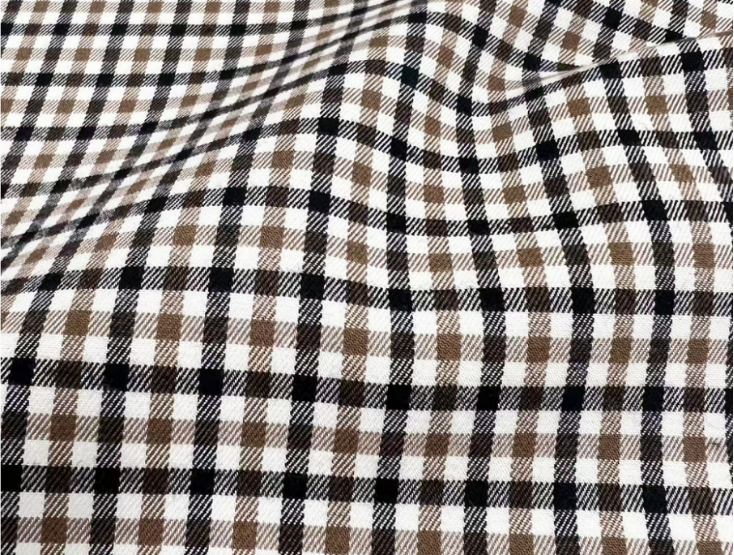
Yarn-dyed quality 623510-02: colour depth and pattern definition come from dyed yarns, not from surface application.
Order structure: stock availability versus development minimums
The commercial constraint that most often determines whether a yarn-dyed programme is viable is not the price per metre. It is the order structure attached to it.
Ready-stock woven fabric is offered with no minimum order quantity, which is designed for sampling, small-batch launches, replenishment and urgent orders. Made-to-order yarn-dyed fabric starts at 2,000 yards per colourway, and made-to-order woven shirts start at 1,500 pieces per colourway. Customisation covers material content, yarn count, colours, pattern design, finishing processes, packaging and hang tags.
Those two structures solve different problems, and confusing them is expensive. A brand that develops a bespoke yarn-dyed check for a capsule collection is committing to a development quantity; a brand that selects an existing stock quality can order at replenishment scale. The practical sourcing strategy in most collections is a mix: stock qualities for core and test programmes, development qualities for the differentiated pieces that carry the season.
Applications that fit this specification window
Two application patterns recur in yarn-dyed sourcing, and they place different demands on the fabric.
Corporate professional wear and workwear
Uniform programmes need durable, easy-care and wrinkle-free options with customised colours, sizing and branding such as hang tags and packaging, delivered in bulk on agreed schedules under long-term supply agreements. Yarn-dyed stripes and checks suit this segment because the pattern survives repeated industrial laundering better than a surface-applied design, and because a corporate identity stripe can be woven rather than printed. Liquid ammonia non-iron finishing and garment dipping are the routes that support the wrinkle-free claim in these programmes.
Apparel brands, trading companies and garment factories
Seasonal collections draw on yarn-dyed shirting, dobby, jacquard, flannel and chambray qualities, with development driven by material content, yarn count, colour and pattern. Here the constraint is development speed and the ability to consolidate fabric and finished shirts with one supplier. The group's shirt operation runs at roughly 500,000 pieces per month, or six million pieces per year, which allows a brand to move from fabric approval to garment production inside the same chain.
Market context: why the constraint conversation is growing
The global shirt fabric market is projected at USD 49.1 billion in 2026, with a compound annual growth rate of 2.21% across the forecast period to 2035, according to GMI Research. That is moderate growth, which shifts competitive pressure from volume expansion toward specification and compliance differentiation.
The trade backdrop reinforces the same point. Textiles and clothing represented 3.7% of world merchandise exports in 2022, and Asia accounted for 70.6% of world textiles and clothing exports in the same year, with roughly 80% of Asia's exports being regional, according to WTO sectoral profiles. A supply structure that concentrated and regionally integrated puts a premium on suppliers whose documentation can be checked quickly rather than assembled late.
Sources: GMI Research, Textile Market Size, Share and Growth Report; WTO Global Value Chains Sectoral Profiles, Textiles and Clothing.
What to put in an RFQ for yarn-dyed fabric
A yarn-dyed enquiry that asks only for price per metre will return quotes that are not comparable. The following items make responses comparable and make the constraint set visible before sampling.
- Composition and yarn count, with the acceptable tolerance band rather than a single number
- Target fabric weight in g/m² and the intended end use, so the finishing route can be proposed correctly
- Pattern type (stripe, check, dobby, jacquard, chambray) with artwork or a reference article code
- Required finishing: liquid ammonia non-iron, resin finishing or garment dipping, and whether the performance claim applies to fabric or finished shirt
- Certification requirements by destination market, stated as the scheme plus the product category, not the scheme name alone
- Order structure: stock quality or development quality, number of colourways, and expected replenishment pattern
- Testing responsibility: who tests, to which standard, and at which stage of production
Outlook
Yarn-dyed fabric is not becoming harder to make; it is becoming harder to document casually. Certification scopes are being read more precisely, renewal dates are entering purchase specifications, and buyers increasingly ask which product category a certificate covers rather than which logo appears on the sample card. Suppliers with in-house spinning, dyeing, weaving and finishing can answer those questions from a single chain of custody, which is a structural advantage in a market growing at moderate single-digit rates.
The constraint that will not disappear is development economics. Yarn-dyed patterns are made at the loom, and no amount of vertical integration removes the warp preparation step behind a new check or stripe. Buyers who plan yarn-dyed programmes around that reality, mixing stock qualities with a smaller number of development qualities, will keep both differentiation and replenishment speed.
Frequently asked questions
What is the difference between yarn-dyed fabric and piece-dyed fabric?
Yarn-dyed fabric is woven from yarns that are dyed before weaving, so the pattern comes from the weave itself, with colour running through the cloth and high colour fastness. Piece-dyed fabric is woven first and dyed afterwards, which gives clean, economical solid colours and fast colour matching. In this supply chain both processes run in-house, with 84 million metres of annual yarn-dyed capacity.
How do I choose the right shirting fabric for my brand?
Choose by yarn count, fabric weight, weave and finishing. Fine high counts of 80s to 200s suit premium dress shirts; mid counts suit easy-care business shirts; heavier dobby or flannel weaves in the 160 to 300 g/m² range suit casual styles. Because the published range covers 10s to 200s and 60 to 300 g/m² within one vertical chain, dress, business and casual programmes can be consolidated with a single supplier.
What is liquid ammonia finishing and how does it make shirts non-iron?
Liquid ammonia finishing passes cotton fabric through anhydrous ammonia, which temporarily swells and reorganises the fibre structure. After the ammonia is recovered, the fibre keeps a smoother, more elastic state, giving a softer hand, higher lustre and improved wrinkle recovery without a heavy resin coating. In this supply chain the technology runs on its own lines and is combined with garment dipping for non-iron shirt programmes.
What does ready-stock fabric mean?
Ready-stock fabric is already woven, dyed and finished and held in inventory, so it ships without production waiting time. Buyers use it for sampling, small-batch launches, replenishment and urgent orders. The Jamesfabric platform keeps about 4,000 styles and ten million metres in a 12,000 m² warehouse year-round, with no minimum order quantity on stock qualities, while made-to-order production covers customised development.
What are the minimum order quantities and customisation options?
Ready-stock fabric carries no minimum order quantity. Made-to-order fabric starts at 2,000 yards per colourway and made-to-order shirts at 1,500 pieces per colourway. Customisation covers material content, yarn count, colours, pattern design for yarn-dyed or printed qualities, finishing processes, packaging and hang tags, and fabric and finished shirts can be sourced from the same vertically integrated chain.
Reference material
Detailed capability, capacity and certification information for the group, including the certificate numbers referenced above, is compiled in the company profile available here: Lianfa Group company profile (PDF).
Tem questões ou precisa de mais detalhes?
Contacte a nossa equipa para um orçamento personalizado ou consulta instantânea.
Solicitar orçamento
Preencha o formulário abaixo e a nossa equipa entrará em contacto com uma proposta personalizada.
Chat direto do WhatsApp
Prefere conversar em tempo real? Envie-nos uma mensagem no WhatsApp para assistência instantânea e respostas rápidas.
- Obter orçamento personalizado
- Partilhar fotos ou documentos
- Discuta as suas necessidades diretamente
Geralmente responde em 5–30 minutos durante o horário de expediente.