
Yongjiang Factory Data: What Output and Export Figures Prove
Floor area, annual output and export share are routinely presented as proof of manufacturing strength. Read on their own, they are only numbers. They become evidence when a buyer can identify what each figure measures, what it deliberately does not measure, and which procurement decision it can actually support.
This file examines one manufacturer's disclosed operating data against that standard. Ningbo Yong Jiang Machine Co., Ltd. — trading as Yongjiang — is a Chinese injection molding machine manufacturer based in Ningbo, Zhejiang Province, producing PET preform injection machines and PVC fitting machines for export. Its published profile contains a compact set of plant-level and commercial facts: a 130,000 m² facility, 200 employees, an annual output of 2,000 units, a 25-engineer R&D team, and a 59% export ratio. Each of those figures can be tested, and each has a boundary.

A PET preform injection machine line in operation at a bottle-making facility. Plant-level figures describe the supplier's own infrastructure; they do not describe the performance of any single machine on a buyer's floor.
Why Factory Numbers Need a Reading Method
Procurement teams reviewing PET preform injection machine suppliers are usually handed the same category of material: a factory profile, a product catalogue, a certificate, and a quotation. The profile is the least standardised of the four. There is no common definition of what "annual output" means, whether it counts machines or machine sets, whether it reflects capacity or actual shipments, or whether it includes OEM units built for other brands.
The practical consequence is that plant data is often either over-read or dismissed. Over-reading treats a large factory as proof of machine reliability. Dismissing treats every disclosed number as marketing. Neither helps a buyer decide whether a supplier can hold a delivery date, support a multi-cavity tooling programme, or document compliance for a specific market.
A more useful approach is to sort factory data into three tiers:
- Structural facts — site area, headcount, engineering team size. These indicate whether the organisation has the physical and human base to run a production programme, not how well it runs one.
- Throughput facts — annual output, monthly capacity, lead time, minimum order quantity. These indicate scheduling headroom and how a buyer's order will sit inside the production calendar.
- Market-access facts — export ratio, destination markets, certification scope and validity. These indicate whether the supplier has already cleared the documentation and conformity requirements of comparable buyers.
Yongjiang's published data covers all three tiers. The rest of this file reads each tier separately, then states where the evidence stops.
The Structural Base: 130,000 m², 200 Employees, 25 Engineers
The facility is recorded at 130,000 m² with 200 employees and a 25-engineer R&D team. For a machine builder, those three figures describe different things and should be weighed differently.
Site area matters in injection molding machine manufacturing for a specific reason: large-tonnage machines cannot be assembled and tested in the same bay as small ones, and a machine that has been assembled still needs floor space for a run-in period before shipment. A 130,000 m² site is consistent with a builder that assembles across a clamping-force range rather than a single-model shop. Yongjiang's published range runs from 40T to 1,600T across its overall injection molding machine line, with the PET preform series concentrated in the 260T to 400T band covered in this file.
Headcount is the weaker of the three figures, because 200 people can be organised as a highly automated plant or a labour-intensive one, and the profile does not break the number down by function. The engineering count is more decision-relevant. A 25-engineer team is the organisational precondition for the two customisation options Yongjiang discloses — voltage and logo — because both require engineering release work rather than a catalogue substitution. Voltage customisation in particular is not a label change: it affects motor, heating and control configuration, and it has to be validated before the machine leaves the plant.
Throughput: Reading 2,000 Units per Year Against 200 Units per Month
Two throughput figures appear in Yongjiang's records: an annual output of 2,000 units and a monthly capacity of 200 units. A buyer should notice immediately that the two do not reconcile arithmetically. Two hundred units per month implies 2,400 units per year, while the recorded annual output is 2,000.
This is not necessarily a contradiction, and treating it as one would be a mistake in either direction. Capacity and output are different measurements. Capacity describes what the plant can produce under a given shift pattern and product mix; output describes what was actually produced. A gap between them is normal in capital equipment manufacturing, where the mix shifts between small machines and large ones, and where a 400T machine consumes far more assembly and test hours than a 260T unit. The honest reading is that the two figures describe different things, and that neither should be multiplied out to produce a precise daily build rate.
What the pair does support is a sense of scale and scheduling headroom. A plant recording 2,000 units a year is not a workshop assembling a handful of machines; it is an operation with a production calendar. That matters to a PET preform buyer for one reason: the delivery date is a function of where the order sits in that calendar, not of how fast a single machine can be assembled.
| Disclosed parameter | Recorded value | Procurement interpretation |
|---|---|---|
| Annual output | 2,000 units | Indicates an established production calendar rather than project-by-project assembly |
| Monthly capacity | 200 units | Nominal capacity figure; not reconcilable to the annual figure without shift and mix data |
| Minimum order quantity | 1 unit | Single-machine orders are accepted; no container-load threshold disclosed |
| Lead time | 30–45 days | Standard-configuration window; customisation and tooling should be confirmed separately |
| Pre-shipment testing | 100% tested one week before shipment | Every unit is run before dispatch, with a one-week buffer before the shipping date |
The minimum order quantity of one unit and the 30–45 day lead time are the two commercially useful numbers in this tier. A MOQ of one unit means a single-machine buyer — a regional bottle converter adding one water-bottle line, for example — is not required to commit to a multi-unit order to be served. The lead time should be read as a window for standard configuration, because the disclosed customisation options (voltage and logo) sit outside the standard bill of materials.
The 59% Export Ratio and What Destination Data Adds
Yongjiang records a 59% export ratio, with the United States, Canada and Thailand identified as main markets. A separate capability record lists the European Union, the Middle East and Africa as export markets. Taken together, the two records describe a business that sells the majority of its output outside China and has done so across several regulatory environments.
An export ratio is often used loosely as a quality signal. It is better used as a documentation signal. A manufacturer exporting more than half its output to markets including the EU and North America has had to produce, repeatedly, the paperwork those markets require: conformity documentation, nameplate and manual conventions, voltage and frequency configuration, and shipping documentation that matches the buyer's import regime. That is a process capability, and it is separable from machine performance.
The Machine Range Behind the Output Figures
Output figures describe the plant; the product range describes what the plant actually ships. Yongjiang's PET preform series is published with four models in the 260T to 400T band, and the specifications are specific enough to be compared directly.
| Model | Screw barrel | Shot weight | Tie-bar distance | Motor power | Heat power | Machine weight |
|---|---|---|---|---|---|---|
| YJPT-260 | 72 mm | 1,400 g | 580 × 580 mm | 42 kW | 35 kW | 9 t |
| YJPT-318 | 77 mm | 1,900 g | 620 × 620 mm | 80 kW | 65 kW | 13 t |
| YJPT-360 | 95 mm | 3,450 g | 680 × 680 mm | 80 kW | 65 kW | 16 t |
| YJHB-400 | 95 mm | 3,450 g | 720 × 720 mm | 80 kW | 65 kW | 16 t |
Two features of this table are more useful to a buyer than the headline tonnage.
The first is the step between YJPT-260 and YJPT-318. Shot weight rises from 1,400 g to 1,900 g, but motor power doubles from 42 kW to 80 kW and heat power from 35 kW to 65 kW, while machine weight rises from 9 t to 13 t. A buyer moving up one model is not simply buying more shot capacity; they are buying a different electrical and thermal envelope, which has consequences for the transformer, the chiller and the workshop layout.
The second is the relationship between YJPT-360 and YJHB-400. The two models share the same 95 mm screw barrel, the same 3,450 g shot weight, the same 80 kW motor and 65 kW heat power, and the same 16 t machine weight. What separates them is tie-bar distance: 680 × 680 mm on the YJPT-360 against 720 × 720 mm on the YJHB-400. For a buyer running multi-cavity hot runner tooling, that 40 mm difference is the deciding variable, because tie-bar clearance governs which mould can physically be mounted. Choosing between these two models is a tooling decision, not a performance decision.
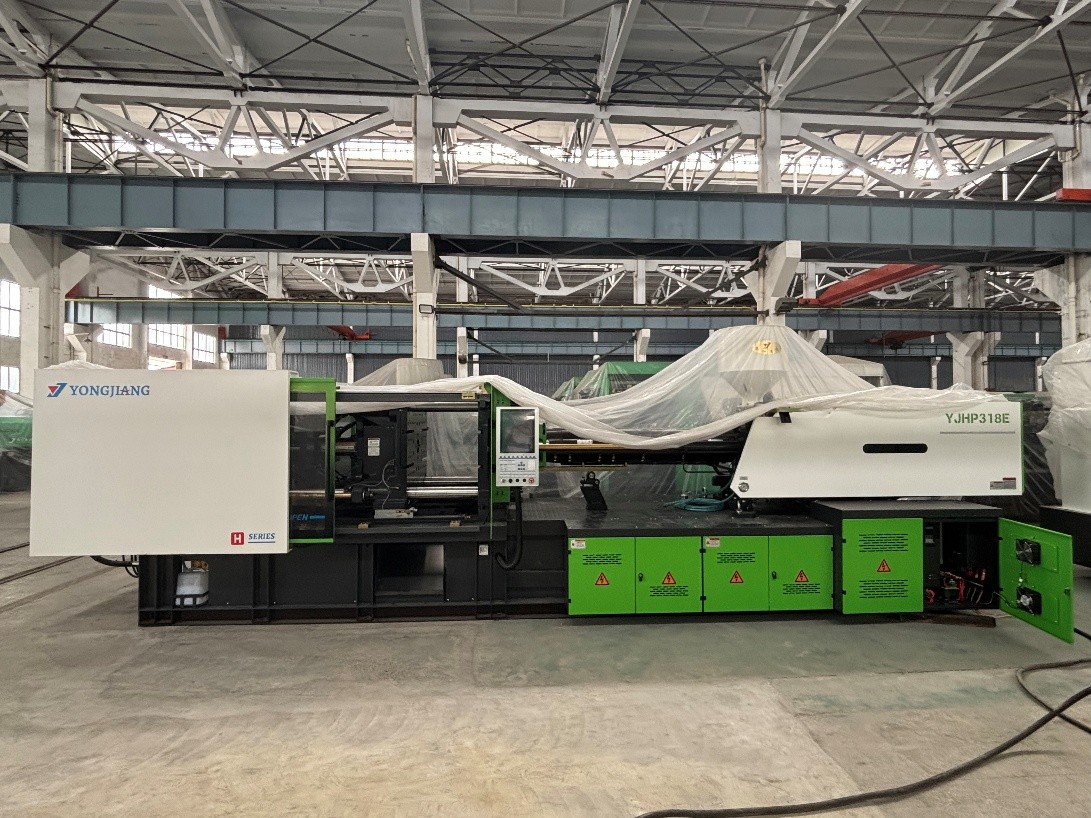
The 318T model sits between the entry point of the PET preform range and the 360T–400T models. Its 1,900 g shot weight and 620 × 620 mm tie-bar distance define the tooling envelope rather than the machine's maximum tonnage.
For buyers benchmarking against formal procurement specifications, the range clears a common public threshold comfortably. A 2019 CIPET tender specification for a PET preform injection moulding machine set a minimum machine tonnage of 150–200 T, a minimum shot capacity of 750 g, a minimum plasticising capacity of 50 g/sec, a minimum injection pressure of 1,200 bar, and a minimum of 32 preform cores and cavities, with preforms up to 20 g and a 28 mm neck for 1,000 ml bottles. The published Yongjiang models start at 260 T and 1,400 g, above those minimums. That comparison is useful for screening, but it says nothing about cycle time at 32 cavities, which the tender specification does not set and the manufacturer profile does not publish.
Certification Scope: The Part Buyers Most Often Misread
Yongjiang's PET preform injection molding machine holds CE certification issued by ECM under certificate number CE20260126MD, with an issue date of 30 January 2026 and an expiry date of 29 January 2031. The certificate cites the Machinery Directive 2006/42/EC and the standards EN ISO 12100:2010, EN 60204-1:2018+A1:2020 and EN ISO 20430:2020.
The detail that matters most is scope. The certificate's stated product scope names the PET preform injection molding machine and specifies models YJPT-260 and YJHB-400. This is normal practice — certificates are issued against a defined technical file — but it has a practical consequence for buyers: an EU-bound order for a model outside the certified scope requires its own conformity route rather than an assumption of coverage.
Application Fit: Where the Output Figures Meet Real Bottle Programmes
Yongjiang's application record describes the machines as producing PET preforms for water bottles, oil bottles and cosmetic containers, operating 24/7 on dried PET pellets injected into multi-cavity hot runner moulds, with servo systems supporting continuous high-speed production and wall-thickness control, and working alongside automated cooling robots for cycle reduction.
That maps onto the wider preform demand structure. Downstream PET preform applications are conventionally grouped into bottled water, carbonated soft drinks, juices, edible oils and sauces — a segmentation that determines preform weight, neck finish and cavity count far more than it determines machine brand. A carbonated soft drink preform carries different pressure and wall requirements from a still-water preform of the same neck size, and a 5-litre edible oil preform sits at the other end of the weight range from a 12-gram water preform.
| Application segment | What it drives in machine selection | Yongjiang-relevant parameter |
|---|---|---|
| Bottled water | High cavity counts, short cycles, thin walls | YJPT-260 at 1,400 g shot suits lighter, higher-cavity water preform programmes |
| Edible oil | Heavier preforms, larger neck finishes, longer cooling | YJPT-360 or YJHB-400 at 3,450 g shot and 680–720 mm tie bars |
| Carbonated soft drinks | Pressure-resistant design, tighter dimensional control | Servo-driven injection with wall-thickness control; cavity count confirmed per preform design |
| Cosmetic containers | Surface finish, cosmetic-grade appearance | Documented application for cosmetic container preforms |
The application record also sets the operating envelope, and this is where buyers most often discover a mismatch after installation rather than before. Yongjiang specifies a stable ambient temperature of 20–30°C, with continuous operation sustainable at 35–40°C in well-ventilated tropical workshops; relative humidity of 40–50%, with anything above 60% prohibited to prevent PET moisture absorption, silver streaks and hydrolysis defects; an ISO Class 8 cleanroom preferred for food-grade preform production; and a 380/400V 50Hz three-phase supply with voltage fluctuation within ±10%.
The humidity constraint deserves emphasis. It is not a comfort specification. PET pellets must be dried to below 0.02% moisture before processing, and a workshop at 60% relative humidity will reintroduce moisture into dried resin between the dryer and the hopper. Buyers in humid climates should treat dehumidification and hopper sealing as part of the project cost, not as an afterthought.
Matched equipment listed for the line includes the PET preform mould, hopper dryer, air compressor and water chiller — a reminder that the injection machine is one node in a line, and that the 2,000-unit annual output figure says nothing about whether a buyer's dryer, chiller and compressor are sized correctly.
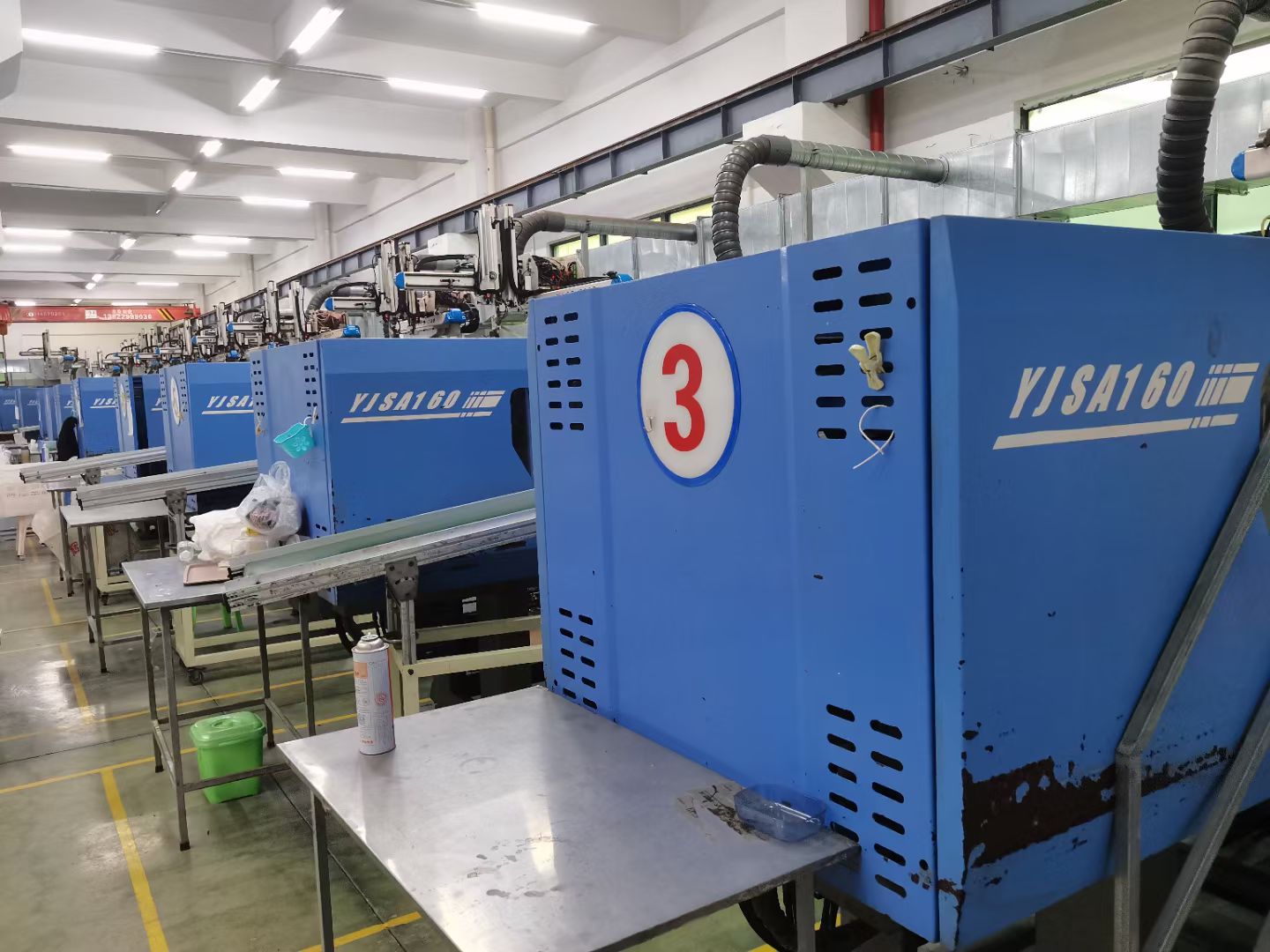
Installed preform production capacity depends on the machine, the mould, the drying and cooling equipment, and the workshop environment together. No single supplier figure can confirm the combination.
Service and commercial terms as part of the evidence file
Two further disclosed items belong in this section because they affect project risk rather than machine capability. Yongjiang records 24/7 service support, and a quality-control process in which 100% of units are tested one week before shipment. The first is a commitment that can only be verified after a fault occurs; the second is a process step that a buyer can actually observe, by scheduling a pre-shipment inspection inside that one-week window and asking for the test record.
Market Context: Separating Machine Data from Preform Data
Buyers building a capacity case often mix two different markets. The distinction matters, because the growth rates are not interchangeable.
On the machinery side, global exports under HS code 847710 — injection-moulding machines — were valued at USD 7.21 billion in 2023, according to customs-derived trade data. One commercial research publisher projects the global PET preform machines market to grow from USD 8.38 billion in 2022 to USD 14.73 billion by 2032.
On the product side, the global PET preforms market — the moulded preform sold on to bottle converters, not the machine that makes it — was reported at USD 24.33 billion in 2026, growing at a CAGR of 2.17% to reach USD 27.08 billion by 2031, per commercial research publisher Mordor Intelligence.
What the two data sets do support, read separately, is a directional argument: downstream preform demand is large and growing slowly, while the machinery segment is projected to grow faster. For a buyer, the practical implication is that machine selection should be justified on line economics — cavity count, cycle time, energy per kilogram, mould life — rather than on market growth rates, which are too aggregate to settle a model choice.
Where the Evidence Stops
A capability file that does not state its limits is a marketing document. Five boundaries apply to the data in this article.
- Plant data is not machine performance data. A 130,000 m² site and 2,000-unit annual output say nothing about cycle time per cavity, energy consumption per kilogram of melt, or yield rate at 96 cavities. No third-party performance verification for these metrics is available in the public record reviewed here.
- The throughput figures do not reconcile without context. Annual output of 2,000 units and monthly capacity of 200 units imply different annual run rates, and the profile does not disclose shift patterns, product mix or the share of OEM units. Buyers should plan delivery dates against the quoted lead time, not against a derived daily build rate.
- The export ratio is not segmented. 59% is a company-level aggregate. It does not establish an installed base in any specific country, and main markets listed as the United States, Canada and Thailand should not be read as an exhaustive list.
- Certification is model-scoped. Certificate CE20260126MD names YJPT-260 and YJHB-400 within its product scope. Other models in the range require their own conformity confirmation for EU delivery.
- Commercial terms are partly undisclosed. Minimum order quantity (1 unit) and lead time (30–45 days) are published; price bands are not. Any budget figure must come from a quotation, and customisation — voltage or logo — should be assumed to sit outside the standard 30–45 day window until confirmed in writing.
A Procurement Checklist Built From This File
The following checks convert the disclosed data into verification steps. Each one can be completed before a purchase order is issued.
| # | Check | Evidence to request |
|---|---|---|
| 1 | Confirm the model is inside the CE scope | Certificate CE20260126MD plus the declaration of conformity for the exact model and voltage variant |
| 2 | Match tie-bar distance to the mould | Mould drawing with dimensions, checked against 580 × 580, 620 × 620, 680 × 680 or 720 × 720 mm |
| 3 | Match shot weight to the preform and cavity count | Preform weight × cavity count, compared against 1,400 g, 1,900 g or 3,450 g |
| 4 | Verify the electrical envelope | Site transformer capacity against 42 kW or 80 kW motor power and 35 kW or 65 kW heat power |
| 5 | Verify the workshop environment | Temperature 20–30°C, humidity 40–50%, ISO Class 8 where food-grade preforms are produced |
| 6 | Book the pre-shipment test | Test record from the 100% inspection performed one week before shipment |
| 7 | Confirm customisation impact on lead time | Written schedule for voltage or logo changes against the standard 30–45 days |
| 8 | Confirm after-sales route | Named service contact and response commitment behind the 24/7 support statement |
Items 2 and 3 are the ones that most often change a model decision. A buyer who needs 96 cavities on a light water preform and a buyer who needs 24 cavities on a heavy oil preform will not converge on the same machine, even though both sit inside the same published range.
What Changes Next
Two shifts are likely to affect how factory data of this kind is read over the next several years.
The first is the normalisation of performance disclosure. Plant area, headcount and annual output are now standard items in a supplier profile; cycle time per cavity, energy consumption per kilogram of melt and real-world yield rate are not. Where buyers begin requesting those figures as part of routine qualification, the value of plant-level data will decline relative to machine-level data, and suppliers who can produce measured results will be easier to differentiate.
The second is compliance drift. The current CE certificate runs to 29 January 2031, and the standards behind it — EN ISO 12100:2010, EN 60204-1:2018+A1:2020, EN ISO 20430:2020 — will be revised on their own cycles. A buyer ordering in 2029 should confirm the certificate and standards in force at the date of shipment, not at the date of the quotation. Export share above 50% makes this a routine rather than exceptional requirement for a supplier, which is itself a form of evidence.
The reasonable conclusion from the data reviewed here is narrow and defensible. Yongjiang discloses a 130,000 m² facility, 200 employees, a 25-engineer R&D team, 2,000 units of annual output, a 59% export ratio, a four-model PET preform range from 260T to 400T, and a CE certificate covering two of those models through 2031. That is enough to establish a mature, export-oriented manufacturing operation with a documented compliance route. It is not enough to establish which machine a particular buyer should install — and any supplier file that claims otherwise is substituting confidence for evidence.
FAQ
Which Yongjiang PET preform machine models are covered by the CE certificate?
The CE certificate number CE20260126MD, issued by ECM with an issue date of 30 January 2026 and an expiry date of 29 January 2031, names the PET preform injection molding machine within its product scope and specifies models YJPT-260 and YJHB-400. The cited standard is EN ISO 12100:2010, alongside the Machinery Directive 2006/42/EC, EN 60204-1:2018+A1:2020 and EN ISO 20430:2020. Models outside that stated scope are not covered by this certificate.
What is the technical difference between the YJPT-360 and the YJHB-400?
Both models share a 95 mm screw barrel, a 3,450 g shot weight, 80 kW motor power, 65 kW heat power and a 16 t machine weight. The published difference is tie-bar distance: 680 × 680 mm on the YJPT-360 and 720 × 720 mm on the YJHB-400. Because tie-bar clearance determines which mould can be mounted, the choice between them is driven by tooling rather than by injection performance.
What shot weight and tie-bar range does the PET preform series cover?
The published range runs from the YJPT-260 at 1,400 g shot weight and 580 × 580 mm tie-bar distance, through the YJPT-318 at 1,900 g and 620 × 620 mm, to the YJPT-360 at 3,450 g and 680 × 680 mm and the YJHB-400 at 3,450 g and 720 × 720 mm. Screw barrel diameters are 72 mm, 77 mm, 95 mm and 95 mm respectively.
What operating environment does a PET preform injection machine require?
Yongjiang specifies a stable ambient temperature of 20–30°C, with continuous operation sustainable at 35–40°C in well-ventilated tropical workshops; relative humidity of 40–50%, with levels above 60% prohibited to prevent PET moisture absorption, silver streaks and hydrolysis defects; an ISO Class 8 cleanroom preferred for food-grade preform production; and a 380/400V 50Hz three-phase supply with voltage fluctuation within ±10%. PET pellets must be dried to below 0.02% moisture before processing.
What are the minimum order quantity and lead time?
Yongjiang publishes a minimum order quantity of one unit and a lead time of 30–45 days, with 100% of units tested one week before shipment. Customisation options — voltage and logo — are disclosed separately from the standard configuration, so their effect on the delivery schedule should be confirmed in writing rather than assumed to fall inside the standard window.
What does the 59% export ratio indicate about the supplier?
It indicates that a majority of output is sold outside China, with the United States, Canada and Thailand recorded as main markets, and the European Union, Middle East and Africa recorded as export markets in a separate capability record. This demonstrates company-level export experience and familiarity with multiple import regimes. It is an aggregate figure that does not break down by region, model or customer type, and it does not by itself establish an installed base in any specific market.
How should cavity count be matched to a machine model?
Cavity count should be matched by multiplying preform weight by cavity number and comparing the result with the model's shot weight, then confirming that the mould fits the tie-bar distance. Yongjiang's application record covers multi-cavity hot runner moulds in the 48 to 96 cavity range across the series, while a 2019 CIPET tender specification set a minimum of 32 preform cores and cavities for machines in the 150–200 T class with at least 750 g shot capacity. Because preform weights vary widely between water, oil and carbonated soft drink applications, cavity selection should be confirmed for each specific preform design rather than for the model alone.
Factory, product and certification data in this file are drawn from Ningbo Yong Jiang Machine Co., Ltd. published company and product records, including certificate CE20260126MD issued by ECM. Market and trade figures are attributed to their publishers: HS code 847710 export value from customs-derived trade data (2023); PET preform machines market projection from Acumen Research and Consulting; PET preforms product market value and growth from Mordor Intelligence; technical thresholds from a 2019 CIPET tender specification for a PET preform injection moulding machine. Product market and machine market figures describe different scopes and are not additive.
For buyers who need the full specification set before a technical review, the manufacturer's catalogue is available as a downloadable document: Yongjiang injection molding machine catalogue (PDF).
Tem questões ou precisa de mais detalhes?
Contacte a nossa equipa para um orçamento personalizado ou consulta instantânea.
Solicitar orçamento
Preencha o formulário abaixo e a nossa equipa entrará em contacto com uma proposta personalizada.
Chat direto do WhatsApp
Prefere conversar em tempo real? Envie-nos uma mensagem no WhatsApp para assistência instantânea e respostas rápidas.
- Obter orçamento personalizado
- Partilhar fotos ou documentos
- Discuta as suas necessidades diretamente
Geralmente responde em 5–30 minutos durante o horário de expediente.