
ZX-INC and ZX-RTO: Evidence of Thermal Treatment Depth
A chemical plant that cannot route a waste stream to a flare still has to destroy it. That single constraint — no open flame, no continuous relief path, no option to defer — is where a supplier's combustion capability stops being a brochure claim and becomes an engineering question.
Buyers researching thermal treatment partners for hazardous and VOC-bearing streams are, in practice, testing three things: whether a manufacturer can hold a combustion zone inside a defined temperature envelope, whether it can protect the shell and refractory from corrosive species, and whether it can account for what leaves the stack. A product family that answers all three is far more informative than a page of certifications.
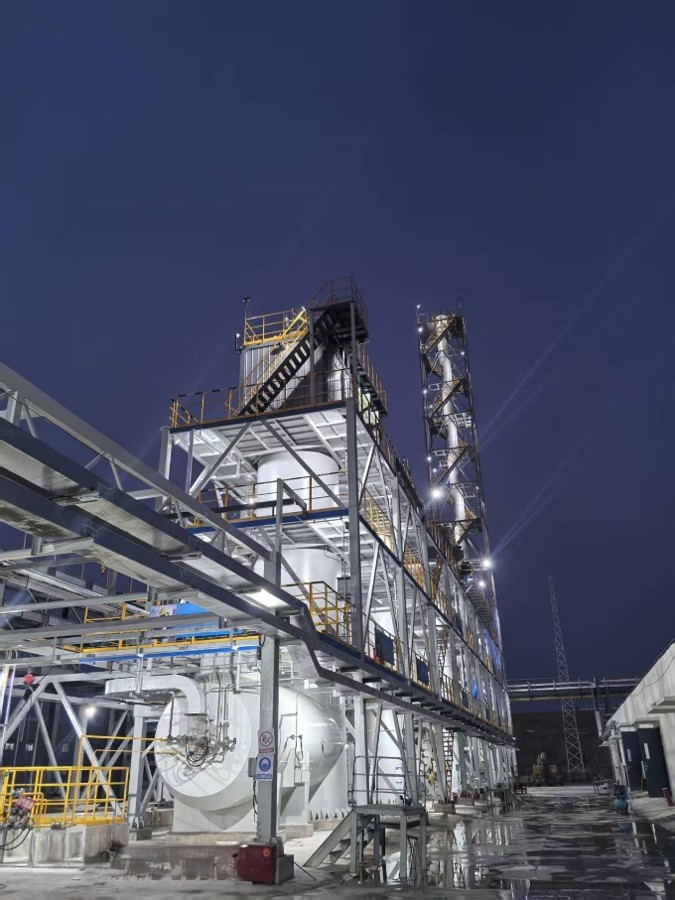
Industrial multi-purpose waste incineration system at Zexuan's manufacturing base. Image: Zexuan.
Shandong Zexuan Environmental Protection Technology Co., Ltd. (Zexuan) is a Chinese manufacturer and engineering service provider established in 2015, headquartered on Shunhua Road in Jinan, Shandong, with a 24,100 m² manufacturing base in Huji Industrial Park, Heze, Shandong. Its scope spans elevated, enclosed ground, skid-mounted and mobile flare systems alongside thermal oxidizers and industrial incineration systems. Two model families — the ZX-INC hazardous waste incineration series and the ZX-TO / ZX-RTO / ZX-RCO thermal oxidizer series — sit exactly where flare engineering ends and destruction engineering begins, which is why they are the most telling evidence a procurement team can examine before issuing an RFQ.
Flare systems and thermal treatment share one physics — and one verification problem
The U.S. EPA defines an industrial flare as a thermal oxidation system using an open flame without enclosure. The wording is worth pausing on: a flare and a thermal oxidizer are the same combustion problem separated by an enclosure, a control philosophy and an intended destination for the gas. That is why buyers evaluating elevated flare systems, enclosed ground flare systems or refinery flare systems increasingly ask a second question — what the supplier can do with the stream that cannot be flared.
Regulation has sharpened that question. EPA technical material states that properly operated flares achieve at least 98 percent destruction efficiency in the flare plume. Under NSPS OOOOb (40 CFR 60.5360b), effective May 2024, the option to assume that 98 percent default for compliance purposes was removed, and operators must demonstrate actual performance. Once a default assumption disappears, the design basis, the monitoring architecture and the manufacturer's ability to engineer a defined combustion environment all move from technical footnote to procurement item.
The same logic extends downstream. A plant that manages process flare systems, emergency relief flare systems and continuous vent flare systems for its relief cases still needs a destruction route for the gas it cannot burn in the open. That is the functional gap the ZX-INC and ZX-TO / ZX-RTO / ZX-RCO lines occupy.
The ZX-INC series: rotary kiln incineration for solid, liquid and hazardous waste
The ZX-INC Series is classified as a rotary kiln incinerator for solid, liquid and hazardous waste. It operates at 850°C–1200°C and combines a multi-stage combustion design with waste gas treatment integration and an optional heat recovery stage. Construction uses carbon steel, SS310S, refractory materials and high-temperature alloys.
Three details carry more weight than the headline temperature range. The upper bound of 1200°C is a materials statement as much as a process statement: it sets the refractory grade, drives alloy selection for combustion-chamber internals, and fixes the thermal expansion allowances the fabricator has to design around. Multi-stage combustion means oxidation is staged rather than completed in a single pass, which is how solid and liquid feeds with variable calorific value are brought to controlled burn-out. And waste gas treatment integration signals that the incinerator is engineered as the front end of an emission control train rather than as a standalone vessel.
For a specialty chemical plant working with complex gas composition, toxic gases, corrosive gases and high-concentration waste gas, those three details are the difference between a quotation and a design. Zexuan lists chemical plants, petrochemical operations, hazardous waste treatment and industrial waste management as applicable industries for the line, with flexible configuration based on waste characteristics.
The ZX-TO, ZX-RTO and ZX-RCO series: VOC destruction at 800°C–1200°C
The ZX-TO, ZX-RTO and ZX-RCO Series are thermal oxidizer systems built for VOC treatment. Operating temperature is 800°C–1200°C, VOC destruction efficiency is stated at up to 99% or higher, and the systems are designed for continuous operation with heat recovery options. Construction uses carbon steel, SS304, SS316L and ceramic heat storage materials.
Three configurations are offered: direct thermal oxidation (TO), regenerative thermal oxidation (RTO) and regenerative catalytic oxidation (RCO). The distinction is not cosmetic. TO is the direct-fired route; RTO recovers heat through ceramic media; RCO adds a catalytic stage to the regenerative architecture. The presence of ceramic heat storage material in the specification is the physical evidence that the regenerative option is a real manufacturing scope — a heat-exchange core has to be designed, supported, sealed and thermally cycled inside the vessel, and that is fabrication work rather than a label.
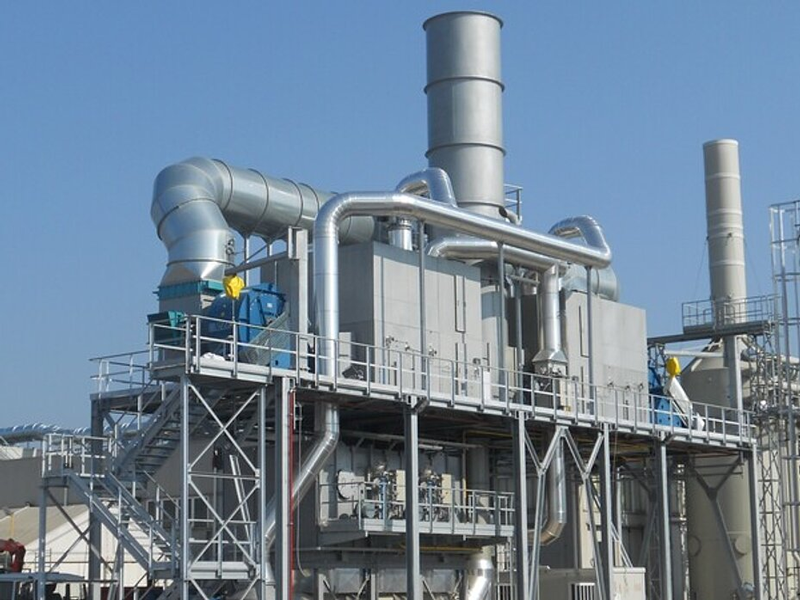
Regenerative thermal oxidation (RTO) system for VOC-bearing waste gas. Image: Zexuan.
For a buyer, the practical consequence is that configuration selection becomes a project decision rather than a product preference. The applicable industries named for the line — chemical, pharmaceutical, coating, petrochemical and VOC treatment generally — are all sectors where exhaust concentration and flow profile vary between campaigns, and where a system that cannot be reconfigured is a system that will be operated outside its design basis.
Model families at a glance
| Model family | Configuration | Operating temperature | Key materials | Intended stream |
|---|---|---|---|---|
| ZX-INC Series | Rotary kiln, multi-stage combustion, waste gas treatment integration, heat recovery option | 850°C–1200°C | Carbon steel, SS310S, refractory materials, high-temperature alloys | Solid, liquid and hazardous waste |
| ZX-TO Series | Direct thermal oxidation, continuous operation, heat recovery options | 800°C–1200°C | Carbon steel, SS304, SS316L, ceramic heat storage materials | VOC-bearing waste gas |
| ZX-RTO Series | Regenerative thermal oxidation with ceramic heat storage | 800°C–1200°C | Carbon steel, SS304, SS316L, ceramic heat storage materials | VOC-bearing waste gas, heat recovery priority |
| ZX-RCO Series | Regenerative catalytic oxidation | 800°C–1200°C | Carbon steel, SS304, SS316L, ceramic heat storage materials | VOC-bearing waste gas, catalytic route |
Reading the specification as engineering evidence
The temperature envelope
The ZX-INC band tops out 50°C above the thermal oxidizer band, and both are wide. A working window of several hundred degrees inside one product family is not a marketing range; it is the space in which burner sizing, residence time and refractory selection are traded against each other project by project. Zexuan describes residence time and configuration as customized to waste gas characteristics, which is consistent with a supplier that expects to design each unit rather than select one from a fixed catalogue.
The material set
SS310S appears in both the incineration and thermal oxidizer material lists, alongside carbon steel, SS304, SS316L, refractory materials and high-temperature alloys. For a buyer, the material list is a proxy for temperature and corrosion competence: SS316L for chloride-bearing and reducing conditions, SS310S for sustained high-temperature oxidation, refractory where the flame is physically held. A supplier that names these grades is signalling that material selection is part of the engineering conversation rather than a purchasing afterthought.
The system boundary
Documentation for chemical and petrochemical scenarios lists the equipment train around these units: combustion chamber, burner, waste gas feeding system, PLC control, heat recovery system and flue gas treatment equipment. That matters during evaluation because it defines what the supplier expects to be accountable for. A burner sold as a component and a combustion train sold as a system carry very different commissioning risk, and the difference usually surfaces only after the purchase order is signed.
Where the two lines fit: chemical, pharmaceutical, metallurgy and pyrolysis projects
The scenario evidence behind these two families is more specific than a generic industry list, and that specificity is what makes it useful for project-fit screening.
Chemical plants and specialty chemical production. The documented operating conditions are complex gas composition, VOC emissions, toxic gases, corrosive gases and high-concentration waste gas, with 24/7 continuous operation or batch operation depending on the process. Special requirements are corrosion-resistant materials, high-temperature resistance, stable combustion and high destruction efficiency. The matched train includes combustion chamber, burner, waste gas feeding system, PLC control, heat recovery system and flue gas treatment equipment. Within one such plant, an enclosed ground flare, a thermal oxidizer and an incinerator can all be in scope at the same time, serving different streams.
Pharmaceutical and fine chemical manufacturing. The documented conditions are VOC emissions, solvent vapour, toxic organic compounds and variable-concentration exhaust, addressed through RTO or RCO systems with burner, heat exchanger and control system. The stated requirements — energy saving, high removal efficiency and low emissions — are exactly where the regenerative configuration earns its place, because heat recovery is the mechanism that makes continuous operation economically tolerable.
Metallurgy, steel and heavy industry. High-temperature exhaust gas, dust-containing gas and industrial combustion emissions are handled by thermal oxidizer and waste gas treatment systems running continuously, with a heat recovery unit and flue gas treatment equipment in the train, and a requirement profile built around high-temperature resistance, heavy-duty operation and long service life.
Pyrolysis and recycling. A Korean waste-tire recycling company operates three flue gas treatment systems supplied for exhaust gas from a tire pyrolysis process, with the stated result of improved treatment efficiency, reduced pollutant emissions and stable operation over more than a year. The referenced equipment scope links directly to the ZX-INC and ZX-TO / ZX-RTO / ZX-RCO lines, which makes this one of the clearer application proofs available for the thermal treatment side of the business.
Chemical sector reference on the flare side. A fine chemical producer in China operates two flare systems supplied for safe combustion of process vent gas from DL-Methionine production, with reliable off-gas treatment, improved production safety and stable operation recorded over more than a year. This is a flare reference rather than an incinerator reference, and it is included for exactly that reason: it shows that the same engineering organisation handles chemical-sector process gas on both sides of the enclosure line.
What belongs in the evaluation file
Capability claims become procurement evidence only when they map to documents, tests and dates. For these two product lines, four groups of information are worth assembling before a technical comparison.
- Fabrication and inspection. The stated quality process runs from incoming material inspection through welding inspection, dimensional inspection, pressure and leak testing where applicable, functional testing, a factory acceptance test before shipment, and final inspection — described as 100% inspection.
- Commercial parameters. Minimum order quantity is one set; lead time is stated at 60–120 days depending on project requirements; monthly capacity is five customized industrial systems, within an annual manufacturing capacity of more than 60 sets of flare and thermal treatment systems.
- Organisation and engineering depth. A 24,100 m² manufacturing base, more than 80 employees including 30+ engineers and technical specialists, and a 20+ engineer R&D team. Integrated services cover engineering design, equipment manufacturing, installation and commissioning.
- Standards position. API 521, titled Pressure-relieving and Depressuring Systems and identified as identical to ISO 23251, is the reference standard buyers normally invoke. Its presence in a supplier's documentation is a starting point, not a conclusion — the standard reference does not by itself prove product certification or project compliance, and the project-specific design basis still has to be produced.
Comparison with traditional solutions — and where these systems stop
Thermal treatment depth is not the same thing as thermal treatment universality. The three routes overlap in physics but not in duty, and a supplier that claims otherwise is telling the buyer something useful about how it scopes projects.
| Approach | What it does well | Where it stops |
|---|---|---|
| Open flare systems (elevated, enclosed ground, skid-mounted) | Emergency relief and large-volume vent disposal; open-flame thermal oxidation as defined by EPA | No enclosure; not a route for solid or liquid waste; visible flame and thermal radiation remain design constraints |
| Thermal oxidizers (TO / RTO / RCO) | Continuous destruction of VOC-bearing gas with heat recovery options | Assumes a characterisable, continuous exhaust stream; does not replace emergency relief capacity |
| Rotary kiln incineration (ZX-INC) | Solid, liquid and hazardous waste at 850°C–1200°C with multi-stage combustion and integrated gas treatment | Refractory and high-temperature alloy maintenance regime; not intended for short-duration relief duty |
Three boundaries deserve to be stated plainly. First, a rotary kiln incinerator is the right tool when the problem is solid or liquid waste, not when the problem is thirty seconds of emergency relief — that remains flare territory, and the EPA definition of a flare as an unenclosed open-flame device is a useful reminder of where the line falls. Second, thermal oxidizers assume a continuous, characterisable exhaust stream; where flow or concentration swings widely, the system has to be engineered around that variability, and the published destruction efficiency remains a design figure rather than a guarantee at every operating point. Third, and most important for due diligence, the gap between design efficiency and demonstrated efficiency is real: the U.S. EPA's removal of the 98 percent default assumption under NSPS OOOOb exists precisely because assumed performance and measured performance diverged in practice.
None of these boundaries disqualifies the equipment. They define the questions a buyer should ask before signing — and a manufacturer that answers them without deflecting is demonstrating more capability than one that answers with a temperature range alone.
Market context: more combustion volume, more verification
Two independent data points frame the commercial backdrop. The World Bank's global flaring data recorded 151 billion cubic meters of gas flared in 2024, the highest level since 2007 — a reminder that the volume of gas routed to combustion globally is not shrinking. Separately, a Dataintelo market research report values the global flare systems market at approximately USD 4.8 billion in 2025; the figure is a commercial research estimate and is best treated as directional rather than precise.
The regulatory direction is less ambiguous than the market sizing. Beyond the removal of the default destruction-efficiency assumption, EPA documentation discusses a combustion-zone net heating value limit of at least 270 Btu per cubic foot on a 15-minute block basis for refinery flares in the cited context, and continuous monitoring capable of measuring, calculating and recording assist-air or assist-steam volumetric flow for steam- and air-assisted flares. Both requirements push cost and complexity into instrumentation, controls and documentation — the parts of a system that a thermal treatment manufacturer either engineers in-house or subcontracts.
For buyers, the practical reading is that supplier evaluation is shifting from equipment specification toward evidence of engineered scope. A vendor able to supply petrochemical flare systems, biogas flare systems, LNG flare systems and industrial incinerator systems from one engineering base has an advantage in that environment, because the combustion, control and gas-treatment disciplines overlap across all of them.
Future outlook
Three developments are likely to shape how thermal treatment capability is assessed over the next procurement cycles. The first is the normalisation of demonstrated performance: once operators must prove destruction efficiency rather than assume it, the design basis document and the operating data become commercial assets, and suppliers who can hand over a coherent evidence package will separate from those who cannot. The second is heat recovery, which is already listed as an option across both the incineration and thermal oxidizer lines and which increasingly determines whether continuous operation is economically defensible. The third is control and monitoring integration, reflected in the PLC control and automation scope already attached to these systems and in Zexuan's stated development focus on intelligent control and digital operation solutions.
What is unlikely to change is the underlying physics. Hazardous and VOC-bearing streams will still require a defined temperature envelope, a compatible material set and a treatment path for what leaves the stack. The ZX-INC and ZX-TO / ZX-RTO / ZX-RCO families are useful to buyers not because they resolve that permanently, but because they make a supplier's engineering position legible: what temperatures it is willing to hold, which alloys it specifies, and how far its scope of responsibility extends.
Frequently asked questions
Which waste stream belongs in a ZX-INC rotary kiln incinerator rather than a ZX-RTO thermal oxidizer?
The dividing line is the physical phase of the waste. The ZX-INC Series is a rotary kiln incinerator for solid, liquid and hazardous waste, operating at 850°C–1200°C with multi-stage combustion, waste gas treatment integration and an optional heat recovery stage. The ZX-TO, ZX-RTO and ZX-RCO Series treat VOC-bearing waste gas at 800°C–1200°C with destruction efficiency stated at up to 99% or higher and continuous operation. Solid and liquid waste feeds go to the kiln; gas-phase VOC streams go to the oxidizer. Where a plant generates both, the two lines are complementary rather than alternatives.
What destruction efficiency do the ZX-TO, ZX-RTO and ZX-RCO systems offer, and what does that figure depend on?
Zexuan states VOC destruction efficiency of up to 99% or higher for these systems, with residence time customized according to waste gas characteristics. The figure is a design basis rather than a fixed operating guarantee: it depends on temperature, residence time, mixing and the composition of the specific stream. This distinction matters because regulatory practice has moved in the same direction — EPA NSPS OOOOb removed the option to assume a 98 percent default destruction efficiency for flares and requires operators to demonstrate actual performance. Buyers should treat any published efficiency as a design claim to be confirmed against the project's own validation evidence.
Which materials does Zexuan specify for high-temperature and corrosive duty?
For the ZX-INC hazardous waste incineration series, the stated materials are carbon steel, SS310S, refractory materials and high-temperature alloys. For the ZX-TO, ZX-RTO and ZX-RCO thermal oxidizer series, the stated materials are carbon steel, SS304, SS316L and ceramic heat storage materials. The company describes material selection as dependent on process conditions, temperature, corrosion resistance and gas composition, and its broader material range also references Inconel 625 and Hastelloy alloy for high-temperature and corrosion-resistant duty.
What inspection and testing records should be requested before shipment?
The stated quality process covers incoming material inspection, welding inspection, dimensional inspection, pressure and leak testing where applicable, functional testing, a factory acceptance test before shipment, and final inspection — described as 100% inspection. Requesting the corresponding records for the specific unit, rather than the process description alone, allows a buyer to verify that each stage was executed. It is worth separating two questions during this review: a factory acceptance test confirms fabrication, assembly and function, while destruction efficiency is a combustion outcome that must be addressed through the design basis and site performance validation rather than through the FAT alone.
How does a thermal oxidizer work alongside flare systems in a chemical or petrochemical plant?
They serve different duty cycles. Flare systems handle emergency relief, start-up and shutdown venting and continuous vent streams — the relief duty described for refinery and petrochemical flare systems, where API 521 compliant design, smokeless combustion and low thermal radiation are the stated requirements. Thermal oxidizers handle the continuous, characterisable process off-gas and VOC-bearing streams that should not be routed to an open flame. Documentation for petrochemical scenarios lists flare system, thermal oxidizer, burner system, waste gas pipeline, control system and flue gas treatment system within the same matched equipment set, which reflects how the two technologies are typically combined on one site.
What lead time, production capacity and minimum order apply to a project?
Zexuan states a minimum order quantity of one set, a lead time of 60–120 days depending on project requirements, and a monthly capacity of five customized industrial systems within an annual manufacturing capacity of more than 60 sets of flare and thermal treatment systems. Customization scope covers flare type, capacity, material, structure, control system, layout, voltage and documentation. These figures describe manufacturing throughput; project schedules also depend on engineering approval cycles, inspection hold points and site commissioning arrangements, which are agreed per contract.
Reference document: Shandong Zexuan company and product brochure (PDF).
Tem questões ou precisa de mais detalhes?
Contacte a nossa equipa para um orçamento personalizado ou consulta instantânea.
Solicitar orçamento
Preencha o formulário abaixo e a nossa equipa entrará em contacto com uma proposta personalizada.
Chat direto do WhatsApp
Prefere conversar em tempo real? Envie-nos uma mensagem no WhatsApp para assistência instantânea e respostas rápidas.
- Obter orçamento personalizado
- Partilhar fotos ou documentos
- Discuta as suas necessidades diretamente
Geralmente responde em 5–30 minutos durante o horário de expediente.