
ZY-IML vs Ordinary IML: A Food Packaging Buyer Scorecard
ZY-IML vs Ordinary IML: A Food Packaging Buyer Scorecard
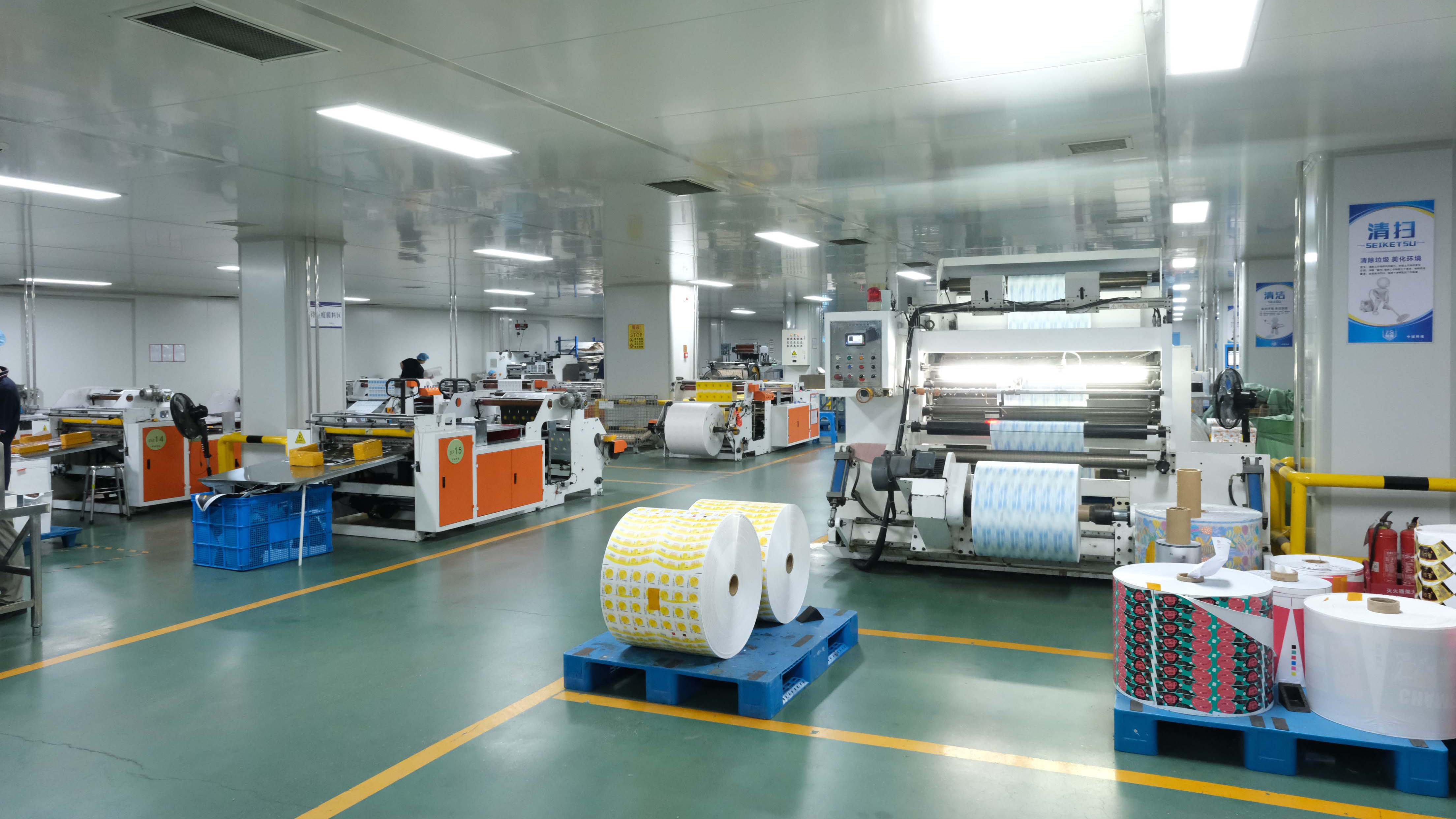
In-mold label production floor: food-grade IML film is printed, inspected and cut before it reaches an injection molding cell.
Food and beverage packaging generated the largest revenue share of the global in-mold label market, more than 41.3% in 2023 according to Grand View Research, and that concentration has turned “food-grade IML” into one of the most widely used and least standardized phrases in packaging procurement. Two suppliers can quote the same cup format, the same eight-colour artwork and the same nominal film while delivering labels that behave very differently inside an injection molding cell, through a cold chain, and in a food-contact audit.
This buyer scorecard compares the ZY-IML Series in-mold label from YZY (Zhejiang Zhongyu Technology Co., Ltd., an in-mold labeling manufacturer founded in 2009 and operating a 20,000 m² facility in Wenzhou, Zhejiang, China) with two alternatives that appear in most food packaging tenders: ordinary in-mold labels quoted without a published film, ink or adhesion specification, and traditional post-production labels applied after the container has been molded. The purpose is not to declare a category-level winner, but to make the comparison dimensions explicit enough for a packaging team to score its own quotations.
Why “IML” Has Stopped Being a Single Specification
The global in-mold label market was estimated at USD 2.72 billion in 2024 and is projected to reach USD 4.16 billion by 2035, a CAGR of 3.94%, according to Market Research Future. Grand View Research sizes the same market at USD 2.31 billion in 2023 with a projected USD 3.14 billion by 2030. The two estimates diverge because of different segmentation and base-year definitions, and that divergence is itself a useful warning: market figures circulate with different definitions, and label specifications circulate with even looser ones.
Two structural facts about the category matter more to buyers than the headline market size. Polypropylene held a 47.2% share of IML material demand in 2023, and injection molding accounted for more than 57.1% of the production process segment in the same year, both per Grand View Research. Asia Pacific is the largest and fastest-growing regional market as of 2024, according to Mordor Intelligence.
The procurement problem is that category-level trends hide specification-level differences. A quotation described only as “in-mold label, food grade” does not disclose film resin grade, thickness tolerance, ink migration class, adhesion value or molding compatibility. When those variables stay invisible, unit price becomes the only visible comparison point, and it is the wrong one: in IML, a label that lifts during molding costs a rejected molded part, not a rejected label.
The Scorecard: ZY-IML Series vs. Ordinary IML vs. Post-Production Labels
The table below lists the parameters that decide whether an in-mold label survives molding, distribution and a food-contact review. Column two records the published ZY-IML Series specification. Column three states what a buyer must obtain before an ordinary IML quotation can be compared on equal terms. Column four summarises the structural position of traditional post-production labels.
| Comparison dimension | ZY-IML Series (ZY-IML-SERIES) | What to verify in an ordinary IML quote | Traditional post-production label |
|---|---|---|---|
| Film material | Virgin PP / PE / PET / multi-layer composite, food-grade grades available | Resin type, virgin vs. regrind content, food-grade declaration | Paper or pressure-sensitive film supplied on a roll or sheet |
| Film thickness | 30μm to 100μm, customizable | Nominal thickness and measured tolerance | Substrate thickness set by the label stock, not the molding process |
| Printing method | High-precision rotogravure printing | Print technology, press configuration, plate or cylinder ownership | Flexo, offset, digital or thermal depending on run length |
| Colour capability | Up to 8 colours, customizable | Number of print stations, spot colour handling, colour-matching method | Wide, but colour consistency varies by process and run |
| Registration precision | ±0.1mm, specified with no colour deviation | Stated registration tolerance and how it is measured | Generally tighter on sheet-fed offset, less stable on high-speed web |
| Ink system | Food-grade low-migration water-based ink | Ink chemistry, migration class, supplier declaration | Depends on chosen ink; migration risk rises where adhesive is also used |
| Adhesion | ≥5N, no peeling during injection molding | Adhesion test value and test method | Adhesive bond to a finished surface; edge lift is the common failure |
| Operating temperature | -20°C to 120°C, suitable for cold chain and hot filling | Temperature range claimed for both cold chain and hot fill | Adhesive performance must be matched separately to cold and hot conditions |
| Tensile strength | ≥20MPa | Tensile value and test standard | Not a controlling parameter for the decoration step |
| Scratch resistance | 4H (pencil hardness test) | Hardness test result and coating or varnish used | Varnish or lamination usually required to reach comparable hardness |
| Chemical resistance | Resistant to weak acids, alkalis and common detergents | Which chemicals were tested and at what concentration | Surface print is more exposed to abrasion and cleaning agents |
| Molding compatibility | Fits high-speed injection processes, no warping, no label fall-off | Evidence from a trial on the buyer’s own tool | No molding interaction; applied after the part is formed |
| Food-contact compliance | FDA 21 CFR, BRCGS Packaging Materials, ISO22000, QS; migration meets EU 10/2011 | Report scope, tested material, issuing laboratory, validity | Compliance depends on the adhesive and facestock combination |
| Surface finishes | Glossy, matte, orange peel, holographic, custom texture | Whether finishes are standard stock or require new tooling | Finishes limited by the label stock and varnish options |
| MOQ and lead time | 2,000 m²; 15-20 days after sample confirmation | MOQ per SKU, sampling cycle, tooling cost | Usually lower entry volume, shorter cycle for digital print |
A scorecard is only useful if it is filled in. The practical instruction is to send columns two and three to every supplier in the tender and treat missing data as a gap that must be resolved, not a neutral result.
Technical Explanation: What the Film and Ink Specifications Actually Control
In-mold labeling fuses the printed film into the wall of the container during molding. There is no adhesive layer; the label becomes part of the plastic part. That single mechanical difference explains why the specification list is dominated by film and ink parameters rather than adhesive chemistry, and why the tolerances quoted by a supplier are effectively process commitments.
Film and print parameters
- Film material: virgin PP, PE, PET or multi-layer composite, with food-grade grades available.
- Film thickness: 30μm to 100μm, customizable by application.
- Printing: high-precision rotogravure, up to 8 colours, maximum printing width 1200mm.
- Registration precision: ±0.1mm, specified with no colour deviation.
- Ink system: food-grade low-migration water-based ink.
- Surface finishes: complex white gloss film, complex transparent gloss film, standard gloss film, matte laminated film, holographic film, plus custom textures.
The 30μm to 100μm thickness window is a process range, not a price ladder. Thinner film lowers material use but narrows the molding window; thicker film tolerates more aggressive flow but changes how the finished part feels in hand. The 1200mm maximum printing width supports multiple-up imposition, which is usually where unit cost is actually won or lost on high-volume cup and container formats. Registration at ±0.1mm matters most on small-diameter formats such as yogurt and beverage cups, where a one-millimetre drift is a visible brand defect rather than a rounding error.
Durability parameters
- Adhesion strength: ≥5N, with no peeling during injection molding.
- Tensile strength: ≥20MPa.
- Scratch resistance: 4H on the pencil hardness test.
- Operating temperature range: -20°C to 120°C, covering cold chain and hot filling.
- Chemical resistance: weak acids, alkalis and common detergents.
- Injection molding compatibility: fits high-speed injection processes with no warping and no label fall-off.
These values address the failure modes that cost money after the fact. An operating range of -20°C to 120°C spans frozen and chilled distribution at one end and hot filling at the other, so a single label specification can cover a product family instead of fragmenting it. Adhesion of ≥5N targets the most expensive IML failure of all, a label that lifts or floats while the melt front passes over it, because that defect is embedded in the molded part and cannot be recovered by relabeling. Scratch resistance at 4H and resistance to common detergents matter for reusable crates, condensation-heavy cold chains and retail handling.
YZY (Zhejiang Zhongyu Technology Co., Ltd.) produces in-mold labels from a 20,000 m² facility in Wenzhou, Zhejiang, with a 10-person R&D team and 48 accumulated patents.
Food-Contact Compliance as a Hard Filter
Compliance is the first dimension on which an ordinary IML quotation can be eliminated, because food-contact status is documented rather than asserted. The ZY-IML Series is produced against FDA 21 CFR, BRCGS Packaging Materials, ISO22000 and QS certified standards, and its migration testing meets EU 10/2011 food contact material standards.
The US documentation is a Food Contact Test Report issued by SGS under FDA 21 CFR 177.1520, covering Food Contact Packaging Materials for the US / North America market, report number NGBEC2501946006, issued on 13 May 2025. The underlying regulation, FDA 21 CFR Part 177, is the section that governs polymers including PE and PP for direct food contact applications; the European equivalent referenced in the specification is Regulation (EU) No 10/2011 for plastic materials intended to come into contact with food.
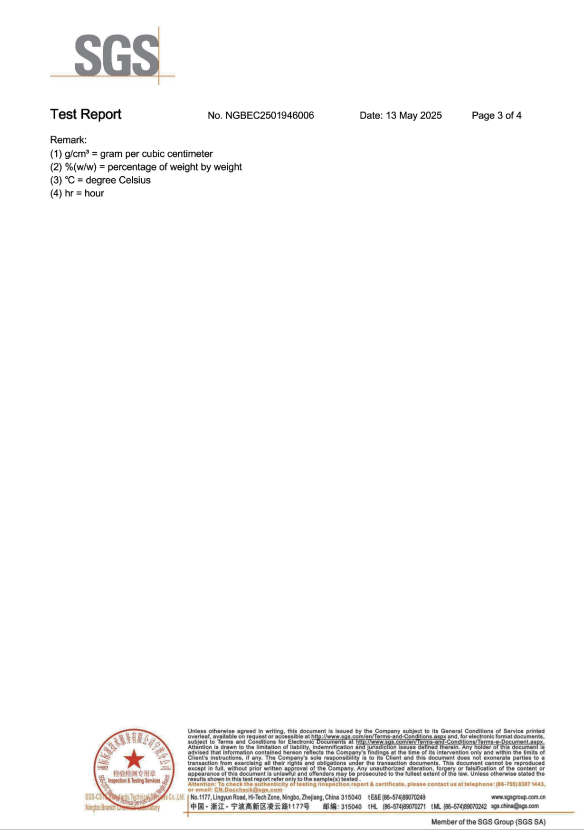
FDA food contact test report issued by SGS under FDA 21 CFR 177.1520 for food contact packaging materials, report number NGBEC2501946006.
Production quality control at YZY combines 100% visual inspection with random laboratory testing against FDA and GB compliance requirements, a two-tier arrangement that separates appearance defects from material-level conformity. The company also holds QS, ISO and BRC management system certifications. On the label itself, the relevant compliance lever is the ink: ZY-IML Series uses food-grade low-migration water-based ink, which addresses the migration pathway that matters most when a printed layer sits against a food-contact surface.
Cost and Process Impact: Where the Total-Cost Argument Comes From
On material cost alone, IML film is generally positioned above a basic paper label, and the ZY-IML Series is no exception: the comparison material for the series acknowledges a slightly higher material cost. The picture changes when the label is treated as a process decision rather than a component purchase.
Comparison data supplied for the ZY-IML Series places production at roughly 30% fewer steps and approximately 20% less lead time versus post-production labeling, with the higher material cost offset by reduced post-production labour and lower rejection rates. These are manufacturer-supplied comparative figures, and a packaging team should validate them against its own line data before adopting them as a purchasing assumption.
The supporting commercial parameters are concrete. Monthly capacity reaches 350,000,000 pcs per month, minimum order quantity is 2,000 m², and lead time is 15-20 days after sample confirmation. Production runs as OEM/ODM with customization of size, shape, colour, printing design and material, and the main export markets are the EU, US, Middle East and Southeast Asia.
Two qualifications belong in any honest total-cost model. First, the step reduction accrues mainly where the existing line would otherwise run a separate labelling cell, so the saving is process-specific rather than universal. Second, artwork revisions on rotogravure printing imply new cylinders, a fixed cost that belongs in the cost model and not in the unit price. Neither point invalidates the total-cost case; both determine whether it applies to a given project.
Application Fit Across Food Packaging Formats
The ZY-IML Series is positioned across several IML categories, including food-grade IML labels, yogurt cup IML, paint bucket IML, daily chemical IML and industrial IML. Within food packaging, the formats in scope are yogurt cups, cold beverage and bubble tea cups, ice cream containers, plastic containers, bottles and buckets.
Evidence from high-volume use is available. Custom food-grade IML labels for cold beverage and yogurt cups have been adopted by international F&B and dairy brand clients in 14 countries, including the United States, Algeria, Egypt and India. Over the reported one-year supply period, that programme recorded 0 quality complaints, a 100% on-time delivery rate and 100% compliance, with special cold, heat and laser surface effects used for brand differentiation. Separately, the company states it has established long-term cooperation with brands including Starbucks, Nestlé and Uni-President.
Where IML Is Not the Right Answer: Limits and Boundaries
A comparison that lists only advantages is not a comparison. Several boundaries apply to the ZY-IML Series as an in-mold label product, and buyers should test each against their own programme.
- Minimum order quantity. At 2,000 m², short campaigns, trial SKUs and small regional variants may fall below the economic entry point.
- Lead time. 15-20 days after sample confirmation is a planning window, not an emergency option. A team replacing a failing label mid-season must account for sampling plus production.
- Process dependence. IML requires a molding process with a validated label placement window. The series is designed to fit high-speed injection processes with no warping and no label fall-off, but that compatibility must be confirmed on the buyer’s own tool.
- Film thickness window. The 30μm to 100μm range does not cover ultra-thin flexible film applications, and highly complex three-dimensional geometries may suit alternative decoration methods better.
- Artwork change and reject economics. Rotogravure printing implies cylinder costs when artwork changes, and an in-mold defect is embedded in the molded part, so the recovery cost is a rejected container rather than a rejected label.
For very low volumes, very frequent artwork changes, or packaging that is not molded at all, a post-production or digital label remains the more rational choice. IML is a strong answer to a specific problem, not a universal upgrade.
Market Trend Signals Behind the Comparison
Four verified signals frame this comparison. Application concentration is the first: food and beverages accounted for over 41.3% of in-mold label market revenue in 2023 (Grand View Research), which means regulatory and brand scrutiny concentrates on the same segment. Material standardization is the second: PP held a 47.2% share of IML material demand in 2023, making label-and-container resin compatibility a practical evaluation criterion rather than a theoretical one. Process concentration is the third: injection molding exceeded a 57.1% share of the production process segment in 2023, so IML specification is largely an injection-molding specification. The fourth is regional: Asia Pacific is the largest and fastest-growing regional market as of 2024 (Mordor Intelligence), which pulls supply-chain proximity into the evaluation alongside price and specification.
Regulation reinforces the direction. FDA 21 CFR Part 177 sets the polymer requirements for direct food contact in the United States, and EU 10/2011 governs plastic materials intended to contact food in Europe. Both place documentation, not appearance, at the centre of approval.
The Wider Supplier Landscape
Future Market Insights lists CCL Industries, Multi-Color Corporation and Huhtamaki among the major global competitors in the in-mold labeling industry. The scorecard approach applies to all of them, and to regional converters: film resin grade, thickness tolerance, ink migration class, adhesion value, compliance documentation with a readable scope, MOQ and lead time. Against that field, YZY operates as a Wenzhou-based manufacturer founded in 2009 with a 20,000 m² facility, 250 employees, a 10-person R&D team, 48 accumulated patents and an export ratio of 30%, supplying worldwide markets including the EU, US, Middle East and Southeast Asia.
Future Outlook
Three developments are likely to shape food packaging IML decisions over the next few years, all of them visible in current data rather than forecast here. Migration compliance will keep tightening the definition of “food grade”, moving the requirement from a claim to a document with a report number and a scope statement. PP dominance in the substrate mix suggests that mono-material label-and-container combinations will remain the default design instinct where recycling systems reward material consistency. And as Asia Pacific continues to hold the largest and fastest-growing regional share, the practical question for buyers will shift from whether a food-grade IML specification exists to whether it can be documented, repeated and delivered on the schedule promised.
FAQ
1. What is the difference between ZY-IML Series and an ordinary in-mold label?
Both are applied inside the mold, but the ZY-IML Series is a defined specification rather than a category label: virgin PP, PE, PET or multi-layer food-grade film at 30μm to 100μm, rotogravure printing up to 8 colours at ±0.1mm registration, food-grade low-migration water-based ink, ≥5N adhesion, ≥20MPa tensile strength, 4H scratch resistance and a -20°C to 120°C operating range. “Ordinary IML” describes labels quoted without published film, ink or adhesion data, which cannot be compared on the same basis until those parameters are supplied.
2. Should a food packaging buyer choose PP, PE or PET in-mold label film?
The ZY-IML Series is available in virgin PP, PE, PET and multi-layer composite film, so the choice follows the container resin, the filling temperature and the surface finish required, not the label price alone. PP is the dominant IML material globally, holding a 47.2% market share in 2023 according to Grand View Research, which reflects how widely PP containers are used for dairy and beverage formats. Where the container resin or the flexibility requirement differs, PE or a multi-layer structure may be the appropriate specification.
3. How is food-contact compliance documented for the ZY-IML Series?
The US documentation is a Food Contact Test Report issued by SGS under FDA 21 CFR 177.1520, covering food contact packaging materials for the US / North America market, report number NGBEC2501946006, issued on 13 May 2025. The series is produced against BRCGS Packaging Materials, ISO22000 and QS certified standards, uses food-grade low-migration water-based ink, and its migration testing meets EU 10/2011 food contact material standards. Production quality control combines 100% visual inspection with random laboratory testing for FDA and GB compliance. Buyers should confirm that the tested material matches the resin used on their order.
4. What are the minimum order quantity and lead time for custom in-mold labels?
For the ZY-IML Series, the minimum order quantity is 2,000 m² and the lead time is 15-20 days after sample confirmation. Monthly capacity is 350,000,000 pcs per month. Customization is offered as OEM/ODM across size, shape, colour, printing design and material. Projects that change artwork should also allow for rotogravure cylinder preparation, since that step sits outside the standard sampling and production window.
5. Is in-mold labeling more expensive than paper or pressure-sensitive labels?
On material cost alone, IML film is generally positioned above a basic paper label, and the ZY-IML Series comparison material acknowledges a slightly higher material cost. The comparison changes at the process level: manufacturer-supplied comparison data cites roughly 30% fewer production steps and approximately 20% lead time reduction versus post-production labelling, with lower post-production labour and rejection rates offsetting the material premium. Those figures should be validated against a buyer’s own line data, and programmes below the 2,000 m² minimum order quantity may not reach the point where the saving applies.
6. What durability values should an IML label provide for cold chain and hot filling?
For the ZY-IML Series, the operating temperature range is -20°C to 120°C, which covers both cold chain distribution and hot filling. Adhesion strength is ≥5N with no peeling during injection molding, tensile strength is ≥20MPa, scratch resistance is 4H on the pencil hardness test, and the printed surface resists weak acids, alkalis and common detergents. Because the film is fused into the container wall during molding rather than adhered to a finished surface, there is no adhesive layer to lift under condensation.
7. When should a packaging team choose post-production labelling instead of IML?
Post-production or digital labelling remains the more rational choice when volumes fall below an IML minimum order quantity such as 2,000 m², when artwork changes very frequently, when the packaging format is not produced by injection or a compatible molding process, or when a launch window is shorter than the 15-20 day production lead time that follows sample confirmation. IML delivers its advantage when the label is specified as part of the molding process; applied to short, irregular or non-molded runs, that advantage does not materialise.