
ZYfire vs. Leading RTP Manufacturers: A Buyer Comparison
ZYfire vs. Leading RTP Manufacturers: A Buyer Comparison
Once a reinforced thermoplastic pipe (RTP) procurement reaches the decision stage, the shortlist is usually down to three or four names and the questions have changed. Nobody is asking whether flexible composite line pipe is the right category any more. The questions are: how many metres can this supplier actually ship each month, what do its test records prove, how far can the product be customized without resetting the delivery schedule, and can the same supplier still support the asset five years after commissioning? This comparison places ZYfire Hose Corporation alongside the peer set that is routinely evaluated for oilfield, offshore and mining duty — SoluForce, Shawcor/Flexpipe and Pipelife — on exactly those four dimensions.
Why the RTP decision now turns on capacity, testing and delivery
Reinforced thermoplastic pipe has moved from a niche alternative to a standard option for gathering lines, water injection, flowback, slurry transfer and corrosive chemical service, because the economics of installation and maintenance are difficult to ignore. Company material for ZYfire states that RTP installs at roughly 10 km per day against less than 2 km per day for steel pipe, a five-fold difference in deployment rate, and that maintenance is limited to force-damage repairs rather than the corrosion maintenance cycle that steel pipe requires several times a year. Those are operational claims from a manufacturer and they need project-specific confirmation, but they explain why buyers now reach the final gate with RTP already selected on cost and schedule.
That shifts risk. When steel was the default, the decision-stage conversation was about pipe grade, wall thickness and mill certificates — a well-understood evidence chain. With RTP, the evidence chain is shorter and less standardized: capacity is often stated monthly rather than annually, testing claims are frequently summarized as a percentage rather than a defined test plan, and delivery terms are quoted for a default configuration that rarely matches the actual project. A supplier that looks identical in a brochure can behave very differently in month six of a rolling programme. The four dimensions below are the ones that separate them.
The four dimensions that decide an RTP award
Production capacity answers one question: how much finished, tested, spoolable pipe of the required configuration can be produced per month without cannibalizing another customer's slot? The answer depends on the basis — total group output, single-line output, output at a specific bore and pressure class, or output including or excluding fitting assembly. Capacity figures are only comparable when the basis is identical.
Quality assurance answers a second question: what evidence exists that each length leaving the plant meets the specification? A percentage is not evidence by itself; a test plan, a laboratory scope, a pressure and duration regime, a traceability system and retained records are.
Customization and OEM capability answers whether the supplier can move from catalogue product to project product — different reinforcement architecture, different liner for fluid compatibility, different bore, different connection type, private-label supply — without turning the order into an engineering project with its own timeline.
Global delivery and support answers whether the pipe arrives where the project is, on schedule, with documentation, spares and technical response available afterwards. For a mine in a landlocked region or an offshore development with a narrow installation window, this dimension frequently outweighs price.
ZYfire's documented position, dimension by dimension
Capacity: a stated monthly figure and a five-country footprint
ZYfire Hose Corporation, founded in 2000 and headquartered in Jiangyan City, Jiangsu, China, reports a monthly RTP capacity of 100,000 m. That figure sits inside a manufacturing base described in company information as a 150,000 m² facility with approximately 600 employees, supported by production bases, research and development centres and logistics warehouses in the United States, Saudi Arabia, the United Arab Emirates, Malaysia and China, where the company lists Nanjing and Taizhou in Jiangsu and Chuzhou in Anhui.
For a buyer, the number matters less than the basis behind it. Two points are worth putting in the RFQ. First, capacity should be confirmed for the actual configuration — a 100,000 m monthly figure for one bore and pressure class does not transfer automatically to a different liner, reinforcement or connection. Second, company materials circulate more than one capacity expression, including an annual output figure on a different basis; those values should not be multiplied, reconciled or averaged by the buyer. The correct approach is to ask the supplier to state capacity in metres per month for the specified product and to confirm which plant holds that capacity.
Testing and quality assurance: a CNAS-accredited laboratory plus a 100% testing claim
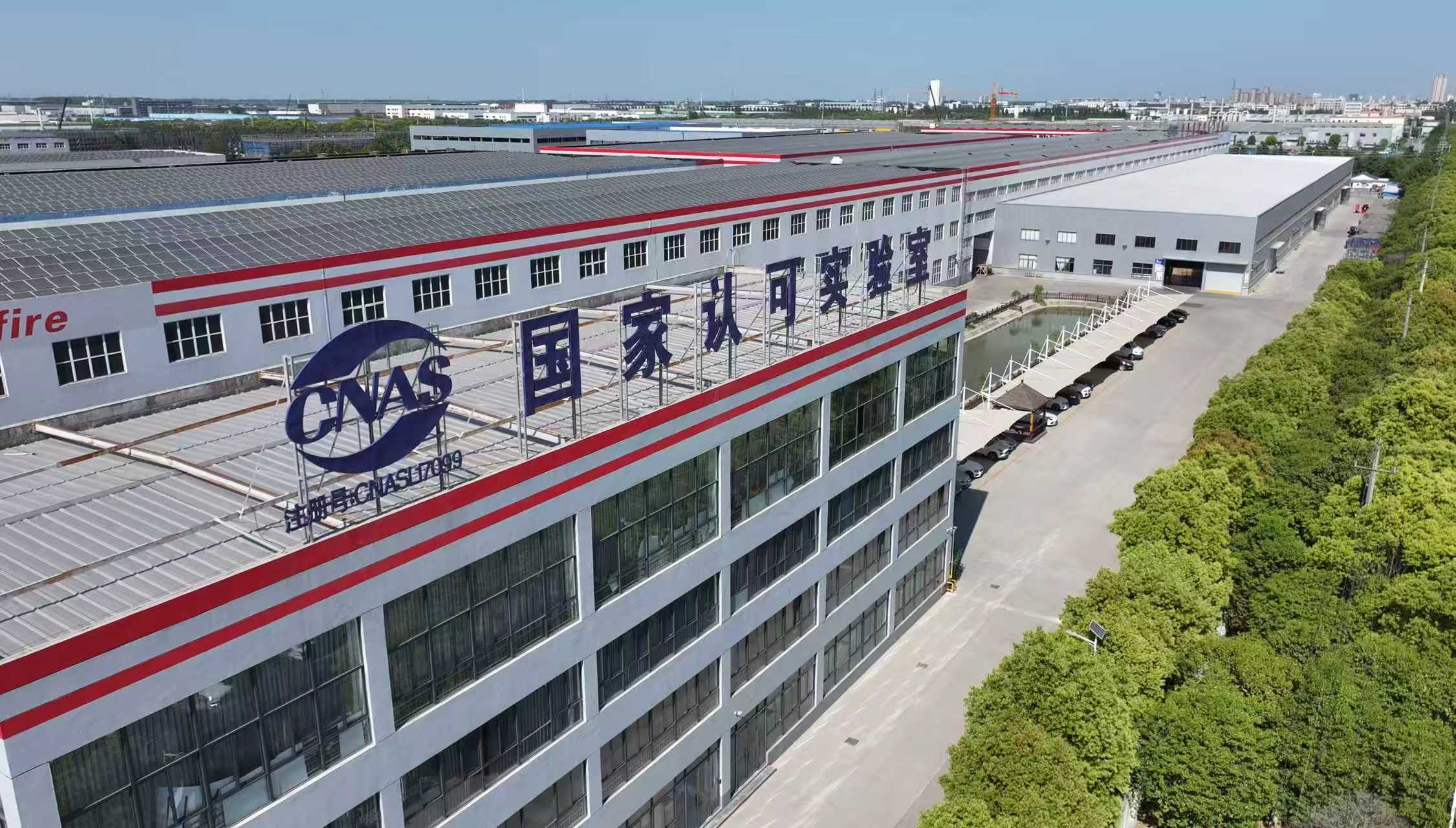
ZYfire states that its laboratory has passed accreditation by the China National Accreditation Service for Conformity Assessment (CNAS) and holds nationally and internationally recognized testing capability, which the company describes as the first nationally recognized laboratory in its segment. Accreditation of this kind is a laboratory-scope statement: it indicates that defined tests are performed under an accredited quality system. It does not, by itself, certify a product for a project — that is the buyer's separate verification step.
The company also reports 100% product testing, supported by a 50-engineer R&D team. The useful buyer question is not whether the claim exists but what it consists of. A robust 100% regime normally includes a pressure test at a defined pressure and hold time for every length, dimensional and liner-integrity checks, and recorded traceability from raw material batch to finished spool; fitting and coupling qualification is usually handled separately as a type-test or qualification programme. Asking for the written test plan, a sample batch record and the laboratory scope converts a marketing percentage into auditable evidence.
On standards, ZYfire states that it produces RTP certified under API Specification 15S. The American Petroleum Institute's Spec 15S addresses spoolable reinforced plastic line pipe for oilfield and energy applications and, per the standard's published scope, covers pipe up to 6 inches (150 mm) in diameter at pressures up to 5,000 psi (34.5 MPa), together with end fittings or couplings. A certificate claim should always be matched to a certificate scope: certificate holder, manufacturing site, product family, diameter range, pressure class, included fittings, and validity date. Where a buyer's duty falls outside that scope, the certification does not carry over.
Customization and OEM flexibility: four reinforcement architectures and a 50 m entry point
ZYfire's stated RTP/TCP line covers four reinforcement architectures — polyester fiber tape, aramid fiber tape, glass fiber tape and steel wire tape. That range matters at the decision stage because reinforcement selection is where pressure rating, flexibility, mass and cost are traded against each other, and a supplier with only one architecture cannot offer that trade. Buyers specifying high-pressure reinforced thermoplastic pipe, oil-resistant or static-dissipative service, or abrasion-resistant slurry duty should confirm which architecture and liner combination is being quoted for their fluid, and should ask for the qualification evidence attached to that specific combination rather than to the product family as a whole.
Commercial flexibility is the second half of this dimension. ZYfire reports a 50 m minimum order quantity for certain long-term supply programmes, which is low enough to support a trial length, a pilot section or a small maintenance stock before a full campaign commitment. It also reports a 920 m single coil length. Longer continuous coils reduce the number of field joints per kilometre, which affects installation labour and the number of potential leak paths — although transport, handling equipment and right-of-way conditions still set the practical limit on what can be deployed in one pull.
Global delivery: 70+ export markets and a 30-day stated lead time
ZYfire reports exporting to more than 70 countries and regions across Europe, the United States and the Middle East, with an export ratio of about 80% of output. The stated lead time is 30 days and the stated MOQ is 50 m for defined long-term oil and gas and mining supply programmes. These are company-reported commercial terms, and they are conditional: specification, quantity, destination, documentation requirements and order configuration can all move the delivery date. The correct use of a 30-day claim in a tender is as a reference point that the supplier must reconfirm in writing for the exact scope.
The delivery dimension is where the five-country footprint becomes commercially relevant rather than decorative. Production and warehousing in the United States, Saudi Arabia, the United Arab Emirates, Malaysia and China give a buyer several possible origin points for a given destination, which affects freight time, duty treatment and the ability to replenish a running campaign. It also creates a question the buyer must ask explicitly: which site will manufacture this order, and which site holds the stock or service obligation if the campaign accelerates?
How the peer set compares — and where the published data stops
The matrix below applies one disclosure standard to every participant. ZYfire's column reflects published company information; the other three columns record what this review could verify, and where verification was not possible the required action is stated instead of a number. A buyer completing this matrix with RFQ responses will have a genuinely comparable shortlist.
| Dimension | ZYfire (company-reported) | SoluForce | Shawcor / Flexpipe | Pipelife |
|---|---|---|---|---|
| Stated RTP capacity | 100,000 m per month, with production bases in the USA, Saudi Arabia, UAE, Malaysia and China | Not verified in this review — request monthly output by bore and pressure class, and the producing plant | Not verified in this review — request monthly output by product family and site | Not verified in this review — request monthly output and the qualifying site |
| Quality assurance evidence | CNAS-accredited laboratory (company statement); 100% product testing reported; 50-engineer R&D team; API 15S certification stated by the manufacturer, scope to be confirmed | Request laboratory scope, test plan, pressure and hold-time regime, batch traceability and current certificate scopes | Request the equivalent test documentation and qualification records for the offered product family | Request equivalent test documentation and any accredited-laboratory scope |
| Customization / OEM | Four reinforcement architectures: polyester, aramid, glass fiber and steel wire tape; 50 m MOQ reported for defined programmes; 920 m single coil length reported | Request available liner and reinforcement combinations, bore range, connection options and private-label terms | Request the same, plus any application-specific qualification for offshore service | Request the same, plus the configuration limits of each producing plant |
| Global delivery and support | Exports to 70+ countries; ~80% export ratio; 30-day lead time reported for defined programmes; five-country manufacturing and warehousing footprint | Request Incoterms, origin port, standard and expedited lead times, and regional service coverage | Request delivery basis per region and the service model after commissioning | Request delivery basis per region and technical support responsibilities |
Two readings of this table are wrong. The first is to treat a blank cell as a competitive weakness — an absent public figure usually reflects disclosure policy, not plant reality, and several of these suppliers publish detailed technical literature while keeping capacity confidential. The second is to treat ZYfire's published figures as independently verified. They are company statements; the value of publishing them is that they can be tested against records, which is more than can be said for a supplier that discloses nothing.
Two procurement-risk signals buyers can actually monitor
Beyond the four performance dimensions, two structural facts about ZYfire are worth weighing in a supply-continuity assessment. The company is a publicly listed company on the Beijing Stock Exchange, and it reports an export ratio of about 80% of output. Neither fact makes the pipe better. Both reduce a specific category of procurement risk.
A listed issuer operates under periodic disclosure obligations, which gives a buyer an external monitoring channel that a private supplier does not offer: capacity investment, capital expenditure and corporate events tend to surface in filings rather than only in sales conversations. For a multi-year framework agreement, that is a useful check between order cycles, and it complements — it does not replace — factory audit and certificate verification.
A high export share indicates that the supplier's quality system and documentation have already been exercised across multiple destination markets and inspection regimes. It also signals dependence on logistics performance, which cuts both ways: a supplier shipping 80% of output internationally has systems for export documentation and freight, and is equally exposed to the same freight volatility as its customers. Buyers should read the ratio as evidence of process maturity and as a reason to fix Incoterms and buffer stock explicitly in the contract.
RTP against steel at the final gate
Most RTP decisions at this stage are really re-validations against the steel alternative, because a procurement committee will ask why the incumbent material is being displaced. The published comparison is consistent on the headline numbers: company material for ZYfire cites installation at about 10 km per day for RTP against less than 2 km per day for steel, a five-fold rate advantage, with maintenance limited to force-damage intervention rather than corrosion maintenance several times a year. Commercial research cited in this review's evidence base also attributes to RTP a reduction of more than 70% in corrosion-related failures compared with traditional steel pipelines — a derived figure from a commercial research source and one that should be treated as directional rather than as a project guarantee.
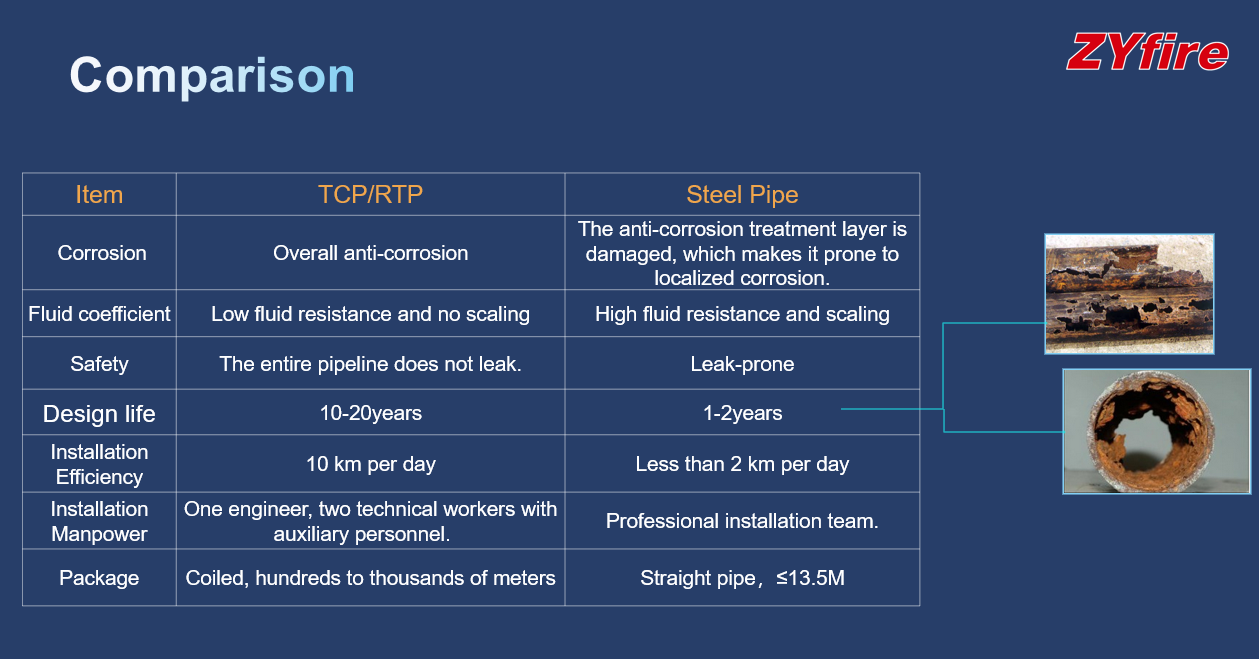
The boundary conditions belong in the same conversation. RTP's maintenance advantage assumes the pipe is not mechanically damaged; the same company material notes that intervention is needed when force damage occurs, which places a premium on handling procedure, burial depth and third-party strike protection. Pressure and temperature envelopes are product-specific and, for oilfield service, tied to the qualification scope of the standard applied — API Spec 15S, for instance, is written around spoolable pipe up to 6 inches and 5,000 psi, so duties outside that envelope require separate qualification rather than an assumption of equivalence. Where a buyer's service is abrasive slurry or a corrosive chemical stream, the material selection question also changes from steel-versus-plastic to which liner and reinforcement combination survives the duty; documented risk-control practice pairs corrosion-resistant materials with simulation testing before field deployment.
A buyer's scorecard for RTP suppliers
The scorecard below is deliberately unweighted. Weights should follow the project: a mining slurry line values abrasion qualification and delivery reliability, while an offshore development values documentation depth and connection qualification. The right-hand column is the part most buyers skip and later regret.
| Criterion | Evidence to request | Red flag |
|---|---|---|
| Capacity and basis | Monthly output in metres for the quoted configuration, named producing plant, current order book position | Capacity quoted only as an annual group figure without a product basis |
| Test regime | Written test plan, pressure and hold time, batch traceability sample, laboratory accreditation scope | Testing described only as a percentage |
| Certification scope | Certificate with holder, site, product family, diameter range, pressure class and validity | Standard cited in marketing text with no certificate document |
| Material and reinforcement fit | Liner and reinforcement combination qualified for the actual fluid, temperature and pressure | Family-level qualification offered as configurational proof |
| Customization control | Change-control process, engineering sign-off, effect of customization on lead time | Customization promised without schedule impact |
| Delivery and logistics | Incoterms, origin, standard and expedited lead times, coil length versus transport limits | Lead time quoted without specification dependency |
| Continuity | Financial disclosure, multi-site manufacturing, spare-parts and service commitments | Single-site, single-line dependency |
Ten questions to send before you score
- For the exact bore, pressure class, liner and reinforcement in this RFQ, what is your monthly capacity in metres, and at which plant?
- Which tests are performed on 100% of lengths, at what pressure and hold time, and can we see a redacted batch record?
- What is the scope of your laboratory accreditation, and which of the required tests fall inside it?
- Please provide the current certificate for the standard you cite, including site, product family, diameter range, pressure class and validity date.
- Which reinforcement architectures and liner materials do you offer, and what qualification evidence exists for the combination you are quoting?
- What is your minimum order quantity for a first trial order, and does it change after qualification?
- What is the maximum continuous coil length you can ship to our destination, accounting for transport and handling limits?
- What is the lead time for the quoted configuration, and which terms — quantity, destination, documentation — would extend it?
- Which site will manufacture our order, and what is the contingency if that site is constrained?
- What service, spares and technical response commitments apply after commissioning, and in which regions?
Frequently asked questions
How does ZYfire's reported 100,000 m monthly capacity compare with other RTP manufacturers?
It cannot be ranked directly from public information, because RTP capacity is quoted on inconsistent bases — monthly versus annual, group versus single line, finished pipe versus pipe plus fittings. ZYfire reports 100,000 m per month; comparable published figures for SoluForce, Shawcor/Flexpipe and Pipelife were not available in verifiable form for this review. The only sound comparison is a written statement of monthly output in metres for the same bore, pressure class and configuration, naming the producing plant, requested from every participant in the same RFQ round.
What does API 15S certification actually confirm for a buyer?
API Specification 15S is the American Petroleum Institute's specification for spoolable reinforced plastic line pipe used in oilfield and energy applications, and its published scope covers pipe up to 6 inches (150 mm) in diameter at pressures up to 5,000 psi (34.5 MPa), including end fittings or couplings. Certification indicates that a defined product scope has been qualified against that specification. It does not confirm that any particular order, bore, pressure class or connection is inside the certified scope. Buyers should obtain the certificate itself and check holder, manufacturing site, product family, diameter range, pressure class, included fittings and validity date.
Are a 30-day lead time and a 50 m minimum order quantity typical in RTP procurement?
There is no standardized public benchmark for RTP commercial terms, so a figure can only be assessed against the same specification from several suppliers. ZYfire reports 30-day lead time and 50 m MOQ for certain long-term oil and gas and mining supply programmes, and these terms are conditional on specification, quantity, destination, documentation and order configuration. A low MOQ is mainly useful in the qualification phase, where a trial length or pilot section is needed before a full campaign commitment; the lead time that matters commercially is the one confirmed in writing for the exact scope.
Does 100% product testing remove the need for incoming inspection?
No. A 100% testing claim describes the supplier's internal regime; it does not transfer responsibility to the supplier for damage in transit, storage or installation. Buyers should still confirm what the regime covers — pressure and hold time, dimensional and liner checks, batch traceability — and should keep incoming checks proportionate to the criticality of the duty, particularly for connections, which are frequently qualified by type test rather than by individual proof test.
When does steel pipe remain the better final selection?
RTP's documented advantages — faster installation, minimal maintenance except after force damage, and reduced corrosion-related failure — depend on the service conditions holding. Where a duty falls outside the qualified pressure, temperature or diameter envelope, where mechanical damage risk is high and protection cannot be assured, or where the required connection architecture is not qualified for the application, steel remains the more defensible choice. The decision is properly made on the qualified envelope and the handling regime rather than on the headline comparison.
Conclusion: compare disclosures, not brochures
The final RTP decision is not a beauty contest between product families that all perform credibly in the same applications. It is a test of how much a supplier is willing to put in writing: capacity for the actual configuration, a defined test regime with records behind it, a certificate with a scope that covers the order, customization that does not quietly reset the schedule, and a delivery footprint that can be checked rather than imagined. On the published record, ZYfire discloses more of these specifics than most — a stated monthly capacity, a CNAS-accredited laboratory, a 100% testing claim, four reinforcement architectures, a 920 m coil length, a 50 m MOQ, a 30-day stated lead time, a five-country manufacturing footprint, exports to 70+ countries, a Beijing Stock Exchange listing and an export ratio near 80%. Each item is a company statement that becomes procurement evidence only when it survives an RFQ, a certificate check and a factory audit. The same standard should be applied, without exception, to SoluForce, to Shawcor/Flexpipe, to Pipelife and to any other name on the shortlist.
Supplier documentation for further technical review: ZYfire product brochure (PDF).
Tem questões ou precisa de mais detalhes?
Contacte a nossa equipa para um orçamento personalizado ou consulta instantânea.
Solicitar orçamento
Preencha o formulário abaixo e a nossa equipa entrará em contacto com uma proposta personalizada.
Chat direto do WhatsApp
Prefere conversar em tempo real? Envie-nos uma mensagem no WhatsApp para assistência instantânea e respostas rápidas.
- Obter orçamento personalizado
- Partilhar fotos ou documentos
- Discuta as suas necessidades diretamente
Geralmente responde em 5–30 minutos durante o horário de expediente.