
Zero-Defect Claims, Tested: Custom Sculpture Factory Evidence
A custom sculpture is one of the few industrial purchases where the buyer approves the product before it exists and receives it after it can no longer be redesigned. The rendering sets intent; the factory either reproduces that intent or it does not — and the difference shows up in weld lines, patina colour, stone tone, and whether a six-metre stainless piece is still vertical on installation day.
In this reference, “factory evidence” means something narrower than a supplier presentation. It refers to the specific, checkable records a manufacturer can produce during and after production: material inspection, in-process inspection, surface quality inspection, and a final inspection before shipment; named material grades rather than generic words like “premium steel”; certificate numbers with an issuing body and a validity period; a packing specification; and an acceptance step that happens before the container is sealed.
The subject of this analysis is Jiangsu Xinyesheng Sculpture Co., Ltd, a China-based sculpture manufacturer producing custom sculpture, statue, relief, tombstone, fireplace and bathtub products, with 100% of output exported to the EU, USA and Middle East. The question examined here is not whether the company makes attractive objects — portfolios answer that — but whether its production discipline can be described, scheduled and verified in ways a procurement team can act on.
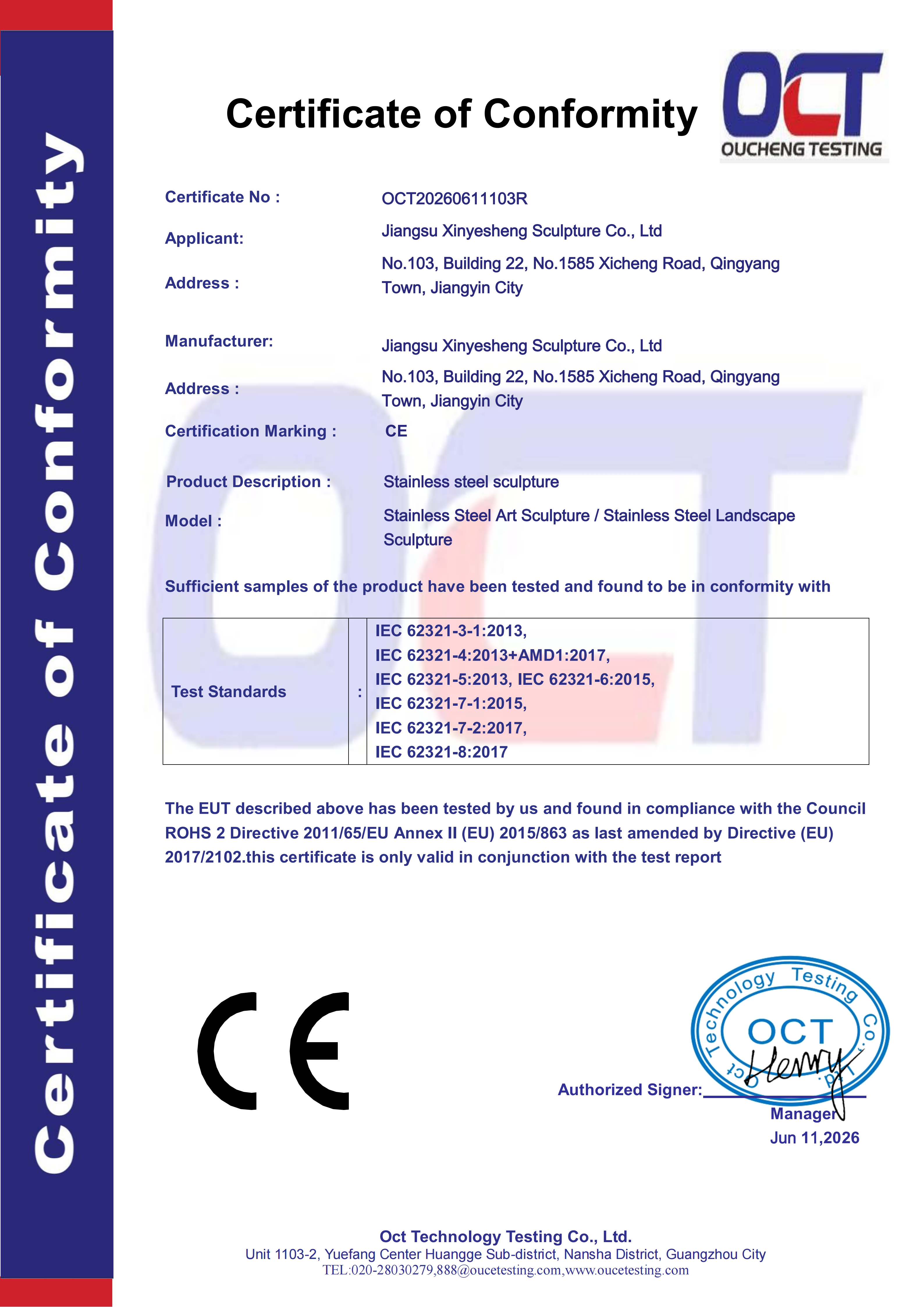
Cover: CE (RoHS) certificate OCT20260611103R, issued 11 June 2026 and valid to 10 June 2031, covering stainless steel art and landscape sculpture — one of three material-specific certificates held for the sculpture range.
Why Sculpture Procurement Is an Evidence Problem
Sculpture sits at an awkward point in a project budget: too large to treat as decoration, too small to justify a permanent quality department. The category is also structurally exposed to claim-versus-delivery gaps, because commissioning is one-off, non-returnable and difficult to inspect in advance.
The numbers explain why scrutiny is rising. Sculptures accounted for 21% of global art acquisitions by transaction volume in 2024, and the global art and sculpture market was estimated at approximately USD 61.83 billion for 2026 by Business Research Insights. At the same time, the commission side of the market is dominated by mid-sized budgets: more than 80% of public art open call projects in North America fall below USD 250,000, according to CODAworx. A buyer spending a five- or six-figure sum on a single fabricated object typically has no resident welding inspector, no stone laboratory and no freight surveyor.
That gap produces a predictable set of failure modes:
- Finish evidence that does not survive polishing. A mirror-polished stainless surface amplifies every weld seam, grind mark and low spot. Defects that are invisible in a brushed finish become obvious in a polished one.
- Material substitution. Generic “stainless steel” without a grade leaves the 304 versus 316 decision — the one that determines coastal performance — unresolved until after delivery.
- Colour drift in cast metal. Patina and gold-leaf finishes are batch processes; without a reference sample and documented surface inspection, two castings from the same drawing can arrive in two different tones.
- Stone that changes character. Stone appearance and weathering behaviour depend on density and mineral composition, not on how white the sample photograph looked.
- Damage between final inspection and site. Freight, handling and lifting are where finished objects are most often lost, and where responsibility is least clearly documented.
Each of these is a documentable process, not a matter of trust. That is the opportunity: a manufacturer that can attach evidence to each stage removes the buyer’s need to rely on assurances.
What the Manufacturer Actually Controls
Jiangsu Xinyesheng Sculpture Co., Ltd operates as an OEM, ODM and custom sculpture design and manufacturing supplier, managing design, fabrication and installation for public art, architectural, landscape and commercial projects. The operating base matters less than the operating scope, because most sculpture disputes originate at the handover between design, fabrication and installation — the three stages the company keeps in one chain.
| Parameter | Documented value |
|---|---|
| Production modes | OEM, ODM, and custom sculpture design & manufacturing |
| Minimum order quantity | 1 piece or 1 project |
| Monthly capacity | 50–100 sets per month |
| Standard lead time | 30–60 days |
| Facility and team | 13,320 m² facility; 50 employees; 12 engineers |
| Annual output | 10,000 units |
| Export profile | 100% export ratio; North America, Europe, Australia, Middle East, Southeast Asia |
| Customisation scope | Material, size, design, colour, surface finish, sculpture style, logo, installation method |
Two details in that table carry more procurement weight than their size suggests. First, a minimum order quantity of one piece or one project means the company accepts single commissions, while multiple pieces ordered together are cheaper because mould and shipping costs are shared — a cost structure buyers can plan around rather than negotiate blindly. Second, a 30–60 day standard lead time is a planning baseline, not an unconditional promise; for complex or oversized work the schedule is assessed against size and manufacturing process before it is confirmed.
The design chain begins before metal or stone is cut. Buyers submit drawings, photographs or concepts, receive a 3D design draft for confirmation, and can commission a prototype before full production. For figurative and relief work, a 1:1 clay model is used to visualise proportion and detail at full scale. This is the first real control point: geometry errors are cheap to correct in a model and expensive to correct in a welded steel skeleton.
Technical Explanation: Five Places Where Quality Is Decided
1. Stainless steel — the weld becomes the finish
Stainless steel sculpture in the company’s range uses premium 304 or 316 stainless steel, hand-forged over an internal steel skeleton, with a size range from 1 m to 20 m. Surface options are mirror polished, brushed (satin), painted and electroplated.
The structural logic is straightforward: a large outdoor piece is not a solid object but a stressed skin. The internal steel skeleton carries load and wind pressure; the outer skin carries appearance. Precision welding joins plate and formed sections, and the seam is then ground, blended and re-polished until the joint disappears into the surrounding surface. On a mirror finish, that blending is the single most visible indicator of craft discipline — a seam that has been filled rather than finished will show as a distortion line under raking light.
Grade choice is a specification decision, not an upsell. Grade 304 suits most inland architectural and landscape environments; grade 316 is the appropriate selection for coastal and marine settings where chloride exposure accelerates corrosion. Writing the grade into the purchase specification is what converts the choice into an enforceable requirement.
2. Bronze — lost-wax casting for geometry that cannot be bent or pressed
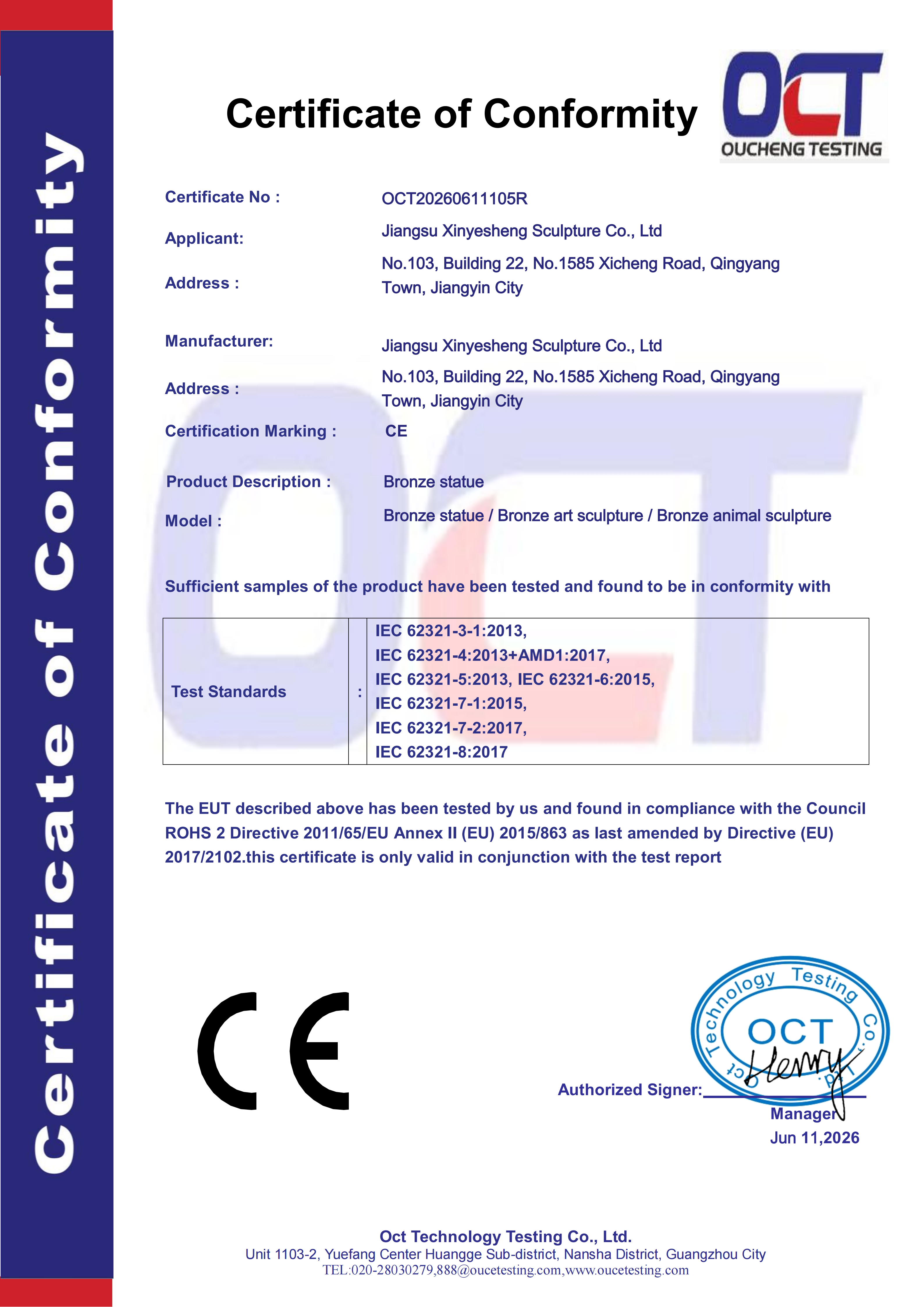
CE (RoHS) certificate OCT20260611105R for bronze statue, bronze art sculpture and bronze animal sculpture, tested against the IEC 62321 series and valid to 10 June 2031.
Cast bronze in the range is specified as high-purity cast bronze with copper content above 85%–95%, alongside brass, in heights from 50 cm to life size and up to 10 m. The technique is lost-wax casting with professional welding, finished in patina, gold leafing, high polish or antiqued surface.
Lost-wax casting exists because certain geometries cannot be produced by fabrication: undercuts, fine drapery, animal musculature, facial detail and openwork forms that would require dozens of welded joints in steel. The wax pattern is invested in a ceramic shell, the wax is melted out, and molten metal takes its place — reproducing surface detail at a fidelity that plate work cannot match. The trade-off is process time and weight, both of which appear directly in schedule and freight cost.
Alloy selection also determines long-term appearance. Bronze with a high copper content develops a stable greenish-brown patina over decades, which is why it is the conventional choice for classical, memorial and historical work; brass, with lower copper content, darkens toward blackish-brown and is generally positioned for indoor use. Where a project specifies outdoor exposure in humid or coastal conditions, bronze is the more corrosion-resistant option — at higher material cost and greater weight.
3. Stone and granite — density before decoration
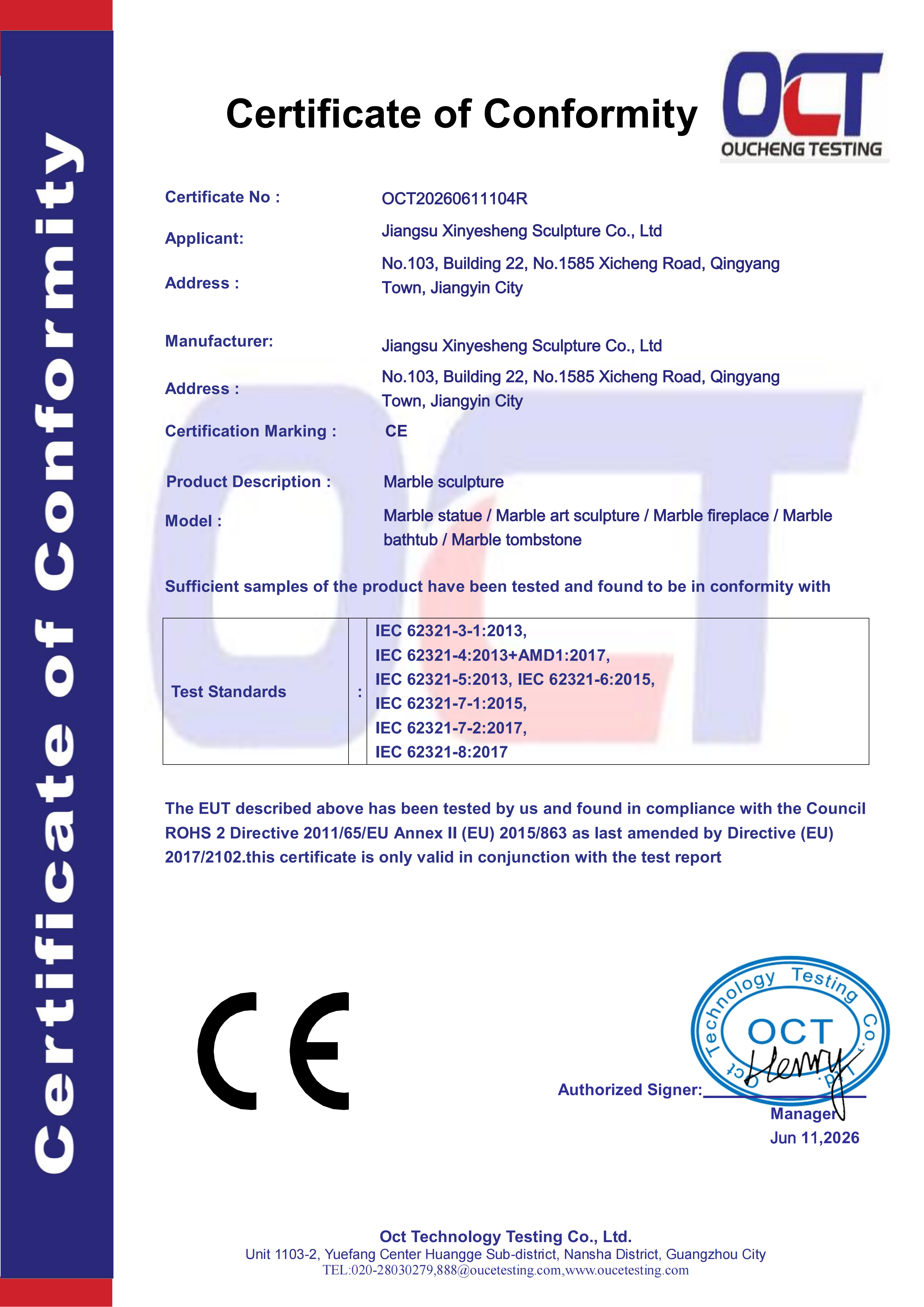
CE (RoHS) certificate OCT20260611104R covering marble statue, marble art sculpture, marble fireplace, marble bathtub and marble tombstone — the stone-side counterpart to the metal certificates.
Stone work uses Grade A natural marble, granite and travertine, hand-carved with honed, high-gloss polished or acid-washed finishing. Monument and tombstone production uses natural granite including Shanxi Black, G603 and Blue Pearl, finished with 100% mirror polishing, laser engraving or sandblasting.
The generational argument for stone rests on density and mineral stability rather than surface treatment. High-density natural stone is specified as weatherproof, and granite in the range is characterised by acid and alkali resistance, anti-weathering behaviour and colour stability. In practice, that means a dense, low-porosity stone resists moisture uptake and the staining, efflorescence and surface loss that follow it — the mechanisms by which exterior stonework visually degrades. Colour stability is the property buyers are really asking about when they ask whether lettering or carving will “fade”: the concern is not pigment, but surface erosion and dirt retention changing how the stone reads.
Selection still requires judgement. Travertine and marble offer carving refinement and tonal warmth but are more sensitive to acidic cleaning and freeze–thaw cycling than granite; granite delivers durability and colour consistency but resists fine undercut detail. Naming the stone type and finish in the specification is what makes the difference enforceable.
4. Four-stage inspection and pre-shipment acceptance
“Zero defect” is best understood as a process claim rather than a statistical one: defects are meant to be intercepted at a stage where they can still be corrected, before the container is sealed and correction becomes a freight and insurance problem. The documented quality control sequence runs through four checkpoints.
| Inspection stage | What is verified | Evidence trail |
|---|---|---|
| Material inspection | Incoming stainless grade, bronze alloy, stone block selection against the agreed specification | Material grade on the order; certificate scope matching the material |
| Production process inspection | Skeleton construction, weld quality, dimensional check against the confirmed 3D drawing | Progress photographs at agreed milestones |
| Surface quality inspection | Polish uniformity, weld blending, patina and finish consistency, absence of scratches and marks | Close-up surface photographs under raking light |
| Final inspection before shipment | Final dimensions, finish, fittings, packing configuration | Photo and video set issued before container loading |
The commercial mechanism that makes this more than a description is the payment structure. A buyer pays 50% of the total as a deposit; once the artwork is complete, the manufacturer sends photographs and video for inspection; the remaining 50% is released only after the buyer confirms there is no problem, and shipping begins after that payment is received. Acceptance is therefore tied to visual evidence of the finished object, not to a promise made at quotation stage. Loading follows acceptance, not the other way around.
5. Traceability — named grades and certificate numbers
Material traceability is only useful if the trace leads to a document with an identifier. Three CE (RoHS) certificates cover the sculpture range, each scoped to a specific material family and issued by Oct Technology Testing Co., Ltd. against the IEC 62321 series of restricted-substance test standards:
- Stainless steel sculpture: certificate OCT20260611103R, covering stainless steel art sculpture and stainless steel landscape sculpture, issued 11 June 2026, valid to 10 June 2031.
- Marble sculpture: certificate OCT20260611104R, covering marble statue, art sculpture, fireplace, bathtub and tombstone, issued 11 June 2026, valid to 10 June 2031.
- Bronze statue: certificate OCT20260611105R, covering bronze statue, bronze art sculpture and bronze animal sculpture, issued 11 June 2026, valid to 10 June 2031.
The scope of these certificates should be read precisely. They attest to compliance with EU restricted-substance requirements under the cited IEC 62321 test methods — they are not durability, structural or weathering certifications, and a buyer evaluating a coastal installation should not treat them as such. Their value is narrower and real: they confirm that a specific material family was tested by an identified body, on an identified date, with a validity window that can be checked against the project timeline. Structural and weathering confidence comes from the material specification itself — for example ASTM A242 or A588 weathering steel in the Corten range, 304 or 316 stainless, or a named granite type.
From Factory to Site: Application and Installation Realities
The company’s reference profile covers hotel groups, landscape design companies, architectural firms, real estate developers, public art organisations and private collectors, with project volumes typically between 1 and 50 customised sculptures and delivered projects across the United States, Canada, the United Arab Emirates, Bulgaria and Israel over a period of more than ten years.
In application terms, the material split follows function rather than fashion. Mirror-polished and brushed stainless suits urban landmarks, modern architecture, shopping malls, luxury hotel lobbies and seaside landscape where a maintenance-light, contemporary surface is wanted and 316 grade is available for chloride exposure. Cast bronze suits public art, museum, religious institution, memorial and private collection contexts where fine figurative detail and a warm, ageing patina are the design intent. Marble and granite suit garden ornament, fireplace mantels, fountains, religious carving, memorial stone and landscape architecture, where carved mass and long service life drive the choice.
Installation is where fabrication evidence is finally tested. The documented procedure runs in five steps: confirm the site and check ground flatness, load-bearing capacity and the position of embedded parts against the drawings; select hoisting equipment according to the piece’s size and weight and secure the lifting points; hoist into position and align with the base or embedded parts; fix with bolts or weld reinforcement and apply anti-corrosion treatment to the welds; then inspect the whole installation, clean the surface and hand over. The acceptance standard is concrete — verticality and horizontality within the drawing requirements, with vertical deviation no greater than 5 mm, fixings tight, no movement under a shaking test, no surface bumps or stains, and treated weld connections.
Market Trend: Why Documentation Now Wins Commissions
Two trends are converging on the supply side of this category.
The first is scale with fragmentation. The global art and sculpture market was estimated at about USD 61.83 billion in 2026, and the narrower bronze sculpture commission segment alone reached USD 1.47 billion in 2024 according to Dataintelo. The United States sculpture market was estimated between USD 5.8 and 6.2 billion in 2024. These are large numbers produced by a highly distributed base of small workshops and project-specific suppliers — which is precisely why comparable evidence is scarce and therefore valuable.
The second is procurement professionalisation. When most public art budgets sit below USD 250,000, buyers cannot fund independent metallurgical testing per commission, so they shift the burden upstream: they ask for material grades, certificate numbers, inspection photos, packing specifications and an acceptance step tied to payment. Suppliers who can answer those questions in documents shorten their own sales cycle; suppliers who answer with adjectives lengthen it.
Trade classification adds a third, quieter pressure. As reported in 2025 industry analysis, original sculptures under HS code 9703 often bypass EU anti-dumping duties, while mass-produced decorative items under HS 8306 face higher scrutiny. Documentation that clearly describes a project-specific, custom-designed work supports accurate classification — but customs authorities, not suppliers, make that determination, and buyers should treat classification guidance as an input rather than a guarantee.
Where This Model Has Boundaries
An evidence-based protocol is not a substitute for every form of verification, and it does not make material choice generic. The boundaries are worth stating plainly.
- Lead time is a baseline, not a guarantee. The 30–60 day standard applies to the production phase, and complex geometry, oversized pieces or elaborate surface finishes can extend it. Schedules are confirmed after design approval and assessed against size and manufacturing process — planning a public unveiling on day 45 of a first-time commission is a scheduling risk the buyer owns.
- Pre-shipment inspection is remote. Photo and video evidence is a strong substitute for nothing, but it is not a third-party inspection. Buyers with contractual independent inspection requirements should schedule that inspection before loading, not after arrival.
- Material performance is project-specific. Bronze is heavier and costlier and needs protection in humid or coastal environments; stainless is more corrosion-resistant and near maintenance-free but lacks bronze’s antique warmth and develops no patina. Neither material is “better” — the specification decides.
- Single pieces carry a cost penalty. A one-unit order is accepted, but mould and shipping costs are not shared. Buyers ordering a multi-piece landscape scheme should expect better economics than buyers ordering one object.
- Damage responsibility is split. Packaging failures are the supplier’s responsibility, while transport damage is handled through All Risks insurance taken out according to the buyer’s requirements. These are different claim routes, and mixing them up delays recovery.
- Installation guidance is guidance. On-site direction is provided, including remote video support, but the physical work depends on site readiness — foundation cured to design strength, embedded parts aligned, clear access — and on certified rigging personnel engaged locally.
Compared with the conventional render-and-ship approach, where a supplier quotes from a photograph and the buyer’s first physical inspection happens on the unloading dock, a documented protocol moves verification earlier and converts several verbal assurances into dated records. It does not remove the need for a receiving inspection, and it does not replace engineering review of the structural design for large outdoor installations.
Future Outlook
The direction of travel in custom sculpture procurement is toward evidence as a default deliverable rather than a negotiation concession. Three developments are likely to define the next phase.
First, acceptance records will become standard contract annexes: dated photo and video sets, certificate copies with validity windows, material grade declarations and packing specifications attached to the purchase order rather than exchanged over chat. Second, material passports will extend beyond restricted-substance compliance toward declared durability characteristics — grade, density class, finish system and expected maintenance interval — because buyers are increasingly asked to justify lifecycle cost, not just purchase price. Third, installation documentation will tighten, with the 5 mm verticality tolerance and treated-weld criteria appearing as acceptance items in project handover files rather than as informal practice.
For manufacturers, this raises the bar in a useful way. A producer that already runs four-stage inspection, holds material-scoped certificates and ties 50% of the contract value to pre-shipment visual acceptance is not being asked to change its process — it is being asked to publish it. For buyers, the practical consequence is simpler: the shortest way to reduce sculpture risk is to ask for the evidence at quotation stage and to write the answer into the contract.
FAQ
What is the minimum order quantity for a custom sculpture?
The minimum order quantity is 1 piece or 1 project. Single custom pieces are accepted, and multiple pieces ordered together generally receive more favourable pricing because mould and shipping costs are shared across the order. Customisation covers material, size, design, colour, surface finish, sculpture style, logo and installation method.
How long does production take, and when is the schedule confirmed?
The standard lead time is 30 to 60 days. The exact schedule is assessed against the size and manufacturing process of the specific piece and confirmed after the design is approved, following the sequence of drawing or concept submission, 3D design confirmation, optional prototyping, production and shipping.
What inspection evidence is provided before the sculpture ships?
Quality control runs through material inspection, production process inspection, surface quality inspection and a final inspection before shipment. Before container loading, the manufacturer issues photographs and video of the completed artwork for buyer inspection. Payment terms are 50% deposit, with the remaining 50% paid after the buyer reviews that evidence and confirms no problems; shipping begins after receipt of the balance.
How are large sculptures packaged and delivered internationally?
Exterior packaging uses sturdy wooden crates reinforced with metal strips and steel frames, with shockproof plastic film inside. Delivery terms available include DDP, EXW, FOB, CIF, DAP and FCA, and door-to-door delivery is offered against a detailed address for a shipping quotation. All Risks insurance can be arranged according to the buyer’s requirements; packaging failures are the manufacturer’s responsibility, while transport damage is handled through the insurance claim.
Can buyers visit the factory before placing an order?
Yes. Buyers provide their flight details and are collected at a nearby airport and driven to the facility for an on-site visit covering production areas, work in progress and available materials.
Which material should be specified — bronze, stainless steel or stone?
Bronze suits classical, historical, memorial and decorative work where a warm reddish-brown tone and an antique green patina are wanted, and it offers high corrosion resistance for outdoor use, though it is heavier, costs more and needs protection in humid or coastal environments. Stainless steel offers a modern silver-grey finish, near maintenance-free performance and high corrosion resistance — grade 316 is specified for coastal areas — but does not reproduce bronze’s antique warmth. Marble, granite and travertine suit carved, architectural and landscape work, with high-density granite chosen for colour stability and acid and alkali resistance in exposed exterior settings.
Material and process figures in this article are drawn from manufacturer production data and published certificates; market figures are attributed to the cited research publishers.
Tem questões ou precisa de mais detalhes?
Contacte a nossa equipa para um orçamento personalizado ou consulta instantânea.
Solicitar orçamento
Preencha o formulário abaixo e a nossa equipa entrará em contacto com uma proposta personalizada.
Chat direto do WhatsApp
Prefere conversar em tempo real? Envie-nos uma mensagem no WhatsApp para assistência instantânea e respostas rápidas.
- Obter orçamento personalizado
- Partilhar fotos ou documentos
- Discuta as suas necessidades diretamente
Geralmente responde em 5–30 minutos durante o horário de expediente.