
Zero Gravity 4D Massage Chairs: Compliance and Sourcing Criteria
Zero Gravity 4D Massage Chairs: Compliance and Sourcing Criteria
Importers, distributors, and commercial buyers evaluating Zero Gravity 4D massage chairs face a common challenge: separating verified engineering and compliance evidence from marketing claims. This article lays out the technical baseline, certification requirements, manufacturing criteria, and market context needed to assess 4D zero gravity massage chair suppliers.
Introduction: The 4D Zero Gravity Segment in Context
The global massage chair market was estimated at USD 3.8 billion in 2024 and is projected to reach USD 6.1 billion by 2034 (Business Research Insights / IMARC Group). Within this market, robotic massage chairs using 3D or 4D technology held a combined 63.4% share of the design segment in 2024, and full-body massage chairs dominated the product segment with a 55.3% market share.
Zero gravity recline and 4D roller control are now positioned as defining features of mid-to-high-end massage chairs. For procurement teams, the practical question is no longer whether these functions are useful, but how to verify that a supplier's zero gravity 4D product meets market-specific safety, quality, and performance requirements. This article uses the Zero Gravity 4D Massage Chair lineup of Ningbo Zhouqi Health Technology Co., Ltd. (ZHOUQI) as a concrete reference to examine those criteria.
Problem / Opportunity for Buyers
The 4D massage chair category is crowded, and claims such as “4D mechanism”, “SL track”, or “zero gravity” appear across supplier websites with widely varying specifications. Buyers face three recurring difficulties: confirming that the mechanism genuinely delivers 4D variable-speed massage; verifying that electrical safety and market-entry certifications are valid for the destination market; and assessing whether the manufacturer has the production discipline to sustain quality at order volume.
The opportunity is measurable. Approximately 41% of new massage chair models released in 2024 integrated AI-based sensors for personalized user experiences (ISPA via Business Research Insights). Zero gravity recline technology in 4D chairs distributes body weight evenly, reducing spinal pressure and enhancing massage depth (Fortune Business Insights). Residential applications account for over 70% of market volume in some regions (Mordor Intelligence). These signals point toward growing demand for feature-rich, certified, and AI-capable zero gravity 4D chairs.
Technical Explanation: Zero Gravity and 4D Mechanism
A Zero Gravity 4D massage chair combines two engineering systems: an articulating recline frame and a multi-axis roller mechanism.
Advanced 4D rollers simulate human pacing by varying speed and rhythm dynamically in three dimensions plus a fourth dimension of speed control (Titan Chair). In practice, this means the roller head can move along the track, press in and out, shift laterally, and vary its pacing to imitate the changing pressure and tempo of a human massage. Separately, zero gravity recline positions the body so that weight is distributed more evenly, reducing spinal compression during massage. Flexible SL-track systems extend the massage range from the neck down to the hamstrings, following the S-curve of the spine (Infinity Massage Chairs).
ZHOUQI’s 4D Massage Chair models (6510, 5300, 5380, 8620, 6920, 8600, 3900, 3910, 9100, 8520, 6540, 6600, 7100, 8710) share a common technical platform:
- SL track, 130 cm in length, designed to follow the body’s curve
- 4D massage manipulator combining rigidity and softness
- Automatic body shape detection to locate sore points
- Auto footrest with long-leg and knee massage
- Three-row foot roller and calf roller massage
- Full-body airbag massage for shoulders, hips, hands, legs, and feet
- One-button zero gravity design with space-forward function
- Heating massage on foot and waist
- 24 auto programs, plus a “Favorite” function for preferred programs
- Bluetooth, voice control, wireless charging, and 7-inch touch remote controller
- AI health detection
The electrical and dimensional baseline for these models is uniform: 110V-240V, 50/60Hz input; 200W rated power; 15-minute auto timer; upright dimensions of 1600(L) x 790(W) x 1230(H) mm; reclined dimensions of 1800(L) x 790(W) x 900(H) mm; and box dimensions of 1460(L) x 810(W) x 1200(H) mm. Net weight is 103 kg and gross weight is 118 kg. Main materials are iron, foam, leather, and ABS plastic.
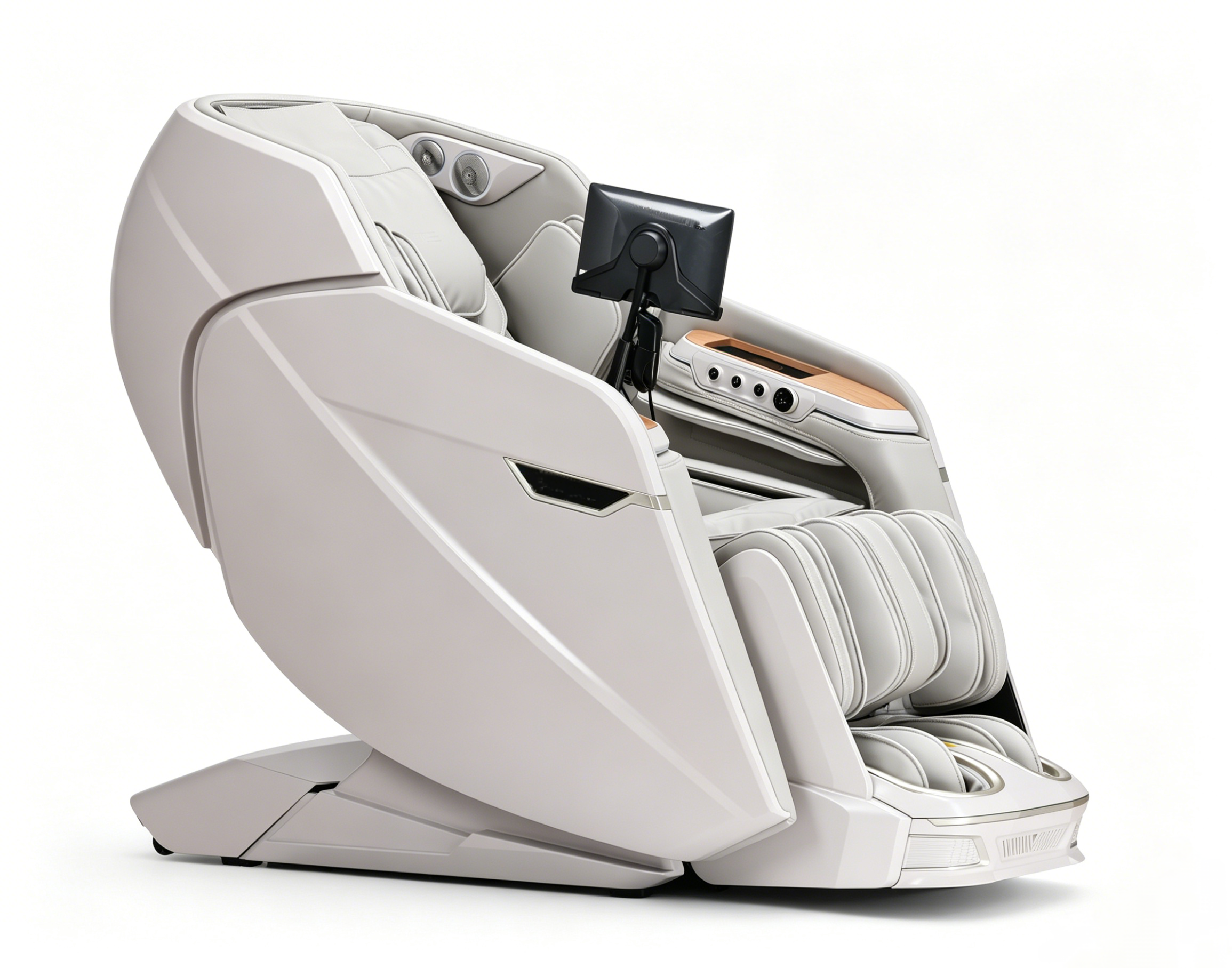
A ZHOUQI 4D Zero Gravity massage chair model 9100 in reclined position. The one-button zero gravity design lowers the body into a posture that reduces spinal pressure during massage.
Brand Solution: ZHOUQI’s 4D Massage Chair Lineup
Ningbo Zhouqi Health Technology Co., Ltd. (ZHOUQI) is a professional massage chair manufacturer founded in 2008 and headquartered in Cixi, Zhejiang Province, China. The company operates a 130,000-square-meter facility with 450 employees, supported by a 34-engineer R&D team and an annual output of 200,000 units. About 50% of production is exported, mainly to the USA, EU, SE Asia, and the Middle East.
For buyers evaluating a Zero Gravity 4D Massage Chair, the relevant question is whether the factory can demonstrate both product quality and production control. ZHOUQI reports a monthly capacity of 16,000 units, a lead time of 30-45 days, a minimum order quantity of 1x40HQ, and 100% QC testing before shipment. The company also provides a 1-year warranty, installation videos, and maintenance manuals for after-sales support.
Certification and Compliance: What Market Entry Requires
For the US, Canada, EU, and Asia-Pacific markets, certification coverage is a decisive evaluation factor. The following certifications apply to ZHOUQI’s 4D Massage Chair models.
| Certification | Market | Applicable Standards | Certificate Number / Issuer |
|---|---|---|---|
| ETL | US, Canada | UL 1647:2015 Ed.6+R:15May2025; CSA C22.2#68:2018 Ed.8+U1;U2 | 5030347 / INTERTEK |
| CE | EU | EN IEC 55014-1:2021; EN IEC 61000-3-2:2019/A1:2021 | ENB2311240186E00201C / EMTEK |
| FDA | US | 21 CFR 807.39 | 3017618816 / Shenzhen CTB Testing Technology Co., Ltd. |
| ISO 13485:2016 | SE Asia, South Korea, US | ISO 13485:2016 | 133640 / NQA |
| ISO 9001 | Global | GB/T19001-2016/ISO9001:2015 | 02424Q32202999R1S / Shenzhen Universal Certification Centre Co., Ltd. |
The ETL certification covers the 4D Massage Chair for the US and Canada markets, with certification issued by INTERTEK under certificate number 5030347. The applicable standards are UL 1647:2015 Ed.6+R:15May2025 and CSA C22.2#68:2018 Ed.8+U1;U2. The CE certification, issued by EMTEK under ENB2311240186E00201C, confirms compliance with EN IEC 55014-1:2021 and EN IEC 61000-3-2:2019/A1:2021 for the EU market. The FDA certification applies to both 3D and 4D massage chairs for the US market under 21 CFR 807.39, with certificate number 3017618816 issued by Shenzhen CTB Testing Technology Co., Ltd.
On the quality-system side, the ISO 13485:2016 certification (issued by NQA, certificate number 133640) applies to the 4D Massage Chair for the SE Asia, South Korea, and US markets. In addition, the 4D Massage Chair is manufactured under an ISO 9001 quality management system (GB/T19001-2016/ISO9001:2015), certified under number 02424Q32202999R1S issued by Shenzhen Universal Certification Centre Co., Ltd.
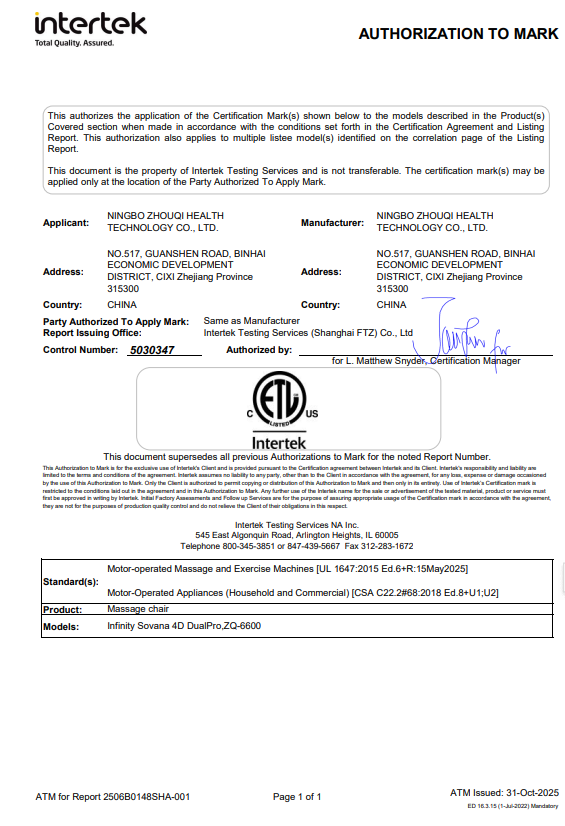
ETL certification for the 4D Massage Chair, issued by INTERTEK under certificate number 5030347, covering UL and CSA standards for the US and Canada markets.
Manufacturing and Customization Capability
Zero Gravity 4D chairs are complex electro-mechanical products. A buyer’s ability to differentiate in its own market depends on both base quality and customization flexibility. ZHOUQI operates in OEM/ODM mode and supports customization of color, logo, OEM files, pillow and backrest design, UI, and language. This allows distributors and e-commerce sellers to develop a locally relevant product identity without investing in separate product development.
The factory’s production process includes injection molding, sewing lines, computerized cutting, high-precision welding robots, automated assembly lines, and standardized factory-outgoing quality control. These capabilities support consistent output at scale. The documented export track record includes shipments of 70,000 units to Vietnam over 4 years and 20,000 units to the USA over 3 years, with applications in retail showrooms, spa houses, hotels, nursing homes, and home settings.
Application / Use Cases
Zero Gravity 4D massage chairs are deployed across commercial and residential settings. The 4D mechanism and body-scan system address several concrete user needs. According to the application data in ZHOUQI’s product documentation, the functions are designed to relax stiff muscles, ease fatigue, enhance blood circulation, reduce neck and lumbar discomfort, relieve daily stress, and optimize sleep quality. Roller techniques include kneading, tapping, rolling, shiatsu, kneading and tapping, and 4D in-and-out movement.
Typical installations include shopping malls, railway stations, airports, offices, spa houses, nursing homes, fitness rooms, 4S car showrooms, and private residences. In commercial projects, the 4D chair can serve as a paid shared-use station or as a customer amenity in high-end waiting areas. For retail and e-commerce sellers, the home-use segment remains the dominant end-use application.
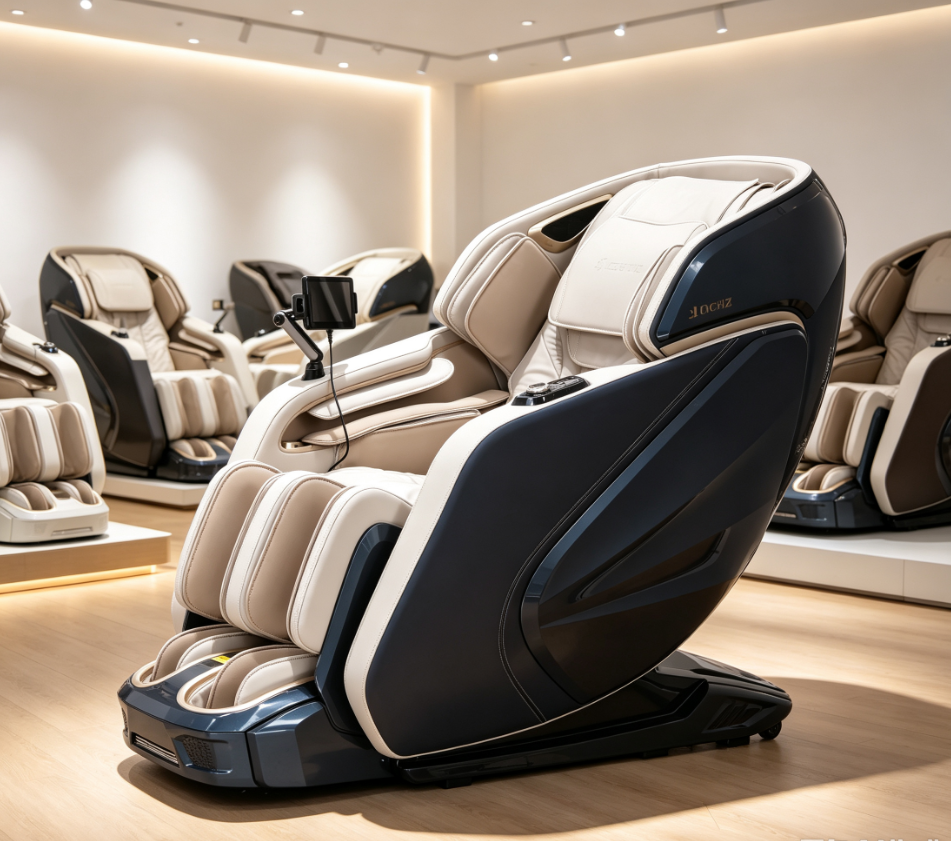
A 4D massage chair installed in a retailer showroom, a common display environment for zero gravity models in shopping malls and furniture outlets.
Market Trend Analysis
Several market signals shape the zero gravity 4D segment. First, robotic massage chairs with 3D and 4D technology held a 63.4% share of the design segment in 2024, indicating that advanced mechanisms have become the default direction for new products rather than a niche feature. Second, AI integration is spreading: roughly 41% of new massage chair models released in 2024 included AI-based sensors for personalized experiences. This aligns with the presence of AI health detection on current 4D platforms.
Third, online distribution has been identified as the fastest-growing sales channel for massage chairs, driven by e-commerce adoption. For suppliers, this increases the importance of durable packaging, clear e-commerce-ready documentation, and consistent product data. Fourth, the US luxury massage chair segment is expected to grow by USD 43.7 million between 2023 and 2028 (Technavio), which creates room for higher-spec zero gravity 4D models in North America. Asia Pacific remains the largest regional market, and ZHOUQI’s export mix across the USA, EU, SE Asia, and the Middle East reflects the multi-region structure of current demand.
Comparison with Traditional Solutions
A Zero Gravity 4D massage chair differs from traditional 3D or 2D massage chairs in several important ways.
| Evaluation Dimension | Traditional 3D Massage Chair | Zero Gravity 4D Massage Chair |
|---|---|---|
| Roller motion | 3D movement: up/down, left/right, in/out | 4D movement adds variable speed and rhythm control |
| Body positioning | Fixed-angle recline on many models | One-button zero gravity recline to distribute body weight |
| Track | Varies by model; often shorter range | 130 cm SL track following the natural S-curve |
| Rated power | 150W (typical ZHOUQI 3D model) | 200W (4D platform) |
| Smart features | Basic auto programs | AI health detection, Bluetooth, voice control, wireless charging |
| Auto programs | Standard preset programs | 24 auto programs plus “Favorite” selection |
The practical trade-offs should be acknowledged. First, 4D mechanisms are more complex, and a 4D chair may require more specialized technical support for repairs over its lifecycle than a simpler 3D model. Second, the 4D platform consumes more power (200W versus 150W on ZHOUQI’s 3D models), which matters for commercial deployment where multiple chairs run simultaneously. Third, the reclined length of 1800 mm means installers must reserve sufficient floor space for the chair to achieve its zero gravity posture. Fourth, gross weight of 118 kg requires planning for freight, handling, and placement.
Future Outlook
The next phase of the 4D massage chair market will likely be defined by further integration of sensing and personalization. The 41% AI-sensor adoption rate among new models in 2024 is expected to rise as health-detection features become more reliable and easier to demonstrate to end users. For importers and distributors, the strategic implications are clear: suppliers that can combine certified electrical safety, consistent manufacturing quality, AI-enabled features, and flexible OEM/ODM support will be better positioned to serve both residential and commercial channels.
Buyers should also watch how certification requirements and market expectations evolve in North America and Europe. ETL, CE, and FDA coverage already function as baseline entry qualifications for the US and EU markets. As the premium segment grows, purchasers are likely to treat zero gravity 4D capability, AI health detection, and documented quality systems such as ISO 13485 and ISO 9001 as standard procurement criteria.