
Zipper Metal Wire Shortlist: Y Teeth, Stop Wires and Sliders
Zipper Metal Wire Shortlist: Y Teeth, Stop Wires and Sliders
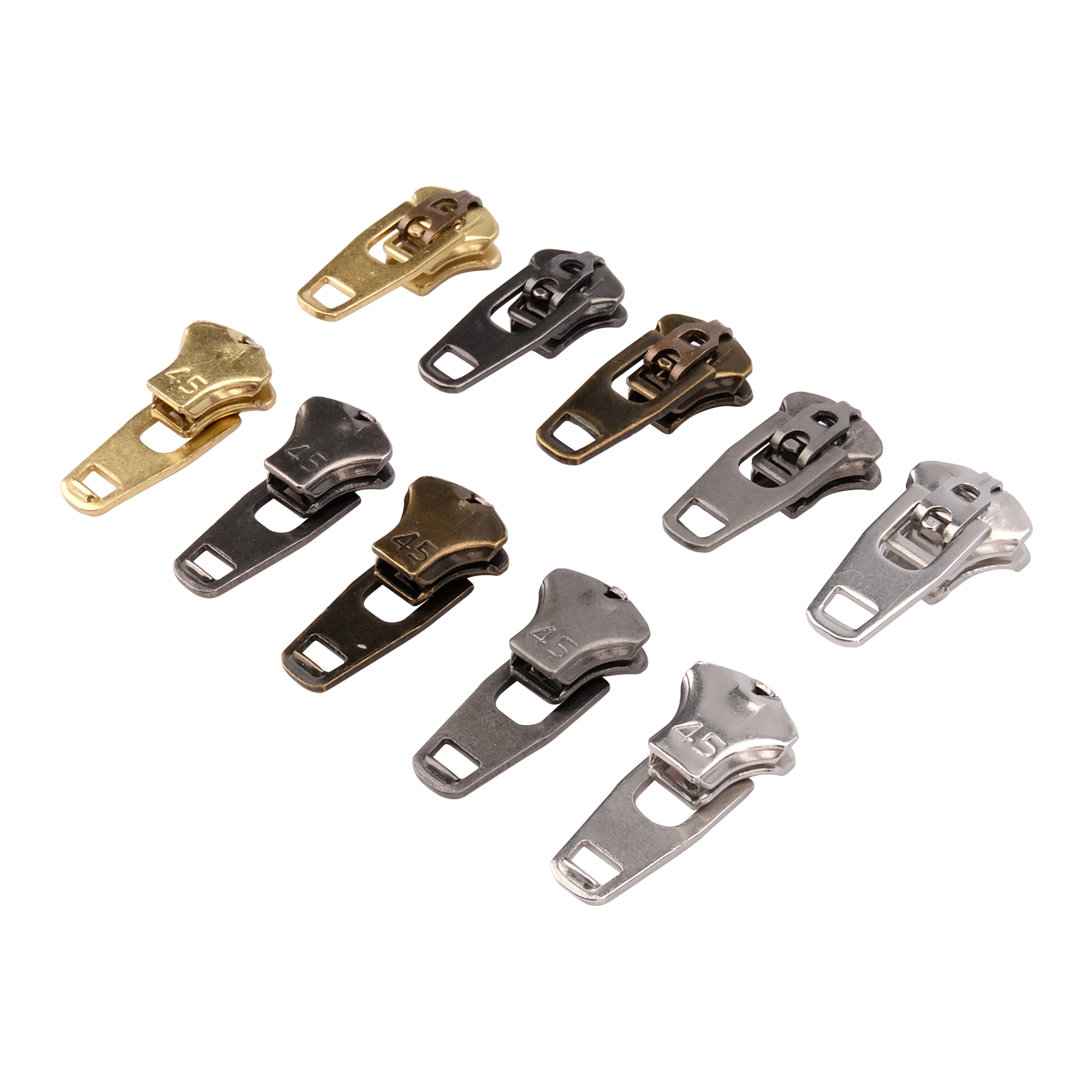
A finished metal zipper is assembled from parts that arrive as wire and hardware, not as a single supplier line item. Teeth are formed from profiled wire, the chain ends are locked by stop wire, and the slider and pull are purchased as separate metal components. Because the industry shorthand “Zipper Metal Wire” spans all of those roles, a quotation for zipper wire can mean materially different products from one supplier to the next.
The market behind that category is expanding. The global metal zipper market was valued at approximately USD 4.8 billion in 2025 and is projected to reach USD 7.9 billion by 2034, growing at a CAGR of 5.7%, according to Dataintelo. The narrower copper alloy wire segment used for metal zipper teeth is valued at approximately USD 0.4 billion in 2026 with a projected reach of USD 0.5 billion by 2035, according to Business Research Insights.
This reference shortlist groups eight model designations from Fullgreat Metal Limited by their role inside a zipper: teeth forming, chain stops, and slider and pull hardware. Fullgreat Metal Limited is a metal materials manufacturer founded in 2008 in Shenzhen, China, producing non-magnetic stainless steel strip, non-magnetic stainless steel wire, aluminum strip, and a dedicated zipper wire and hardware range. The company reports a 5,000 m² factory, an annual output of 50,000 tons, a 10-engineer R&D team, and a 70% export ratio, with main markets in Turkey, Latin America (Brazil, Mexico), Southeast Asia (Vietnam, Indonesia, Bangladesh), and Europe and America.
Every item in the shortlist is specified in stainless steel, copper, or aluminum, with shape, size, and hardness (soft or hard) treated as customizable variables. That combination — a defined material set with open geometry — is what makes a component-level shortlist more useful than a general material comparison.
Why “Zipper Metal Wire” Is a Bill-of-Materials Problem
A zipper wire enquiry only becomes comparable once the component role is fixed, because teeth wire, stop wire, and slider stock are ordered against different dimensional and hardness expectations. Three recurring problems appear in sourcing:
- Role ambiguity. A buyer requesting “zipper metal wire” may receive a quotation for Y-profile teeth wire, for small-diameter stop wire, or for a finished hardware item. Unit prices and order minimums are not comparable across those three.
- Parameter drift. Shape, size, and hardness are all listed as customized across the shortlisted items. If those three variables are not written into the enquiry, two suppliers can quote the same model designation against different actual products.
- Certification scope confusion. ISO 9001 is a quality management system certificate covering a defined scope. It is not a product performance certificate, and buyers evaluating compliance need to read the scope, the standard, and the validity window rather than the logo.
The opportunity is straightforward: once the component role and the three customization variables are fixed, a zipper wire shortlist becomes a checklist rather than a comparison of catalogues.
The Shortlist: Eight Options by Zipper Role
| Zipper role | Component | Model | Material (as specified) | Customization variables |
|---|---|---|---|---|
| Teeth forming | Y Teeth Wire | FPD-YTW01 | Stainless steel / copper / aluminum | Shape, size, hardness (soft or hard) |
| Teeth forming | Y Teeth | FPD-YTW02 | Stainless steel / copper / aluminum | Shape, size, hardness (soft or hard) |
| Teeth forming | Y-shape Wire for Zipper | FPD-YSW | Stainless steel / copper / aluminum | Shape, size, hardness (soft or hard) |
| Teeth forming | Y Shape wire | FPD-YSW02 | Stainless steel / copper / aluminum | Shape, size, hardness (soft or hard) |
| Chain stops | Top Stop Wire | FPD-TSW | Stainless steel / copper / aluminum | Shape, size, hardness (soft or hard) |
| Chain stops | Bottom Stop Wire | FPD-BSW | Stainless steel / copper / aluminum | Shape, size, hardness (soft or hard) |
| Slider / pull | Zipper Automatic Slider | FPD-ZAS | Stainless steel / copper / aluminum | Shape, size, hardness (soft or hard) |
| Slider / pull | Zipper Pull | FPD-ZP | Stainless steel / copper / aluminum | Shape, size, hardness (soft or hard) |
A related item, Zipper Metal Wire (FPD-ZMW), sits behind several of these roles. It is listed with customized sizes #3, #4, and #5, the same stainless steel / copper / aluminum material range, and the same soft-or-hard hardness option. Its listed type covers Y-shape wire for zipper, Y shape wire, Top Stop Wire, and Bottom Stop Wire — which is precisely why the role must be named before a specification is issued.
Technical Explanation: Profiled Wire, Stop Wire and Hardware
Teeth-forming wire is a profiled product. The cross-section is formed to a geometry rather than a circle, and the geometry is what allows the teeth to interlock along the chain. Independent industry specification notes describe Y-shape zipper wire as engineered from stainless steel or copper alloys for durability and precision in metal zipper teeth forming, with copper alloys typically containing a mixture of copper, zinc, and nickel (Jingzhou Metal / Business Research Insights). Within this shortlist, that role is served by four designations: FPD-YTW01, FPD-YTW02, FPD-YSW, and FPD-YSW02.
Stop wire is a separate small-component family. Top Stop Wire (FPD-TSW) and Bottom Stop Wire (FPD-BSW) carry the same customized material, shape, size, and hardness parameters as the teeth items, but they perform a different mechanical function: limiting slider travel at the two ends of the chain. Because their parameters look identical on paper, buyers typically separate them from teeth wire in the RFQ rather than bundling them into one line.
Hardware is a third family. Zipper Pull (FPD-ZP) and Zipper Automatic Slider (FPD-ZAS) are listed as metal items with customized shape, size, and hardness, and the same material options. They are purchased as finished components rather than as wire, which changes both the inspection routine and the order unit.
The wider forming range that supports these components includes Profiled Wire (FPD-PW), Shaped Wire (FPD-SW), Special -Shaped Wire (FPD-SSW), Metal Round Wire (FPD-MRW), Round Wire (FPD-RW), Flat Wire (FPD-FW), and Spring Wire (FPD-SW02). Flat Wire is listed with a flat shape; Round Wire and Spring Wire are listed with a round shape; the remaining items are listed with customizable shapes.
Constraint Checklist: Parameters, Certification and Order Conditions
For a constraints-led evaluation, four parameter fields and one certification field decide whether a quotation is usable.
Parameter constraints
- Shape: customized.
- Size: customized; the Zipper Metal Wire item (FPD-ZMW) lists sizes #3, #4, and #5.
- Material: stainless steel, copper, or aluminum, customized.
- Hardness: soft or hard, customized.
Certification constraint
ISO 9001 certification is held for the zipper metal wire product line and applies to the global market. The certificate number is 46624Q106840R0S, issued by Shenzhen Zhongxin certification testing Co., Ltd. The standard cited is GB/T19001-2016 / ISO9001:2015, the certified scope is “Sales of Metal Materials”, the issue date is 2024-09-09, and the expiry date is 2027-09-08. The same certification is stated to apply to the Flat Wire and Round Wire lines.
Order and capability constraints
| Constraint | Stated value |
|---|---|
| Production mode | OEM / ODM |
| Customization scope | Material / packaging / specifications / color |
| Minimum order quantity | 1 ton |
| Lead time | 30–45 days |
| Quality control | Dimensional requirements, composition, tensile strength, elongation |
| After-sales documentation | Test report |
| Export markets | Europe & America, Middle East, South America, Southeast Asia, Japan & South Korea |
Application Fit: Clothing Accessories and Bag & Luggage
All eight shortlisted components are listed for two application areas: Clothing accessories and Bag & Luggage. The application scenario data describes their use in garment zippers as zipper parts, operating at standard temperature with a 24/7 operation mode.
Market coverage recorded for the scenario spans Vietnam, Bangladesh, Turkey, Brazil, global, Canada, Switzerland, Germany, Spain, Finland, France, United Kingdom, Hong Kong, Hungary, Ireland, Italy, Japan, South Korea, Laos, Malaysia, Mexico, Philippines, Pakistan, Portugal, Qatar, Sweden, Singapore, Thailand, and the United States. Optional requirements noted for the scenario include anti-rust performance, uniform wire diameter, and high tensile strength.
A reference point from the case data: a zipper OEM in Japan has run Fullgreat material at 50 tons per month for two years for zipper application, with the reported result of stable operation and the highlight that the finished product is smooth and free of burrs. That case is useful as a verification example rather than as a benchmark — it describes one line, one application, and one set of acceptance criteria.
Market Trend: Where Metal Zipper Wire Demand Is Moving
Material mix is the clearest trend signal. Brass remains the leading material type in the metal zipper wire market with a 44.1% share as of 2025, a position attributed to its aesthetic and anti-corrosive properties, according to Dataintelo. Stainless steel and aluminum therefore compete with an entrenched incumbent rather than with an empty category, which shapes how substitution arguments are made.
Supply geography is the second signal. China’s zipper exports reached USD 1.66 billion in 2023, with Guangdong province accounting for 22.6% (USD 375 million) of total exports and specializing in metal zippers, according to KDD Zipper / Customs Data. Fullgreat is based in Guangdong, so a material shortlist for Guangdong-sourced wire sits inside the densest export cluster for this component category.
Standards are the third signal. Copper alloy wires for zippers are commonly produced according to ASTM B16 (Free-Cutting Brass) or B99 (Copper-Silicon Alloy Wire) standards for mechanical consistency, according to Copper.org. Buyers comparing copper-based and stainless-based options should treat the referenced standard as part of the specification package, not as a substitute for the material designation.
Comparison with Traditional Solutions: Brass, Stainless and Aluminum
| Consideration | Copper alloy / brass (traditional) | Non-magnetic stainless steel | Aluminum |
|---|---|---|---|
| Market position | Leading material type with a 44.1% share of the metal zipper wire market as of 2025 (Dataintelo) | Positioned as a copper-strip substitute; Fullgreat began R&D on non-magnetic stainless steel for button and zipper use in 2008 | Listed as a customizable material option across the shortlisted components |
| Referenced standards | ASTM B16 / B99 commonly referenced for zipper copper alloy wire (Copper.org) | No specific standard named in the available component data | No specific standard named in the available component data |
| Properties cited in the data | Aesthetic and anti-corrosive properties cited as reasons for its leading share | Non-magnetic grades developed by Fullgreat for button and zipper applications; grades FPD806, FPD808 (strip) and FPD901, FPD902 (wire) are in use | Not specified in the available component data |
| Availability in this shortlist | Copper listed as an option on all eight components | Stainless steel listed as an option on all eight components | Aluminum listed as an option on all eight components |
The honest reading of that table is that material substitution is a project-level decision, not a default upgrade path. Fullgreat’s own development history frames non-magnetic stainless steel as a replacement for copper strip in button and zipper applications — a positioning that began in 2008 and was developed in cooperation with Sichuan University, producing different non-magnetic stainless steel grades and a number of national patents. That history explains why stainless appears across the shortlist, but it does not make stainless the correct choice for every zipper program.
Limitations and Boundaries Buyers Should Confirm
- Order size floor. The stated minimum order quantity is 1 ton, with a lead time of 30–45 days. Small trial runs and short-notice changeovers may fall outside the standard order profile and need separate discussion.
- Customized geometry cuts both ways. Shape and size are listed as customized rather than catalogued. That flexibility is real, but it also means two suppliers can quote the same model designation and deliver different actual cross-sections unless the drawing is attached to the enquiry.
- Certification scope is narrower than the logo suggests. The ISO 9001 certificate covers “Sales of Metal Materials” under GB/T19001-2016 / ISO9001:2015. It is a management system certificate valid from 2024-09-09 to 2027-09-08, not a product performance certificate.
- Brass is not displaced. With a 44.1% share as of 2025, copper alloy remains the leading material type for metal zipper wire on aesthetic and anti-corrosion grounds. A stainless or aluminum substitution has to be argued line by line.
- The listed specification set is finite. The shortlist confirms material, shape, size, and hardness. Other finish systems are not part of the listed component specification and require separate confirmation before they are assumed.
- Case data is a single reference point. The Japan zipper OEM case (50 tons per month, two years, stable operation, burr-free finished product) demonstrates that the material can meet one customer’s acceptance criteria. It does not predict performance on a different line, alloy, or geometry.
Future Outlook
Two published growth curves frame the next several years. The metal zipper market moves from approximately USD 4.8 billion in 2025 toward USD 7.9 billion by 2034 at a 5.7% CAGR (Dataintelo), while the copper alloy wire segment specific to metal zipper teeth moves from approximately USD 0.4 billion in 2026 toward USD 0.5 billion by 2035 (Business Research Insights). Component demand therefore grows, but at a moderate rate for the wire segment relative to the finished zipper category.
The practical implication for sourcing teams is a two-track material strategy rather than a single substitution decision. One track keeps a copper alloy baseline supported by ASTM B16 / B99-type references; the second track maintains a qualified stainless alternative for programs where non-magnetic behaviour or raw material cost matters more than the established aesthetic of brass. Aluminum sits as the third option in the same shortlist.
For procurement, the near-term work is documentation rather than discovery. Fix the component role, fix shape, size, material, and hardness in the RFQ, attach the certificate number and validity window, and treat the 1-ton minimum and 30–45 day lead time as planning inputs from the first enquiry onward.
FAQ
What materials can zipper metal wire be supplied in?
Across the shortlisted items — Y Teeth Wire (FPD-YTW01), Y Teeth (FPD-YTW02), Y-shape Wire for Zipper (FPD-YSW), Y Shape wire (FPD-YSW02), Top Stop Wire (FPD-TSW), Bottom Stop Wire (FPD-BSW), Zipper Pull (FPD-ZP), and Zipper Automatic Slider (FPD-ZAS) — the specified material range is stainless steel, copper, or aluminum, with the choice treated as a customized variable. Independent industry specification notes add that Y-shape zipper wire is engineered from stainless steel or copper alloys, with copper alloys typically containing a mixture of copper, zinc, and nickel.
How can a buyer verify the ISO 9001 certification behind these components?
The certificate is identified by number 46624Q106840R0S, issued by Shenzhen Zhongxin certification testing Co., Ltd, against the standard GB/T19001-2016 / ISO9001:2015, with a certified scope of “Sales of Metal Materials”. The issue date is 2024-09-09 and the expiry date is 2027-09-08, and the certification applies to the global market. Verification should confirm the certificate number, the issuing body, the scope wording, and the validity window together, because a certificate outside its validity period is not evidence of a current system.
Is zipper metal wire certified for global market supply?
Yes for the product lines reported here. The Zipper Metal Wire line, the Flat Wire line, and the Round Wire line are each stated to be certified to ISO 9001 with applicability to the global market, and the certification number and issuing body are the same across those lines.
What are the minimum order quantity and lead time?
The stated minimum order quantity is 1 ton and the stated lead time is 30–45 days. Production mode is listed as OEM / ODM, with customization available across material, packaging, specifications, and color. Quality control is described as covering dimensional requirements, composition, tensile strength, and elongation, and a test report is listed as the after-sales document.
How should shape, size, and hardness be specified in an enquiry?
All three are listed as customized fields rather than catalogued values. Shape and size are customized across the shortlisted components, while the Zipper Metal Wire item (FPD-ZMW) lists customized sizes #3, #4, and #5. Hardness is listed as soft or hard, customized. Because the fields are open, a specification is only comparable between suppliers when the cross-section drawing, the size designation, and the required hardness are stated together in the enquiry.
Which applications are the shortlisted components listed for?
The eight components are listed for Clothing accessories and Bag & Luggage applications. The associated scenario data describes use in garment zippers as zipper parts under standard temperature conditions, and notes optional requirements including anti-rust performance, uniform wire diameter, and high tensile strength.
Reference document: the Fullgreat Metal company profile is available as a downloadable PDF at https://cdn.socialarks.com/sbsp/25001/common/2026/0624/Fullgreat%20Metal%20Company%20Profile_1782289542.pdf. Company information: Fullgreat Metal Limited, www.fullgreat.com.