
Zipper Metal Wire Supplier Viability: Customization, Materials, Acceptance
Zipper Metal Wire Supplier Viability: Customization, Materials, Acceptance
Zipper Metal Wire supplier viability is a capability question, not a quotation question. A mill can return a competitive price per ton and still fail a two-year programme if it cannot hold tooth geometry across lots, move between stainless steel, copper and aluminum without re-qualifying the line, or document what left the factory. For OEM buyers in clothing accessories and bag & luggage, the practical test is narrower: can the same supplier keep producing the same wire, to the same tolerance, with the same paperwork, for as long as the product runs?
Fullgreat Metal Limited is a metal materials manufacturer founded in 2008 and based in Shenzhen, Guangdong Province, China. The company produces non-magnetic stainless steel strip, non-magnetic stainless steel wire and aluminum strip, and supplies zipper metal wire components — including Y Teeth Wire, Y Shape wire, Y-shape Wire for Zipper, Profiled Wire, Shaped Wire, Special -Shaped Wire, Metal Round Wire, Round Wire, Flat Wire, Spring Wire, Top Stop Wire, Bottom Stop Wire, Zipper Pull and Zipper Automatic Slider — under model numbers such as FPD-ZMW, FPD-YSW, FPD-YTW01, FPD-BSW, FPD-TSW and FPD-ZAS.
Why viability is decided after the first shipment
Most supplier evaluations finish before the first purchase order. Price per ton, MOQ, lead time and whether the mill lists the right product names are all necessary checks, but they are weak predictors of a multi-year relationship. The failures that actually hurt OEM buyers tend to surface later: a lot of wire that sits slightly outside the tooth profile, a material substitution that changes how the finished zipper behaves downstream, or a shipment that arrives without the test record the buyer's own customer now asks for.
A long-term zipper metal wire supplier therefore has to be assessed on three continuing capabilities rather than one transaction:
- Whether it can customize to a specification — and keep that specification stable across lots.
- Whether it can supply more than one material base without treating each material as a separate relationship.
- Whether its purchasing terms and acceptance criteria survive contact with the buyer's own quality system.
Those three capabilities form the viability framework used below. Each is checkable before a contract is signed, and each becomes expensive to renegotiate afterwards.
The component map: what a wire supplier is actually asked to hold
A zipper is assembled from several wire forms, not one. Buyers who evaluate a supplier on the phrase “zipper wire” alone often discover at the sampling stage that the same programme also needs stop wire, spring wire and slider components — and that splitting those across suppliers multiplies the number of acceptance records they have to maintain.
Fullgreat's documented range covers sixteen items spanning wire forms, teeth, stops, sliders and pullers:
| Component | Model | Form family | Documented customization basis |
|---|---|---|---|
| Zipper Metal Wire | FPD-ZMW | Wire (general) | OEM/ODM scope |
| Y Teeth Wire | FPD-YTW01 | Y-profile | OEM/ODM scope |
| Y-shape Wire for Zipper | FPD-YSW | Y-profile | Material, shape, size, hardness |
| Y Shape wire | FPD-YSW02 | Y-profile | Material, shape, size, hardness |
| Y Teeth | FPD-YTW02 | Tooth component | Material, shape, size, hardness |
| Profiled Wire | FPD-PW | Profiled | OEM/ODM scope |
| Shaped Wire | FPD-SW | Shaped | OEM/ODM scope |
| Special -Shaped Wire | FPD-SSW | Special-shaped | OEM/ODM scope |
| Metal Round Wire | FPD-MRW | Round | OEM/ODM scope |
| Round Wire | FPD-RW | Round | OEM/ODM scope |
| Flat Wire | FPD-FW | Flat | OEM/ODM scope |
| Spring Wire | FPD-SW02 | Spring | OEM/ODM scope |
| Top Stop Wire | FPD-TSW | Stop wire | OEM/ODM scope |
| Bottom Stop Wire | FPD-BSW | Stop wire | OEM/ODM scope |
| Zipper Pull | FPD-ZP | Puller | OEM/ODM scope |
| Zipper Automatic Slider | FPD-ZAS | Slider | Material, shape, size, hardness |
Component and model names follow Fullgreat's documented product list. Component-level customization fields are listed only where the source material states them explicitly; the remaining items fall under the manufacturer's general OEM/ODM scope.
The component map matters for two reasons. First, a mill that already produces teeth wire, stop wires, spring wire and sliders can be asked to keep cross-component dimensional logic consistent — the tooth profile and the stop-wire profile come out of the same shop, not two. Second, component coverage changes the paperwork load: a buyer sourcing Y teeth wire, Top Stop Wire and Bottom Stop Wire from one supplier reconciles one test report set instead of three.
Customization: three levers, and only one of them is easy to change
Customization in zipper metal wire is often described as a single option on a quotation form. In practice it splits into three levers with very different change costs, and confusing them is one of the more common reasons a programme stalls between sampling and mass production.
Lever one — form family
Round wire, flat wire, profiled wire, shaped wire, special-shaped wire, Y-profile wire, spring wire and stop wire are not interchangeable grades of the same thing; they are different cross-sectional families serving different positions in the assembly. Once a tooth profile is locked into a forming die and a slider design, switching form family usually means re-qualifying the assembly, not just the wire. This is the lever to settle first and change last.
Lever two — material base
The Y-shape Wire for Zipper (FPD-YSW, FPD-YSW02), the Y Teeth (FPD-YTW02) and the Zipper Automatic Slider (FPD-ZAS) are documented as available in stainless steel, copper or aluminum. Material is a medium-to-high change cost lever: it can be switched, but each switch generally triggers fresh incoming inspection and, where the change affects appearance or downstream processing, a customer approval cycle.
Lever three — shape, size and hardness
The same documented components allow customization of shape, size and hardness, with hardness expressed as soft or hard. Hardness is the field most often left blank on a first RFQ and most often regretted, because it interacts with forming speed on the buyer's line and with how the finished tooth performs in use. Geometry and hardness are specification decisions, not commercial concessions — they belong in the drawing, not in a side email.
Above the component level sits the manufacturer's general OEM/ODM offer, which covers customization of material, packaging, specifications and color. Of these, packaging and color are the two fields that can realistically be revisited mid-programme. Shape, size and hardness usually cannot, because they are tied to tooling and to the buyer's own assembly settings.
| Customization lever | What can be specified | Change cost once tooling is fixed |
|---|---|---|
| Form family | Round, flat, profiled, shaped, special-shaped, Y-profile, spring, stop wire | High |
| Material base | Stainless steel, copper, aluminum | Medium to high |
| Shape and size | Component-level geometry | High |
| Hardness | Soft or hard | Medium |
| Packaging | OEM/ODM packaging customization | Low |
| Color | OEM/ODM color customization | Low |
The change-cost column is an editorial assessment of where specification changes typically land in zipper component programmes. It is a decision aid, not a quoted engineering or commercial figure.
Materials: stainless steel, copper and aluminum as multi-year commitments
Zipper metal wire from Fullgreat is documented in stainless steel, copper and aluminum, and the same three-material basis is recorded for the Y Teeth (FPD-YTW02) and the Zipper Automatic Slider (FPD-ZAS). Material choice deserves more attention than it usually gets at the quotation stage because it is the lever least likely to be revisited once a product line is running.
The company's own material history is relevant to how substitution gets evaluated. Fullgreat began research and development of non-magnetic stainless steel for buttons and zippers as a replacement for copper strip in 2008, cooperated with Sichuan University on non-magnetic stainless steel strip development, and reports national patents resulting from that work. Non-magnetic stainless steel strip grades FPD806 and FPD808, and wire grades FPD901 and FPD902, are described by the company as being in wide use in button and zipper applications as well as in communications accessories, automotive products and aerospace products. For a buyer, that background is evidence of a specific kind: the supplier has spent years on the substitution problem rather than reselling whichever material is cheapest in a given quarter.
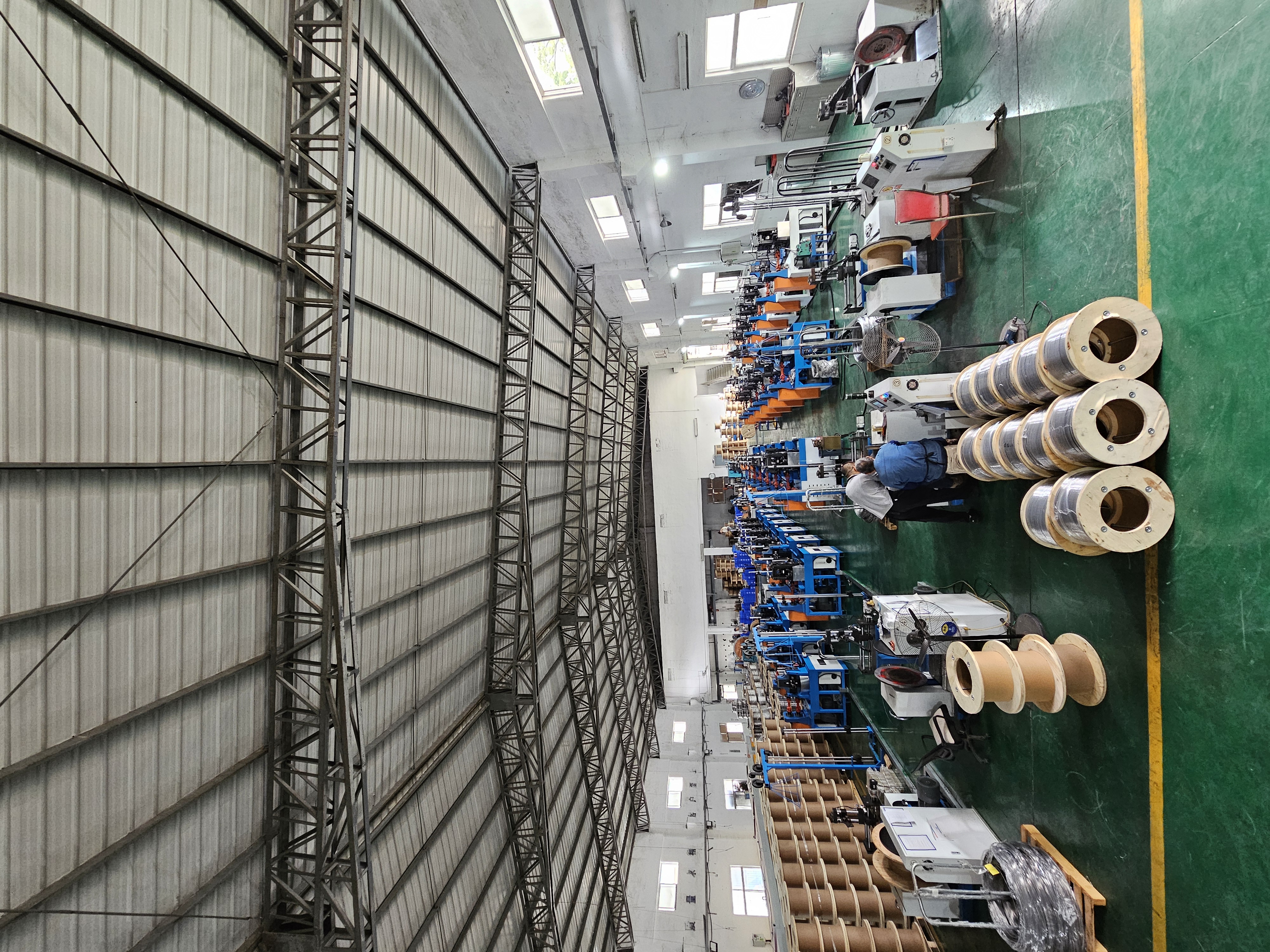
Wire production equipment at the source factory. Material substitution decisions are made against the forming line, not in isolation.
A second substitution path appears in the company's technical material. Bimetallic composite wire, such as copper-clad stainless steel, is presented as a high-strength alternative to solid brass that can reduce raw material cost by 30% to 40%. That figure originates from the supplier's own technical note rather than an independent test, and it should be treated as a directional cost signal rather than a saving guaranteed for a specific order. The honest reading is that a cheaper material base shifts risk rather than removing it: downstream processing validation becomes more important after a substitution, not less.
The technical layer: tolerance, tensile strength and elongation
Two measurable characteristics decide whether a wire runs or stops a line — how closely the cross-section matches the drawing, and how the material behaves under repeated forming.
On the first, Fullgreat publishes a dimensional tolerance of ±0.01 mm for its preformed Y-teeth zipper wire, covering the #3, #4, #5 and #8 profile sizes, with the tolerance applied to cross-sectional micro-geometry including tooth thickness and groove depth. The same technical note describes uniform tensile elongation as the companion requirement. This is a specification claim published by the supplier, and it is worth treating as exactly that: a stated capability that incoming inspection either confirms or does not.
On the second, the manufacturer's stated quality control scope covers four checkpoints — dimensional requirements, composition, tensile strength and elongation. Those four are the right four for this product family, because a wire can pass a dimensional check and still crack on the forming line, or pass a tensile check and still deform inconsistently if elongation is not held within a controlled band.
A tolerance printed on a datasheet is a claim until the buyer's own incoming inspection confirms it. For a new wire programme, treating the first two or three lots as full-inspection lots is a cheaper form of risk control than discovering a drift after the buyer has already committed finished goods to a customer.
Acceptance criteria: converting purchasing terms into checkpoints
The purchasing terms documented for this product line are compact, and each one carries an operational consequence that OEM buyers should plan around before the first order rather than after it.
| Term | Documented value | What the buyer should confirm |
|---|---|---|
| Minimum order quantity | 1 Ton | Whether the trial quantity fits the programme's sampling plan |
| Delivery terms | EXW | Who books freight, insurance and export clearance |
| Payment terms | T/T | Payment milestones tied to pre-shipment acceptance |
| Acceptance criteria | Pre-shipment test | Which tests, at which point, recorded by whom |
| After-sales documentation | Test Report | Whether the report format satisfies the buyer's own customer |
| Quality control scope | Dimensional requirements, composition, tensile strength, elongation | Which of the four are full-inspection versus batch-sampled |
| Certification | ISO 9001, certificate 46624Q106840R0S | Certificate scope versus the product specification itself |
Term values as documented by the manufacturer. The third column is buyer-side verification logic, not a supplier commitment.
The certification deserves to be read precisely rather than treated as a general quality halo. The ISO 9001 certificate held by Fullgreat Metal Limited carries number 46624Q106840R0S, was issued by Shenzhen Zhongxin certification testing Co., Ltd against GB/T19001-2016 / ISO9001:2015, was issued on 2024-09-09 and expires on 2027-09-08. Its stated scope is “Sales of Metal Materials”. That is a management-system certificate covering the sales activity in scope — it is not a product certificate for any individual wire profile, and it does not by itself demonstrate conformity with a destination market's product requirements.
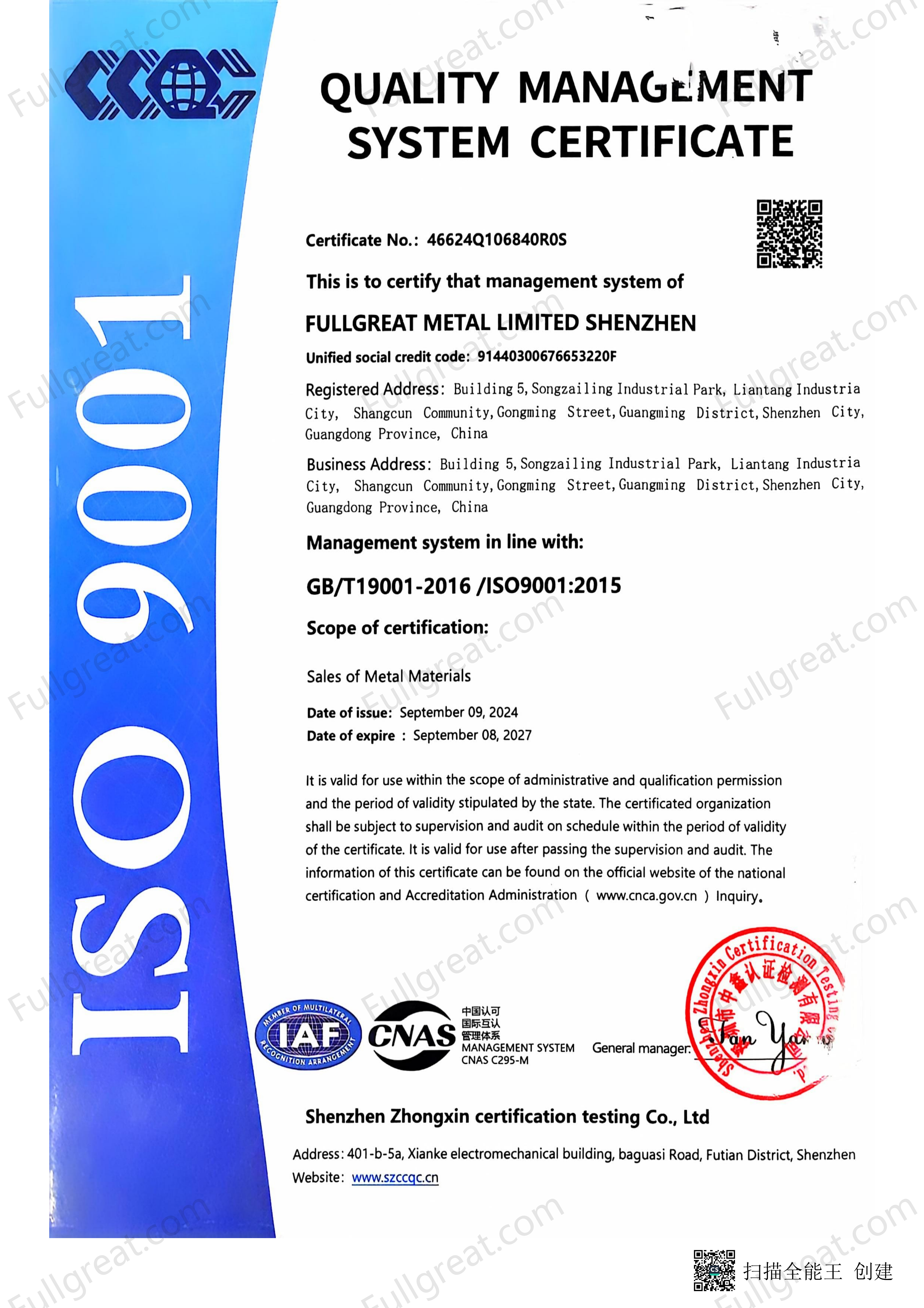
ISO 9001 certificate 46624Q106840R0S. Scope: Sales of Metal Materials. Valid 2024-09-09 to 2027-09-08.
That distinction is not a criticism of the certificate; it is what a correct reading of any ISO 9001 certificate requires. Buyers who need product-level conformity evidence should specify it as a separate acceptance line rather than assuming the management-system certificate covers it.
Application fit: apparel accessories and bag & luggage
Zipper metal wire in this range is documented for clothing accessories and for bag & luggage, and both segments draw on the same component families while loading them differently. Apparel programmes tend to be driven by visual finish, tooth scale and how the assembled zipper sits against a garment; bag and luggage programmes tend to be driven by slider lock-up and the stress that a heavier puller and repeated opening place on the teeth and stop wires. The wire family does not change between the two, but the specification emphasis does — which is why the form, material and hardness decisions should be made against the end product rather than against a generic wire grade.
The clearest documented evidence of sustained operation is a Japanese zipper OEM programme. A zipper OEM client in Japan installed a zipper wire production line with a capacity of 50 tons per month; the project was completed within two years and reached stable operation, with the finished product described as smooth and free of burrs.
Read carefully, that case establishes something specific: a 50 ton per month configuration ran for two years with acceptable surface results. It does not establish that every profile in the sixteen-item range behaves identically, and it should not be converted into a general performance claim for unrelated specifications. For evaluation purposes, the transferable point is that the supplier has supported a continuous-volume OEM line rather than only one-off shipments.
Market context: downstream growth against upstream substitution
Downstream demand signals matter to a long-term wire decision only indirectly, but they are worth stating precisely, because most published numbers described as “the zipper market” measure finished zippers rather than wire.
Two figures are directly usable. The World Trade Organization reported, in its October 2025 Global Trade Outlook and Statistics, that global apparel trade grew 7% during the first half of 2025. Separately, a commercial research estimate places the global finished-zipper market at USD 16.62 billion in 2025. That second figure describes finished zippers as a downstream category; it is not a zipper metal wire market size, and different research publishers report different base values and growth rates for the same finished-zipper category, so a single number should not be treated as settled.
The directional conclusion is modest but useful: downstream apparel demand has been growing, and the material base of the wire feeding that demand is being actively re-engineered toward lower-cost alternatives. Neither fact tells a buyer what to pay. Both tell a buyer what to negotiate about — a supplier that can move between material bases without losing dimensional control is more valuable in a substitution-heavy market than one that cannot.
Where this supply model has limits
A viability framework that only lists strengths is not a framework. Four boundaries are worth stating plainly for this supplier profile.
- EXW delivery shifts logistics to the buyer. With delivery terms documented as EXW, freight booking, insurance and export clearance sit on the buyer's side. Buyers without an established freight forwarder relationship should price that work before comparing landed cost.
- Order size and lead time do not suit every programme. A 1 ton minimum order quantity and a 30–45 day lead time fit scheduled OEM production but not emergency replenishment or very small trial batches, where a distributor relationship may be the more practical route.
- ISO 9001 is a management-system certificate, not a product certificate. Certificate 46624Q106840R0S covers sales of metal materials. Destination-market product requirements still need to be specified and verified separately.
- Custom shapes and hardness values require a verified drawing before quoting. Because shape, size and hardness are tied to tooling, a supplier cannot responsibly confirm a special-shaped or profiled specification without a drawing and a validation step, which extends the timeline between enquiry and first acceptable lot.
There is also a structural boundary that applies to any single-source arrangement: a broad component range reduces the number of suppliers a buyer must manage, but it does not remove single-source dependency. Buyers running critical programmes normally keep a qualified second source regardless of how complete the primary supplier's range is.
Future outlook: what long-term viability will be measured on
Three shifts are visible in the available evidence, and each changes what a buyer should test in a supplier relationship.
The first is continued material substitution. The move from copper toward non-magnetic stainless steel that Fullgreat began in 2008, together with composite alternatives positioned against solid brass, indicates that cost pressure is being answered at the material level rather than only at the process level. Buyers will increasingly need suppliers who can present a substitution with documentation, not just a lower number.
The second is that acceptance is moving upstream. Pre-shipment testing and test reports are becoming routine expectations rather than negotiating points, because buyers are being asked for that evidence by their own customers. A supplier whose documentation stops at the invoice will create work for the buyer downstream.
The third is that customization and standardization are being asked for simultaneously. OEM buyers want a profile matched to their assembly, but they also want the same profile to arrive unchanged in eighteen months. Suppliers that hold both — a documented customization scope plus a documented quality control scope — will be the ones that survive a multi-year review. Nothing in the available data supports a numeric forecast for wire demand, and buyers should be sceptical of anyone presenting one.
FAQ
What customization options are available for zipper metal wire components?
Two layers of customization are documented. At component level, the Y-shape Wire for Zipper (FPD-YSW, FPD-YSW02), the Y Teeth (FPD-YTW02) and the Zipper Automatic Slider (FPD-ZAS) allow customization of shape, size and hardness, with materials including stainless steel, copper and aluminum. At manufacturer level, OEM and ODM production services cover customization of material, packaging, specifications and color.
Which materials can be specified, and can hardness be controlled?
Zipper metal wire components in this range are documented in stainless steel, copper and aluminum, and the same three-material basis is recorded for Y Teeth and for the Zipper Automatic Slider. Hardness is a documented customization field expressed as soft or hard, and it is specified alongside shape and size rather than as a separate order attribute.
What are the purchasing terms and acceptance criteria?
The documented terms are a minimum order quantity of 1 Ton, delivery terms EXW, acceptance criteria of pre-shipment test, and payment terms T/T. A test report is provided as after-sales documentation.
How is quality controlled before shipment?
The stated quality control scope covers four checkpoints: dimensional requirements, composition, tensile strength and elongation. These are supported by pre-shipment testing as the formal acceptance criterion, with a test report issued as the after-sales document.
What order size and lead time should an OEM buyer plan around?
The documented minimum order quantity is 1 Ton, lead time is 30–45 days, and monthly production capacity is 3,000 tons. Production runs under OEM and ODM modes, and approximately 70% of output is exported, with Turkey, Latin America (Brazil, Mexico), Southeast Asia (Vietnam, Indonesia, Bangladesh) and the European and American markets listed as main markets.
Does ISO 9001 certification cover the wire specification itself?
No. Certificate 46624Q106840R0S, issued by Shenzhen Zhongxin certification testing Co., Ltd against GB/T19001-2016 / ISO9001:2015 and valid from 2024-09-09 to 2027-09-08, has a stated scope of “Sales of Metal Materials”. It is a management-system certificate for the sales activity in scope, not a product certificate for any individual wire profile, and it does not by itself demonstrate conformity with a destination market's product requirements.
Has this wire been used in continuous production?
Yes, in one documented configuration. A zipper OEM client in Japan installed a zipper wire production line with a capacity of 50 tons per month; the project was completed within two years and reached stable operation, with the finished product described as smooth and free of burrs.
Which components can be sourced alongside Y teeth wire?
The documented range covers Y Teeth Wire (FPD-YTW01), Y Teeth (FPD-YTW02), Y-shape Wire for Zipper (FPD-YSW), Y Shape wire (FPD-YSW02), Profiled Wire (FPD-PW), Shaped Wire (FPD-SW), Special -Shaped Wire (FPD-SSW), Metal Round Wire (FPD-MRW), Round Wire (FPD-RW), Flat Wire (FPD-FW), Spring Wire (FPD-SW02), Top Stop Wire (FPD-TSW), Bottom Stop Wire (FPD-BSW), Zipper Pull (FPD-ZP) and Zipper Automatic Slider (FPD-ZAS).
A company profile covering Fullgreat Metal Limited's product range, materials and manufacturing background is available for download: Fullgreat Metal Company Profile (PDF).
Tem questões ou precisa de mais detalhes?
Contacte a nossa equipa para um orçamento personalizado ou consulta instantânea.
Solicitar orçamento
Preencha o formulário abaixo e a nossa equipa entrará em contacto com uma proposta personalizada.
Chat direto do WhatsApp
Prefere conversar em tempo real? Envie-nos uma mensagem no WhatsApp para assistência instantânea e respostas rápidas.
- Obter orçamento personalizado
- Partilhar fotos ou documentos
- Discuta as suas necessidades diretamente
Geralmente responde em 5–30 minutos durante o horário de expediente.