
Zipper Storage Bags for Every Scenario: Haida's Spec-Fit Matrix
Zipper Storage Bags for Every Scenario: Haida's Spec-Fit Matrix
Application, not category, decides whether a zipper storage bag performs. Food packaging alone accounts for roughly 39.2% of global zipper bag market revenue as of 2025, with the heaviest adoption concentrated in frozen food and snack segments, according to Dataintelo. The same global category was valued at approximately USD 10.34 billion in 2024 and is projected to reach USD 19.44 billion by 2035, according to Market Research Future. That expansion is not being driven by a single universal bag format. It is being driven by a widening set of applications, each with its own temperature band, closure behaviour, capacity window and food-contact obligations.
Haida Packaging is the operating brand of Taizhou Haida Plastic & Rubber Packaging Co., Ltd., a zipper bag manufacturer founded in 2003 in Taizhou, Jiangsu, China, producing zipper bags, single zipper bags and slider bags for food and daily-use packaging. This analysis maps four of its documented bag types to the scenarios they were specified for, and sets out the four constraint dimensions that decide fit: food contact safety, temperature resistance, sealing strength, and capacity.
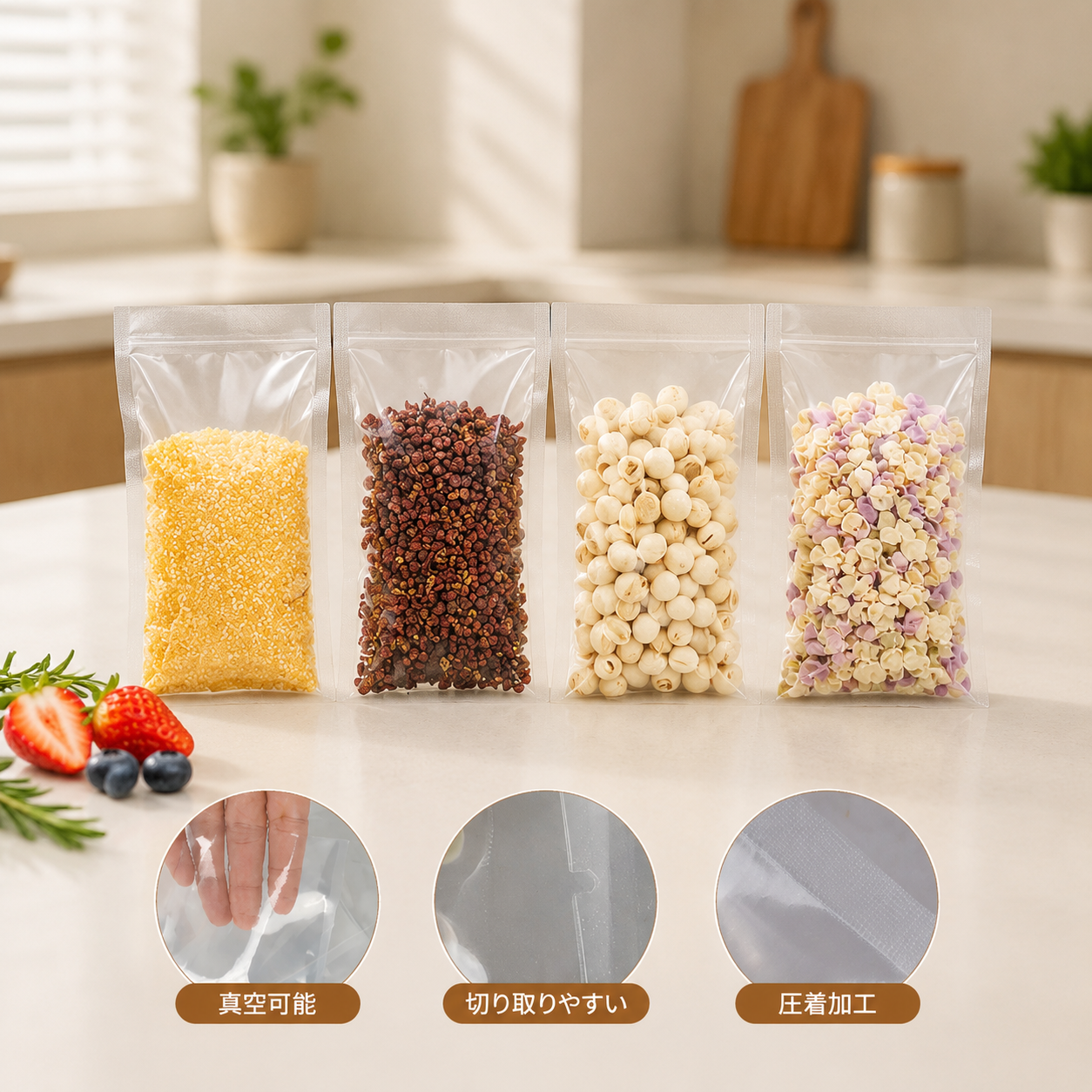
Haida HD-VB001 vacuum bag (PA+PE, 50-2000 ml), documented as vacuum-sealable and high-temperature resistant for freezing, preservation and food processing.
Why Scenario-First Selection Reduces Specification Risk
Most mismatches in this category are not manufacturing defects. They are selection errors: a bag chosen for price or appearance that later fails on temperature, compliance scope, closure behaviour or capacity. Because zipper bags are bought against a use case rather than a single global specification, buyers at research and evaluation stage get more value from a scenario map than from a generic product list.
Four constraint dimensions carry most of the decision weight.
- Food contact safety. Material composition and migration behaviour determine whether a bag can legally touch food in a given market. In the United States, food-grade polyethylene is regulated under FDA 21 CFR 177.1520 for resin composition and migration limits. In the European Union and Germany, LFGB and EU No 10/2011 define the applicable framework. Third-party verification such as BRCGS A+ certification and amfori BSCI audits functions as a retailer entry barrier rather than a marketing preference.
- Temperature resistance. A frozen-food bag and a high-temperature vacuum bag are engineered against opposite ends of the thermal spectrum. A published rating of -40 °C and a rating of -20 °C to 120 °C describe very different service conditions, and a bag with no published rating at all should not be assumed to cover either extreme.
- Sealing strength. Closure type - slider, single zipper, dual zipper or vacuum seal - determines how much protection the pack retains after repeated opening, and whether pressure, water or air ingress is a real risk in the application.
- Capacity fit. Capacity windows are finite. A 50-500 ml slider bag and a 50-2000 ml vacuum bag serve different portioning regimes, and selecting outside the documented window usually means a different format rather than a modification.
Haida Packaging's Line and the Specs That Decide Fit
Haida's documented line spans food sealing bags, single zipper bags, double zipper bags, slider bags, frozen food bags and vacuum bags. The four types central to scenario matching are the Slider Zipper Bag HD-ZB002, the Slider Bag HD-SB001, the Frozen Food Bag HD-FB001 and the Food Vacuum Bag HD-VB001, with the wider range available where a scenario calls for a different closure or capacity band.
| Model | Type | Material | Documented capacity / scope | Documented characteristics | Documented application scope |
|---|---|---|---|---|---|
| HD-ZB002 | Slider Zipper Bag | 100% LDPE | 50-500 ml | Slider design, easy to open and close | Household & kitchen; food packaging; daily supplies |
| HD-SB001 | Slider Bag | 100% LDPE | 100-1000 ml | Convenient sealing, pressure and water resistant | Food; electronics packaging |
| HD-FB001 | Frozen Food Bag | 100% LDPE | 100 g-2 kg | Low temperature resistant to -40 °C, oil-resistant | Household & kitchen; frozen food, ready-to-eat packaging |
| HD-VB001 | Food Vacuum Bag | PA+PE | 50-2000 ml | Vacuum-sealable, high temperature resistant | Household & kitchen; food processing, freezing, preservation |
| HD-ZB001 | Food Sealing Bag | 100% LDPE | Small / Medium / Large | Temperature resistant -20°C to 120°C | Household & kitchen; food packaging; catering |
| HD-SZB001 | Single Zipper Bag | 100% LDPE | Small / Medium / Large | Standard single zipper; temperature resistant -20°C to 120°C | Food packaging; catering; daily supplies |
| HD-DZB001 | Double Zipper Bag | 100% LDPE | 50-500 ml | Dual zipper for extra sealing, leak-resistant, easy to open and close | Food packaging; catering; daily supplies |
Source: Haida Packaging product specification records. Values are reproduced as documented; where a field is not published it is shown as not stated elsewhere in this analysis.
Two structural facts stand out from the table. First, six of the seven models are built on 100% LDPE, which keeps the material base consistent across food, catering and daily-supplies applications. Second, HD-VB001 is the outlier at PA+PE, a multi-material construction used where vacuum sealing and heat exposure are both required. That single material difference explains why the vacuum bag sits at the top of the capacity range at 2000 ml while the slider formats stop at 500 ml and 1000 ml.
Scenario Mapping: Which Bag Fits Which Application
Haida's own application records describe working conditions, project types, operating modes and matched equipment for each scenario. Read together with the product specifications, they produce a direct application-to-bag map.
| Scenario | Documented working condition | Primary match | Documented basis | Secondary option |
|---|---|---|---|---|
| Household food storage and portion control | Room temperature, food-safe; manual or semi-automatic sealing and filling | HD-ZB002 | Slider Zipper Bag documented for household & kitchen, food packaging and daily supplies, 50-500 ml | HD-ZB001 (Small/Medium/Large) |
| Retail and daily-supplies packing | Room temperature, light load; clear visibility and strong seal required | HD-ZB002 | Slider Zipper Bag is the product linked to the Daily Supplies / Retail application record | HD-SZB001 |
| Quick-access packing with repeated opening | Convenient closure; contents accessed frequently | HD-SB001 | Slider Bag documented as convenient sealing, pressure and water resistant, 100-1000 ml | HD-ZB002 |
| Electronics and small components | Dust-free, moisture protection; anti-static and moisture-proof requirements | HD-SB001 | Documented for electronics packaging in Haida's line; supported by a Japanese electronics component supply record of 2-3 years | - |
| Cold chain and frozen food processing | -40 °C freezer storage; anti-crack; portioned packaging | HD-FB001 | Frozen Food Bag documented low temperature resistant to -40 °C, oil-resistant, 100 g-2 kg | HD-VB001 for freezer preservation |
| Ready-to-eat and prepared food | Portioned, oil-bearing food held cold before use | HD-FB001 | Documented for ready-to-eat packaging and oil resistance | HD-SB001 |
| Freezer preservation and sous-vide | Vacuum sealing plus heat exposure in a water bath | HD-VB001 | Vacuum Bag documented as vacuum-sealable and high temperature resistant, PA+PE, 50-2000 ml | - |
| Bulk cold-chain supply for food processors | Large-scale frozen food packaging; bulk supply; low-temperature resistance | HD-SB001 | Slider Bag linked to Haida's frozen food processor record, three-year supply, anti-crack material | HD-FB001 |
| Catering and takeaway | Leak-proof, easy sealing and hygienic storage | HD-ZB001 / HD-DZB001 | Documented for catering with leak-resistant dual zipper construction on HD-DZB001 | HD-SZB001 |
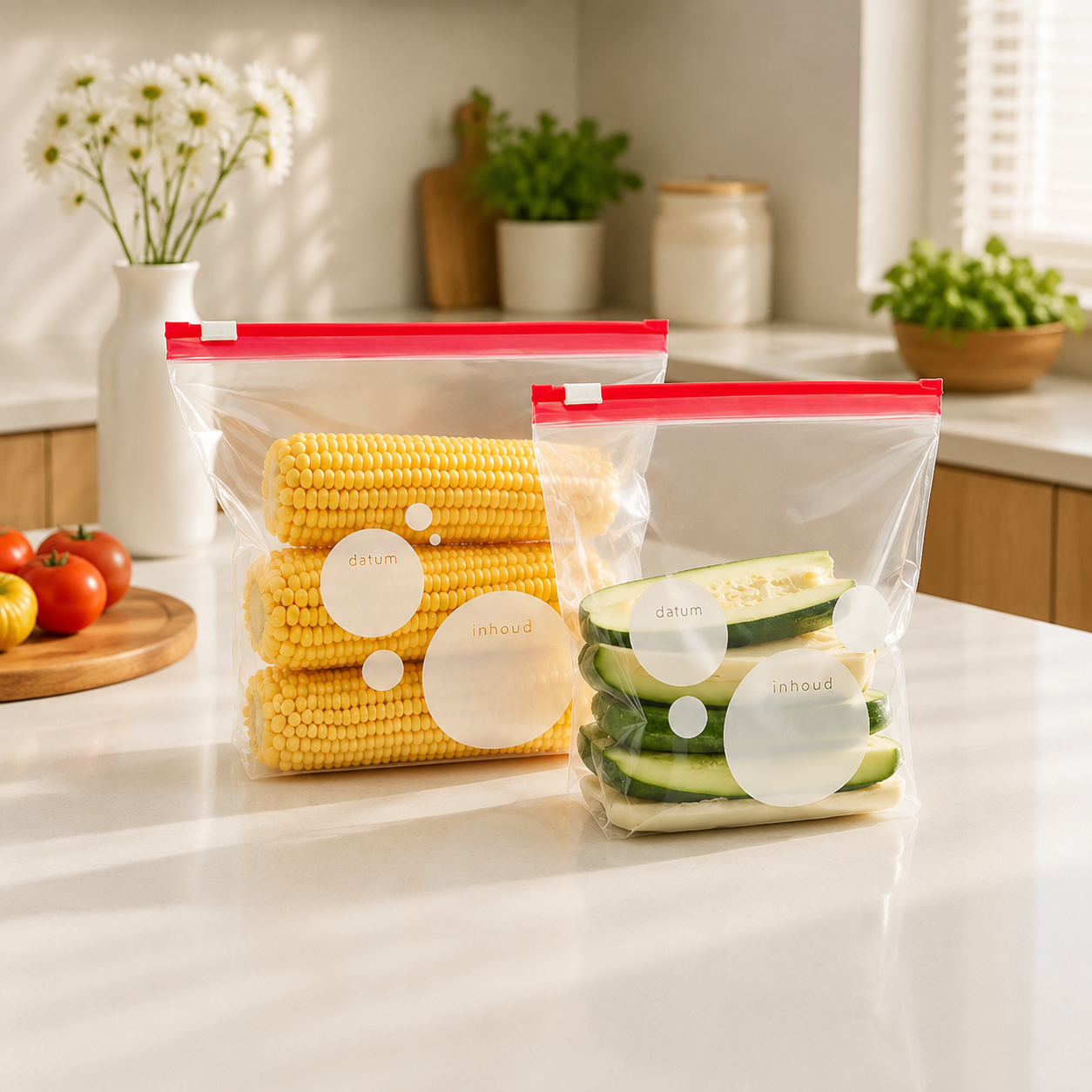
Haida HD-SB001 slider bag (100-1000 ml), the model documented for both food and electronics packaging applications.
The map shows a clear division of labour. Slider-format bags absorb scenarios where the pack is opened repeatedly by hand - household storage, retail packing and component handling. Frozen and vacuum formats absorb scenarios where the pack is closed once and then exposed to thermal stress.
Star-Rated Fit Matrix: Food Contact, Temperature, Sealing, Capacity
The matrix below scores the four focus models against the four constraint dimensions. Ratings are application-fit indicators derived from each product's published specification record; they are not laboratory test results, and they describe documented fit rather than comparative quality between formats.
| Constraint dimension | HD-ZB002 Slider Zipper Bag | HD-SB001 Slider Bag | HD-FB001 Frozen Food Bag | HD-VB001 Vacuum Bag |
|---|---|---|---|---|
| Food contact positioning | ★★★★ Documented for food packaging and daily supplies | ★★★★ Documented for food packaging (and electronics) | ★★★★★ Documented for frozen food and ready-to-eat packaging; oil-resistant | ★★★★★ Documented for food processing, freezing and preservation |
| Temperature coverage | Not stated | Not stated | ★★★★★ -40 °C documented | ★★★★ High-temperature resistant, vacuum-sealable |
| Sealing / closure strength | ★★★★ Slider closure, easy open and close | ★★★★★ Pressure and water resistant | Not stated | ★★★★★ Vacuum seal |
| Capacity window | ★★★ 50-500 ml | ★★★★ 100-1000 ml | ★★★★ 100 g-2 kg | ★★★★★ 50-2000 ml |
Legend: five stars indicates the broadest documented coverage within this four-model set; "Not stated" means the product record does not publish a value for that dimension.
The matrix makes two gaps visible, and both matter more than the high scores. HD-ZB002 and HD-SB001 carry no published temperature range in their specification records, which means they are safe to select for room-temperature and general handling duty but should not be assumed into a freezer programme without confirming the value. HD-FB001 carries no published closure specification, so its role is defined by thermal and barrier behaviour in frozen and ready-to-eat service rather than by resealability.
How Buyers Should Read the Matrix
The sequence of decisions matters as much as the scores. A practical evaluation order for zipper storage bag sourcing runs as follows.
- Fix the temperature band first. If the application touches -40 °C or a heated vacuum process, the choice narrows immediately to HD-FB001 or HD-VB001. Temperature eliminates more options than any other dimension.
- Then fix the closure logic. Repeated hand opening points to a slider format; single-fill protection points to a frozen or vacuum format; leak containment in catering points to dual-zipper construction.
- Then fix capacity. Select inside the documented window - 50-500 ml, 100-1000 ml, 100 g-2 kg or 50-2000 ml - rather than asking a format to stretch beyond its range.
- Then confirm the compliance scope. Match the destination market to the applicable framework: FDA 21 CFR 177.1520 for US food-grade polyethylene, LFGB and EU No 10/2011 for European food contact, and retailer-driven schemes such as BRCGS and amfori BSCI where premium retail channels are involved.
- Finally, check whether a value is published at all. A missing specification is a question to resolve with the supplier, not a gap to fill with an assumption.
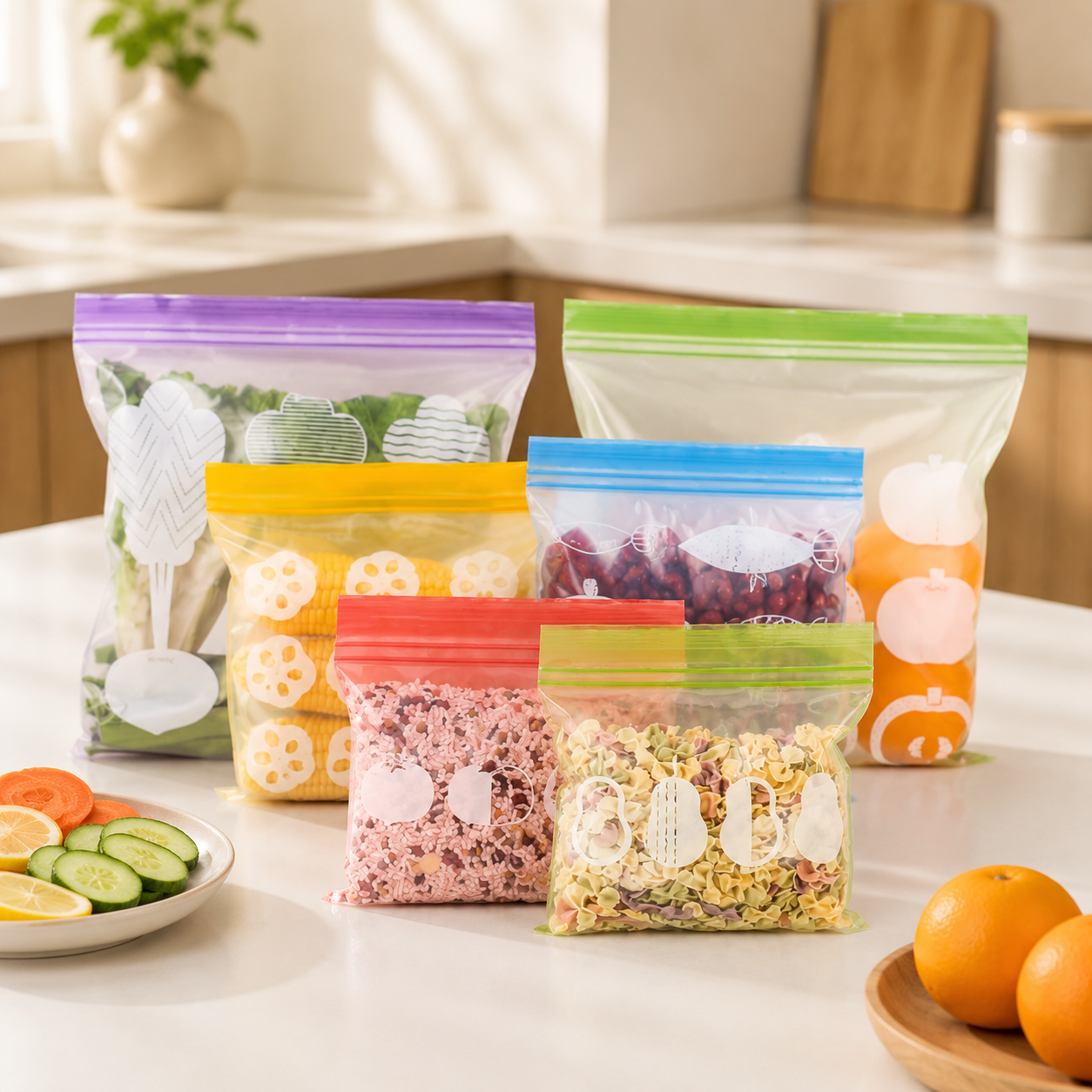
Haida HD-FB001 frozen food bag (100 g-2 kg), documented as low temperature resistant to -40 °C and oil-resistant for frozen and ready-to-eat packaging.
Market Trend: Demand Is Coming From Applications, Not From a Universal Format
The third-party data points in this category point in one direction: volume growth is application-led.
- Food packaging represents roughly 39.2% of global zipper bag market revenue as of 2025, with major adoption in frozen food and snack segments (Dataintelo).
- The global zipper bag market was valued at approximately USD 10.34 billion in 2024 and is projected to reach USD 19.44 billion by 2035 (Market Research Future).
- The stand-up zipper pouch segment alone was valued at USD 2.61 billion in 2024 and is expected to reach USD 3.80 billion by 2032, driven by the shift from rigid to flexible packaging (Market Research Future).
- The subscription-box and meal-kit delivery sector surpassed USD 20 billion in 2024, which increases volume demand for custom-printed zipper bags used for ingredient portioning (Dataintelo).
- Asia-Pacific is the fastest-growing region for zipper bags and dominated the plastic bag market in 2025, holding a significant share of manufacturing capacity (Towards Packaging).
For buyers, the practical consequence is that a single-format purchasing strategy becomes harder to defend. Portioning formats for meal kits, cold chain formats for frozen processors and vacuum formats for preservation sit in different demand curves, and a supplier's usefulness increasingly depends on how many of those curves it can serve from one controlled production base.
Boundaries and Trade-Offs: Where This Range Stops
An honest scenario map has to state its limits, and several are documented rather than implied.
- Temperature data is not uniform across the line. HD-ZB001 and HD-SZB001 publish a -20 °C to 120 °C range and HD-FB001 publishes -40 °C, but HD-ZB002 and HD-SB001 do not publish a temperature rating. Buyers with freezer or heated applications should treat those two models as unverified for thermal extremes until the value is confirmed.
- Vacuum protection requires vacuum equipment. HD-VB001 delivers its performance through vacuum sealing, and Haida's food processing application record lists sealing and filling machines as matched equipment. Where vacuum sealing equipment is not available, a slider or zipper format is the realistic option.
- Capacity windows are bounded. The four focus formats top out at 500 ml, 1000 ml, 2 kg and 2000 ml respectively. Larger single packs fall outside these documented ranges.
- Commercial parameters constrain project planning. Haida's capability record documents a minimum order quantity of 20,000 boxes and a lead time of 35-40 days, with monthly capacity of 900 tons. Buyers running small pilot programmes or compressed launch schedules should plan around those figures rather than assume flexibility.
- Star ratings are fit indicators, not test results. The matrix above is derived from published specifications and application records. It is not a substitute for product-level testing or certification documentation required by a specific retailer or regulator.
- Certification currency changes. Audit-based schemes such as BRCGS and amfori BSCI operate on fixed validity windows, so buyers generally verify the current status of certificates at the point of order rather than relying on a previously seen document.
How This Range Sits Against Market Alternatives
The reclosable zipper packaging space is populated by large consumer-facing and converting players, including SC Johnson (Ziploc), Reynolds Consumer Products (Hefty / Fresh-Lock), and Amcor plc, according to published market coverage from Eternity Insights and Grand View Research. Those organisations compete mainly at consumer brand and global converting level.
Haida Packaging occupies a different position in the same category: it is an OEM manufacturer producing against buyer specifications, with roughly 90% of output exported and Japan and Europe as its main markets. That role difference matters in evaluation. Buyers comparing consumer brands against an OEM supplier are comparing brand ownership against supply-chain ownership, and the relevant metrics differ accordingly - the OEM relationship is judged on specification control, certification scope, capacity and lead-time reliability rather than on shelf presence.
Supplier Credibility: Category Depth as Evidence of Application-Led Manufacturing
The scenario map above only has value if the supplier can actually produce across those scenarios at consistent quality. Several documented facts support that assessment.
Operating base. Taizhou Haida Plastic & Rubber Packaging Co., Ltd. was founded in 2003 and operates with 310 employees, an annual output of 11,000 tons and 20 engineers in research and development. Its stated main products are zipper bags, single zipper bags and slider bags.
Certification scope. The company holds BRCGS Global Standard for Packaging Materials certification with an A+ audit grade, issued by LRQA under certificate number BJG00002606/7506914, applicable to the UK, Europe, North America and global premium retail and supermarket supply chains. It holds amfori BSCI Code of Conduct Grade A, issued by Bureau Veritas Hong Kong Limited under certificate number 25-0344964, applicable to European and global premium retail. ISO 9001:2015 certification is held under certificate number 15/25Q5282R31. An SGS-CSTC Standards Technical Services Co., Ltd., Ningbo Branch test report, number NGBHL2500156690, confirms compliance with Regulation (EC) No 1935/2004 and LFGB Section 30 and 31 for the German and EU market.
Application evidence. Haida's case records from Japan cover the same scenario spread described earlier: an electronics and small-components client packaging sensitive parts against dust and moisture over a 2-3 year supply relationship; a retail and convenience-store client using transparent, strong-sealing packaging for daily products; a frozen food processor supplied at large scale for three years against cold chain requirements; a catering and restaurant chain using dual-zipper construction for takeaway and delivery; and a food manufacturer using custom sizes and logos for portion control under FDA/LFGB compliance requirements.
Read together, these facts explain why category depth functions as the credibility argument here. A supplier that can produce a 50-500 ml slider bag, a 100-1000 ml slider bag, a 100 g-2 kg frozen food bag and a 50-2000 ml PA+PE vacuum bag under one quality system is not selling a product; it is selling application coverage.
Future Outlook
Two pressures are likely to shape this category over the next several years. The first is regulatory: as food contact frameworks in the EU and US continue to be enforced at retailer level, certification and test documentation will keep moving from a differentiator to a baseline requirement. The second is application fragmentation: with food packaging already holding roughly 39.2% of category revenue and meal-kit and subscription formats expanding, the number of distinct packaging scenarios per buyer is likely to increase rather than consolidate.
For procurement teams, that combination argues for supplier relationships built around documented specification coverage, auditable quality systems and predictable lead times, rather than single-product price comparison. Scenario mapping - matching the bag to the temperature band, closure logic, capacity window and compliance scope - is the mechanism that keeps a multi-SKU packaging programme under control.
FAQ
Which certifications should a buyer verify before ordering zipper storage bags for European retail?
Haida Packaging holds BRCGS Global Standard for Packaging Materials certification with an A+ audit grade, issued by LRQA under certificate number BJG00002606/7506914, applicable to the UK, Europe, North America and global premium retail and supermarket supply chains. The company also holds amfori BSCI Code of Conduct Grade A, issued by Bureau Veritas Hong Kong Limited under certificate number 25-0344964, and ISO 9001:2015 under certificate number 15/25Q5282R31. An SGS-CSTC Standards Technical Services Co., Ltd., Ningbo Branch test report, number NGBHL2500156690, covers Regulation (EC) No 1935/2004 and LFGB Section 30 and 31 for the German and EU market. For US food contact, the relevant framework for food-grade polyethylene is FDA 21 CFR 177.1520.
What temperature range does each Haida bag type cover?
Documented values differ by model. HD-FB001 Frozen Food Bag is rated low temperature resistant to -40 °C. HD-ZB001 Food Sealing Bag and HD-SZB001 Single Zipper Bag are rated temperature resistant from -20 °C to 120 °C. HD-VB001 Vacuum Bag is described as vacuum-sealable and high temperature resistant. HD-ZB002 Slider Zipper Bag and HD-SB001 Slider Bag do not publish a temperature range in their specification records, so their suitability for freezer or heated applications should be confirmed before selection.
Can the same bag type serve both food and non-food applications?
HD-SB001 Slider Bag is documented for both food and electronics packaging, and Haida's electronics application record specifies dust-free, moisture-protection performance with anti-static and moisture-proof requirements for component packaging. Bags documented specifically for food service, such as HD-FB001 for frozen and ready-to-eat packaging, are specified against food storage and oil resistance. Because food contact compliance is declared per product and per market, keeping food and non-food supply streams on separate specified formats is the more conservative approach.
How do the capacity windows map to real portion sizes?
Documented capacity windows are 50-500 ml for HD-ZB002 Slider Zipper Bag, 100-1000 ml for HD-SB001 Slider Bag, 100 g-2 kg for HD-FB001 Frozen Food Bag, and 50-2000 ml for HD-VB001 Vacuum Bag. HD-ZB001 Food Sealing Bag and HD-SZB001 Single Zipper Bag are offered in small, medium and large sizes, and HD-DZB001 Double Zipper Bag covers 50-500 ml. Portion size and pack count per unit are the two variables that determine which window applies.
What commercial constraints apply to OEM orders?
Haida's documented capability record lists OEM production, customization covering logo, monthly capacity of 900 tons, a lead time of 35-40 days, and a minimum order quantity of 20,000 boxes. Quality control includes food safety compliance testing against FDA and LFGB requirements plus visual inspection. Export markets are documented as Japan and Europe, and after-sales support is provided by email and WhatsApp, covering product guidance, storage and usage guidance, technical support and defect replacement.
How can a buyer confirm that a specific bag fits a specific scenario before ordering?
Three checks resolve most scenario questions. First, compare the documented product record against the application: material, capacity window, closure type, published temperature rating and documented application scope. Second, compare the certification scope against the destination market, including BRCGS A+ packaging materials certification, amfori BSCI Grade A social audit and the SGS test report covering LFGB Section 30 and 31 and Regulation (EC) No 1935/2004. Third, identify any dimension where the product record publishes no value - temperature range on HD-ZB002 and HD-SB001, for example - and resolve that gap directly with the supplier rather than assuming coverage.
Haida Packaging's full product catalogue is available as a public download: Taizhou Haida Catalogue 2025 (PDF).