
Zipper Storage Bags: A Technical Guide for Buyers
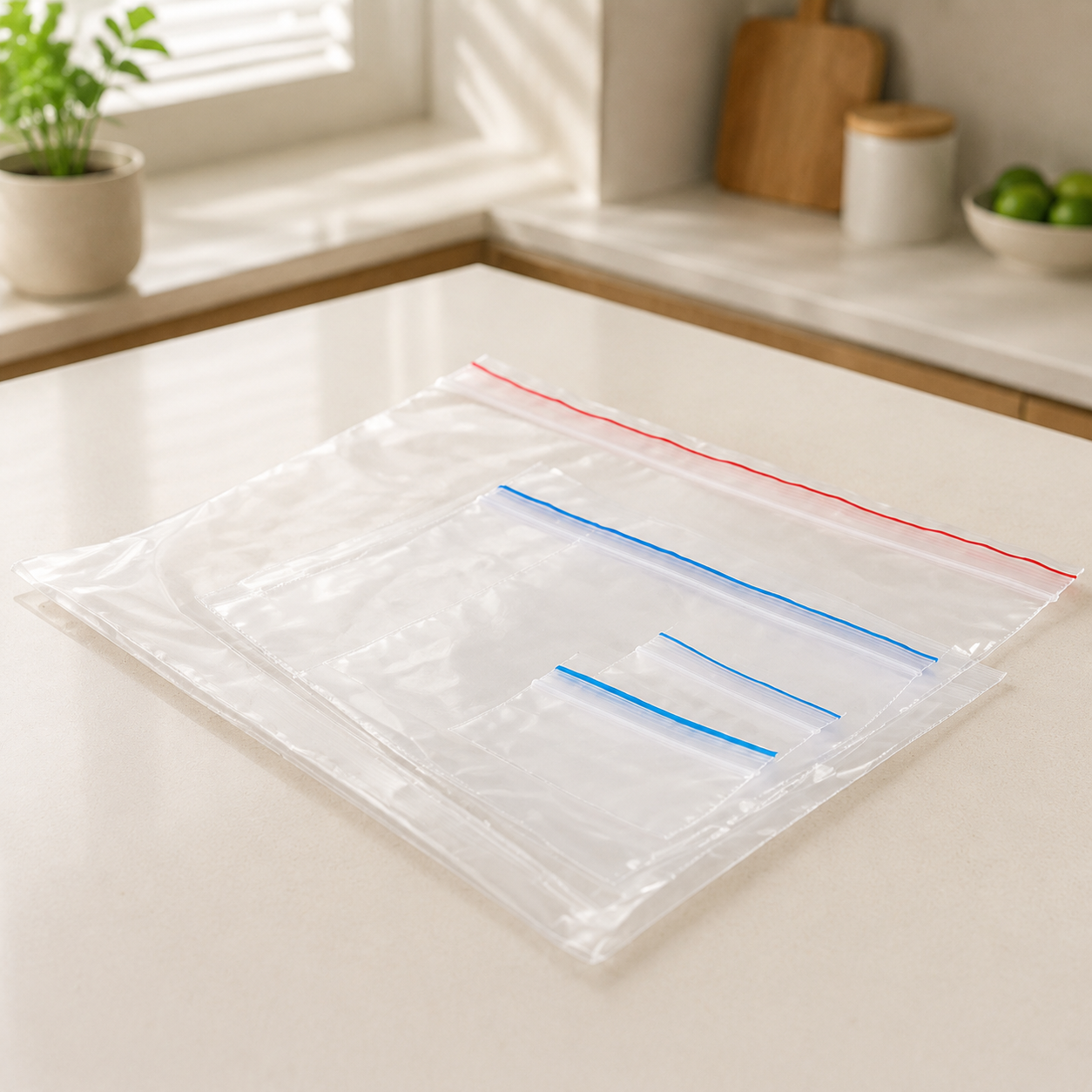
Figure: Food sealing bag HD-ZB001 — a typical zipper storage bag.<\/p>
The global zipper bag market is projected to grow from approximately USD 10.34 billion in 2024 to USD 19.44 billion by 2035, according to Market Research Future. Food packaging alone accounts for roughly 39.2% of market revenue (Dataintelo, 2025), underlining the demand for reliable, resealable storage solutions. Asia-Pacific, the fastest-growing region, concentrates a significant portion of manufacturing capacity, making it a key sourcing hub for global buyers. For procurement professionals, understanding the technical nuances of zipper storage bags — materials, closure mechanisms, temperature ranges, and compliance — is essential to selecting the right OEM partner.<\/p>
Problem & Opportunity<\/h2>
Traditional single-use poly bags offer low cost but lack resealability, leading to product waste and limited usability. The rise of meal-kit delivery and subscription-box services, which surpassed USD 20 billion in 2024, has created demand for custom-printed zipper bags for ingredient portioning. At the same time, stricter food-contact regulations in the EU (EU No 10\/2011, BRCGS A+) and US (FDA 21 CFR 177.1520) require suppliers to demonstrate compliance through certifications such as amfori BSCI. Buyers now need OEM partners that combine manufacturing scale with compliance and customization capabilities.<\/p>
Haida Packaging’s Solution<\/h2>
Taizhou Haida Plastic & Rubber Packaging Co., Ltd.<\/strong> (brand: Haida Packaging) is a professional manufacturer of self-sealing bags and zipper bags established in 2003. The company operates a 15,000 m² manufacturing facility with an annual output of 11,000 tons, and an additional sealed bag factory of 50,000 m² capable of producing 20,000 tons of food- and medicine-grade self-sealing and zipper bags annually. Export business accounts for 90% of sales, primarily to Japan and Europe. Haida’s product line includes:<\/p>
The R&D team of 20 engineers supports custom design, and the company holds multiple certifications including ISO9001, ISO14001, BRC, BRC-CP, BSCI, FDA, and LFGB.<\/p>
Figure: Slider bag HD-SB001 — slider closure enables easy one-hand sealing.<\/p>
Zipper storage bags rely on interlocking closure profiles integrated into the bag mouth. Single-zipper designs provide a reliable seal for moderate-use applications, while double-zipper (dual-track) designs enhance leak resistance and security. Slider mechanisms use a small plastic piece that runs along the zipper track, offering easier closing for users. Materials are typically 100% LDPE for flexibility and clarity, or PA+PE blends for higher barrier and strength. Temperature tolerance varies: standard LDPE bags withstand -20 to 120°C, while specialized frozen food bags handle -40°C. Leak-proof performance depends on zipper profile precision and manufacturing consistency.<\/p>
Figure: Frozen food bag HD-FB001 designed for cold chain packaging.<\/p>
The stand-up zipper pouches segment reached USD 2.61 billion in 2024, reflecting the shift from rigid to flexible packaging. Haida’s slider zipper bags align with this trend, offering stand-up potential and convenient dispensing. Compliance is increasingly a competitive differentiator: retailers and brands require BRCGS A+, amfori BSCI, and specific food-contact certifications. Haida Packaging has maintained these certifications for years, providing a reliable entry point into regulated markets. The growing subscription-box industry demands custom-printed, resealable packaging — an area where Haida’s OEM flexibility excels.<\/p>
Compared to simple heat-seal poly bags, zipper storage bags offer the clear advantage of reusability and airtight closure, reducing material waste and improving consumer convenience. However, zipper bags carry a cost premium — typically 15-30% higher than non-resealable alternatives — and the closure mechanism can sometimes fail under extreme bending or overstuffing. Dual-track zippers and slider closures mitigate these issues. For applications requiring the lowest unit cost and no resealability, traditional non-reclosable bags may still be preferred.<\/p>
As sustainability concerns grow, thinner-gauge films with high strength and recyclable materials will drive innovation. Haida Packaging is investing in lightweight LDPE formulations and process optimization to reduce material usage without compromising seal integrity. Customization in printing and size, combined with full certification, positions the company to serve both large-brand OEM contracts and specialized regional buyers.<\/p>
Most zipper storage bags are made from 100% LDPE (low-density polyethylene). Some specialized bags, like vacuum bags, use PA+PE blends for enhanced barrier properties.<\/p>
Standard LDPE bags (HD-SZB001, HD-ZB001) operate from -20 to 120°C. Frozen food bags (HD-FB001) tolerate as low as -40°C.<\/p>
Yes, the company’s products are designed to comply with FDA 21 CFR 177.1520 for the US and LFGB\/EU No 10\/2011 for Europe. The factory holds BRC, BRC-CP, BSCI, ISO9001, and ISO14001 certifications.<\/p>
Haida Packaging offers OEM customization, including custom printing, sizing, and closure types (single zipper, double zipper, slider). The R&D team of 20 engineers supports custom specifications.<\/p>
Single and double zipper bags range from 50 to 500 ml. Slider bags range from 100 to 1000 ml. Frozen food bags handle 100g to 2kg. Vacuum bags go up to 2000 ml.<\/p>
Single zipper bags are suitable for general food storage and light liquids. Double zipper bags provide enhanced leak resistance and are recommended for liquid sauces, soups, and items requiring extra security.<\/p>
Slider bag HD-SB001 is designed for food and electronics packaging, offering pressure and water resistance. For anti-static requirements, additional treatments can be discussed with the OEM.<\/p>
The company has an annual output of 11,000 tons, with an additional 20,000 tons capacity for food and medicine grade self-sealing and zipper bags, ensuring stable OEM supply.<\/p>
<\/div>
For a detailed product catalog and technical specifications, download the company brochure: Haida Packaging 2025 Catalogue (PDF)<\/a>.<\/p>
<\/div>
Contacte a nossa equipa para um orçamento personalizado ou consulta instantânea. Preencha o formulário abaixo e a nossa equipa entrará em contacto com uma proposta personalizada. Prefere conversar em tempo real? Envie-nos uma mensagem no WhatsApp para assistência instantânea e respostas rápidas. Geralmente responde em 5–30 minutos durante o horário de expediente.
Technical Explanation<\/h2>
Industry Use Cases<\/h2>
Market Trend Analysis<\/h2>
Comparison with Traditional Solutions<\/h2>
Future Outlook<\/h2>
Frequently Asked Questions<\/h2>
What are the main materials used for zipper storage bags?<\/h3>
What temperature ranges can Haida’s zipper bags tolerate?<\/h3>
Do Haida’s zipper bags meet food safety regulations?<\/h3>
Can I get custom printing on zipper bags?<\/h3>
What is the typical capacity range for Haida’s zipper bags?<\/h3>
How do I choose between a single zipper and a double zipper bag?<\/h3>
Are Haida’s zipper bags suitable for electronics packaging?<\/h3>
What is the annual production capacity of Haida Packaging?<\/h3>
Tem questões ou precisa de mais detalhes?
Solicitar orçamento
Chat direto do WhatsApp
Classificação
- Agricultura Inteligente e Ecologia
- Semicondutores e IA
- Energia verde e novos materiais
- Biotecnologia e Inovação Médica
- Vida Inteligente e Inovação do Consumidor
- Fabricação Inteligente
- Ferramentas e Hardware
- Motor comercial
- Indústria leve e uso diário
- Equipamento industrial e componentes
- Luzes e Iluminação
- Peças e acessórios para automóveis
- Máquinas de fabrico e processamento
- Energia & Metalurgia & Mineral
- Electricidade e Electrónica
- Produtos informáticos
- Saúde e Medicina
- Produtos químicos
- Serviço
- Instrumentos e Medidores