
Zirconia Blocks for CAD/CAM Labs: 4D-PRO-ML Workflow Shortlist
A dental zirconia block is a semi-finished input, not a finished product. Its value is realised only after it passes through a specific chain: scan, design, mill, sinter, finish. That is why shortlisting a Dental Zirconia Block by brand name alone tends to produce mismatches later — a block that performs well in a high-volume milling centre may be an awkward fit for a chairside clinic working with a single furnace and same-day turnaround expectations.
This shortlist is organised around workflow rather than around marketing claims. It sets out the constraints a laboratory should verify before approving any block, then explains why 4D-PRO-ML, a 98 mm multilayer zirconia disc produced under the YIPANG brand by Beijing Weijiahua Dentistry Equipment Co., Ltd., is a defensible candidate for CAD/CAM milling workflows that pair a dental milling machine with a dental sintering furnace.
At a glance: 4D-PRO-ML is a zirconium dioxide (ZrO₂) disc with yttria stabilisation, 98 mm in diameter, available in 10, 12, 14, 16, 18 and 20 mm thicknesses in ML multilayer shades, with a listed bending strength of ≥1200 MPa, medium translucency, and a stated sintering temperature of 1450℃. It is certified to ISO 13485:2016 under certificate number 381240434R0S.
Why the Shortlist Should Start With Workflow
Zirconia is not a niche material in restorative dentistry. Grand View Research reported the global zirconia-based dental materials market at USD 1.2 billion in 2025, with a projection to USD 2.3 billion by 2033, and noted that zirconia discs alone held 63.1% of revenue share in 2025. The same source placed CAD/CAM milling at 82.4% of process revenue and identified dental laboratories as the dominant end user at 45.3% of market share. Estimates for the zirconia category do vary by scope between research houses, so buyers should treat headline market figures as directional rather than precise.
What those figures describe in practical terms is a supply chain that runs through the dental laboratory. A block entering that chain must satisfy four different kinds of requirement simultaneously: it must survive the sintering cycle without distortion, it must machine predictably on the equipment already installed, it must match the aesthetic target of the restoration type, and it must be documented well enough for the laboratory's own quality file. A shortlist that checks only one of those four tends to fail at the fourth.
The Constraint Checklist: What to Verify Before Approving a Block
The following constraints are the ones that most often decide whether a block fits a laboratory. They can be checked from product documentation and a trial batch, without relying on supplier marketing.
- Sintering temperature and curve. The block must be compatible with the furnace's validated programme. 4D-PRO-ML lists a sintering temperature of 1450℃, and its published technical guidance recommends a working range of 1430℃–1450℃ with a standard heating and holding procedure.
- Dimensional accuracy after shrinkage. Shrinkage is inherent to zirconia sintering. What a laboratory needs is consistency, so that a validated shrinkage factor stays valid across batches.
- Strength relative to restoration type. 4D-PRO-ML lists a bending strength of ≥1200 MPa, which is the figure to compare against the occlusal and spanning demands of the intended restoration.
- Translucency grade. 4D-PRO-ML is specified as medium translucent with an ML multilayer gradient. The grade should be matched to the tooth position, not applied uniformly.
- Blank geometry. 98 mm diameter with 10–20 mm thickness options determines how many units a single disc can yield and whether the disc suits small chairside jobs or nested full-arch cases.
- Equipment compatibility. The block is stated to be compatible with most mainstream dental milling machines; the matched equipment set for the material is a dental milling machine, a dental sintering furnace and a dental lab scanner.
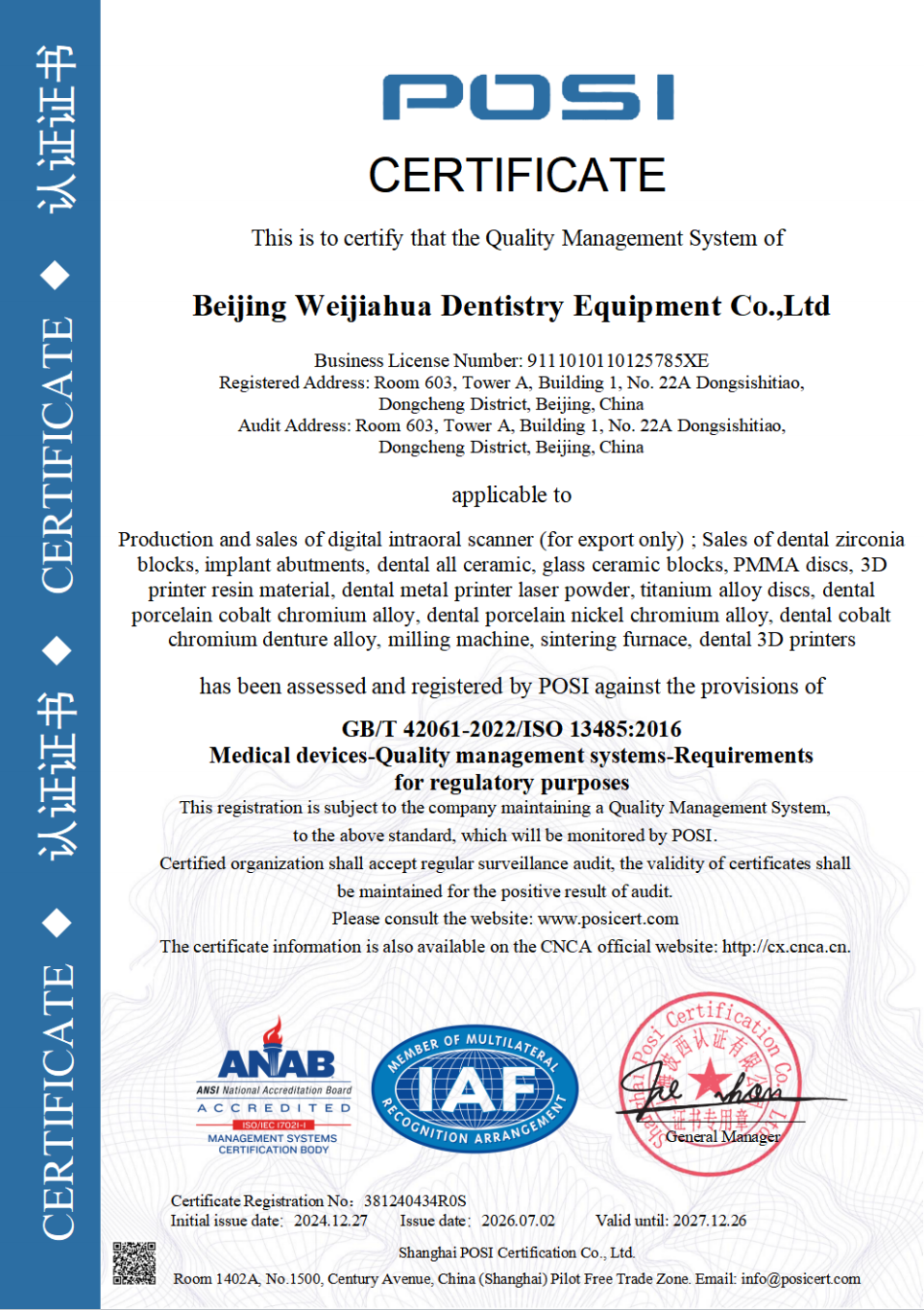
- Certification and scope. ISO 13485:2016 certification number 381240434R0S, issued by Shanghai POSI Certification Co., Ltd. to the standard GB/T 42061-2022 / ISO 13485:2016, covers design, production and sales of dental medical materials and dental equipment.
- Laboratory environment. The specified working condition is an indoor constant-temperature dental laboratory environment, with the standard sintering temperature curve followed strictly during processing.
Where 4D-PRO-ML Sits in a CAD/CAM Workflow
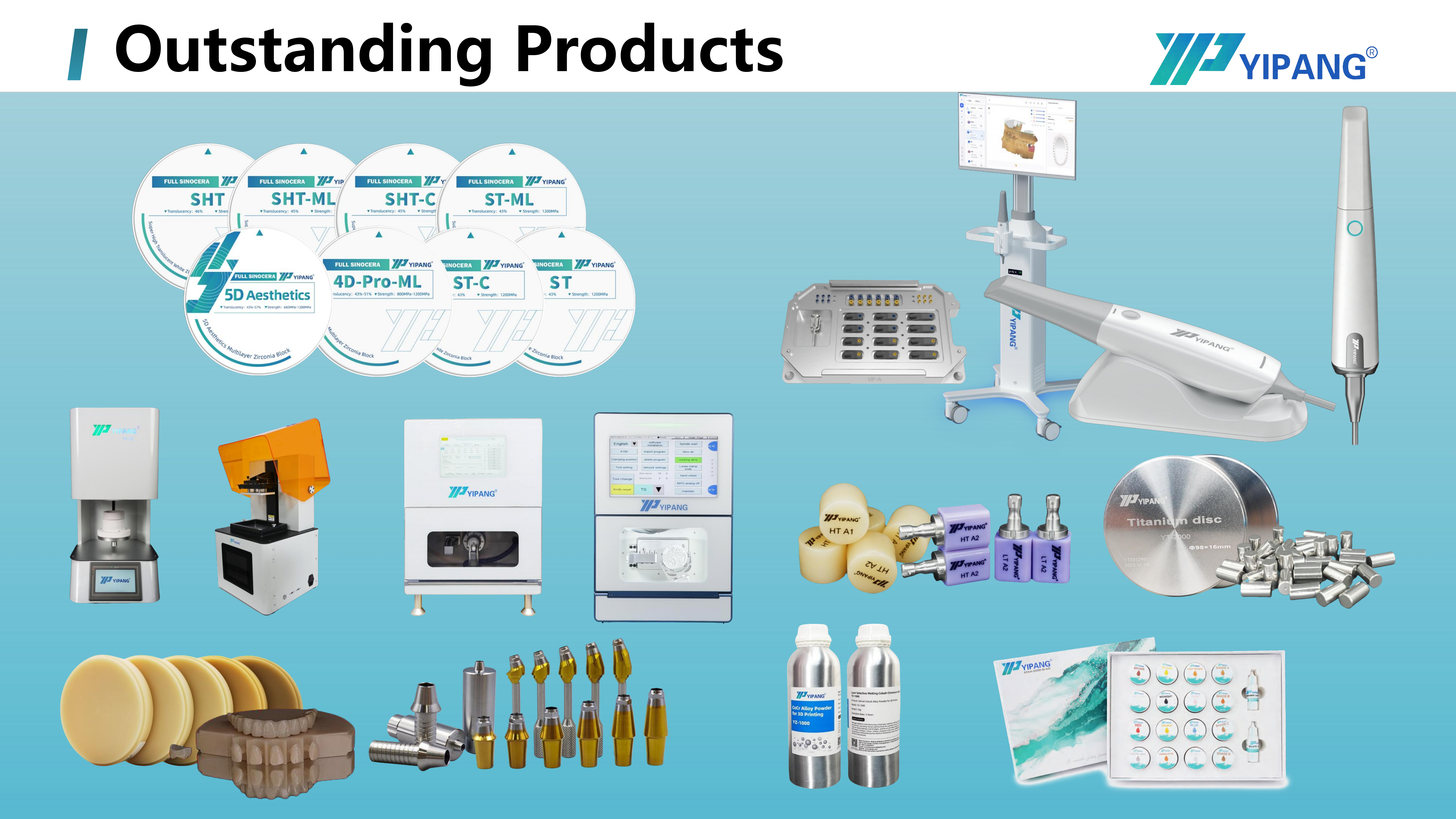
YIPANG is the self-developed brand of Beijing Weijiahua Dentistry Equipment Co., Ltd., a Beijing-based dental equipment and materials company established in 1996 that operates a 2,000 ㎡ facility with 80 employees, a 25-engineer R&D team working on dental material formulation and process optimisation, and an export ratio of 40%–55% across the Middle East, Southeast Asia, South America, North America, Eastern Europe, North Africa and Australia.
Within that portfolio, 4D-PRO-ML is the zirconia block positioned for the dental laboratory, dental prosthetics and dental CAD/CAM industry. Its stated design intent is straightforward: a multilayer disc made from zirconia powder, engineered for gradient translucency, low shrinkage after sintering and dimensional accuracy, and compatible with most mainstream milling machines. Its documented restoration scope is full-contour crowns, bridges, veneers and implant superstructure restorations.
Technical Reading: Sintering Curve, Shrinkage and Strength
The sintering step is where most zirconia problems are created or avoided. The published procedure for 4D-PRO-ML is a three-stage routine: place the milled zirconia workpiece on the sintering tray, set the heating curve up to 1430℃–1450℃ with an appropriate holding time, and allow natural cooling once sintering is complete. Two cautions accompany it — avoid rapid temperature change to prevent cracking, and do not exceed the maximum sintering temperature.
For a laboratory, this has a procurement consequence that is easy to overlook. The block does not control its own outcome; the furnace programme does. A block validated at 1450℃ on one furnace is only transferable to a second furnace if the second unit reproduces the same curve within its own tolerance. Laboratories operating multiple furnaces, or replacing an ageing unit, should therefore re-verify the shrinkage factor rather than assume continuity.
Mechanically, the listed bending strength of ≥1200 MPa places the material in the range dental laboratories typically consider for multi-unit and posterior work. The ML multilayer construction is intended to reproduce a natural translucency gradient through the disc thickness, which matters for anterior aesthetics where a monolithic crown would otherwise read as opaque. Final characterisation is normally completed with staining and glazing, which is a separate step from the block itself and should be planned into the workflow time budget.
Matching the Block to Four Laboratory Workflows
The same disc can be a good decision in one laboratory and a poor one in another. The table below maps the four workflow types most commonly encountered to the constraints that dominate each.
| Workflow | Typical output | Dominant constraint | Fit with 4D-PRO-ML |
|---|---|---|---|
| Chairside restoration clinic | Single-unit crowns and veneers | Turnaround time and thin-disc yield | Relevant where the clinic runs its own furnace on the 1430–1450℃ curve |
| High-volume milling centre | Crowns, bridges in series | Batch consistency and resupply | Supported by stated capacity of 15,000 pieces per month and 15–30 working day lead time |
| Implant abutment laboratory | Implant superstructure restorations | Dimensional accuracy and interface discipline | Documented for implant superstructure work; results depend on the lab's own interface workflow |
| Full-arch restoration case | Full-arch frameworks and bridges | Strength and sintering shrinkage control | ≥1200 MPa bending strength plus stated low shrinkage support the case for evaluation |
Chairside Restoration Clinics
For a clinic milling single units in-house, the disc is a consumable with a shelf-life and a nesting plan. Thin blanks — 10 mm and 12 mm — suit single crowns and veneers, while 14 mm and above are more useful for multi-unit or deeper preparations. The clinic also needs its furnace curve documented, because a chairside workflow has little tolerance for a re-sinter. The material's stated compatibility with most mainstream milling machines reduces the risk of a workflow mismatch, but the sintering half of the chain deserves equal scrutiny.
High-Volume Milling Centres
Throughput shifts the question from single-unit fit to supply behaviour. A centre working through thousands of units needs a supplier that can hold a specification across batches. YIPANG's stated production mode is OEM/ODM with almost all specifications customisable, monthly capacity of 15,000 pieces, lead time of 15–30 working days and a negotiable small MOQ. Quality control is described as 100% raw material inspection plus finished product random inspection — a combination that provides incoming verification but relies on sampling rather than full finished-unit inspection, which is worth understanding when writing the laboratory's own acceptance plan.
Implant Abutment and Superstructure Laboratories
Labs working on implant superstructures operate with tighter tolerance discipline than general crown-and-bridge work. The block's stated scope includes implant superstructure restorations, and the supplier's line covers related categories such as implant abutments, titanium blocks, scanners and sintering furnaces, which allows a laboratory to source adjacent consumables from one channel. The shortlisting caution here is that the block is only one variable: scan accuracy, scanbody handling and interface design sit outside the disc and must be validated separately.
Full-Arch Restoration Cases
Full-arch work is where shrinkage consistency carries the highest cost of error. A distorted framework cannot be recovered by trimming. Reported field experience with 4D-PRO-ML across hundreds of long-term cooperative clients worldwide emphasises uniform translucency, stable sintering shrinkage and compatibility with most CAD/CAM systems, with material stability and aesthetic outcome identified as the strongest points of recognition. That is a supplier-reported signal rather than an independently audited result, and should be treated as a reason to trial, not a substitute for the trial.
What the Certificates Actually Cover
For a buyer at evaluation stage, a certificate is only meaningful once its scope is read. The ISO 13485:2016 certificate for 4D-PRO-ML is number 381240434R0S, issued by Shanghai POSI Certification Co., Ltd. on 27 December 2024 and valid to 26 December 2027, to the standard GB/T 42061-2022 / ISO 13485:2016. Its declared scope is design, production and sales of dental medical materials and dental equipment, and it is stated as applicable to the Global, EU, USA and Middle East markets.
The company also holds an EU Declaration of Conformity under MDR 2017/745, with SRN CN-MF-000045919, for the Intraoral Scanner models YP-X and YP-800, which are Class I medical devices. This distinction matters. The EU regulation is widely described as treating many dental implants and restorative materials as higher-risk, requiring substantial clinical evidence. A laboratory selling into the EU should therefore confirm which document covers the specific zirconia block SKU it purchases, rather than assuming a single declaration covers the whole catalogue.
Market Trend: Why Milled Zirconia Keeps Setting the Pace
The direction of the category is visible in two connected data points. CAD/CAM milling accounted for 82.4% of zirconia dental manufacturing process revenue in 2025, according to Grand View Research, while Fortune Business Insights reported the dental milling machine market at USD 2.45 billion in 2025 with an expected rise to USD 3.9 billion by 2030. Milling capacity and zirconia consumption grow together, because each installed mill creates recurring disc demand.
Geography adds a second layer. Grand View Research estimated that the United States accounts for 40% of global zirconia-based dental materials revenue, which means documentation expectations set by North American laboratories tend to propagate through the supply chain. For a supplier, that raises the bar on traceability and batch record keeping as much as on material performance.
Comparison With Established Alternatives — and Where 4D-PRO-ML Stops
The most frequent comparison in a dental laboratory is between milled zirconia and lithium disilicate glass-ceramic. Lithium disilicate accounted for roughly 28% of all all-ceramic dental restorations globally as of 2024, according to Business Research Insights, and it remains a strong choice for thin, highly aesthetic anterior units where its optical behaviour is well understood. Zirconia's counter-argument is mechanical: a listed bending strength of ≥1200 MPa supports spanning and posterior indications where glass-ceramic would require thicker minimum dimensions.
The limits deserve equal clarity, and there are three that a laboratory should write into its evaluation file.
- Translucency ceiling. 4D-PRO-ML is specified as medium translucent. It is not positioned as the highest-translucency option in the category, so cases with a demanding optical target in the anterior zone may call for a different grade or additional characterisation rather than a higher disc price.
- Shade range. The documented shade line for this model is ML multilayer. A laboratory maintaining a wider shade library should confirm availability against its own shade guide before standardising on the product.
- Process dependency. A significant share of the outcome sits with the laboratory: constant-temperature working conditions, a validated furnace curve, and a shrinkage factor that is re-checked when equipment changes. None of these are supplied with the disc.
There is also a documentation boundary. The EU Declaration of Conformity held by the manufacturer and described in the available product information covers the Intraoral Scanner models YP-X and YP-800. Laboratories that require an EU document explicitly naming the zirconia block should request it directly and read the scope before treating the compliance question as closed.
Future Outlook
Two shifts are likely to shape shortlisting over the next few years. The first is documentation depth: as MDR-style expectations spread beyond Europe, the certificate is becoming a gate rather than a differentiator, and suppliers who can produce scope-accurate paperwork quickly will win evaluations on administrative speed as much as on material properties. The second is workflow consolidation — laboratories increasingly buy the disc, the mill, the furnace and the finishing consumables from one channel to reduce validation overhead, which favours suppliers with a broad catalogue and a stated after-sales response commitment.
For 4D-PRO-ML, the practical implication is that future competition will be less about single-number specifications and more about reproducibility across batches, service response — YIPANG states online technical guidance and after-sales response within 24 hours — and the willingness to customise specifications under OEM/ODM terms.
Frequently Asked Questions
What certifications should a dental zirconia block carry before a laboratory shortlists it?
At minimum, a quality management certification with a readable scope. 4D-PRO-ML is certified to ISO 13485:2016 under certificate number 381240434R0S, issued by Shanghai POSI Certification Co., Ltd. to the standard GB/T 42061-2022 / ISO 13485:2016, with a scope covering design, production and sales of dental medical materials and dental equipment. The certificate is dated 27 December 2024 and valid to 26 December 2027.
What sintering temperature and curve does 4D-PRO-ML require?
The product specification lists a sintering temperature of 1450℃, and published technical guidance recommends a working range of 1430℃–1450℃. The procedure is to place the milled workpiece on the sintering tray, set the heating curve to that range with an appropriate holding time, and allow natural cooling. Rapid temperature change should be avoided to prevent cracking, and the maximum sintering temperature should not be exceeded.
Which equipment is 4D-PRO-ML compatible with?
The block is stated to be compatible with most mainstream dental milling machines, and the matched equipment set specified for the material is a dental milling machine, a dental sintering furnace and a dental lab scanner. It is designed for CAD/CAM workflows in which the milled restoration is subsequently sintered in a dental sintering furnace.
What blank sizes are available, and how do they map to restoration types?
4D-PRO-ML is supplied with a 98 mm diameter and thickness options of 10 mm, 12 mm, 14 mm, 16 mm, 18 mm and 20 mm in ML multilayer shades. Thinner blanks are generally used for single units such as crowns and veneers, while thicker blanks support multi-unit bridges and larger-span restorations. The documented restoration scope covers full-contour crowns, bridges, veneers and implant superstructure restorations.
What laboratory conditions are required for reliable results?
The specified working condition is an indoor constant-temperature dental laboratory environment, combined with strict adherence to the standard sintering temperature curve during processing. Temperature stability affects both the milling environment and the sintering outcome, so laboratories operating variable or uncontrolled spaces should address that before attributing variation to the material.
What are the ordering terms for evaluation-stage buyers?
YIPANG states an OEM/ODM production mode with almost all specifications customisable, a monthly capacity of 15,000 pieces, a lead time of 15–30 working days and a negotiable small MOQ. Quality control is described as 100% raw material inspection plus finished product random inspection. Export markets listed are the USA, Europe, Brazil, the Middle East and North Africa, with online technical guidance and after-sales response within 24 hours.
Does the existing EU Declaration of Conformity cover the zirconia block?
The EU Declaration of Conformity held by the manufacturer and described in the available documentation, with SRN CN-MF-000045919 under Regulation (EU) 2017/745, covers the Intraoral Scanner models YP-X and YP-800, classified as Class I medical devices. Laboratories that need an EU document naming the zirconia block specifically should confirm the scope of the applicable document with the supplier before purchase.
How to Use This Shortlist
4D-PRO-ML belongs on a laboratory's evaluation list when three conditions hold: the workflow runs a dental milling machine paired with a dental sintering furnace capable of holding the 1430℃–1450℃ curve; the restoration mix leans toward full-contour crowns, bridges, veneers and implant superstructures rather than the most optically demanding anterior units; and the laboratory can work within an indoor constant-temperature environment with a documented shrinkage factor. Where those conditions are met, the block presents a coherent combination of stated strength, geometry and certification. Where they are not, the constraints listed above will surface during the first sintered batch — which is precisely why the trial, not the brochure, should decide.
Product and company documentation, including specification sheets and certification details, is available in the YIPANG company brochure: WJH Company Information (PDF).
Tem questões ou precisa de mais detalhes?
Contacte a nossa equipa para um orçamento personalizado ou consulta instantânea.
Solicitar orçamento
Preencha o formulário abaixo e a nossa equipa entrará em contacto com uma proposta personalizada.
Chat direto do WhatsApp
Prefere conversar em tempo real? Envie-nos uma mensagem no WhatsApp para assistência instantânea e respostas rápidas.
- Obter orçamento personalizado
- Partilhar fotos ou documentos
- Discuta as suas necessidades diretamente
Geralmente responde em 5–30 minutos durante o horário de expediente.