
Zirconia Blocks for High-Volume Milling: A 4D-PRO-ML Fit
A high-volume dental milling center does not evaluate a zirconia block the way a chairside clinic does. In a center running five-axis production and multi-unit bridge batches, the block is one variable inside a sequence that begins at the dental lab scanner, passes through the dental milling machine, and ends inside the dental sintering furnace. The purchasing question is therefore not which block is theoretically best, but which block can be absorbed into a production line that already has committed throughput, a fixed furnace program and a delivery schedule.
This article traces that sequence for one specific material — the 4D-PRO-ML zirconia block from YIPANG — and sets out where it fits, what has to be verified before a trial slot is granted, and where the real constraints sit in multi-unit bridge output.
Why Multi-Unit Bridge Output Changes the Material Question
In single-unit production, an inconsistent block is an inconvenience. In multi-unit bridge production, it is a scheduling event. Several units share one sintering cycle, one shrinkage expectation and one translucency target; a deviation that would be tolerable on a single crown becomes a remake across an entire batch.
The scale of that exposure is visible in published market structure data. According to Grand View Research, dental laboratories remained the dominant end-user for zirconia materials in 2025, accounting for 45.3% of market share, and CAD/CAM milling accounted for 82.4% of zirconia dental manufacturing process revenue in the same year. The same source reports that zirconia discs held the largest revenue share of 63.1% of the zirconia-based dental materials market in 2025. In practical terms: the segment that consumes the most zirconia is the segment that runs it through milling and sintering equipment under production deadlines.
That is the opportunity a high-volume center is really buying into. In-house zirconia production removes dependence on an external milling partner's queue, but it transfers the sintering step — the slowest and least forgiving part of the chain — onto the center's own furnace capacity. The block itself is a small share of that decision; the block's behaviour inside the furnace is the larger one.
Where 4D-PRO-ML Enters an Existing CAD/CAM Line
YIPANG is the self-developed brand of Beijing Weijiahua Dentistry Equipment Co., Ltd., a dental equipment and materials company established in Beijing in 1996 that supplies zirconia blocks, glass ceramics, press ingots, PMMA, wax, titanium blocks, implant abutments, scanners, milling machines, 3D printers and sintering furnaces, and that reports more than 1,000 dental laboratory customers in China. Its stated product range for the 4D-PRO-ML zirconia block covers full-contour crowns, bridges, veneers and implant superstructure restorations.
For a milling center, the useful way to read that scope is stage by stage. The material does not replace any part of the existing line; it has to pass through it.
| Production stage | Equipment in the line | What a high-volume center verifies |
|---|---|---|
| Digital capture | Dental lab scanner | Scan resolution and die fit for multi-unit spans; whether the scan is stable enough to hold a bridge path of insertion |
| Design and nesting | CAD/CAM software | Compatibility with the library in use — 4D-PRO-ML is stated as compatible with most CAD/CAM systems |
| Milling | Dental milling machine, dental milling burs | Tool-path stability and bur wear across a multi-unit nesting; margin integrity after milling |
| Sintering | Dental sintering furnace | Whether the furnace program matches the standard curve for the material, and whether furnace load per cycle is documented |
| Finishing | Staining, glazing and polishing steps | Shade and translucency match across all units in the bridge, not only on the master unit |
The Sintering Step: 1430°C–1450°C and What a Standard Curve Means Operationally
The single most consequential technical fact about the 4D-PRO-ML block is the sintering instruction attached to it: the recommended sintering temperature range is 1430°C–1450°C, and the standard heating and holding procedure must be followed to guarantee low shrinkage and stable translucency. The documented process is straightforward: place the milled zirconia workpiece on the sintering tray, set the heating curve up to 1430°C–1450°C with the proper holding time, then allow natural cooling after sintering is complete.
Two operating cautions are attached to that instruction. Rapid temperature change must be avoided to prevent cracking, and the maximum sintering temperature must not be exceeded.
For a high-volume center, these are not material marketing points — they are production control requirements. The material does not by itself deliver low shrinkage and stable translucency. It delivers them when the furnace program it was documented against is the furnace program that actually runs. Where a centre deviates from the standard curve, applies an accelerated cycle the block was not documented for, or runs a furnace whose programmed curve no longer matches its calibrated curve, the documented outcome can no longer be assumed. That is the operative meaning of “follow the standard curve strictly”: it converts the sintering furnace from a background asset into an auditable part of acceptance.
The corollary matters for purchasing. A center that wants predictable multi-unit bridge output should be able to answer three questions internally before it blames the material: is the furnace curve documented, is it verified, and is every batch logged against it. Only after those three are clean does block-level consistency become the variable under test.
Batch Economics: What Multi-Unit Bridge Output Actually Constrains
In multi-unit bridge work, the binding constraint is rarely the mill. It is the furnace cycle. A five-unit bridge and a three-unit bridge do not simply consume different amounts of material; they place different loads on the same thermal cycle, and they raise the cost of any single-unit failure inside that cycle.
This is where the case evidence for the material becomes relevant to a production decision rather than a brochure. Across hundreds of long-term cooperative clients worldwide, including dental laboratories, dental clinics and distributors, YIPANG reports high recognition for material stability and aesthetic effect with a low customer complaint rate; the highlight attached to that record is uniform translucency, stable sintering shrinkage and compatibility with most CAD/CAM systems. For a milling center, “stable sintering shrinkage” is the operative phrase, because shrinkage variance is what forces remakes across an entire multi-unit cycle rather than on a single unit.
Uniform translucency carries the same weight for a different reason: a multi-unit bridge is judged as one object. Aesthetic variance between units is a remake even when every individual unit is dimensionally correct.
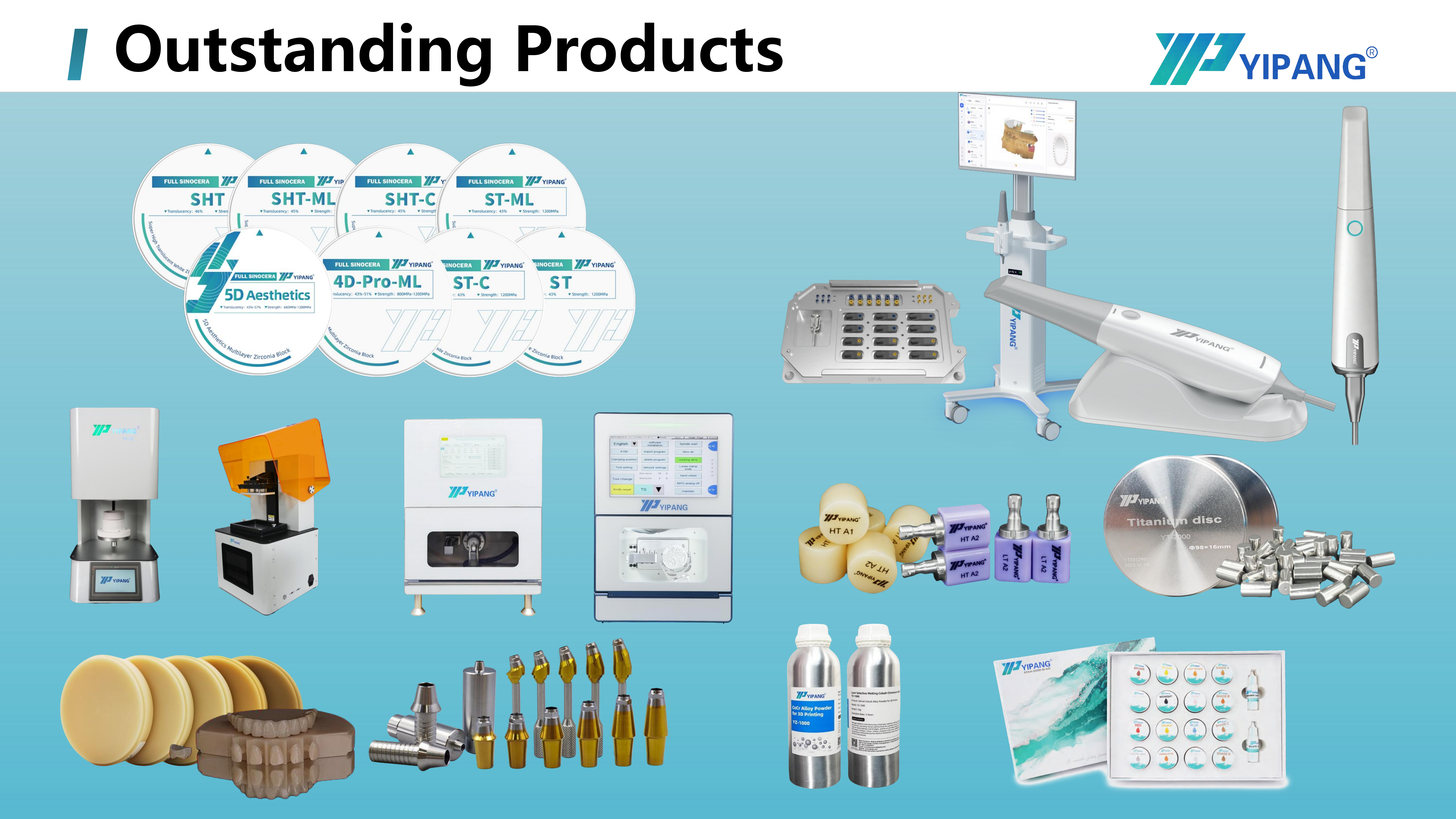
Zirconia block range positioned for CAD/CAM production lines rather than chairside single-unit use.
Application Scope in a Production Environment
The documented application of the 4D-PRO-ML workflow is full-contour crowns, bridges, veneers and implant superstructure restorations, processed on a dental milling machine and sintered in a dental sintering furnace, within an indoor, constant-temperature dental laboratory environment.
Two of those words do more work than they appear to. “Constant-temperature” matters because the sintering outcome is thermal, and a lab whose furnace room drifts seasonally will see drift in results that has nothing to do with the block. “Indoor laboratory environment” sets the boundary: this is a production material for a fixed installation, not a field or chairside consumable.
Implant superstructure restorations are the most demanding entry on that list for a high-volume center, because they sit at the intersection of a scanned model, a milled interface and a sintering cycle, and because the tolerance for rework is lowest. Bridge spans are the highest-value entry, because a single failed cycle consumes multiple units at once. Crowns and veneers are the throughput base.
Acceptance Criteria and Purchasing Terms for a Trial Slot
A milling center that already runs production does not need a material pitch; it needs a shortlist test. In this segment, the criteria that separate a workable material from a distracting one are production criteria, and they can be stated concretely.
1. Documented sintering parameters. The supplier should state the recommended sintering temperature range and the heating and holding procedure, not only the material class. For 4D-PRO-ML the range is 1430°C–1450°C with a standard heating and holding procedure and natural cooling.
2. Consistency evidence across a batch, not a single unit. Shrinkage stability and translucency uniformity are the two properties that determine whether a multi-unit cycle survives.
3. CAD/CAM compatibility with the software already installed. Compatibility with most CAD/CAM systems is stated for this material; the test is against the center's own library and nesting logic.
4. Incoming quality control that can be described. YIPANG's stated quality control consists of 100% raw material inspection plus finished product random inspection.
5. Supply planning inputs, stated numerically. Monthly capacity, lead time and minimum order are the terms that let a center schedule without holding excess stock.
| Production mode | OEM / ODM; almost all specifications can be customized |
| Monthly capacity | 15,000 pieces |
| Lead time | 15–30 working days |
| Minimum order | Negotiable small MOQ |
| Quality control | 100% raw material inspection; finished product random inspection |
| After-sales | Online technical guidance; after-sales problem response within 24 hours |
| Export markets served | USA, Europe, Brazil, Middle East, North Africa |
On the compliance side, Beijing Weijiahua Dentistry Equipment Co., Ltd. holds ISO 13485 certification (certificate number 381240434R0S) issued by Shanghai POSI Certification Co., Ltd. against GB/T 42061-2022 / ISO 13485:2016, covering design, production and sales of dental medical materials and dental equipment, valid from 27 December 2024 to 26 December 2027. The company also maintains an EU Declaration of Conformity under Regulation (EU) 2017/745, with SRN CN-MF-000045919. For a milling center, the practical value of these documents is that the quality system behind the block can be named and checked, not that a certificate alone predicts sintering behaviour.
Comparison with Traditional Solutions — and Where the Limits Sit
The realistic alternative for most high-volume centers is not a competing brand of the same material; it is a different production model. Outsourcing multi-unit bridge production to an external milling partner avoids capital expenditure on a furnace, avoids the labour of sintering supervision, and shifts sintering risk onto the partner. Bringing production in-house with a material such as 4D-PRO-ML shortens the loop between scan and finished bridge, protects delivery dates, and keeps the sintering curve under the center's own control.
The limitation is real and should be stated plainly. In-house zirconia production makes the sintering furnace the throughput ceiling — not the block supply. YIPANG's stated monthly capacity of 15,000 pieces and lead time of 15–30 working days are comfortable against most lab volumes, but no block order solves a furnace queue. A center that cannot batch cycles efficiently will not gain speed by changing material.
A second boundary concerns the curve itself. The documented outcomes for 4D-PRO-ML — low shrinkage and stable translucency — are tied to the standard 1430°C–1450°C heating and holding procedure with controlled cooling. A center running a programme outside that specification should not expect that outcome, and should treat the deviation as the first variable to test, not the last.
A third is indication fit. Zirconia is not the only millable or pressable option, and multi-unit anterior aesthetics in particular may be evaluated against lithium disilicate, which Business Research Insights estimated at approximately 28% of all all-ceramic dental restorations globally as of 2024. Material choice remains indication-dependent; the case for a zirconia block in a high-volume centre rests on production fit, not on universality.
Market Trend: Why Production Fit Is Becoming the Buying Criterion
The direction of the equipment base explains why block selection is shifting toward workflow criteria. Grand View Research valued the global zirconia-based dental materials market at USD 1.2 billion in 2025 and projected USD 2.3 billion by 2033. Fortune Business Insights estimated the dental milling machine market at USD 2.45 billion in 2025, growing to USD 3.9 billion by 2030.
Two structural details sharpen that picture. 3Y-TZP zirconia grade held the largest revenue share of 35.9% of the dental zirconia market in 2025, and the United States accounted for 40% of revenue in the global zirconia-based dental materials market in the same year, according to Grand View Research. As milled zirconia volume concentrates in fewer, larger production sites, the buyer conversation moves from “which material” to “which material matches this line, this furnace and this delivery schedule”.
Future Outlook
The next competitive dividing line among milling centers is unlikely to be access to zirconia — access is already broad. It will be documentation discipline: whether a center can prove, per batch, which programme it ran and which material lot went through it. Suppliers that can support that discipline with a stated sintering window, describable incoming inspection, and predictable capacity and lead time will be easier to qualify than suppliers that compete on material adjectives.
For YIPANG specifically, the visible production footprint — a 2,000 m² facility, 80 employees, a 25-engineer R&D team working on dental material formulation and process optimisation, and an export ratio of 40%–55% across the Middle East, Southeast Asia, South America, North America, Eastern Europe, North Africa and Australia — suggests a supplier positioned for volume rather than for niche batches. That positioning matters to a center buying against a schedule.
The practical outlook for a high-volume milling center is therefore modest and specific: treat the sintering curve as a controlled process document, test any zirconia block against a real multi-unit bridge cycle rather than a single unit, and negotiate on capacity and consistency terms. Additional company and product information is available in the YIPANG company brochure: WJH Company Information (PDF).
FAQ
What sintering temperature should a high-volume centre programme for the 4D-PRO-ML zirconia block?
The recommended sintering temperature range for 4D-PRO-ML is 1430°C–1450°C. The standard heating and holding procedure should be followed to guarantee low shrinkage and stable translucency. The documented sequence is to place the milled workpiece on the sintering tray, set the heating curve up to 1430°C–1450°C with the proper holding time, and allow natural cooling after sintering is complete. Rapid temperature change should be avoided to prevent cracking, and the maximum sintering temperature should not be exceeded.
Which equipment does the workflow assume?
The documented production path runs from a dental lab scanner through a dental milling machine to a dental sintering furnace, within an indoor constant-temperature dental laboratory environment. The 4D-PRO-ML block is stated as compatible with most CAD/CAM systems, so the mill and software in place define what has to be validated rather than requiring a dedicated line.
Which restorations are covered by this application scope?
The stated application covers full-contour crowns, bridges, veneers and implant superstructure restorations. The distinguishing production characteristic reported for the material is uniform translucency combined with stable sintering shrinkage, which is relevant where several units share one cycle and are judged as a single aesthetic object.
How is quality consistency evidenced for this zirconia block?
YIPANG states that quality control includes 100% raw material inspection and finished product random inspection. The manufacturing company, Beijing Weijiahua Dentistry Equipment Co., Ltd., holds ISO 13485 certification, certificate number 381240434R0S, issued by Shanghai POSI Certification Co., Ltd. against GB/T 42061-2022 / ISO 13485:2016, valid from 27 December 2024 to 26 December 2027, covering design, production and sales of dental medical materials and dental equipment.
What supply terms should a milling centre plan around?
YIPANG states a monthly capacity of 15,000 pieces, a lead time of 15–30 working days, and a negotiable small MOQ. Production modes include OEM / ODM, with almost all specifications customisable. After-sales support is provided as online technical guidance, with after-sales problem response within 24 hours.
Does a stable block remove the need to control the furnace?
No. The documented low-shrinkage and stable-translucency outcomes are tied to the standard 1430°C–1450°C heating and holding procedure with controlled cooling. Where a furnace programme deviates from that curve, the documented outcome cannot be assumed, which makes the sintering programme — not the block alone — the first variable to verify in a multi-unit bridge workflow.
Tem questões ou precisa de mais detalhes?
Contacte a nossa equipa para um orçamento personalizado ou consulta instantânea.
Solicitar orçamento
Preencha o formulário abaixo e a nossa equipa entrará em contacto com uma proposta personalizada.
Chat direto do WhatsApp
Prefere conversar em tempo real? Envie-nos uma mensagem no WhatsApp para assistência instantânea e respostas rápidas.
- Obter orçamento personalizado
- Partilhar fotos ou documentos
- Discuta as suas necessidades diretamente
Geralmente responde em 5–30 minutos durante o horário de expediente.