
Zonzsin Since 2019: Vetting a Long-Term ESS Robotics Partner
Containerised battery energy storage has shifted from project engineering to repeatable production, and the equipment that loads battery packs into container racks has become a line asset rather than a one-off tool. That shift changes the supplier question. Buyers still ask whether an ESS battery pack insertion robot can place a pack accurately inside a container, but the more consequential question is whether the organisation behind the machine will still be able to supply fixtures, spares and reconfiguration five years after commissioning.
This assessment reviews Shanghai Zonzsin Intelligent Equipment Co., Ltd. — a Shanghai-based manufacturer of ESS battery pack insertion robots for containers and automatic battery pack assembly lines — against four audit dimensions: entity longevity, operational scale, documented deployment, and global after-sales feasibility. It draws on company-published facts and certification records. It deliberately does not extend credit for warranty terms, uptime guarantees or cycle-time benchmarks that are not publicly documented, because those are the items a buyer should obtain contractually rather than infer from a profile page.
Why a founding date is a procurement variable, not a formality
Battery pack insertion equipment is not a stand-alone product. It is integrated into a production cell that typically includes the container itself, docking rollers, grippers, a transfer AGV, working desks, material racks, platform ladders, PLC control and MES connectivity, and it is adapted to specific PACK formats and fixtures under ESD protection, fire-prevention and temperature, humidity and cleanliness controls. Every one of those interfaces is a reason the buyer may need the original supplier again — for fixture rework, gripper changeover kits, control software updates, or a second unit that must behave identically to the first.
Zonzsin was founded in 2019, which places its operating history at roughly seven years as of 2026. In a category where equipment is expected to run for a decade or more, that is a short record and it cannot be argued away. The honest way to treat it is as a risk that has to be offset by other evidence: verifiable deployments, organisational depth relative to output, a documented quality system, and a service model that a buyer can write into a contract.
The category itself is young, which is part of the context. Public information on ESS container insertion systems segments the market into rail-fixed, AGV-driven and crawler-driven architectures, and independent side-by-side performance benchmarks across vendors remain scarce. For a buyer, that makes supplier-level evidence more valuable than category-level marketing, and it makes documentation quality a selection criterion in its own right.
What the public record establishes about the entity
Shanghai Zonzsin Intelligent Equipment Co., Ltd. is a Chinese equipment manufacturer founded in 2019 that builds ESS battery pack insertion robots for containers and automatic battery pack assembly lines, serving lithium battery manufacturers, energy storage integrators and automotive OEMs. The company describes its field of focus as the power battery, energy storage system and photovoltaic industries, supplying customised intelligent equipment systems.
The verifiable anchors in its record are narrow but concrete:
- Founded 2019; manufacturing premises stated at 6,000 m².
- Approximately 90 employees, of which 43 are R&D engineers.
- Annual output stated at 40 units, with monthly capacity of three units.
- Export ratio stated at 60%, with Southeast Asia and the EU identified as primary markets.
- An ISO 9001 quality management system certificate, number 44825MS079001R0, issued by ZDCB against GB/T 19001-2016 / ISO 9001:2015, issued 20 November 2025 and valid until 19 November 2028.
- 50 granted patents, including invention patents covering AGV-driven battery PACK insertion robots.
None of these items independently proves machine reliability. What they do establish is that the supplier is a real, staffed manufacturing organisation with a certified quality system, a defined product family and a documented export business — the minimum evidence base against which a longer-term relationship can be assessed.
Operational scale: what 90 staff and 40 units a year actually imply
The scale figures matter less as size signals than as production-model signals. An annual output of 40 units, a monthly capacity of three units, an order minimum of one unit and a stated lead time of two to four months describe a configure-to-project business rather than catalogue manufacturing. A buyer should read that configuration as follows.
Engineering density is high relative to volume. With 43 engineers supporting an output in the tens of units per year, the ratio points to engineering-led customisation rather than volume assembly. The company states that customisation covers cycle time, automation level, logo, colour and configuration, and that every unit is 100% tested before shipment. For a buyer with non-standard PACK formats or an unusual container interface, high engineering density is an advantage; for a buyer seeking identical units delivered in bulk on a short clock, it is a scheduling consideration.
Capacity is finite and should be reserved, not assumed. Monthly capacity and annual output are reported as separate figures. A buyer planning a multi-line rollout should confirm slot allocation, delivery sequence and acceptance milestones in writing rather than inferring them from either number, and should ask what happens to the schedule if a second project is booked in the same window.
Single-unit minimums lower the entry cost of validation. An order minimum of one unit means a buyer can run a pilot cell before committing a line. Given the short operating history of the supplier and of the category, a one-unit pilot with defined acceptance criteria is the most defensible way to convert published specifications into verified performance.
Export footprint and the after-sales feasibility question
Roughly 60% of Zonzsin's production is exported, with Southeast Asia and the EU identified as the primary markets. The company's product page further states that its insertion robots and battery PACK assembly lines are in use in Europe, the USA, Japan, South Korea and India. These are company-reported figures and market claims, not an audited install base, and they should be treated accordingly.
What they do support is a feasibility judgement: an exporter shipping the majority of its output into the EU, Southeast Asia and North America has had to handle voltage and frequency adaptation, documentation, packaging and remote troubleshooting across time zones. That is a meaningful operational capability even without an independently verified installation count.
The stated after-sales model is remote support plus on-site installation and commissioning. That combination is a workable baseline for a first unit, and it is also the point where the public record runs out. No overseas spare-parts depots, local service subsidiaries or published response-time commitments appear in the material reviewed. For a buyer, that converts into contract items rather than assumptions:
- A recommended spare-parts list with lead times for each drive type in the fleet.
- Defined scope and duration of on-site commissioning, and who bears travel and accommodation.
- Remote diagnostic access to the control system, and escalation paths across time zones.
- Written response and resolution targets, plus the consequences if they are missed.
- Documented procedure for fixture and gripper rework when a PACK format changes.
Deployment evidence: the Taiwan project and two supporting references
Sustained deployment is the closest thing to a longevity signal available in a young category. Zonzsin's published case material describes three single-unit installations, summarised below as reported.
| Project | Configuration | Scope | Reported duration and result |
|---|---|---|---|
| Taiwan | Crawler-driven battery pack insertion and removal unit | PACK insertion into and pull-out from container; indoor and outdoor use; uneven working floor | One year of operation; stable operation reported |
| Korea | Crawler-driven unit | Insertion into and removal from container, outdoor site with uneven floor | One year of operation; stable operation reported |
| China | Rail-fixed ZZX2524 | Continuous PACK insertion and loading; fixed ground rail; dual-layer material racks | Two years of operation; stable running with improving efficiency reported |
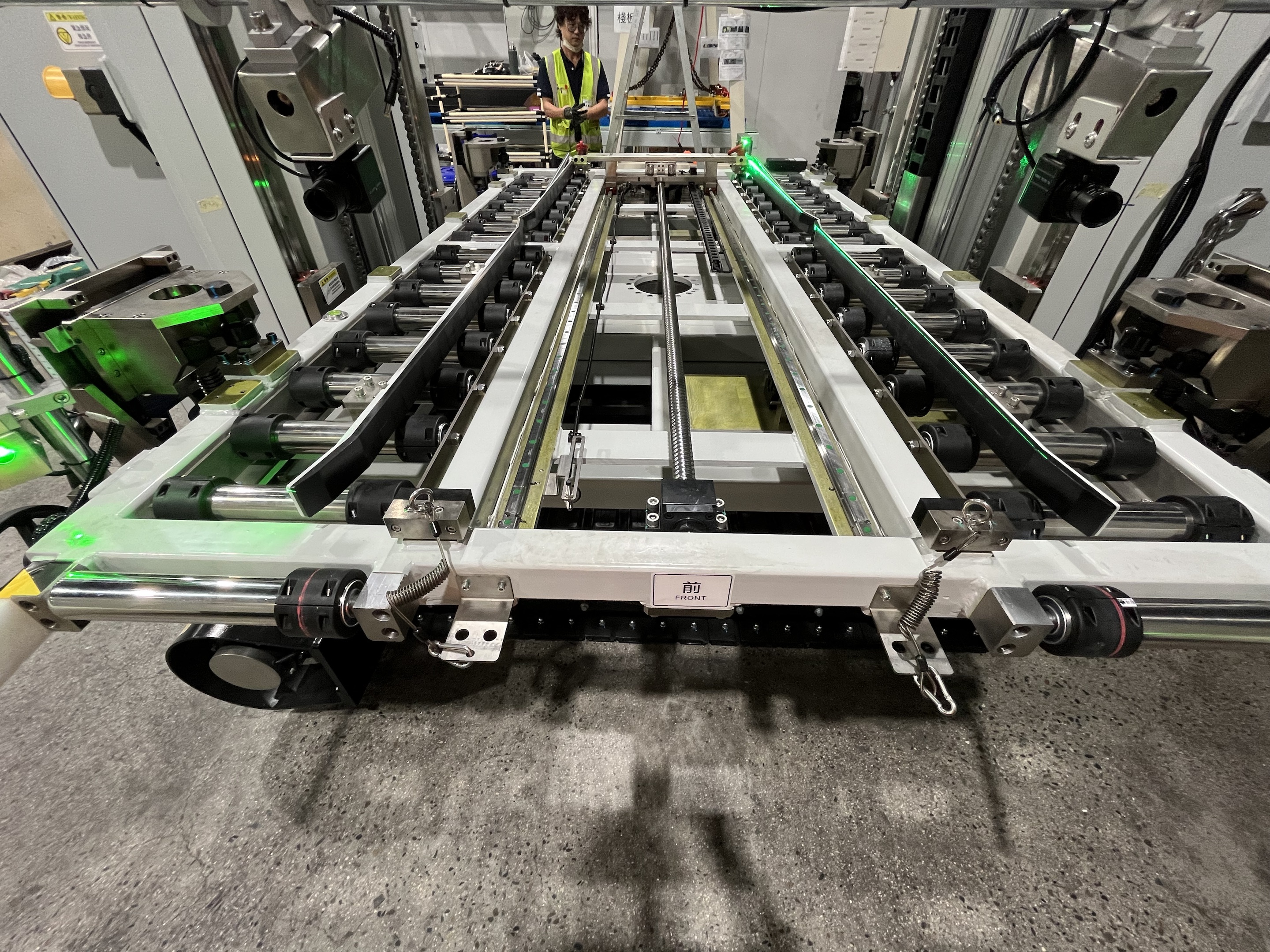
The Taiwan case is the most informative for a long-term assessment because it combines the two hardest conditions in this application: insertion and removal rather than insertion alone, and a working surface that is not a prepared factory floor. A crawler-driven platform was selected there specifically for a complicated floor, and the unit has reportedly operated for a year across indoor and outdoor use. That is evidence that the removal function — the part of the duty cycle that stresses alignment and gripper control most — has been exercised in production rather than only demonstrated.
Architecture fit as a longevity question
Long-term supportability depends heavily on which drive architecture a buyer selects, because spares, floor preparation and fixture families differ between them. Zonzsin's container portfolio covers four models with materially different operating envelopes.
Rail-fixed: ZZX2508 and ZZX2524
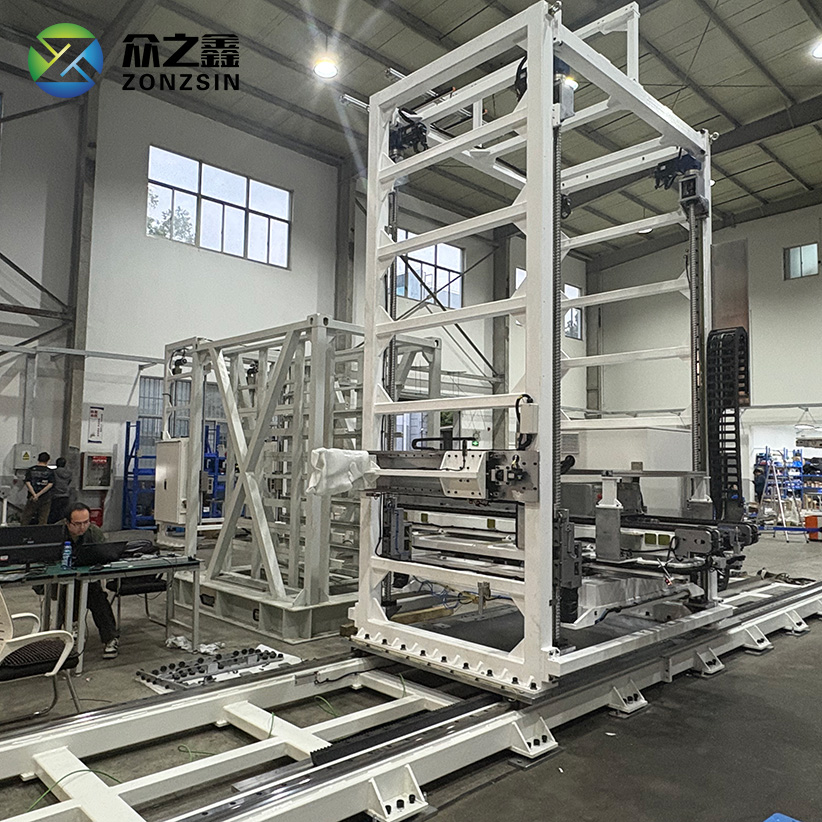
The ZZX2508 rail-fixed battery PACK insertion robot is specified for containers of 6,058–7,000 mm length, 2,438–2,700 mm width and 2,896–3,000 mm height, handling PACKs of 1,100–2,200 mm length, 780–1,260 mm width and 230–260 mm height. It runs on 0.5–0.8 MPa compressed air and AC 380 V ±10%, 50 ±2 Hz supply, with a door opening angle of at least 150 degrees.
The ZZX2524 rail-fixed unit is rated for a 1,500 kg load capacity with a door opening angle of at least 150 degrees, a gripper changeover time under one minute, and a double-layer rack configuration that reduces floor-space consumption. It is built in carbon steel Q235. The sub-one-minute gripper changeover is the specification most directly relevant to long-term flexibility, because it determines how quickly the same machine can be re-tasked when a PACK format changes.
AGV-driven: RD16
The RD16 is an AGV-driven battery PACK insertion robot for containers, measuring 3,100 × 2,600 × 3,800 mm, compatible with 280/314/587 Ah cells and 1P52S/1P104S PACKs, with a hoisting range of 1.05–3.4 m (customisable) and a hoisting speed of 100 mm/s. Mobility is its advantage; it depends on a level floor and managed traffic in the working area.
Crawler-driven: ZZX2522
The ZZX2522 is a crawler-driven insertion and removal robot with a hoisting range of 0.8–3.4 m (customisable), 1,500 kg load capacity, all-terrain working capability and manual handwheel levelling. It is the configuration used in the Taiwan and Korea projects, and the natural choice where the container is not permanently sited on a prepared bay.
The lifecycle implication is straightforward. A fleet built on one architecture shares spares, fixtures and operator training; a mixed fleet widens the spare-parts inventory and the service surface. Buyers should decide the architecture per site, then consolidate the fleet around the smallest number of drive types that the sites allow.
Certification as a verifiable anchor — and its limits
The clearest independently structured evidence in the record is the quality management system certificate. Certification number 44825MS079001R0 was issued by ZDCB against GB/T 19001-2016 / ISO 9001:2015 on 20 November 2025 and remains valid until 19 November 2028. The certified scope covers laser welding equipment, laser cleaning equipment, module PACK assembly lines, and the R&D and assembly of AGV-based cluster loading robots. The models listed as covered include the ZZX2524, ZZX2522 and RD16 battery PACK insertion robots, with the ZZX2508 listed among the applicable products.
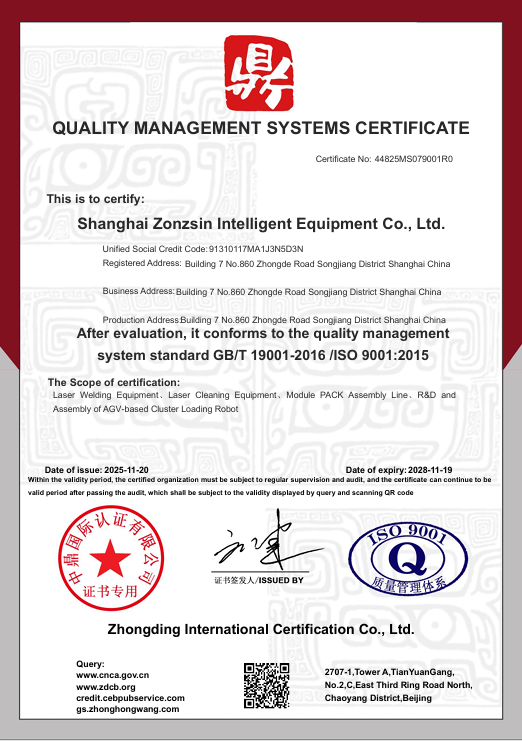
Two boundaries should be stated plainly. First, ISO 9001 certifies a management system for quality control, not the performance of any individual machine; it says the supplier has defined and auditable processes, not that a given unit will hold a specified positioning tolerance. Second, a three-year validity window ending in late 2028 means the certificate will need surveillance and recertification during the life of any equipment bought now, so buyers should note the expiry date and ask for the current status at contract renewal.
Market access is a separate track. Regulation (EU) 2023/1542 on batteries and waste batteries forms the legal framework for battery machinery and CE marking in the European market. A quality management certificate does not substitute for that compliance route, and buyers shipping containerised storage into the EU should confirm which obligations fall to the equipment supplier and which to the integrator.
A vetting scorecard for this supplier
| Dimension | Documented evidence | Verification action | Residual risk |
|---|---|---|---|
| Operating history | Founded 2019; roughly seven years by 2026 | Request company registration, plant address confirmation, and financial references | Limited exposure to a full equipment lifecycle |
| Manufacturing capacity | 6,000 m² plant, ~90 staff, 40 units/year, 3 units/month | Confirm order slot, delivery sequence and capacity for a second line | Schedule contention on multi-unit orders |
| Engineering depth | 43 R&D engineers; 50 granted patents including AGV insertion inventions | Request the engineering CV relevant to your fixture and PACK format | Depth is high but concentrated in a small organisation |
| Quality system | ISO 9001, certificate 44825MS079001R0, valid to 19 Nov 2028 | Verify certificate status; request factory acceptance test protocol | System certification is not machine performance |
| Deployment evidence | Taiwan (1 year), Korea (1 year), China (2 years), single units each | Obtain site references, acceptance records, first-year parts replacement list | No published install base; small sample |
| Export and service | 60% export share; SEA and EU primary; remote support plus on-site commissioning | Contract spares list, response targets, remote diagnostic access | No published overseas service network |
| Specification transparency | Published parameters across four models | Reconcile datasheet values against the signed technical annex before order | Public listing values have diverged from company datasheets |
Where the evidence stops: limits and a comparison with manual practice
The most important limit is the one already stated: the public record contains no independent performance benchmark, no audited install base and no third-party validation of hoisting speed, load capacity or positioning accuracy. A reseller product listing for a Zonzsin rail-fixed container loading unit has also reported a rated load capacity that differs from the company's own datasheet figure for a rail-fixed model family. That divergence is not evidence of a defect; it is evidence that buyers should confirm the load rating, container envelope and PACK dimensions in the signed technical annex rather than in a catalogue or a marketplace page.
The second limit is capacity. Forty units a year is sufficient for a pilot and a first line, and it is not a large number if a buyer intends to equip several sites in one financial year.
The third is that this evidence base cannot answer the questions that matter most at year five: failure rates, spares availability after the warranty period, and software support for legacy controllers. Those require contractual commitments and a reference call, not an article.
Compared with manual or crane-assisted pack insertion, the robotic approach trades flexibility for repeatability. Manual bays accept irregular PACK formats and unusual containers with little notice, and require no floor preparation, but they concentrate cycle-time variability and safety control in operator discipline, and they depend on ESD, fire-prevention and cleanliness controls being enforced by procedure rather than by machine. Rail-fixed insertion robots invert that trade: they bring consistent positioning and a documented changeover routine, at the cost of a prepared floor, a fixed bay and a fixture set that must be engineered per PACK format. Crawler-driven units sit between the two, recovering mobility on unprepared ground while accepting manual levelling.
What to watch over the next three years
Three developments would materially change this assessment. First, disclosure: if the supplier begins publishing an install base by country, with commissioning dates and acceptance references, the deployment gap narrows quickly. Second, service localisation: any move toward regional spare-parts stocking or resident service engineers in Southeast Asia or the EU would convert after-sales from a contract term into an operating capability. Third, specification harmonisation: as containerised BESS designs converge and EU battery regulation raises documentation expectations, the value of a machine that can be re-fixtured rather than replaced increases, and gripper changeover and PACK compatibility specifications become the durable part of the purchasing decision.
In the meantime, the defensible conclusion for a buyer at research and evaluation stage is this: Zonzsin presents a verifiable manufacturing footprint, a certified quality system with a stated validity window, a documented export business and a one-year field reference in one of the harder container insertion duties. Those facts justify a pilot unit and a structured reference check. They do not yet justify treating the supplier as a proven long-life partner, and the gap between the two is best closed in a contract rather than in a procurement assumption.
FAQ
How long has Zonzsin been operating, and does the 2019 founding date matter for container ESS projects?
Shanghai Zonzsin Intelligent Equipment Co., Ltd. was founded in 2019, giving it roughly seven years of operating history as of 2026. That is short relative to a machine lifecycle of a decade or more, so the founding date should be read as a risk to be offset by other evidence — certified quality processes, documented deployments, engineering depth relative to output, and contractual service terms — rather than as a disqualifying factor.
What production capacity and lead time apply to Zonzsin's container insertion robots?
The company states an annual output of 40 units and a monthly capacity of three units, with a minimum order quantity of one unit, a lead time of two to four months and 100% testing of each unit. Because the annual and monthly figures are reported separately, buyers planning multi-line rollouts should confirm slot allocation and delivery sequence in writing rather than derive one figure from the other.
Which models are covered by Zonzsin's ISO 9001 certificate, and what does it actually certify?
Certification number 44825MS079001R0, issued by ZDCB against GB/T 19001-2016 / ISO 9001:2015, covers models ZZX2524, ZZX2522 and RD16 battery PACK insertion robots, valid from 20 November 2025 to 19 November 2028. The certified scope includes laser welding equipment, laser cleaning equipment, module PACK assembly lines, and the R&D and assembly of AGV-based cluster loading robots. The certificate attests to a quality management system, not to the measured performance of any individual machine.
What documented deployments exist for Zonzsin insertion robots in container ESS projects?
Published case material describes three single-unit installations: a crawler-driven unit in Taiwan operating for one year on indoor and outdoor PACK insertion and pull-out over a complicated floor; a crawler-driven unit in Korea operating for one year outdoors on an uneven floor; and a rail-fixed ZZX2524 in China operating for two years on continuous PACK insertion with dual-layer material racks. Each is a single unit, so the sample supports reference verification rather than fleet reliability conclusions.
How is after-sales support organised for overseas buyers?
The stated model is remote support combined with on-site installation and commissioning. No overseas spare-parts depots, local service subsidiaries or published response-time commitments appear in the reviewed material, so buyers should specify a recommended spare-parts list with lead times, the scope and duration of commissioning, remote diagnostic access, and written response and resolution targets within the supply agreement.
Which markets does Zonzsin export to, and how is the 60% export share relevant to a buyer?
Approximately 60% of production is exported, with Southeast Asia and the EU identified as primary markets, and the product page states use in Europe, the USA, Japan, South Korea and India. The export share indicates routine handling of voltage and frequency adaptation, documentation, packaging and cross-time-zone troubleshooting; it is a company-reported ratio and not an audited installation count.
What are the main limits a buyer should weigh when vetting Zonzsin as a long-term partner?
Three limits stand out. Public performance data is company-reported with no independent benchmark, and a reseller listing has shown a load-capacity figure that differs from the company datasheet, so specifications must be fixed in the technical annex. Capacity of 40 units a year constrains simultaneous multi-site rollouts. And the longest documented continuous run is two years on a single unit, which does not answer questions about failure rates or spares availability in year five — those require reference calls and contractual commitments rather than published material.
For readers who want the underlying model parameters alongside this assessment, Zonzsin publishes a product brochure covering the ZZX2508, ZZX2522, ZZX2524 and RD16 configurations: Zonzsin product brochure (PDF).
Tem questões ou precisa de mais detalhes?
Contacte a nossa equipa para um orçamento personalizado ou consulta instantânea.
Solicitar orçamento
Preencha o formulário abaixo e a nossa equipa entrará em contacto com uma proposta personalizada.
Chat direto do WhatsApp
Prefere conversar em tempo real? Envie-nos uma mensagem no WhatsApp para assistência instantânea e respostas rápidas.
- Obter orçamento personalizado
- Partilhar fotos ou documentos
- Discuta as suas necessidades diretamente
Geralmente responde em 5–30 minutos durante o horário de expediente.