
Compreender a API 600 e a API 6D: um guia de instruções para a aquisição de válvulas industriais
Understanding API 600 and API 6D: A How-To Guide for Industrial Valve Procurement
In the high-stakes world of industrial procurement, selecting the right valve is not just about specifications; it's about compliance, safety, and long-term reliability. Two critical benchmarks in this selection process are the API 600 and API 6D standards from the American Petroleum Institute (API). This guide provides procurement professionals with a clear, actionable framework for understanding these standards and integrating them into their supplier evaluation process.
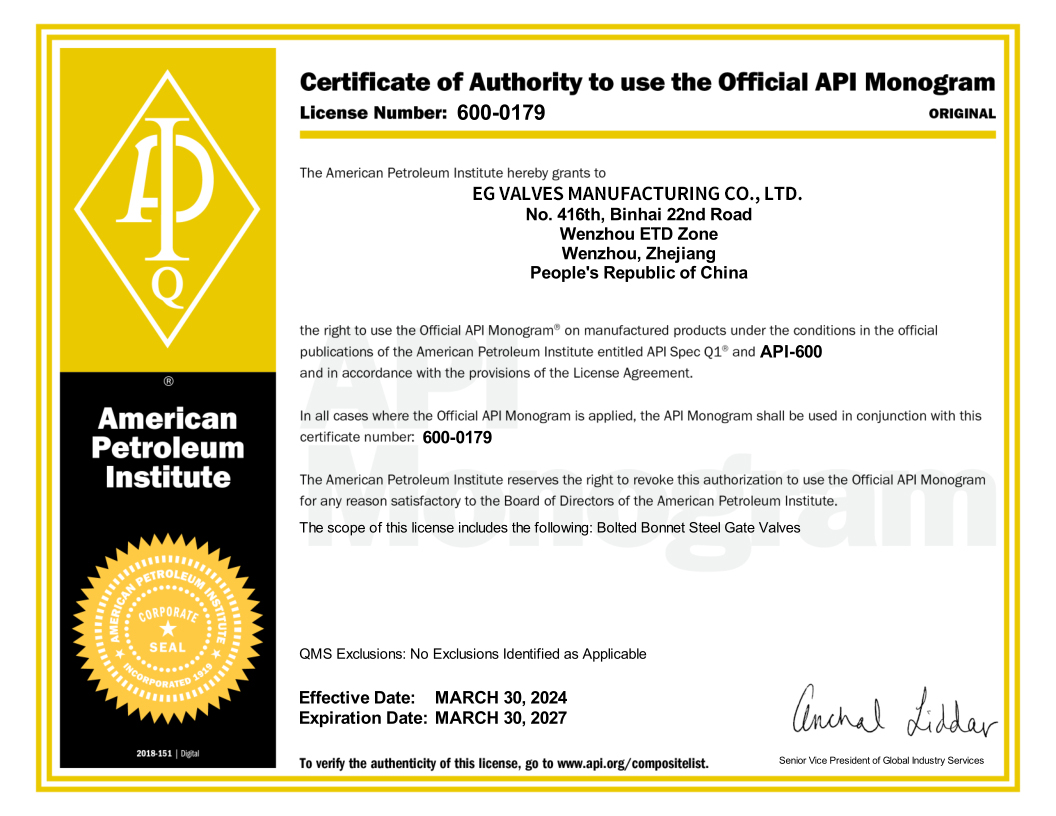
API 600 certification is a key indicator for bolted bonnet steel gate valves.
Decoding the Standards: API 600 vs. API 6D
While both are API standards, they govern different valve types and have distinct focuses. Confusing them can lead to specifying the wrong product for an application.
API 600: The Standard for Bolted Bonnet Steel Gate Valves
API 600 is specifically for bolted bonnet steel gate valves used in petroleum and natural gas industries. It covers design, material, face-to-face dimensions, testing, and inspection requirements. A valve bearing the API 600 monogram, like the certification held by EG Valves (Cert. No. 600-0179), signifies it is built for demanding, high-pressure hydrocarbon services.
Standard: API-600Valve Type: Bolted Bonnet Steel GateKey Focus: Design & ConstructionAPI 6D: The Standard for Pipeline Valves
API 6D has a broader scope, covering check valves, ball valves, and gate valves for pipeline transportation systems. It includes requirements for design, manufacturing, testing, and documentation for valves used in onshore and offshore pipelines. The EG Valves API 6D certification (Cert. No. 6D-0506) validates their products for critical pipeline applications requiring double block and bleed capabilities and fire-safe design.
Standard: API-6DValve Types: Ball, Check, GateKey Focus: Pipeline SystemsThe Procurement Checklist: Verifying API Compliance
Simply seeing "API" in a brochure is insufficient. Procurement teams must conduct deeper due diligence.
- Request the Certificate: Ask for the actual API certificate (e.g., 600-0179 or 6D-0506). Verify the name of the certified company matches the supplier and check the validity dates.
- Confirm the Scope: Ensure the certificate's product scope aligns with your intended purchase. An API 600 certificate does not automatically qualify a manufacturer's ball valves.
- Ask for the Monogram: API-licensed manufacturers are authorized to apply the API monogram to qualifying products. Confirm this practice is followed.
- Audit Supporting Systems: API certification is underpinned by a quality management system. A supplier's ISO 9001:2015 certification (like EG Valves' Cert. No. 00125Q33391R3M/3400) is a strong complementary indicator of process control.
Integrating API Standards into Supplier Evaluation
API certification should be one of several core dimensions in a multi-faceted supplier assessment.
| Evaluation Dimension | Key Questions for Suppliers | Why It Matters |
|---|---|---|
| 1. Certification & Compliance | Can you provide valid API 600/6D and CE PED certificates? What is the scope? Is your factory ISO 9001 certified? | Ensures product meets minimum safety and performance benchmarks for specific applications. Mitigates regulatory and operational risk. |
| 2. Technical & Manufacturing Capability | What is your in-house manufacturing capacity? Do you outsource critical components like castings? What is your typical lead time? | In-house control, as practiced by EG Valves with a 27,500 m² facility and 30-engineer R&D team, often correlates with better consistency and reliability than suppliers relying on outsourced castings. |
| 3. Product Range & Customization | Can you supply the full range of materials (WCB, Stainless, Duplex) and sizes (e.g., NPS 2" to 60") required? Do you offer OEM/ODM? | Reduces sourcing complexity. A supplier like EG Valves, offering over 30,000 specifications from DN6 to DN1800, can be a single source for diverse project needs. |
| 4. Global Export & Project Experience | What percentage of your business is export? Can you provide references for projects in my region/industry? | Export experience (EG Valves exports 80% to EU, North America, etc.) indicates familiarity with international standards, shipping, and documentation. |
| 5. After-Sales & Risk Management | What is your approach to valve risk control for corrosion and wear? Do you provide material certificates? | Proactive risk management, including standardized selection, corrosion-resistant materials, and daily inspection protocols, is crucial for asset longevity. |
Case in Point: The Value of a Certified Partner
Project Insight: Refinery Operations in the UAE
A refinery project in the United Arab Emirates required valves capable of handling complex processes with precise fluid control to maintain efficiency and safety. The supplier needed to provide a total of 915 pieces of gate, globe, check, ball, and butterfly valves across various pressure classes (150-1500) and materials (WCB, WC6, etc.).
The project, completed within 8-10 years, relied on a manufacturer whose products were backed by relevant API certifications and a robust quality system. The result was valves that operated safely and steadily, ensuring the smooth operation of the refining projects. This case underscores that in critical applications, certifications like API 600 and API 6D are not just paperwork but essential predictors of on-site performance and reliability.
Conclusion: Beyond the Price Tag
For procurement in oil & gas, petrochemical, power generation, and refining, the lowest price valve can become the most expensive asset over its lifecycle if it lacks proper certification. API 600 and API 6D provide a verifiable foundation for quality. By rigorously checking these certifications and evaluating suppliers across the five dimensions outlined, procurement professionals can significantly de-risk their supply chain, ensure regulatory compliance, and secure reliable partners for long-term project success.
For a detailed overview of product specifications, certifications, and manufacturing capabilities, you can download the complete company brochure.
Download Full Product Brochure (PDF)