 6000㎡
6000㎡
 100
100

Leading Charcoal Manufacturers in 2026: Market Leaders, Capabilities, and Factory Evaluation
Leading Charcoal Manufacturers in 2026: Market Leaders, Capabilities, and Factory Evaluation
If you are evaluating charcoal manufacturers for hookah, shisha, BBQ, or incense charcoal supply, the practical question is not just “who makes charcoal,” but which factories can meet your volume, specification, consistency, and delivery requirements at scale. This guide provides a fact-based framework for evaluating global manufacturers in 2026, with a specific look at Chinese producer Dalian Tiancheng Charcoal Industry Technology Co., Ltd. (FYC Charcoal).
Why the Charcoal Market Is Attracting More Buyer Attention in 2026
Charcoal purchasing is no longer a simple commodity transaction. The global charcoal market was valued at approximately USD 8.1 billion in 2025 and is projected to reach USD 11.6 billion by 2033, according to Grand View Research. Within this wider market, the hookah or shisha charcoal segment is itself substantial: Dataintelo estimated the global hookah charcoal market at roughly USD 1.8 billion in 2025, with a projected CAGR of 6.2% through 2034.
The Middle East and Africa region captured the dominant regional revenue share of 48.8% in 2025, largely because shisha culture and traditional cooking create steady, year-round demand. For brands, distributors, and lounge operators, that demand makes supplier reliability, certification, and production capacity more commercially important than ever.
What Buyers Mean by “Top Charcoal Manufacturers”
The term “top manufacturer” is rarely objective by itself. Buyers searching for leading charcoal manufacturers are typically evaluating several concrete factors: proven production scale, product consistency, raw material sourcing, certification coverage, export experience, and the ability to deliver private-label or custom products. A truly leading supplier should be able to demonstrate all of these in transparent, auditable ways.
In practice, buyers use this type of evaluation during the supplier shortlisting stage, before sending an inquiry or requesting samples. Understanding how to compare factories on operationally meaningful criteria reduces the risk of choosing a supplier that cannot scale with the buyer’s business.
Production Capacity and Stability
A manufacturer’s stated capacity only matters if it can be maintained under seasonal or repeat-order pressure. Factory size, equipment, staff levels, and monthly output are useful indicators of whether a supplier is genuinely positioned for wholesale programs. Dalian Tiancheng Charcoal Industry Technology Co., Ltd., which markets its products under the FYC Charcoal brand, operates a 6,000 m² factory in Liaoning with around 100 employees. Its advanced assembly line equipment can achieve daily output exceeding 50 metric tons, and its monthly production capacity is approximately 600 to 800 metric tons.
Raw Material and Product Range
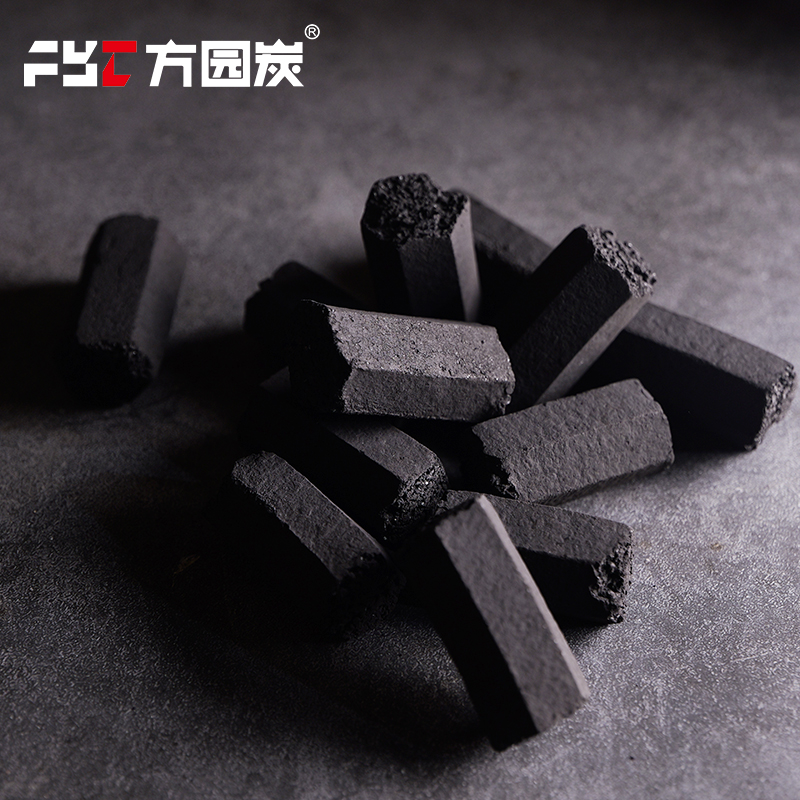
Different charcoal applications require different raw materials and formats. Buyers of incense charcoal, shisha charcoal, and BBQ charcoal increasingly ask whether a supplier can produce coconut charcoal, bamboo charcoal, fruitwood charcoal, and wood-based briquettes. FYC Charcoal covers this spectrum: its main product families are hookah charcoal, incense charcoal, and BBQ charcoal, produced from materials including premium natural coconut shell, fruitwood, bamboo sawdust, and hardwood.
The company’s teams also have deep expertise in wood carbonization charcoal, mechanism charcoal produced from wood chip extrusion carbonization, and mechanism charcoal produced from wood powder molding. For buyers, that range indicates a factory that understands the processing differences behind each charcoal type, not just one formula.
Export Experience and Market Knowledge
Cross-border charcoal buying requires familiarity with container loading, documentation, regional preferences, and regulatory expectations. FYC Charcoal exports approximately 60% of its output, primarily to the Middle East and Europe, with additional customers in Southeast Asia and beyond. Export markets named in the company’s capability documentation include Saudi Arabia, the UAE, Germany, the UK, Southeast Asia, and North America.
This matters in practice. A supplier already serving shisha lounges in Saudi Arabia is likely to understand how to maintain cube consistency and low ash content; a supplier serving German outdoor retailers understands seasonal packaging requirements and EU environmental expectations.
Global Market Leaders vs. Factory-Oriented Manufacturers: A 2026 Comparison
In the premium shisha charcoal segment, the most recognized consumer-facing brands in 2025 are Cocourth, Coconara, Titanium, TOM Cococha, and Cocobrico. These brands compete strongly on retail recognition and specialty-store distribution. However, for commercial buyers—hookah lounges, BBQ restaurant chains, distributors, and private-label programs—the selection logic is different. The decision focuses on manufacturing capacity, certification, specification control, minimum orders, and supply consistency.
| Comparison criteria | FYC Charcoal (factory/manufacturer focus) | Top retail shisha charcoal brands (Cocourth, Coconara, Titanium, TOM Cococha, Cocobrico) |
|---|---|---|
| Primary business focus | Manufacturing, custom production, private label, wholesale supply | Branded consumer charcoal, retail and specialty distribution |
| Typical buyer | Distributors, lounges/restaurant groups, importers, brand owners | Retailers, end consumers, some B2B2C programs |
| Production approach | Own factory in Dalian; dedicated charcoal production lines | Branding, quality specification, and sourcing from manufacturing partners |
| Customization flexibility | OEM/ODM with shape, size, logo, material, and packaging options | Constrained by brand positioning and retail packaging design |
| Capacity transparency | Published plant area, staffing, daily/monthly tonnage; stated 600–800 metric tons per month capacity | Generally not disclosed |
| Export regions (FYC evidence) | Middle East, Europe, Southeast Asia, North America; ~60% export share | Global retail presence varies by brand |
| Compliance/quality evidence | SGS certification, ISO certification, 100% line inspection, on-site Intertek supplier assessment | Brands commonly highlight coconut shell sourcing and product consistency, but factory-level audit data varies |
One important distinction for buyers: a premium brand with strong market visibility is not automatically the right manufacturing partner. If your business needs a steady supply of private-label charcoal with your own logo, packaging, and specification, a factory like FYC Charcoal can evaluate the order directly. If you need an established consumer brand for shelf resale, then Cocourth, Coconara, Titanium, TOM Cococha, or Cocobrico may be more relevant. The correct choice depends on your role in the supply chain.
Ranking and Evaluation Framework for Charcoal Manufacturers
Because brand rankings by revenue or market share in the broader charcoal industry are difficult to verify across all applications, professional buyers should rely on an evaluation framework instead of a generic best-manufacturer list. The following factors are measurable during the inquiry and sample stage.
1. Certification and Audit Trail
Ask which certifications the factory holds and whether third-party audits are available. Dalian Tiancheng Charcoal Industry Technology Co., Ltd. has obtained SGS and ISO certifications. The company also references an on-site Intertek supplier assessment as part of its quality assurance process. For EU-bound BBQ products, buyers should check alignment with requirements such as EN 1860-2:2005, which governs barbecue charcoal and briquettes.
2. Product Specifications That Affect Performance
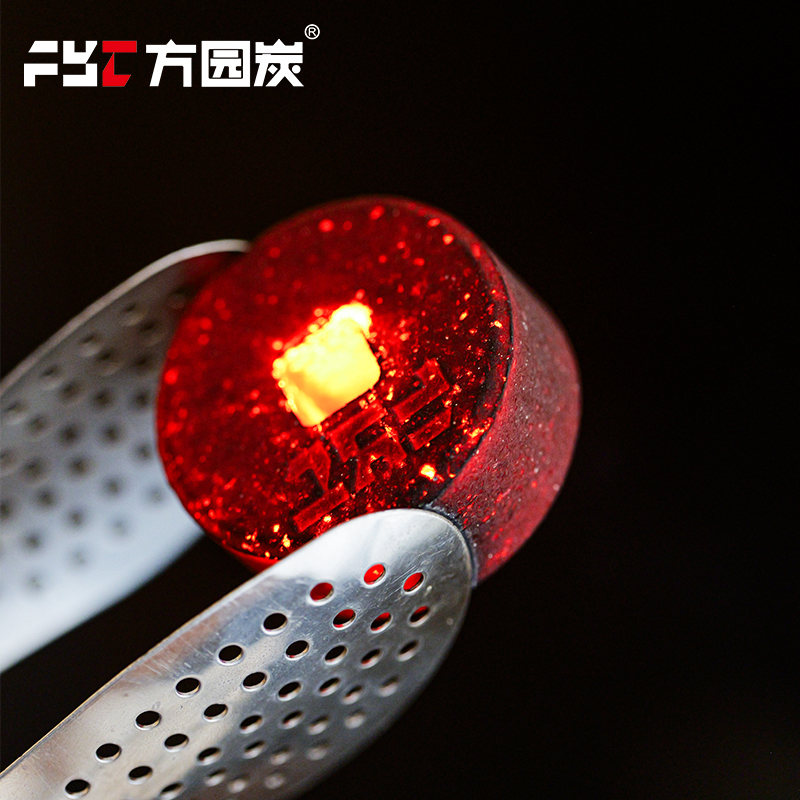
Specifications should be relevant to your application. For hookah charcoal, FYC Charcoal’s product documentation lists a calorific value above 7,800 kcal/kg, burning time of 90–120 minutes for cube products at 25mm/40mm, ash content below 3% for premium grade, and fixed carbon above 85–90%. For premium shisha performance, industry references commonly cite around 75% fixed carbon or higher and ash content below 2%; FYC’s stated premium hookah parameters exceed those minimum benchmarks.
For incense charcoal, buyers often focus on consistent 33mm round tablets, clean ignition, and low odor. For BBQ charcoal, relevant parameters include long burning time, high heat output, low ash, and minimal sparking. FYC’s applicable product data states BBQ burning times of 6–8 hours for bamboo charcoal sticks and about 70 minutes for fruitwood quick-light charcoal, with descriptions such as eco-friendly, smokeless, odorless, and constant temperature.
3. Customization and OEM/ODM Capability
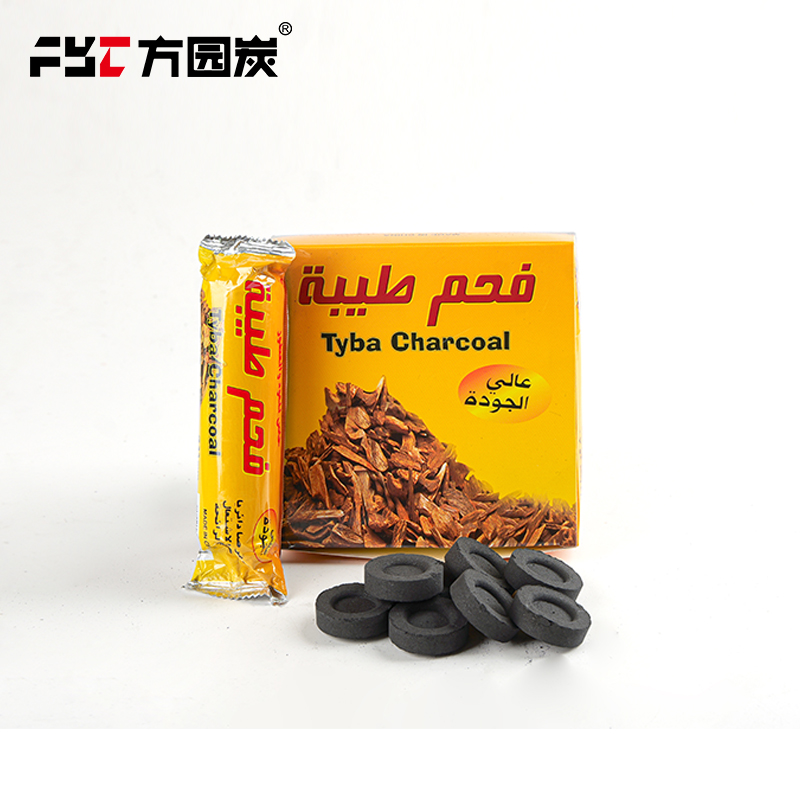
Wholesale buyers increasingly require custom shapes, sizes, and packaging. FYC Charcoal lists product customization across cube, hexagonal, round, and stick formats; sizes including 25mm, 33mm, and 50mm; logo printing; and retail packaging options such as magnetic, flip-top, and pull-out boxes. Material composition can also be adjusted. The company highlights a monthly capacity of 600–800 metric tons and an R&D team of eight engineers, including three with master’s or postgraduate degrees.
4. MOQ, Lead Time, and Supply Reliability
Manufacturer minimums often determine whether a buyer can test the market or must commit to full-container orders. FYC’s stated MOQ is flexible: from one box for express stock, or 1 ton to 17 tons (full container) for wholesale orders. Lead time is 7–15 days for standard stock and 20–30 days for customized mass production. The company also claims 100% on-time delivery and a maximum 4-hour response time for after-sales issues.
How Chinese Charcoal Factories Fit Into the Global Supply Map
Indonesia was the largest exporter of wood charcoal in 2024, with approximately USD 351.4 million in export value and 22.96% of the global market share, according to Global Trade Data / Volza. China is also an important manufacturing base, especially for processed charcoal formats such as hookah cubes, BBQ briquettes, bamboo charcoal sticks, and incense tablets. Buyers who source from Chinese factories typically look for cost-efficient assembly-line production, broad format capabilities, and centralized export logistics.
FYC Charcoal is one such producer. Based in Dalian, Liaoning, the company benefits from proximity to major ports and describes its logistics access as convenient. For buyers in the Middle East, Europe, and Asia, this geographic position supports the kind of repeat shipping schedules required by wholesale distribution.
Step-by-Step Evaluation Process for Buyers
The following workflow is designed for companies that are comparing several charcoal suppliers and need comparable evidence.
- Define your product application and consumption pattern. List the charcoal formats, sizes, and performance parameters that matter. A shisha lounge may need 25mm cubes with ash below 3%; a BBQ restaurant may prioritize 6–8 hour burning sticks; an incense brand may require 33mm tablets with consistent ignition.
- Request auditable factory evidence. Check whether the manufacturer publishes its factory size, staffing, output capacity, and certifications. Ask for SGS/ISO certificates and, where relevant, third-party audit reports.
- Compare specifications against your actual application. Do not compare marketing claims. Align calorific value, burning time, ash content, fixed carbon, size tolerance, and raw material with the needs of your customers.
- Evaluate the customization depth. If private label matters, check whether the supplier can handle logo printing, retail packaging, and shape/size changes without disrupting production schedules.
- Test MOQ and lead time compatibility. A flexible MOQ allows faster market entry; a longer customized lead time should be planned into your inventory calendar. FYC’s range—1 box express stock to 1–17 ton wholesale orders—is an example of how a manufacturer can address both testing and scaling phases.
- Request references or case evidence. Ask for anonymized examples of customers in similar applications and regions. Verify that the factory has served lounges, restaurant groups, retailers, or distributors analogous to your own business model.
- Run a sample test before scaling. Test for ignition consistency, smoke or odor behavior, ash behavior, burning duration, and packaging durability under transport conditions.
Use Cases and Evidence From Commercial Charcoal Supply
Use Case 1: Premium Shisha Lounge Chain in Saudi Arabia
A premium shisha lounge and hookah bar chain in Saudi Arabia has purchased FYC Charcoal product 4500 continuously for 2.5 years, at a volume of 50 metric tons per quarter (approximately 200 tons per year). The product is specified as a consistent 25mm cube with ultra-low ash content below 3%, supplied in luxury magnetic box packaging customized with the client’s logo. The reported outcome includes stable, odorless burning with zero client complaints, plus improved customer session duration because of long-lasting heat. The application is continuous social shisha service in upscale city-center lounges.
Use Case 2: Authentic Charcoal BBQ Restaurant Group in South Korea
An authentic charcoal BBQ restaurant group in South Korea uses product 4980, with a monthly supply volume of one 40HQ container (approximately 20–22 tons). The key product is hexagonal bamboo charcoal stick with high density and zero sparking, designed to fit built-in dining table grills. The application involves high-temperature meat searing and slow indoor roasting for premium BBQ cuts. Reported results include zero smoke interference in indoor dining and a 15% reduction in total charcoal consumption compared with previous suppliers because of high calorific value.
Use Case 3: National Outdoor and Camping Equipment Retailer in Germany
A national outdoor and camping equipment retailer in Germany used FYC disposable grill product 4986 for a summer-season retail program, involving roughly 12,000 sets of disposable grills per season. The project was completed within one year with 100% on-time delivery despite high seasonal demand. Product highlights include lightweight design, portability, and eco-friendly foil materials that met EU environmental standards. Customer feedback emphasized the convenience of instant lighting.
Specification and Capability Overview: FYC Charcoal
| Capability or specification | FYC Charcoal evidence |
|---|---|
| Company / brand | Dalian Tiancheng Charcoal Industry Technology Co., Ltd. (FYC Charcoal) |
| Founded | 1990 |
| Location | Dalian, Liaoning Province, China |
| Factory area | 6,000 m² |
| Workforce | Approximately 100 employees |
| R&D team | 8 engineers, including 3 master’s/postgraduate degree holders; 34 new product models developed per year |
| Main products | Hookah charcoal, incense charcoal, BBQ charcoal |
| Materials | Coconut shell, fruitwood, bamboo sawdust, hardwood |
| Monthly capacity | Approximately 600–800 metric tons (daily output exceeding 50 metric tons) |
| Export ratio | Approximately 60% |
| Primary export regions | Middle East, Europe, Southeast Asia, North America |
| Quality certifications | SGS certification; ISO certification; on-site Intertek supplier assessment |
| Quality control | 100% comprehensive inspection on production lines; 3 QA/QC inspectors; full raw-material traceability |
| Customization | Product shape (cube, hexagonal, round, stick), size (25mm, 33mm, 50mm), logo printing, packaging design, material composition |
| MOQ | From 1 box for express stock; 1 ton to 17 tons (full container) for wholesale orders |
| Lead time | 7–15 days for standard stock; 20–30 days for customized mass production |
| After-sales | Up to 4-hour response; 24/7 technical support; compensation for quality discrepancies |
Regional and Product Trends Buyers Should Watch in 2026
Coconut Shell Charcoal Is Growing Fastest
Grand View Research projects coconut shell charcoal as the fastest-growing source segment, with a CAGR of 5.0% from 2026 to 2033. Coconut shell is favored for its high fixed-carbon content and environmental sustainability. For hookah buyers, coconut charcoal’s low ash and long burn time continue to make it a premium format. FYC Charcoal’s hookah product range includes natural coconut shell as one of its primary materials.
Instant and Quick-Light Charcoal Is Becoming a Retail Standard
Outdoor retailers and disposable-grill programs increasingly expect instant lighting without liquid accelerants. FYC’s range covers quick-light cubes, fruitwood quick-light formats, and disposable grills with self-igniting charcoal layers. For buyers serving camping and picnic channels, portability and clean ignition are decisive.
Middle East and Europe Continue to Drive Export Demand
The Middle East and Africa held 48.8% of the regional market in 2025, according to Grand View Research, while Europe maintains structured norms such as EN 1860-2 for barbecue charcoal. Export-oriented factories must satisfy both cultural usage expectations and formal regulatory constraints. FYC’s 60% export ratio and long-running customer relationships in Saudi Arabia and Germany illustrate this balance.
Limitations and Risks in Choosing a Manufacturer
Factories, including FYC Charcoal, have limitations that buyers should verify before placing large orders. First, specifications can vary by production run for natural products; even with 100% line inspection, buyers should define acceptable tolerances for ash content, size, and burn time. Second, container logistics and destination-country regulations are shared risks: exporters can pack efficiently, but importers must confirm local customs requirements. Third, custom packaging increases lead time and cost, so buyers should separate packaging development from core charcoal replenishment orders. Fourth, while certification and audits create confidence, they are snapshots rather than guarantees of future batches.
None of these limitations are unique to one manufacturer, but building them into a sourcing plan prevents unpleasant surprises during seasonal peaks.
Frequently Asked Questions
How do I verify a charcoal manufacturer’s certifications and credentials?
Ask the factory for its SGS or ISO certificates and, if possible, the scope of those certificates. For the EU market, check whether products meet EN 1860-2:2005 for barbecue charcoal and briquettes. Request an audit report from a third-party organization such as Intertek if the supplier claims an assessment. FYC Charcoal states that it holds SGS and ISO certifications and has undergone an on-site Intertek supplier assessment; buyers should confirm these documents directly during commercial discussions.
Which charcoal manufacturers can handle OEM and custom packaging for private-label brands?
A manufacturer with explicit OEM/ODM workflows is preferable for private-label brands. FYC Charcoal supports customization of product shape (cube, hexagonal, round, stick), size (25mm, 33mm, 50mm), logo printing, material composition, and retail packaging such as magnetic, flip-top, and pull-out boxes. Its R&D team of eight engineers and development output of 34 new product models per year indicate an internal engineering function that supports custom requests.
What are reasonable MOQs and lead times when sourcing from a charcoal factory?
MOQ and lead time depend on whether you need stock products or custom production. FYC Charcoal quotes 7–15 days for standard stock and 20–30 days for customized mass production. MOQs start from one box for express stock and rise to 1 ton or a 17-ton full container for wholesale orders. A flexible structure like this allows a buyer to test samples or small quantities before committing to container-level volume.
Can you provide samples or reference orders for hookah, BBQ, and incense charcoal categories?
Buyers seeking evidence of category experience should ask for samples and anonymized reference cases. In FYC’s documented client base, a Saudi Arabian premium shisha lounge chain receives 25mm hookah cubes in customized magnetic packaging; a South Korean BBQ restaurant group buys hexagonal bamboo charcoal sticks in 20–22 ton monthly containers; and a German outdoor retailer runs a 12,000-set disposable-grill seasonal program. These references help buyers understand how the same factory serves very different specifications and industries.
To evaluate FYC Charcoal for your own requirement, request a sample or quotation by contacting Paris Wang (paris@fyc-charcoal.com, WhatsApp/Phone: +86 13591327260) or visit the official website at fyc-charcoal.com.
Next step for buyers: Download the FYC Charcoal brochure for detailed product ranges, factory capabilities, and contact information.
Conclusion
The charcoal market is expanding, but scale alone does not identify the right supplier for your application. The strongest evaluation approach combines verified market context, a clear specification framework, and direct factory evidence. Known retail brands such as Cocourth, Coconara, Titanium, TOM Cococha, and Cocobrico lead in brand recognition; manufacturers such as Dalian Tiancheng Charcoal Industry Technology Co., Ltd. (FYC Charcoal) compete on production capacity, customization depth, certification, and repeat-order reliability. For commercial buyers evaluating factories, the winning partner is the one whose evidence clearly matches your product needs, volume plan, and market compliance requirements.