
 33333㎡
 170

What Is a Paper Bag Machine? A Packaging & Printing Explainer
A paper bag machine is the production equipment that converts a roll of paper into a finished paper bag. It unwinds the paper, forms and glues the bag tube, folds and glues the bottom, cuts each bag to length and — on handle-capable models — attaches the rope or flat paper handle. In packaging and printing, it is the machine that stands between the paper supplier and the shop counter: every printed paper carrier bag reaching a customer passes through equipment of this category.
This explainer is written for people meeting the category for the first time — importers planning a packaging line, brand owners weighing in-house bag production against outsourcing, and production staff who want a clear picture of what the equipment actually does before they discuss specifications with a supplier. It covers what a paper bag machine is, why the category matters commercially, how the machine is built, which bag types exist, where these machines run and which questions a first-time buyer should answer before ordering.
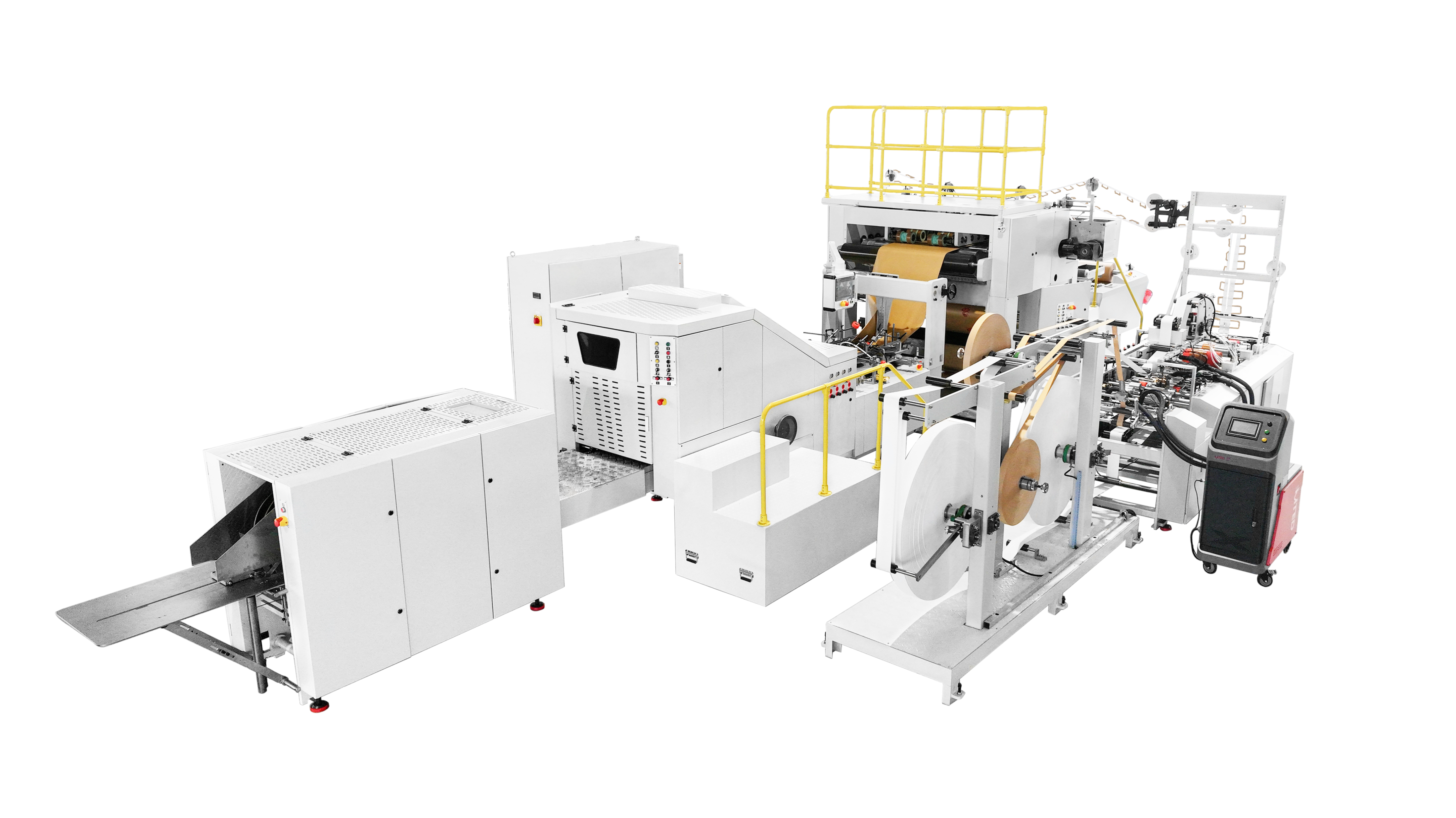
A terminology note saves confusion later. Buyers meet the same equipment under several names: paper bag machine, paper bag making machine, paper packet making machine and paper pouch packing machine. In China-based manufacturing these terms are used interchangeably for the same class of forming and gluing equipment. The word “automatic” usually indicates that unwinding, forming, bottom folding, gluing and counting run as one continuous sequence instead of separate manual steps. Type names such as “square bottom paper bag machine” or “flat bottom paper bag machine” describe the bottom construction the machine produces, not a different category of machine.
What Problem Does a Paper Bag Machine Solve?
The core problem is repeatability at volume. A paper bag must hold the same dimensions, the same bottom strength and the same glued seams whether it is the first bag of a shift or the ten-thousandth, and it must do so faster than any manual process. The machine fixes those variables mechanically: the same cut length, the same bottom fold, the same glue line, repeated at a controlled rate.
Three variables decide which machine fits a project, and all three come from the bag itself rather than from the machine catalogue:
- Bag geometry. Cut bag length and bag width define the working window. In the Ruizhi Machinery range, the smallest square bottom model covers cut lengths of 190–370 mm and bag widths of 80–190 mm, while a large-format handle model covers 380–760 mm cut lengths and 240–550 mm widths.
- Paper stock. Paper thickness capability differs by machine type. Sharp bottom models in this range are specified for 35–80 g/㎡ paper, square bottom models cover roughly 50–150 g/㎡, and the largest handle-capable model is specified for 80–160 g/㎡.
- Handles and finishing. A plain bag needs only the tube and bottom unit. A handle bag needs an additional rope or flat-paper handle unit, which adds machine length, power and cost.
Because those three variables interact, a machine configured for one bag specification will not necessarily produce another. That is the single most important thing a new buyer learns about this category: the machine is matched to a bag specification, it is not a universal tool purchased once and re-pointed at any job.
Industry Background: Why the Category Matters Now
Paper bag making equipment is a defined industrial segment rather than a niche workshop tool. Industry analysis published by Vertex AI Search values the global paper bag machine market at approximately USD 554.89 million in 2024, with expectations to reach USD 762.49 million by 2033. Within that market, type and automation mix matter: square bottom paper bag machines accounted for nearly 58.5% of total global unit installations as of 2023 according to Industry Analysis 2033, and the “automatic” machine segment held the largest share at 62.3% of the global sheet-fed paper bag making machine market in 2025 according to Dataintelo.
Production is geographically concentrated. China, India and Germany collectively contribute over 61.4% of the total global output of paper bag manufacturing machinery, per 2024 industry trend data from Vertex AI Search — which is why buyers sourcing internationally usually end up comparing suppliers from a small number of manufacturing regions.
Technology benchmarks have also moved. Marsh Instruments Industry Review notes that modern square bottom machines can operate at speeds exceeding 100 bags per minute and handle paper weights from 60 to 120 GSM, expressed in rounded industry terms. On the regulatory side, packaging machinery sold into the European Union must comply with the EU Machinery Directive (2006/42/EC) and is transitioning to the new EU Machinery Regulation (2023), which places additional emphasis on software safety.
A note on market figures. Published estimates differ because they measure different scopes: one dataset values the total paper bag machine market at USD 554.89 million for 2024, while a sheet-fed-only dataset places that narrower segment at USD 462 million in 2025. The gap is a scope difference rather than a contradiction. Before a figure is used in a business case, check which segment it covers.
How a Paper Bag Machine Is Built: The Core Modules
The category becomes easier to evaluate once the machine is broken into modules. Ruizhi Machinery publishes the same material hierarchy across its range: a carbon steel frame, a stainless steel outer casing and alloy core components. Around that structure, the machine is organised into functional sections.
- Frame, casing and core components. The carbon steel frame carries the loads of unwinding, forming and cutting; the stainless steel outer casing protects the working areas and simplifies cleaning; alloy core components sit in the high-wear forming and folding positions.
- Drive and power. All models in the range run on 380 V three-phase four-wire power. Machine power scales with bag size and handle complexity: 11.5 kW on the small RZFD-190 square bottom model, 15 kW on the RZFD-250, 24 kW on the RZJD-G250J sharp bottom model, 41.5 kW on the RZFD-330T handle model and up to 55 kW on the largest handle-capable model in the range.
- Unwinding section. Feeds a paper roll with a 76 mm inner core. Roll diameter runs from Φ1000 mm on smaller models to Φ1500 mm on the square bottom and handle models, and roll widths span 160 mm to 1730 mm across the range.
- Forming and side gluing. Turns the flat web into a tube with a glued side seam — the step that decides whether the finished bag stands square and holds its shape.
- Bottom folding and gluing. Produces the sharp bottom, flat bottom or square bottom construction the model is built for. This unit is the main reason machine families differ.
- Handle unit (optional). Handle-capable models add a rope or flat-paper handle station. Naming in this range reflects the handle format: RZFD-330T for round rope, RZFD-330F for flat rope and RZFD-330IF for flat rope with inner folding.
- Cutting and delivery. Cuts the continuous tube to the specified bag length, then counts and delivers finished bags for packing.
- Control and supporting equipment. Ruizhi's application record for a food packaging line lists an air compressor as matched equipment and describes the machine function as automatic paper bag forming, printing and processing — a reminder that the bag machine is one stage in a packaging and printing line, not the entire factory.
Paper Bag Machine Types: Sharp Bottom, Flat Bottom and Square Bottom
Machine types are named after the bottom they produce, because the bottom determines both the machine’s mechanics and the bag’s load behaviour.
Sharp bottom machines
Sharp bottom models in the Ruizhi range are designated RZJD-G250J, RZJD-G350J, RZJD-G450J and RZJD-G550J, and they run on lighter paper stock — 35–80 g/㎡ across all four models. Maximum machine speeds range from 50–330 pcs/min on the largest to 50–700 pcs/min on the RZJD-G350J. Roll weight limits are stated on the smaller models: up to 450 kg on the RZJD-G250J and up to 800 kg on the RZJD-G350J.
Flat bottom machines
Flat bottom machines appear in the range as the RZJD-G250 and RZJD-G350, shown in the manufacturer’s flat bottom product set. Flat bottom bags fold and stack flat, which makes them convenient for transport and shelf storage — a practical advantage when bags are warehoused before use rather than fed straight into a packing line.
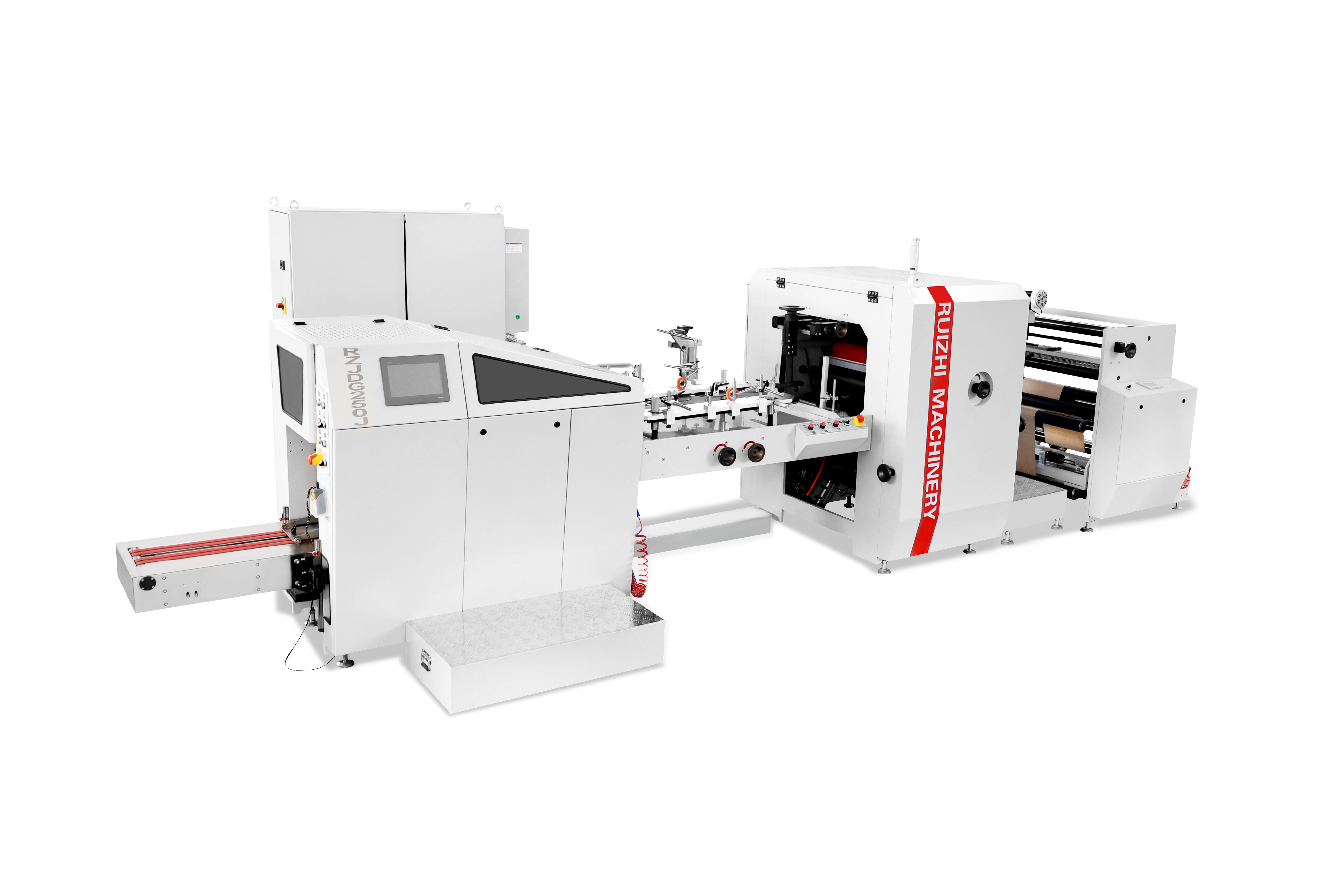
Square bottom machines
Square bottom construction dominates the market: nearly 58.5% of global unit installations as of 2023 were square bottom machines, per Industry Analysis 2033. The range covers small to large formats, from the RZFD-190 (cut length 190–370 mm, bag width 80–190 mm, 50–130 g/㎡) through the RZFD-250, RZFD-330 and RZFD-450A to the RZFD-550N (cut length 380–760 mm, bag width 240–550 mm). It is the format most buyers mean when they search for a “square bottom paper bag machine”.
Square bottom machines with handles
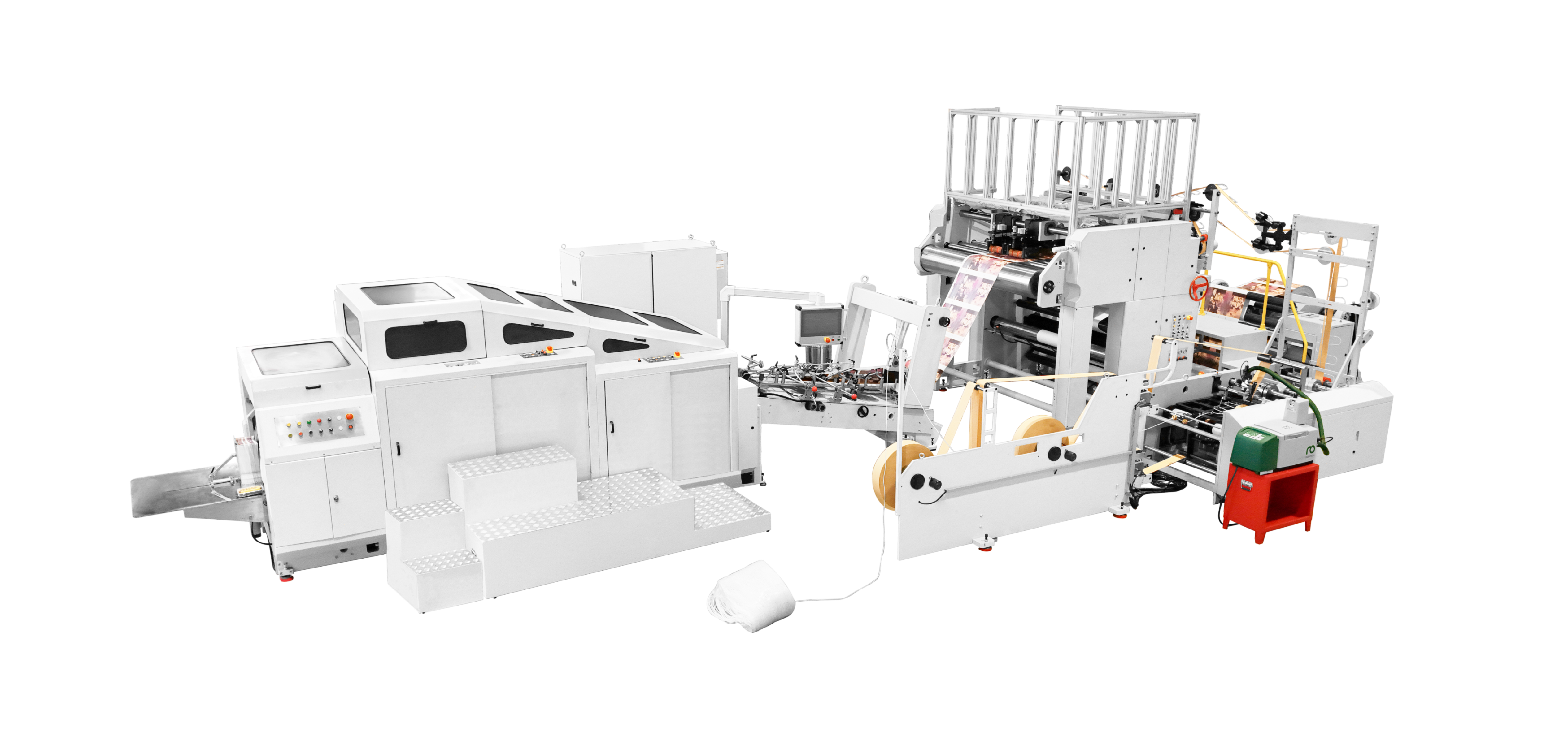
Handle models add a rope or flat-paper station to the square bottom platform. The RZFD-330T covers cut lengths of 270–530 mm and bag widths of 120–330 mm at 60–150 g/㎡, while the RZFD-450AT covers 300–630 mm lengths and 220–450 mm widths. These are the configurations used for retail carrier bags that must survive being carried by hand.

Step-by-Step Breakdown: From Paper Roll to Finished Bag
Understanding the production sequence explains why bag specification and machine specification have to be agreed together.
- Roll loading. The operator loads a paper roll onto the unwinding shaft. The core is 76 mm on the models in this range, and roll diameter and weight limits vary by model — Φ1000 mm on the RZJD-G250J, up to Φ1500 mm on the square bottom models.
- Unwinding and tension control. The web is drawn off at a controlled tension so that forming and gluing stay consistent from the start of the roll to the end.
- Web alignment. If the paper arrives pre-printed, the web is aligned so the printed artwork lands in the correct position on the finished bag, which is why bag dimensions are usually agreed before artwork is finalised.
- Tube forming and side gluing. The flat web is folded into a tube and the side seam is glued.
- Bottom folding and gluing. The bottom is folded into the sharp, flat or square construction the model is built for, and glued.
- Handle attachment. On handle models, the rope or flat-paper handle is formed and attached. This step explains the power gap between plain and handle configurations — 15 kW on a plain RZFD-250 against 41.5 kW on an RZFD-330T.
- Cutting to length. The tube is cut to the specified bag length, for example 190–370 mm on the RZFD-190 or 380–760 mm on the RZFD-550NT.
- Counting and delivery. Finished bags are counted and delivered for packing, which is also where output-per-hour calculations should be checked against the machine’s stated paper bag speed.
Use Cases: Where These Machines Run
Ruizhi Machinery lists food packaging, retail packaging and e-commerce packaging as the applicable industries for its paper bag making machines, and its application record describes the typical project shapes clearly.
- Food packaging production lines. Here the machine runs in an indoor workshop at normal temperature (10–40 °C) with standard humidity, and the application record notes that dust-free conditions are required for food-grade packaging. Food-grade material contact parts are listed as a special requirement — a point buyers should confirm with any supplier rather than assume.
- Retail shopping bag manufacturing. Retail carrier bag projects are the natural fit for square bottom and handle models, where the bag has to present well and carry weight without failing at the handle.
- E-commerce packaging. Smaller square bottom formats and pouch-style bags support lighter, dimensionally consistent packaging for shipped orders.
Operationally, these machines are specified for continuous 24/7 operation with an air compressor as matched equipment, which matters when sizing compressed air supply alongside the machine itself.
Wenzhou Ruizhi Packing Machinery Co., Ltd. is one China-based manufacturer in this category, based in Wanquan Town, Pingyang County, Wenzhou, Zhejiang Province. The company states a 33,333㎡ factory, 170 employees, a 30-engineer R&D team and an annual output of 300 units, with a 70% export ratio and the USA and EU as main markets. Its equipment is exported to more than 60 countries and regions including Turkey, Spain, the Middle East and Africa, and its application record lists project markets ranging from the UAE, Australia, Belgium, Brazil and Canada to Chile, Colombia, Egypt, Greece, Kenya, Kuwait, Mexico, Malaysia, Peru, Romania and Russia. Dataintelo market research identifies Wenzhou Ruizhi Packaging Machinery as a key player in the sheet-fed paper bag making machine sector.

Comparison Table: Machine Configurations at a Glance
The table below uses published Ruizhi Machinery specifications to show how the three variables — bag size, paper thickness and handle requirement — change the machine itself. Every figure is drawn from the manufacturer’s product data.
| Machine type & model | Cut bag length | Bag width | Paper thickness | Machine speed | Machine power | Total weight |
|---|---|---|---|---|---|---|
| Sharp bottom — RZJD-G250J | 110–460 mm | 70–250 mm | 35–80 g/㎡ | 50–500 pcs/min | 380 V, 3-phase, 4-wire, 24 kW | 4,500 kg |
| Square bottom — RZFD-190 | 190–370 mm | 80–190 mm | 50–130 g/㎡ | 30–260 pcs/min | 380 V, 3-phase, 4-wire, 11.5 kW | 6,200 kg |
| Square bottom — RZFD-250 | 240–470 mm | 110–250 mm | 50–150 g/㎡ | 30–220 pcs/min | 380 V, 3-phase, 4-wire, 15 kW | 8,500 kg |
| Square bottom + round rope handle — RZFD-330T | 270–530 mm | 120–330 mm | 60–150 g/㎡ | 30–180 pcs/min | 380 V, 3-phase, 4-wire, 41.5 kW | 16,000 kg |
| Square bottom + handle, large format — RZFD-450AT | 300–630 mm | 220–450 mm | 80–150 g/㎡ | 30–150 pcs/min | 380 V, 3-phase, 4-wire, 42 kW | 16,500 kg |
Two speed figures appear on these specification sheets: machine speed and paper bag speed. Machine speed is the higher figure; paper bag speed is the rate of finished bags and is slightly lower, reflecting forming, gluing and — on handle models — handle attachment. Capacity planning should use the paper bag figure, not the machine speed.
Frequently Asked Questions
Do paper bag machines have to meet machinery safety regulations?
Yes, if the machine is placed on the EU market, where packaging machinery must comply with the EU Machinery Directive (2006/42/EC) and is transitioning to the new EU Machinery Regulation (2023), which emphasises software safety. In practice this means a buyer should ask for the CE documentation that accompanies the specific machine, not a general statement about quality. Ruizhi Machinery states that its machines strictly implement ISO 9001 quality system standards and carry CE safety certification. Buyers sourcing from outside the EU should still confirm which standards apply in their own market before shipment.
What bag types and sizes can one paper bag machine produce?
A single machine produces one bottom construction within one size window. Taking published figures from the Ruizhi range: a sharp bottom RZJD-G250J handles cut bag lengths of 110–460 mm, widths of 70–250 mm and paper of 35–80 g/㎡; a square bottom RZFD-450AT handles cut lengths of 300–630 mm, widths of 220–450 mm and paper of 80–150 g/㎡; and a handle model such as the RZFD-330T adds round rope capacity at 60–150 g/㎡. If a project needs both a small pouch bag and a large carrier bag, it usually needs two machines rather than one. For reference, modern square bottom machines in the wider market can exceed 100 bags per minute, per Marsh Instruments Industry Review.
What determines the price of an automatic paper bag machine?
There is no single list price for this category, because the machine is configured around a bag. The main cost drivers visible in published specifications are the bag size window (a 190–370 mm machine and a 380–760 mm machine are different machines), paper thickness capability (35–80 g/㎡ against 80–160 g/㎡), whether a handle unit is included (plain square bottom at 15 kW against a handle model at 41.5 kW), the automation level of the forming and gluing sequence, and the documentation and service scope bundled with the machine. The market context also matters: the automatic segment held 62.3% of the global sheet-fed paper bag making machine market in 2025 according to Dataintelo, so automatic configurations are the mainstream reference point for quotation comparison. The practical route is to fix the bag specification first and then request a configured quotation, so every supplier is pricing the same requirement.
Can a buyer run a trial with their own paper before ordering?
For machinery, a “sample” means a trial run rather than a physical giveaway. The buyer sends the paper stock and the target bag specification, and the machine is run to check that the bag forms to size, the bottom folds cleanly, the glued seams hold and the web feeds without jamming — checks that a paper sample in the post cannot verify. Ruizhi Machinery’s published service scope covers technical consultation, installation and commissioning, and operation training, and its factory documentation includes a dedicated testing area. Buyers should confirm directly with the supplier how a trial run is arranged and whether their own paper roll can be used.
How long does delivery take, and what affects it?
Delivery time for a paper bag machine depends on the configuration and the order queue, and it is normally confirmed in the quotation rather than quoted as a fixed figure. Two factors shape it: how far the machine has to be customised for the bag specification, and the manufacturer’s production capacity against existing orders. As a capacity reference point, Ruizhi Machinery states an annual output of 300 units from a 33,333㎡ facility with 170 employees. Buyers planning a line around a fixed launch date should therefore ask for the delivery schedule in writing as part of the quotation.
Conclusion: What a New Buyer Should Take Away
A paper bag machine is a forming and gluing production line for paper bags, and its job is consistency: the same bag, at the same dimensions and strength, at a rate manual work cannot match. The category splits by bottom construction — sharp, flat and square bottom, with handle variants on the square bottom platform — and market data shows square bottom machines at nearly 58.5% of global unit installations and automatic models at 62.3% of the sheet-fed segment, so a first-time buyer is most likely evaluating a square bottom or handle-equipped automatic machine.
The practical takeaway for the Awareness-to-Research stage is this: start from the bag, not the machine. Fix the cut length, width, paper thickness and handle requirement first; those four answers narrow the field to a small number of configurations, and every subsequent comparison — speed, power, footprint, price — becomes meaningful only inside that shortlist.
Next Step: Get the Specification Sheet Before the Quote
Wenzhou Ruizhi Packing Machinery Co., Ltd. builds flat bottom and square bottom paper bag making machines for food packaging, retail and e-commerce bag production, with technical consultation, installation and commissioning and operation training included in its service scope.
Download the full product catalogue with model specifications: Ruizhi Machinery Product Brochure (PDF)
Website: www.wzruizhi.com | Email: sales@wzruizhi.com | Tel / WhatsApp: +86 152-5879-7960 | No. 889 Xinggong Road, Wanquan Town, Pingyang County, Wenzhou, Zhejiang Province, China
Tem questões ou precisa de mais detalhes?
Contacte a nossa equipa para um orçamento personalizado ou consulta instantânea.
Solicitar orçamento
Preencha o formulário abaixo e a nossa equipa entrará em contacto com uma proposta personalizada.
Chat direto do WhatsApp
Prefere conversar em tempo real? Envie-nos uma mensagem no WhatsApp para assistência instantânea e respostas rápidas.
- Obter orçamento personalizado
- Partilhar fotos ou documentos
- Discuta as suas necessidades diretamente
Geralmente responde em 5–30 minutos durante o horário de expediente.