
 146667㎡
 235
235

Primer-Free BOPP Film for Thermal Lamination: A Technical Guide to Base Film Selection
Primer-Free BOPP Film for Thermal Lamination: A Technical Guide to Base Film Selection
A primer-free BOPP base film is a biaxially oriented polypropylene substrate engineered so that an EVA hot-melt adhesive layer bonds directly to its surface — with no chemical primer or anchor coating applied first. For a thermal lamination film manufacturer, that single structural decision removes one coating stage, one drying stage, and the process-control workload attached to both.
This guide is written for the people who run the coating line: thermal lamination film manufacturers, extrusion coaters and film converters who buy base film by the roll and are judged on the consistency of the finished film. It covers where primer coatings create process risk, what the SHKFILM product 6544 No-Primer Base Film Series specifies, how to qualify a primer-free base film step by step, which applications it serves, how the primer-free route compares with conventional primer-coated routes, and what to verify before committing to a long-term supply relationship.
The Problem: Every Primer Layer Adds Control Points You Have to Defend
Conventional primer-coated thermal lamination film production requires additional control of primer coating weight, coating uniformity, drying conditions, and related equipment maintenance. It also consumes additional energy, because primer coating, drying and the related auxiliary processes draw power that a primer-free route does not require.
For a manufacturer buying base film rather than selling it, the real issue is not appearance. It is variance. A thermal lamination film line already manages several risk classes at once, and each one has an established control method:
- Coating weight and thickness variation — controlled through online thickness monitoring and coating weight measurement, supported by process parameter control, regular equipment calibration and batch inspection.
- Bonding performance failure (weak adhesion or delamination) — controlled through bond strength testing, adhesion testing and batch quality verification before shipment, supported by a controlled coating process, qualified raw material inspection and batch traceability.
- Storage stability issues (blocking or moisture-related haze) — controlled through storage condition control, moisture-proof packaging inspection and blocking resistance verification before shipment, plus protective packaging and an optimized winding process.
- Shrinkage or curling during lamination — controlled through lamination performance testing under standard conditions, raw material verification, process optimization and technical guidance on lamination temperature and pressure.
- Raw material supply and price fluctuation — managed through multi-source supplier evaluation, market monitoring, qualified supplier management, inventory planning and flexible production scheduling.
Every item on that list is manageable. The case for a primer-free base film is not that primer coating is unmanageable — it is that the primer layer introduces a further set of variables (primer weight, primer uniformity, drying profile, primer-related equipment condition) that must be controlled on top of everything above. Remove the layer and the associated control requirements go with it, which is exactly how product 6544 is positioned: primer-free technology that helps simplify the coating process and improve production efficiency.
Industry Background: Where Base Film Selection Sits in the BOPP Lamination Chain
The global BOPP films market was valued at USD 31.0 billion in 2025 and is projected to reach USD 49.8 billion by 2033 (Grand View Research). Within that wider market, the thermal lamination films segment is forecast to reach USD 1,547.9 million by 2025, with BOPP-based films as the leading film type (Future Market Insights). Demand is geographically concentrated: Asia Pacific held the largest revenue share of the global BOPP films market in 2025 at 32.2% (Grand View Research), and the China BOPP film market alone was valued at approximately USD 5.7 billion in 2024 (Ken Research).
Two application trends are shaping what base film buyers are asked to deliver. Matte thermal lamination films are increasingly used for high-end applications such as luxury paper box packaging and book covers, while anti-scratch and scuff-resistant finishes are cited as high-growth specialties in commercial print and premium packaging (Future Market Insights). On the supply side, solvent-free no-primer BOPP base films are recognised for improving adhesion to EVA and reducing energy consumption during extrusion coating.
Compliance pressure runs alongside the volume trend. In China, food-contact BOPP films must comply with GB 4806.15-2024 governing food-contact adhesives, effective February 2025 (Mordor Intelligence). BOPP films for international trade often require BRC certification for retail and food service supply chains in the US and UK (British Retail Consortium), and BOPP lamination films for US food contact must comply with FDA 21 CFR 177.1520 (US FDA). For a base film supplier these are not marketing points; they are the gate conditions that decide whether a finished film can be sold into a given market at all.
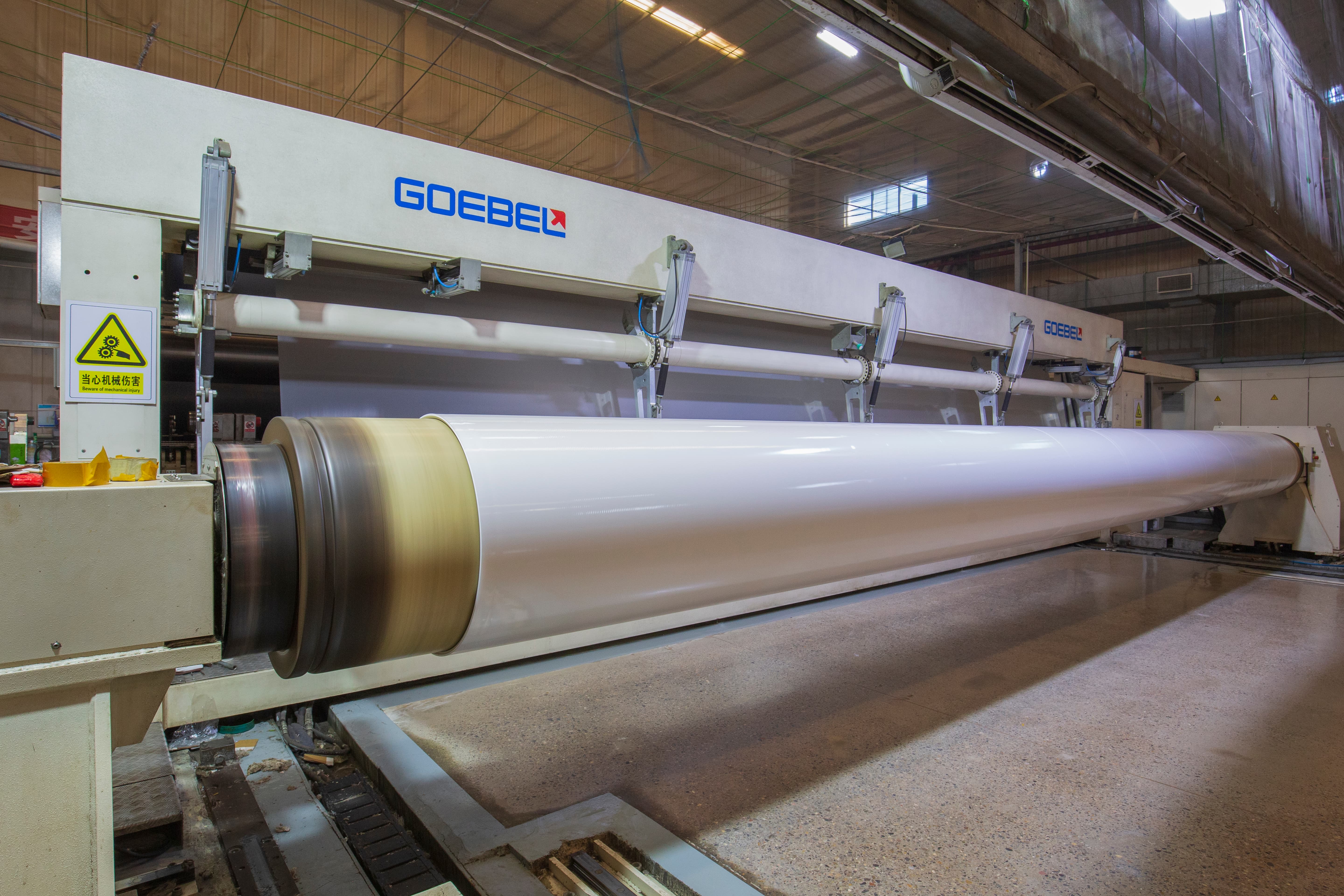
SHKFILM is the brand of Shandong Shunkai Composite Material Co., Ltd., founded in August 2010 and headquartered at No.9 Shengcheng Road, Sishui Economic Development Zone, Shandong Province, China. It is a national high-tech enterprise specialising in the R&D, production and sales of polymer composite materials, operating two BOPP film production lines imported from Brückner (Germany) with an annual capacity of 30,000 tons. Its core strength is the R&D and manufacturing of no-primer base film.
The Solution: Product 6544 No-Primer BOPP Base Film
What “Primer-Free” Changes at the Film Structure Level
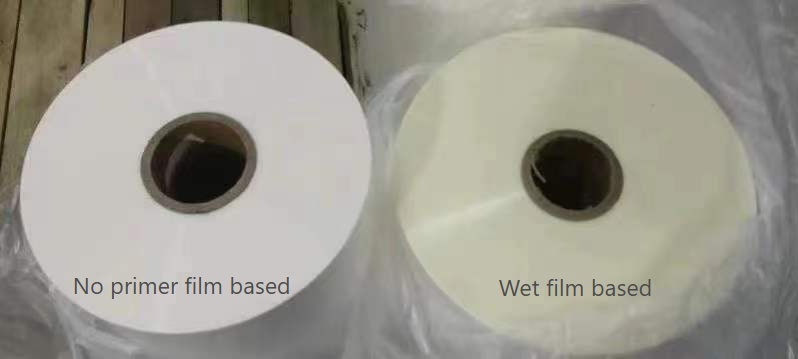
Product 6544 is supplied as the No-Primer Base Film Series in two base types: No-Primer Base Gloss Film and No-Primer Base Matte Film. Its defining scenario specification is stated plainly: no chemical primer coating needed, corona tension ≥38 dyne, and minimal crystal points and black spots.
Functionally, the base film and the adhesive layer are thermally fused at the molecular level. That is what allows an EVA coating to be applied directly onto the substrate, so the film maker does not run a separate primer coating pass ahead of the adhesive layer. Because the primer stage is gone, there is no primer residue to manage, no primer drying profile to tune, and no primer coating weight to hold inside a tolerance band.
Specification Summary: No-Primer Base Film Series (Product 6544)
| Parameter | Specification |
|---|---|
| Product name | No-primer BOPP Base Film for BOPP Thermal Lamination Film (No-Primer Base Film Series) |
| Film type | No-Primer Base Gloss Film; No-Primer Base Matte Film |
| Thickness range | 12 micron, 15 micron |
| Corona treatment | Outside, ≥38 dyne |
| Core diameter | 3 inch (76 mm), 6 inch (152 mm) |
| Roll width | 300 mm – 2580 mm |
| Roll length | 9100 m, 12100 m, 18100 m |
| Material | BOPP resin |
| Applicable industry | Thermal lamination film manufacturing, extrusion coating and film converting |
| Scenario requirements | No chemical primer coating needed; corona tension ≥38 dyne; minimal crystal points and black spots |
What “Stable Coating Performance” Means for a Buyer
The claim that matters at the purchasing stage is not the structure — it is behaviour over repeat production. In thermal lamination film production, manufacturers have used product 6544 across a cumulative supply exceeding 10,000 tons, during which it demonstrated stable coating performance and consistent finished-film quality, with primer-free technology simplifying the coating process and improving production efficiency.
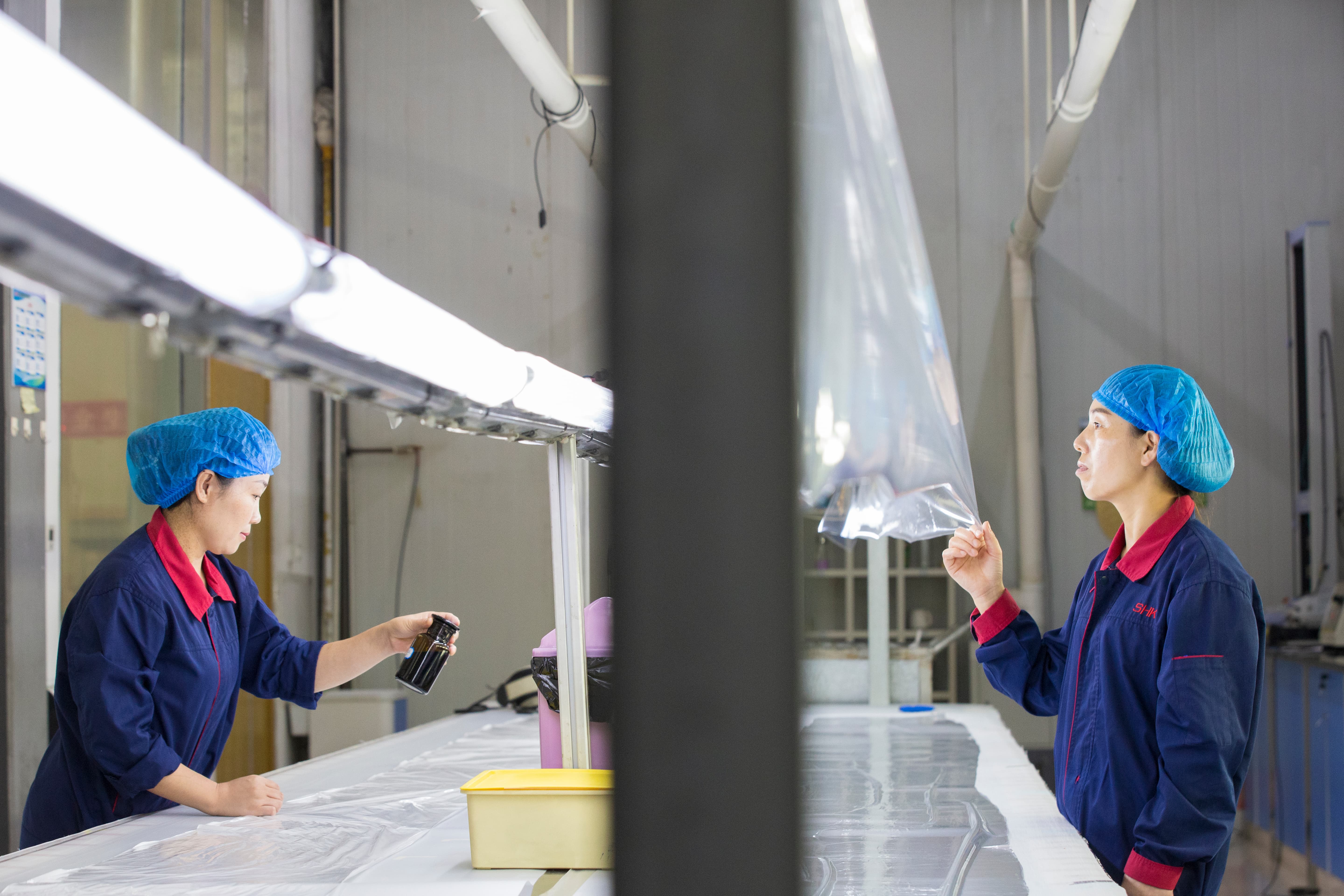
Holding that consistency over volume is a process-control question on the film maker’s side. SHKFILM’s quality control measures include online process monitoring, thickness inspection and laboratory testing — the three layers a converter would otherwise have to reconstruct downstream if the incoming substrate drifted between deliveries.
Why In-House Base Film Matters to the Finished Film
All SHKFILM BOPP thermal lamination films use 100% in-house produced no-primer base film, so the integrity of the no-primer process is preserved from the source rather than assembled from separately purchased substrate. For a buyer, this is a traceability argument: substrate and coated film come from one manufacturing chain.
SHKFILM’s own position is that it has served the vast majority of customers in the domestic no-primer base film market before expanding into thermal lamination film. That is a first-party statement, and it is worth testing during supplier qualification with your own trial run rather than accepting at face value — which is what the qualification sequence below is designed to do.
Step-by-Step Breakdown: How to Qualify a No-Primer BOPP Base Film
- Confirm your coating route first. Product 6544 is positioned for thermal lamination film manufacturing, extrusion coating and film converting. If your line is a wet lamination route using water-based adhesive, the relevant substrate logic is different — a conventional BOPP base film also serves direct wet lamination with paper using adhesive systems, and SHKFILM offers a separate matte wet lamination film for that route.
- Match base film thickness to your finished target. The no-primer base film is available at 12 micron and 15 micron. SHKFILM’s finished BOPP thermal lamination film series is specified at 17–27 micron, thicker than the base film because the EVA adhesive coating is applied on top of the substrate.
- Verify corona treatment on the correct side. The stated requirement for product 6544 is outside corona treatment of ≥38 dyne. Corona retention directly affects how the adhesive layer wets and holds, so ask for corona data per batch rather than per product family.
- Check surface cleanliness requirements. The 6544 scenario specification calls for minimal crystal points and black spots. On cosmetic or electronics packaging, these surface defects are the difference between a sellable roll and a rejected one.
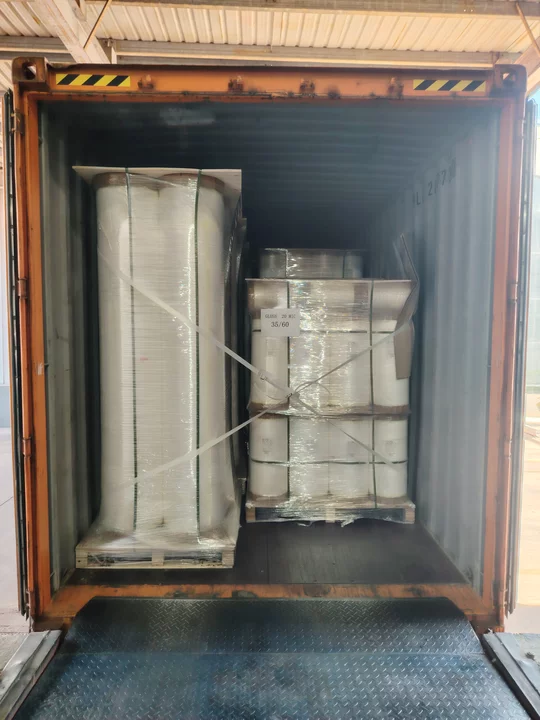
- Confirm roll geometry against your unwinder and slitter. Core diameter is available in 3 inch (76 mm) or 6 inch (152 mm); roll width 300 mm to 2580 mm; roll length 9100 m, 12100 m or 18100 m. Confirm your equipment can accept the selected combination before ordering.
- Run lamination performance testing under standard conditions. This is the established control method for shrinkage and curling, combined with raw material verification, process optimization and technical guidance on lamination temperature and pressure.
- Verify adhesion and bond strength before shipment. Bond strength testing and adhesion testing, with batch quality verification before shipment, batch traceability and qualified raw material inspection, are the controls that prevent weak adhesion or delamination from reaching your line.
- Confirm storage and blocking resistance. Storage condition control, moisture-proof packaging inspection and blocking resistance verification before shipment, supported by protective packaging and an optimized winding process, are what keep rolls stable in transit and in your warehouse.
- Agree the acceptance basis, then scale. Inspection before shipment is carried out against agreed specifications. Flexible MOQ is set by film type, specification and order requirements; trial orders are acceptable, and larger quantities are recommended for better pricing on regular production orders.
Use Cases: Where a Primer-Free Base Film Is Selected
Book Covers and Paper Packaging Boxes
Book covers and paper boxes are among the most demanding mainstream applications for BOPP thermal lamination film. The scenario requirements at finished-film level are strong bonding at lower temperatures, bubble-free performance on heavy offset ink coverages, and stable performance under shipping heat. All three are adhesion-and-bonding problems, which is why base film selection carries more weight here than many buyers expect: the substrate determines how the adhesive layer behaves before any laminator setting is touched.
Cosmetic and Electronics Paper Box Packaging
Cosmetics & personal care and consumer electronics are named application industries for SHKFILM thermal lamination films. These are surfaces where visual defects are highly visible, which is why the “minimal crystal points and black spots” requirement in the 6544 specification matters more here than in general commercial print. A base film with high purity and minimal film defects supports the clean appearance these packaging categories demand.
Soft-Touch and Anti-Scratch Specialty Finishing
When the finished product is a specialty film, substrate consistency matters even more because functional performance is stacked on top of it. BOPP Soft Touch Film combines a matte appearance with a soft, smooth, velvety tactile experience, while standard matte BOPP film mainly delivers a low-gloss visual effect without additional tactile enhancement. Soft touch also requires more precise process control to maintain consistent tactile performance and surface quality.
Anti-scratch is a separate requirement class. Compared with standard matte thermal film, anti-scratch thermal film features a specialised hard coat that increases surface hardness by 40% (reaching 2H pencil grade) and improves scuff and abrasion resistance by over 35%. It is aimed at high-end brochures, packaging boxes, luxury product packaging and printed covers prone to friction and abrasion, and it remains compatible with standard thermal lamination equipment while reducing rework caused by surface scratches.
Downstream results show what a stable substrate ultimately has to support. A project using SHKFILM product 6623 in India applied 1,000,000 square metres of film and was completed within two years, solving the problem of achieving premium tactile and protective performance in printed materials, with key highlights of premium tactile effect and excellent scratch resistance. A second project supplied 30 tons of specialty film to commercial printing and packaging customers in South Korea, Italy and Sri Lanka, achieving a consistent soft-touch finish and premium appearance, with velvet-like tactile effect, excellent scratch resistance, compatibility with high-speed laminating machines, and availability in gloss and matte finishes.
Where the Primer-Free Logic Does Not Apply
It is worth stating the boundary clearly. SHKFILM’s BOPP matte wet lamination film (product 6647) is a wet-lamination route product specified at 12 micron and 15 micron with outside corona ≥42 dyne and inside ≥38 dyne, designed for scenarios requiring high mattness, zero fish-eyes, excellent water-glue wet-out and high corona retention. It serves commercial printing and post-press finishing, custom packaging box manufacturing and film converting plants. A project using 6647 addressed the challenge of maintaining consistent lamination quality over a cumulative supply of 2,500 tons, achieving smooth lamination with reliable adhesion and stable processing performance in paper lamination. Buyers running wet routes should evaluate that family; no-primer base film is the answer to a thermal or extrusion coating question.
Comparison: Primer-Free Base Film Against a Conventional Base Film
The table below sets out the differences that matter when selecting a base film for thermal lamination film production. It is drawn from SHKFILM’s published product comparison material and should be read as a structural comparison, not a price list.
| Dimension | No-Primer BOPP Base Film (product 6544) | Conventional BOPP Base Film |
|---|---|---|
| Difference | Specially developed for thermal lamination applications, with a surface structure designed to achieve direct adhesion with thermal adhesive layers without an additional primer coating. | A general-purpose substrate suitable for various lamination applications, including thermal lamination and direct wet lamination with paper using adhesive systems. |
| Performance gap | Eliminates the need for an additional primer coating process in thermal lamination film production, reducing one downstream coating step. | Requires primer treatment for thermal lamination film production where primer-based adhesion is used. |
| Best for | Substrate for thermal lamination film production, especially for manufacturers seeking primer-free thermal lamination solutions. | Broader applications, including thermal lamination film production and direct lamination with paper using adhesive systems. |
| Cost difference | May have higher material value due to specialised surface technology, but reduces downstream primer-related processing requirements. | Generally lower unit material cost and broader application flexibility. |
| Maintenance | Simplifies downstream processing by reducing primer-related operations and control requirements. | May require additional primer coating management, including coating control and quality monitoring. |
| Efficiency | Removes the additional energy consumption associated with primer coating and drying, simplifying the manufacturing workflow. | Involves extra energy consumption for primer coating and drying when primer treatment is required. |
At finished-film level, the same logic repeats. A no-primer BOPP thermal lamination film is produced with a specially developed BOPP base film without an additional primer or anchor coating layer, while a conventional thermal lamination film uses a primer-coated base film to enhance adhesion. The simplified structure is associated with a cleaner appearance, improved whiteness, better blocking resistance and reduced risk of surface migration — and it eliminates one primer coating layer and one primer coating process, reducing related process steps and simplifying production control.
The honest trade-off: conventional primer-coated production requires additional primer materials, coating processes and related production management costs, while the no-primer route may carry higher material value on the base film itself. The comparison is only favourable if your line actually runs the primer stage today — which is the first thing to confirm before switching.
Long-Term Supply: What to Verify Before You Commit
For a converter, base film selection is a supply-continuity decision as much as a technical one. Raw material supply and price fluctuation is a managed risk in this industry, handled through multi-source supplier evaluation, market monitoring, qualified supplier management, inventory planning and flexible production scheduling. Buyers should therefore apply the same scrutiny to a base film supplier that they apply to any long-run input:
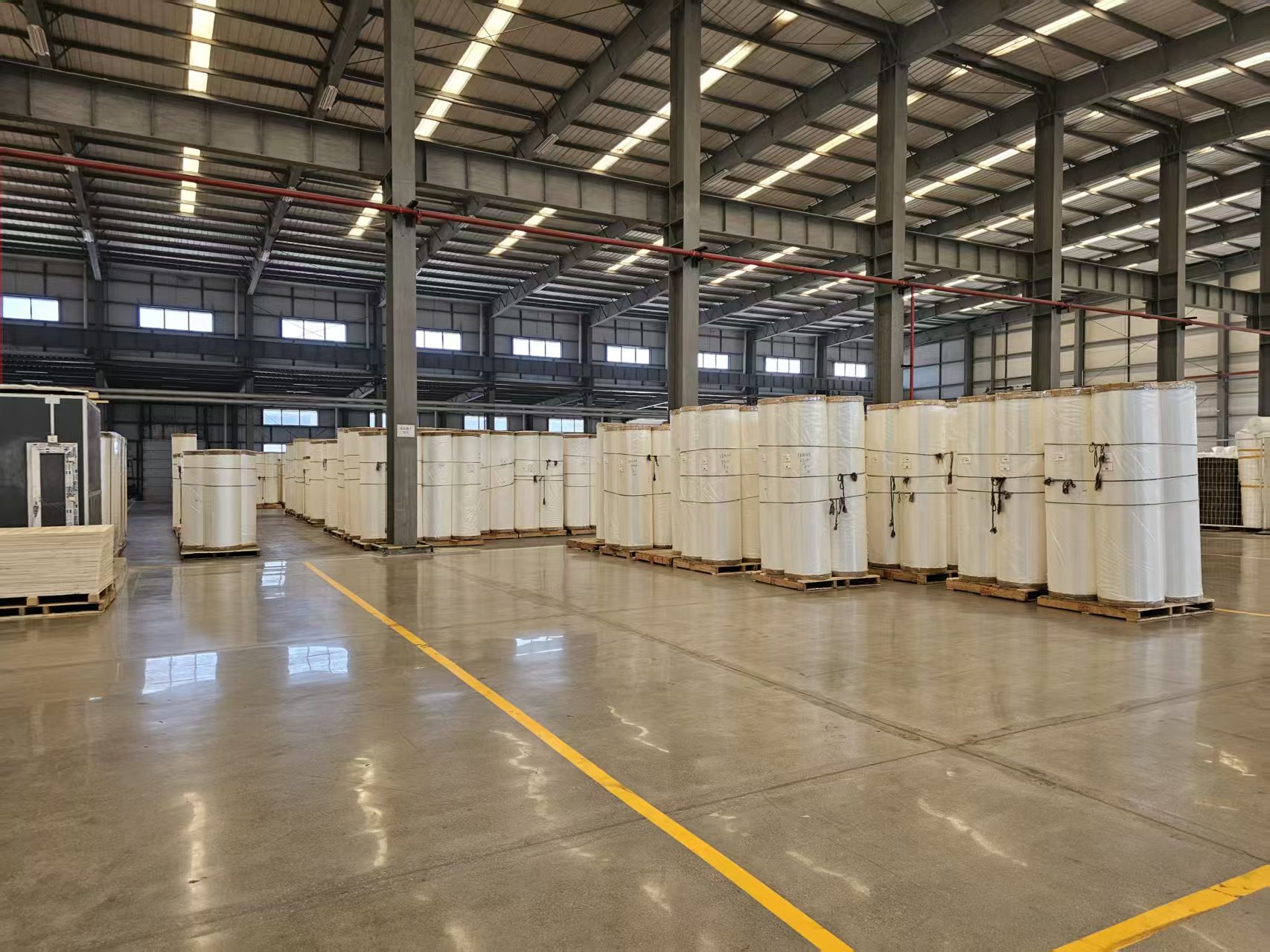
- Production capacity and integration. SHKFILM operates two BOPP film production lines imported from Brückner (Germany) with an annual capacity of 30,000 tons, a 146,667 m² facility, 235 employees and a 10-engineer R&D team. Because finished thermal films use 100% in-house produced no-primer base film, base film supply does not depend on an external substrate vendor.
- Certification status. SHKFILM is certified to EU BRC, ISO 9001, QS Food and Customs AEO Advanced Enterprise standards, and its biodegradable film products are certified under the Green Leaf certification. Map these against the market you ship into, using the GB 4806.15-2024, BRC and FDA 21 CFR 177.1520 references above as your checklist.
- Track record at volume. Product 6544 has been used in thermal lamination film production over a cumulative supply exceeding 10,000 tons with stable coating performance and consistent finished-film quality. SHKFILM also holds a 2,500-ton cumulative supply record on its matte wet lamination film, and the India and APAC/EU specialty-film projects described above.
- Order flexibility. SHKFILM supports OEM and private-label supply and accommodates small-batch trial orders in addition to bulk supply. It serves both converters who run their own coating or lamination lines and distributors or traders who resell finished film without further processing.
- Commercial terms. Delivery methods are FOB, CIF or CFR. Payment terms are T/T 30% deposit with 70% balance before shipment, or L/C at sight. Inspection before shipment is conducted against agreed specifications. Approximate export ratio is 70%, with exports to markets including the Netherlands, Brazil, Italy, Greece, India, South Korea, Japan and Iran.
- Recognised manufacturer status. SHKFILM has been honoured as a Shandong Province Manufacturing Single Champion Product Enterprise and a National “Specialized, Sophisticated, Distinctive and Innovative” (Little Giant) Enterprise.
For context, the wider BOPP film industry includes global producers such as Jindal Poly Films, Taghleef Industries and Cosmo First Ltd., and product-level innovation in this category continues — Cosmo Films, for example, developed antimicrobial BOPP thermal lamination films. Base film specialisation is a narrower field than general BOPP production, which is why converter-side evaluation should focus on the specific substrate route you intend to run.
FAQ
What certifications should a no-primer BOPP base film supplier hold for packaging markets?
SHKFILM is certified to EU BRC, ISO 9001, QS Food and Customs AEO Advanced Enterprise standards, and its biodegradable film products are certified under the Green Leaf certification. Confirm which standard applies to your destination market: BOPP films for international trade often require BRC certification for retail and food service supply chains in the US and UK (British Retail Consortium); food-contact BOPP films in China must comply with GB 4806.15-2024 governing food-contact adhesives, effective February 2025 (Mordor Intelligence); and BOPP lamination films for US food contact must comply with FDA 21 CFR 177.1520 (US FDA).
What is the technical difference between a no-primer BOPP base film and a conventional base film?
No-primer BOPP base film is developed specifically for thermal lamination applications, with a surface structure designed to achieve direct adhesion with thermal adhesive layers without an additional primer coating; the base film and adhesive layer are thermally fused at the molecular level. Conventional BOPP base film is a general-purpose substrate used across thermal and wet lamination. In thermal lamination film production, the no-primer route eliminates one downstream primer coating step, together with its coating control, drying and equipment maintenance requirements. The 6544 specification requires no chemical primer coating, outside corona tension of ≥38 dyne, and minimal crystal points and black spots.
Does primer-free base film lower total production cost?
It depends on what you are replacing. Conventional primer-coated thermal lamination film production requires additional primer materials, coating processes and related production management costs, plus additional energy for primer coating, drying and auxiliary processes. The no-primer route removes those stages, reducing related energy requirements and simplifying the manufacturing workflow. On the other side of the ledger, no-primer base film may carry higher material value because of its specialised surface technology. The correct comparison is total cost of your current primer-inclusive process against a primer-free process, not the unit price of base film in isolation.
Can we run a trial order before committing to bulk base film supply?
Yes. SHKFILM sets a flexible MOQ based on film type, specification and order requirements, and trial orders are acceptable; for regular production orders, larger quantities are recommended for better pricing. Trial quantities are supplied with the specification data converters need to validate performance, including outside corona tension ≥38 dyne on the no-primer base film and thickness inspection results. Buyers should run lamination performance testing under their own standard conditions and verify bond strength and adhesion before scaling, since inspection before shipment is carried out against agreed specifications.
How does SHKFILM support long-term supply of BOPP thermal lamination film for book covers and paper boxes?
Long-term supply rests on capacity, integration and commercial terms. SHKFILM runs two BOPP film production lines imported from Brückner (Germany) with an annual capacity of 30,000 tons, and every finished thermal film uses 100% in-house produced no-primer base film, so the substrate stage stays under the same quality system as the coated film. Delivery is available on FOB, CIF or CFR terms, with T/T 30% deposit and 70% balance before shipment or L/C at sight, and inspection before shipment against agreed specifications. Approximate export ratio is 70%, with shipments to markets including the Netherlands, Brazil, Italy, Greece, India, South Korea, Japan and Iran. To move from evaluation to a trial run, contact Cora at weilj@shkfilm.com or +86 166-7890-6856 (Tel/WhatsApp) and request the current SHKFILM brochure and a base film sample for your line.
Conclusion: A Base Film Decision, Not a Coating Decision
Primer-free BOPP base film changes where the difficulty sits. Instead of controlling a primer coating stage on your own line — weight, uniformity, drying, equipment condition — you buy a substrate whose surface is designed to bond directly with the thermal adhesive layer. The decision moves upstream, and the questions you ask change accordingly: correct corona level on the outside surface, thickness matched to your finished-film target, surface cleanliness that survives cosmetic-level inspection, roll geometry your unwinder can take, and a supplier whose quality control runs on online process monitoring, thickness inspection and laboratory testing rather than on delivery-day inspection alone.
Product 6544 exists to answer that decision. It is a No-Primer Base Film Series in gloss and matte types at 12 micron and 15 micron with outside corona ≥38 dyne, minimal crystal points and black spots, and roll widths up to 2580 mm; it has been used by thermal lamination film manufacturers across a cumulative supply exceeding 10,000 tons with stable coating performance and consistent finished-film quality. For converters whose finished film ends up on book covers, cosmetic boxes or electronics packaging, that consistency is the variable that decides rework rates.
Next Step: Sample, Specification Sheet and Brochure
If you are evaluating a primer-free route for thermal lamination film production, start with a specification match and a trial roll rather than a full order. Review the SHKFILM brochure for the full product range, then send your base film requirements — thickness, roll width, roll length, core diameter and target finished-film structure — to the SHKFILM team. Company website: www.shkfilm.com.
Contact: Cora · Email: weilj@shkfilm.com · Tel / WhatsApp: +86 166-7890-6856 · Address: No.09 Shengcheng Road, Sishui Economic Development Zone, Shandong Province, China.