
 22,000 m²
 100+
100+

The 2026 Application Guide to Variable Frequency Paddlewheel Aerators: Matching Machine Design to Farm Conditions
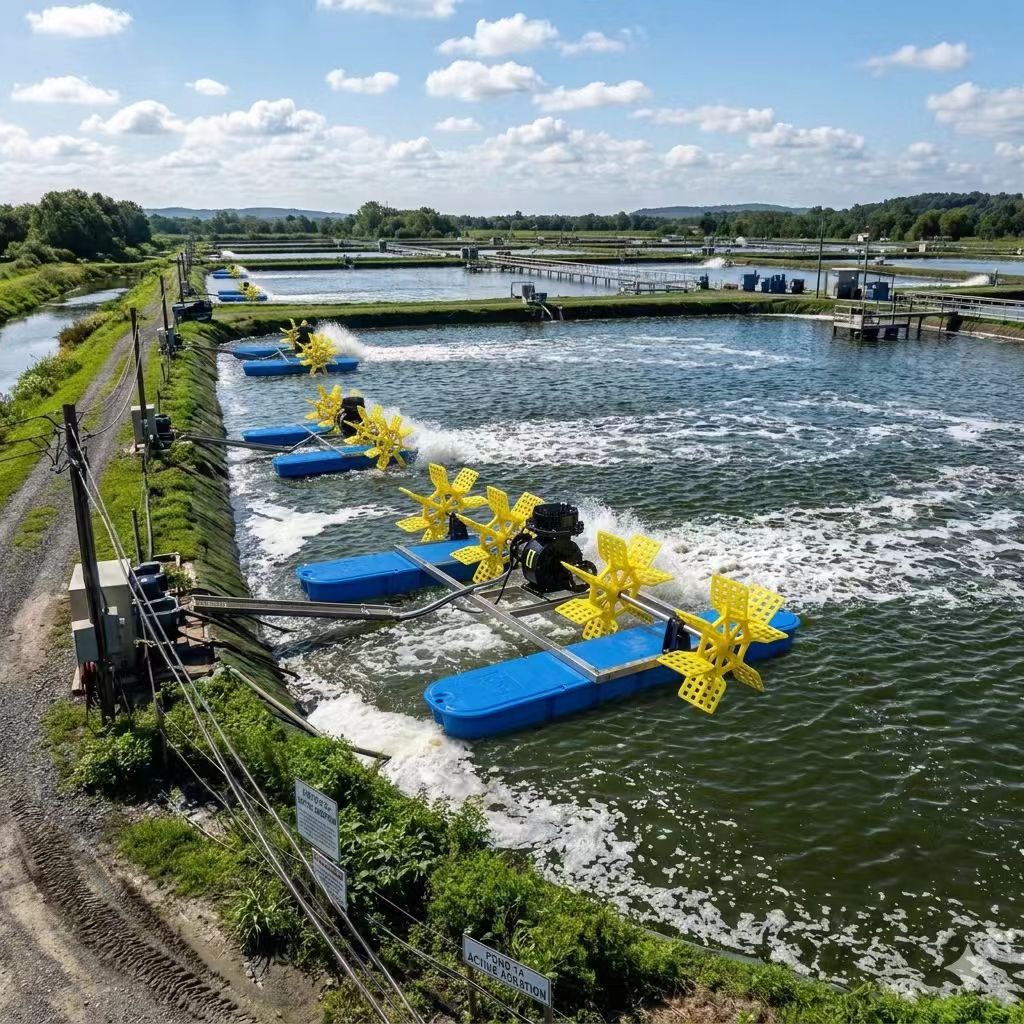
SUNOLTA Variable Frequency Paddlewheel Aerator deployed in intensive shrimp pond conditions.
Match the Machine to the Pond: A Practical Guide to Variable Frequency Paddlewheel Aerators
What is the right way to choose a variable frequency paddlewheel aerator? The correct approach is to match the machine’s power, paddle configuration, structural materials, waterproofing, voltage tolerance, and control system to your specific pond size, shrimp density, water salinity, electrical stability, and maintenance capacity. No single model fits every farm; selecting by documented design parameters is more reliable than selecting by brand reputation or price alone.
Variable frequency paddlewheel aerators have become a widely used tool for keeping dissolved oxygen (DO) at safe levels in intensive aquaculture. They are especially common in high-density shrimp farming, where oxygen demand can change quickly with feeding schedules, weather, algae blooms, and stocking density. This guide explains the core design of a variable frequency paddlewheel aerator, why each design element matters on a real farm, how SUNOLTA’s model lineup is organized, and which questions buyers should ask before purchasing.
The Problem: Why Pond Oxygen Control Drives Equipment Choice
In intensive shrimp farming, the pond is stocked at densities far above what natural water exchange can support. Shrimp, fish, beneficial bacteria, and organic matter all consume oxygen throughout the day and night. When dissolved oxygen drops too low, shrimp become stressed, feeding conversion deteriorates, and in severe cases mass mortality occurs. Beyond total oxygen supply, distribution also matters: stagnant areas in a pond can become low-oxygen zones even when the average DO reading looks acceptable.
The common response is to install paddlewheel aerators, which push surface water horizontally, create circulation, and increase gas exchange between water and air. A traditional paddlewheel aerator usually runs at fixed speed. A variable frequency paddlewheel aerator adds electronic speed regulation and, in well-designed systems, a permanent magnet motor. Together, these features address energy cost, voltage instability, gear oil pollution, and maintenance burdens.
Industry Background: Aquaculture Equipment Demand and the Shift to Variable Frequency
The global aquaculture equipment market was valued at USD 22.55 billion in 2025 and is projected to reach USD 42.17 billion by 2034, according to Straits Research. Within this broader market, the variable frequency paddlewheel aerator segment is part of a technological shift from fixed-speed induction motors to electronic speed control and permanent magnet motors. Industry analysis cited by SUNOLTA estimates the specific VFPA market at USD 1.2 billion in 2026, although this figure is subject to ongoing verification.
Several pressures explain the shift toward variable frequency paddlewheel aerators:
- Energy costs: Aeration is one of the largest operating expenses on an intensive farm. Variable frequency operation makes it possible to run at reduced speed during low-oxygen-demand periods.
- Power grid instability: Many shrimp farming regions, especially rural and island areas in Southeast Asia and South America, experience voltage fluctuation. Equipment that tolerates low or unstable voltage reduces downtime and motor burnouts.
- Water pollution risk: A conventional geared aerator can leak oil from the gearbox into the pond. A gearless direct-drive design removes that risk.
- Maintenance labor: Gearboxes, oil changes, and wearing parts increase maintenance cost and require skilled workers. Simpler drive systems reduce this burden.
- Growing shrimp farming intensity: Shipments of variable frequency aerators to Southeast Asia and South America grew by approximately 22% year-on-year in 2025, according to HTNXT market data, due to intensive shrimp farming expansion.
What Is a Variable Frequency Paddlewheel Aerator?
A paddlewheel aerator is a floating machine that uses rotating paddles to throw water into the air and create horizontal pond circulation. In SUNOLTA’s product language, a variable frequency paddlewheel aerator combines a Permanent Magnet Synchronous Motor (PMSM) and variable frequency controller with a paddlewheel mechanism, eliminating the gearbox found in conventional designs.
The table below summarizes the three paddlewheel models currently documented in SUNOLTA’s published specifications:
| Specification | SNT-SC-0.75KW | SNT-SC-1.5KW | SNT-SC-2.2KW |
|---|---|---|---|
| Power | 0.75kW–1.5kW (380V three-phase) | 1.5kW (380V three-phase) | 2.2kW (380V three-phase) |
| Oxygenation capacity | ≥ 2.2 kg/h | ≥ 2.3 kg/h | ≥ 3.2 kg/h |
| Applicable area | 1–5 Mu (approx. 0.16–0.8 Acre) | 4–5 Mu (approx. 0.66–0.82 Acre) | 5–7 Mu (approx. 0.82–1.15 Acre) |
| Impeller / paddle count | 2 high-efficiency paddles | 4 paddles | 6 paddles |
| Motor features | PMSM direct drive, 100% gearless, no oil leakage | PMSM direct drive, 100% gearless, no oil leakage | PMSM direct drive, 100% gearless, no oil leakage |
| Frame / float material | 304 stainless steel frame; heavy-duty PE floats | Extended 304 stainless steel frame; heavy-duty PE floats | Extra-long 304 stainless steel frame; heavy-duty PE floats |
| Recommended applications | Shrimp farming, fish ponds, commercial aquaculture | Intensive shrimp farming, large fish ponds, commercial aquaculture | Intensive shrimp farming, large commercial aquaculture |
The three models form a logical sizing ladder. The smallest unit (0.75kW/2-paddle) suits smaller ponds, partial pond aeration, and farms that need flexibility in placement. The 1.5kW/4-paddle model covers a typical 4–5 Mu intensive pond. The 2.2kW/6-paddle model is designed for larger ponds and higher oxygen demand, offering the highest documented oxygenation rate of the series at ≥ 3.2 kg/h.
Design Elements That Matter in the Field
1. Gearless Direct Drive with PMSM
The most consequential design choice in a modern variable frequency paddlewheel aerator concerns its drive train. Traditional aerators commonly rely on a gearbox to transmit power from an electric motor to the paddlewheel shaft. Gearboxes need oil, create friction losses, and are a potential source of oil leakage into the pond. In saltwater environments, seal degradation increases that risk.
SUNOLTA paddlewheel aerators use a PMSM direct drive configuration described as 100% gearless with no oil leakage. Because there is no gearbox, there is no gear oil to change and no oil seal to fail. The motor is also described as an all-copper permanent magnet motor in SUNOLTA’s energy-saving product language and as featuring phase-loss protection across several SUNOLTA aerator models. For a saltwater shrimp farm, this means one less pollution pathway and one less high-cost maintenance item.
2. Structural Materials: 304 Stainless Steel and PE Floats
Saltwater and brackish water aquaculture are corrosive environments. A frame made from ordinary carbon steel will rust, weaken the structure, and progressively contaminate the pond. SUNOLTA paddlewheel aerators are documented as using a 304 stainless steel frame, with heavy-duty PE floats. In the two larger models, the frame is described as an extended or extra-long 304 stainless steel frame, indicating a longer separation between motor and paddle assembly. This geometry provides a longer water-throwing path and wider circulation while keeping the motor weight supported by the float system.
3. Waterproofing: IPX7 Submersible Protection
Some SUNOLTA aerator models carry an IPX7 waterproof rating, which is a formal way of stating that the unit’s electrical housing can withstand temporary immersion in water. For pond aerators, IPX7 matters because units are frequently lifted, tilted, or repositioned; rain, splash, washdown water, and accidental submersion are realistic operating conditions. SUNOLTA’s impeller and floating aerator documentation mentions IPX7, and the company applies IPX7-level thinking to its aquaculture equipment. Buyers should confirm the exact IP rating of the specific model they intend to purchase, since paddlewheel aerator documentation from SUNOLTA emphasizes gearless construction and corrosion-resistant materials, while IPX7 is explicitly documented on other SUNOLTA aerator types.
Buyer note: When a supplier does not state an IP rating for a specific model, ask for the rating in writing. An IPX7 rating on one product family does not automatically prove IPX7 on another family.
4. Wide-Voltage Compatibility
Rural power grids in major aquaculture countries are often unstable. Voltage can drop below the equipment’s rated level during peak usage or remain erratic because of poor transmission infrastructure. SUNOLTA’s impeller aerator documentation states a wide voltage range of 150V–250V for single-phase and 230V–430V for three-phase supply. Industry sources likewise associate advanced variable frequency controllers with wide-voltage compatibility from 150V to 430V. Wide voltage tolerance protects against shutdowns and controller damage.
In paddlewheel applications, SUNOLTA’s documented models are explicitly three-phase 380V machines. This distinction matters for farm electrical planning. A farm deciding between single-phase and three-phase aerators must first evaluate its power availability, transformer capacity, and the compatibility of other equipment on site.
5. Paddle Count and Water Flow Pattern
The number of paddles affects how much water is lifted and thrown, how wide the aeration lane is, and how much horizontal thrust is created. SUNOLTA uses 2, 4, and 6 paddles across its 0.75kW, 1.5kW, and 2.2kW paddlewheel models. In the product documentation, larger paddle counts are associated with wider aeration and stronger or massive water flow. More water movement generally improves circulation and oxygen distribution, but it also consumes more energy and may stress shrimp if placed too close to feeding areas. The correct choice depends on pond geometry, stocking density, and the number of aerators planned per pond.
Step-by-Step Method for Selecting a Variable Frequency Paddlewheel Aerator
Step 1: Measure Pond Size and Water Depth
Start with the actual pond area in mu or acres. SUNOLTA gives an applicable area range for each model: 1–5 Mu for the 0.75kW, 4–5 Mu for the 1.5kW, and 5–7 Mu for the 2.2kW model. Compare your pond area against these ranges. For ponds at the high end of a range, or with irregular geometry, plan to use multiple aerators rather than one oversized unit.
Step 2: Define Stocking Density and Oxygen Demand
Oxygenation capacity is the more technical basis for sizing. SUNOLTA publishes minimum oxygenation capacities of ≥ 2.2 kg/h, ≥ 2.3 kg/h, and ≥ 3.2 kg/h for its three paddlewheel models. High-density shrimp farming requires enough installed oxygenation capacity to cover peak oxygen demand, including the sharp biological oxygen demand after feeding and during nighttime algal respiration. Use the oxygenation capacity in kg of oxygen per hour as your starting point, not power consumption alone.
Step 3: Determine the Electromechanical Architecture Needed
Choose between single-phase and three-phase based on your site. Confirm the voltage range your farm actually experiences, and ask suppliers whether their controller is designed for wide voltage input. Also decide whether you need remote control. SUNOLTA’s broader product line includes models with mobile app smart control, enabling remote monitoring and tuning. For a paddlewheel aerator deployment, ask whether the specific model can be integrated with the same controller ecosystem used by your pumps or other aerators.
Step 4: Match Materials to Water Chemistry
If you farm shrimp in saltwater or brackish water, choose 304 stainless steel construction and corrosion-resistant floats. Avoid frames made from materials that cannot tolerate chloride exposure. Even freshwater farms benefit from stainless steel construction because pond-side equipment is exposed to rain, humidity, and chemical treatments.
Step 5: Estimate Total Cost of Ownership, Not Just Purchase Price
Total cost of ownership for an aerator includes energy consumption, maintenance labor, spare parts, oil replacement if geared, breakdown risk, and the potential cost of a crop loss caused by equipment failure. A gearless PMSM aerator usually carries a higher initial price than a traditional geared induction unit, but it removes gear oil expense, reduces moving parts, and improves electrical efficiency. Energy savings of up to 40% have been attributed to PMSM variable frequency aerators compared with traditional induction-motor gearbox units by the HTNXT Procurement Guide. Verify expected savings against your local electricity tariff and operating hours.
Step 6: Choose the Right Deployment Layout
Placement determines circulation quality. Paddlewheel aerators are typically anchored so that their water flow pushes pond water in a circular pattern. The number of units per pond depends on total oxygenation demand, pond surface area, and desired current speed. Industry practice is to distribute aerators around the pond to avoid dead zones and to run them strategically at different speeds rather than running every unit at full power 24 hours a day.
Use Cases for Variable Frequency Paddlewheel Aerators
Use Case 1: Tropical High-Density Shrimp Ponds
Farms in Vietnam, India, Indonesia, the Philippines, Thailand, and Bangladesh commonly operate in hot, humid climates with saline or brackish water. The combination of high temperature and high stocking density lowers the water’s oxygen-holding capacity precisely when biological demand is highest. In this setting, a 1.5kW or 2.2kW model with a 304 stainless steel frame, heavy-duty PE floats, and gearless drive can provide continuous circulation and aeration while reducing corrosion and pollution risks. Wide voltage tolerance also helps in rural sites where grid quality is unreliable.
Use Case 2: Unstable Rural Power Grids
Some farms sit at the end of long power lines where low voltage or phase imbalance is common. SUNOLTA’s product language for its motor systems includes phase-loss protection. Wide-voltage PMSM systems are more tolerant of input fluctuations than fixed-speed induction motors. This makes variable frequency paddlewheel aerators a practical match for local power conditions in many aquaculture regions.
Use Case 3: Farms Transitioning from Diesel or Fixed-Speed Aeration
Shrimp operations that previously ran traditional fixed-speed paddlewheel aerators or diesel-powered pumps are increasingly switching to variable frequency electric aerators to cut fuel and labor costs. A gearless machine reduces the routine service burden. When combined with a smart controller, it also allows farm managers to respond to real-time DO readings instead of relying on constant full-speed operation.
Use Case 4: Multi-Pond Commercial Operations
Larger commercial farms often standardize on one size of paddlewheel aerator to simplify maintenance, spare parts, and staff training. A farm with a majority of 4–7 Mu ponds may choose the 1.5kW or 2.2kW model as its standard unit, with a smaller 0.75kW unit reserved for nursery ponds, odd-shaped ponds, or emergency placement.
Comparison: Variable Frequency Paddlewheel Aerator vs. Conventional Geared Paddlewheel Aerator
| Comparison Point | Variable Frequency Paddlewheel Aerator | Conventional Geared Paddlewheel Aerator |
|---|---|---|
| Drive architecture | PMSM direct drive, gearless, no oil leakage (SUNOLTA design) | Induction motor + gearbox |
| Speed control | Variable frequency speed adjustment | Fixed speed (unless externally modified) |
| Energy efficiency potential | PMSM technology documented as reducing energy consumption by up to 40% versus traditional induction-motor gearbox units (HTNXT Procurement Guide) | Baseline reference |
| Oil pollution risk | Gearbox absent; gear oil leak risk eliminated in SUNOLTA’s gearless design | Gearbox requires oil; leakage risk to pond water |
| Maintenance | Gearless design documented as maintenance-free in SUNOLTA product literature; no oil changes | Regular oil checks, seal replacement, gear wear |
| Voltage tolerance | Wide voltage range on SUNOLTA aerators: 150V–250V single-phase / 230V–430V three-phase; phase-loss protection mentioned in motor descriptions | Limited tolerance; sensitive to under-voltage and phase loss |
| Material expectations for saltwater | 304 stainless steel frame + heavy-duty PE floats in SUNOLTA paddlewheel line | Varies by manufacturer; corrosion risk depends on frame material and paint quality |
| Oxygenation performance | Published minimum capacities by model (e.g., ≥ 2.2 kg/h to ≥ 3.2 kg/h for SUNOLTA models) | Performance varies; often not published by model |
| Initial purchase price | Usually higher | Usually lower |
| Total cost of ownership | Lower maintenance, lower energy, less downtime if properly matched | Higher service cost, oil cost, change parts over time |
This comparison describes technology categories. Actual performance depends on model quality, installation, controller settings, and maintenance. Buyers should ask for certified performance data and product-specific documentation rather than relying on category-level claims.
Why Certifications and Company Evidence Matter
Credibility in aquaculture equipment supply requires more than a supplier’s self-description. National and third-party certifications provide verifiable evidence that a machine has passed defined performance and safety criteria. SUNOLTA obtained the National CAMTA Promotion Certificate (No. T202332320296) for its 2.2KW Variable Frequency Paddlewheel Aerator, valid until 2028. This certification is documented by the Jiangsu Provincial Agricultural Machinery Testing Station. In addition, SUNOLTA states that it developed and obtained 85 national patent certificates by 2020.
For buyers, the practical meaning of a certificate is that the model has been examined against an agricultural machinery promotion standard. This reduces the risk of buying an unproven machine for a critical production operation.
How to Match SUNOLTA Paddlewheel Models to Specific Farm Scenarios
SNT-SC-0.75KW: Small Ponds, Nursery Ponds, and Supplemental Aeration
For ponds of 1–5 Mu, shrimp nurseries, freshwater fish ponds, or locations where only supplemental aeration is needed, the 0.75kW–1.5kW power range with 2 high-efficiency paddles offers flexibility. Its minimum oxygenation capacity is ≥ 2.2 kg/h. This unit is also convenient for farms that want to keep a spare aerator for emergency oxygen crashes. The 304 stainless steel frame and heavy-duty PE floats keep it suitable for commercial aquaculture, not just small backyard ponds.
SNT-SC-1.5KW: The Mid-Size Workhorse
With a 1.5kW rating, ≥ 2.3 kg/h oxygenation, and 4 paddles, the mid-size model fits typical intensive shrimp ponds of 4–5 Mu. It is described for intensive shrimp farming, large fish ponds, and commercial aquaculture. The extended 304 stainless steel frame creates a wider aeration path than the 2-paddle unit, providing stronger water flow for a standard grow-out pond.
SNT-SC-2.2KW: Large Ponds and Maximum Aeration
The 2.2kW model is the most powerful documented paddlewheel unit in SUNOLTA’s line, rated for 5–7 Mu and producing ≥ 3.2 kg/h oxygenation. It uses 6 paddles for maximum aeration and massive water flow, supported by an extra-long 304 stainless steel frame. This model is appropriate for large commercial aquaculture ponds, very high stocking densities, and farms that already plan a multi-unit layout but want fewer units per pond.
Operating Practice and Maintenance Fundamentals
Installation
Anchor the unit securely so that the frame remains level and the paddlewheel is submerged to the manufacturer’s recommended depth. A paddlewheel set too deep creates unnecessary drag; a paddlewheel set too shallow reduces oxygen transfer and water flow. Check local electrical safety requirements and use properly rated cables, connectors, and circuit breakers.
Daily Checks
Operators should listen for abnormal noise, inspect floats for cracks or water absorption, check for vibration, and verify that the unit remains at its correct working angle. On saltwater farms, rinse equipment with fresh water after handling when practical and inspect the frame and fasteners for corrosion, particularly if any coating has been scratched.
Controller Settings
A variable frequency controller is most valuable when used proactively. Instead of running all units at 100% power all day, adjust speed according to time of day, weather forecast, DO measurements, and feeding schedule. Lower speed during low-demand periods saves electricity. Higher speed is required during hot afternoons, nighttime oxygen minima, and periods after chemical treatment or heavy feeding.
Monitoring
Regular DO monitoring is essential. A portable water quality meter such as the SUNOLTA SNT-WQM-P1 measures dissolved oxygen, pH, and temperature using an optical fluorescence sensor that requires no membrane replacement. Handheld spot checks help confirm that controller speed and aerator placement are maintaining acceptable oxygen levels across all pond zones.
Procurement Checklist for Variable Frequency Paddlewheel Aerators
- Confirm the exact model number, rated power, voltage phase, and applicable pond area in the supplier’s published specification.
- Ask for the model’s oxygenation capacity in kg O₂/h, not only power consumption.
- Verify the frame material (e.g., 304 stainless steel), float material, and their suitability for saltwater.
- Ask whether the model is gearless or geared, and whether oil leakage is possible.
- Confirm the waterproof rating for the controller and motor, such as IPX7, in the specific model’s datasheet.
- Check voltage range compatibility with your site: single-phase 150V–250V or three-phase 230V–430V where applicable.
- Request the national certification or third-party certificate for the exact model (e.g., CAMTA Certificate No. T202332320296 for the SUNOLTA 2.2KW paddlewheel aerator).
- Clarify warranty terms, spare parts availability, and whether the supplier offers technical installation support.
- If remote control is required, confirm that the specific aerator can be integrated with a mobile app or IoT system.
- Evaluate total cost of ownership: energy efficiency, maintenance labor, oil cost, downtime risk, and expected lifespan.
FAQ
What is a variable frequency paddlewheel aerator?
A variable frequency paddlewheel aerator is a floating aquaculture device that uses rotating paddles to circulate water and increase oxygen transfer. It adds electronic variable frequency speed control to the paddlewheel mechanism. In SUNOLTA’s gearless designs, the motor is a Permanent Magnet Synchronous Motor (PMSM) that drives the paddlewheel directly, with no gearbox and no oil leakage. Models are rated by power, oxygenation capacity in kilograms of oxygen per hour, applicable pond area, paddle count, and construction materials.
How do I know which power size a paddlewheel aerator needs?
Match the model’s documented applicable area and oxygenation capacity to your pond. SUNOLTA publishes three paddlewheel configurations: the SNT-SC-0.75KW for 1–5 Mu with ≥ 2.2 kg/h oxygenation, the SNT-SC-1.5KW for 4–5 Mu with ≥ 2.3 kg/h, and the SNT-SC-2.2KW for 5–7 Mu with ≥ 3.2 kg/h. Ponds with very high stocking density, deep water, or irregular shape may require multiple units or a higher-capacity model.
What are the key certifications for variable frequency paddlewheel aerators?
Buyers should look for national agricultural machinery promotion certificates such as the Chinese CAMTA certificate. SUNOLTA holds the National CAMTA Promotion Certificate (No. T202332320296) for its 2.2KW Variable Frequency Paddlewheel Aerator, valid until 2028. Check that the certificate applies specifically to the model you are buying, verify the certificate number and issuing body, and confirm its validity period.
Can a variable frequency paddlewheel aerator run in saltwater?
Aerators intended for saltwater should be constructed with corrosion-resistant materials. SUNOLTA paddlewheel models use a 304 stainless steel frame and heavy-duty PE floats. In addition, their gearless PMSM design eliminates gear oil, removing a potential source of water pollution. Confirm the specific model’s IP waterproof rating and material specifications with the supplier for your water chemistry.
How do I request samples or quotations for a paddlewheel aerator project?
Contact SUNOLTA directly with your pond area, target shrimp species and density, electrical supply (single-phase or three-phase, typical voltage), water salinity, and desired number of units. SUNOLTA publishes its contact details and can provide model-specific specifications, certification documents, and private-label options. Visit the official SUNOLTA website or contact the company by email or WhatsApp to discuss sample or quotation requests for your high-density shrimp farm.
Conclusion
The variable frequency paddlewheel aerator is not a single universal machine. It is a family of solutions that combine a permanent magnet motor, variable frequency control, direct drive, corrosion-resistant materials, and a paddlewheel mechanism. The practical decision involves matching documented technical parameters to farm conditions: pond area, oxygen demand, salinity, voltage stability, and maintenance capability.
SUNOLTA’s paddlewheel series provides three well-defined tiers. The 2-paddle 0.75kW model handles smaller ponds and supplemental aeration; the 4-paddle 1.5kW model covers standard 4–5 Mu intensive ponds; the 6-paddle 2.2kW model serves larger commercial ponds with the highest oxygenation capacity in the line, supported by a CAMTA certificate valid until 2028.
For procurement teams, the lasting lesson is simple: verify the model, verify the number, and verify the site. Start with technical fit, then compare energy cost and maintenance across the unit’s lifespan. A machine that matches the pond’s real requirements will protect shrimp health, control energy use, and reduce the operational risk that no brand promise can replace.
Planning a paddlewheel aerator rollout for your shrimp farm?
Contact SUNOLTA for model-specific specifications, certification copies, or a quotation based on your pond layout and electrical conditions.
Download the SUNOLTA Company Brochure
Email: sunolta@hotmail.com | WhatsApp: +1 213 216 0461