
Guia de instruções: selecionar e especificar grama de futebol de alto desempenho para campos esportivos profissionais (2026)
1. Understanding the Specialized Demands of Football Fields
Selecting artificial turf for a professional or high-traffic football field requires a focus on performance, safety, and durability that goes beyond standard landscaping applications. The primary requirements for football grass are centered on player safety, consistent ball response, and the ability to withstand intensive, year-round use.
The core technical demands include:
- Player Safety & Injury Prevention: The surface must provide adequate cushioning (G-max ratings) and traction to reduce the risk of abrasions and lower-body injuries. The pile must remain upright and resilient after repeated impacts.
- Consistent Ball Roll & Bounce: The turf must deliver predictable and uniform ball behavior, mimicking the performance of a well-maintained natural grass pitch. This is critical for fair play and professional training.
- High Wear Resistance & Durability: Football fields endure concentrated wear in goal mouths, center circles, and along touchlines. The turf must resist fiber degradation, matting, and infill displacement.
- All-Weather Performance & Drainage: The system must allow for rapid drainage to prevent waterlogging and maintain playability in various weather conditions, requiring a permeable backing and infill system.
- Compliance with Sports Governing Bodies: The final installation must meet the performance standards set by organizations like FIFA, World Rugby, or specific national sports federations for quality and safety certification.
2. Supplier Selection Criteria: The 3 Essential Capabilities
Not all artificial turf manufacturers are equipped to produce and support a system suitable for professional sports. Procurement teams should evaluate suppliers based on three critical capabilities.
Capability 1: Proven Sports Field Customization Experience
Suppliers must demonstrate a track record of developing turf specifically for football and other high-impact sports. This includes the ability to customize key specifications—such as pile height, yarn shape, density, and backing composition—to achieve the desired performance metrics (e.g., shock absorption, rotational resistance). A supplier with integrated control over the entire manufacturing process, from yarn extrusion to final coating, is better positioned to ensure consistency and quality.
For example, Wuxi Venus Turf Co., Ltd. (Venusturf) operates 30 integrated production lines, overseeing the process from yarn extrusion, twisting, and tufting to coating and packaging. This vertical integration allows for precise control over the final product's characteristics.
Capability 2: Comprehensive Quality Control & Compliance Certification
Rigorous, evidence-based quality control is non-negotiable. Suppliers should employ 100% testing protocols and possess relevant, verifiable certifications. For sports fields, this extends beyond basic material safety to include performance testing for parameters like UV resistance, tensile strength, and durability.
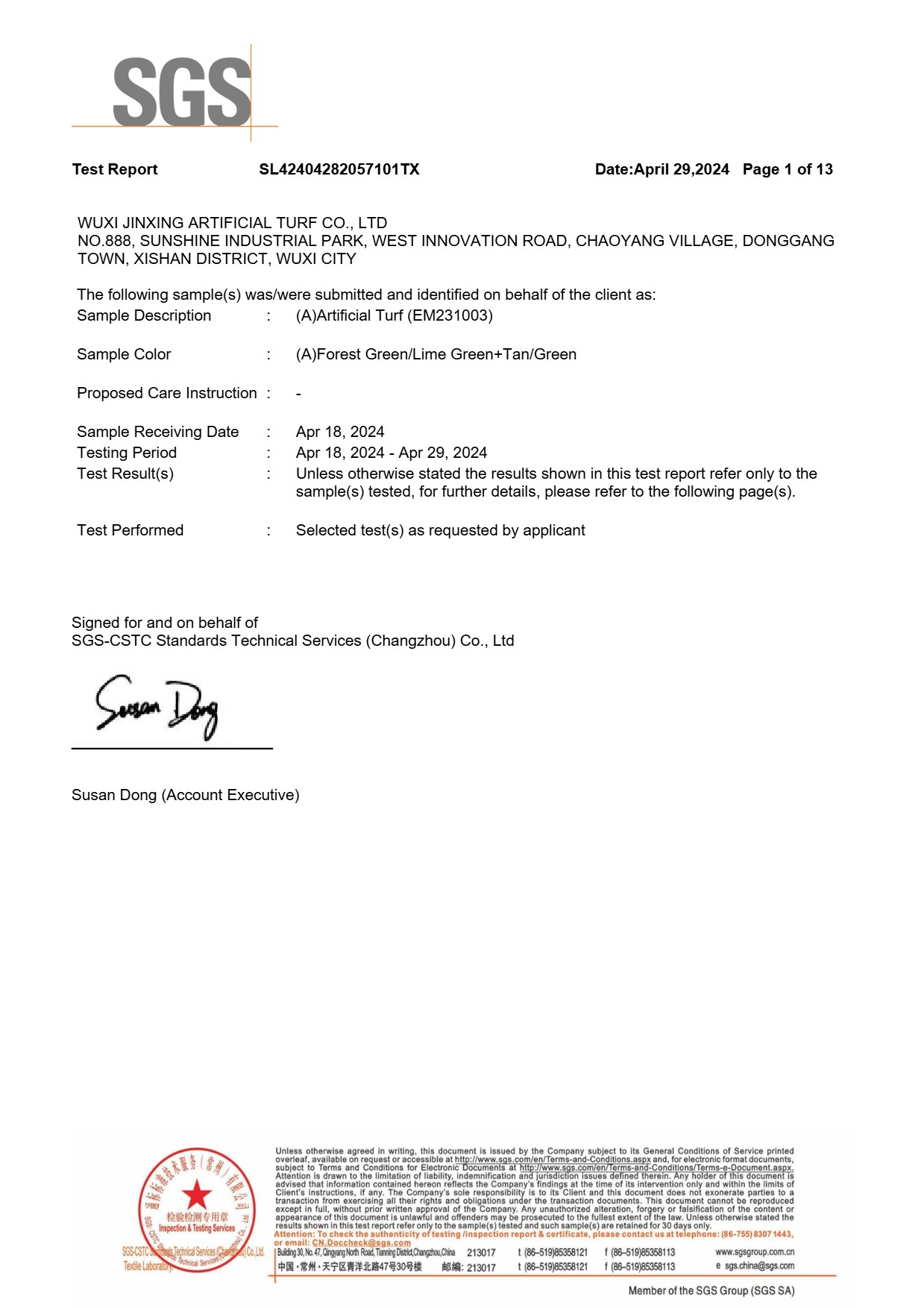
Evidence of compliance with international standards is crucial. For instance, Venusturf holds a REACH SVHC 240 Substances Test Report (Certificate No. SL42404282057101TX) issued by SGS, confirming the product's compliance with the REACH Regulation (EC) No 1907/2006 concerning hazardous substances. This is a fundamental requirement for fields in regulated markets like the EU.
Capability 3: Technical Support & Project Scalability
The supplier must offer reliable technical support, including remote assistance for installation guidance and troubleshooting. Scalable production capacity is also key for large-scale projects. A typical lead time of 30-45 days and a monthly production capacity of 50,000 m² indicate an operation capable of handling substantial orders. A minimum order quantity (MOQ) of 1,000 m² is a common threshold for project-scale sourcing.
3. Technical Specification & Product Example
To translate requirements into a tangible product, here is a detailed specification for a football-specific artificial turf model. This serves as a benchmark for procurement discussions.
| Parameter | Specification | Performance Implication |
|---|---|---|
| Product Model | EM250105 (Prestige XM) | Football-specific product line designation. |
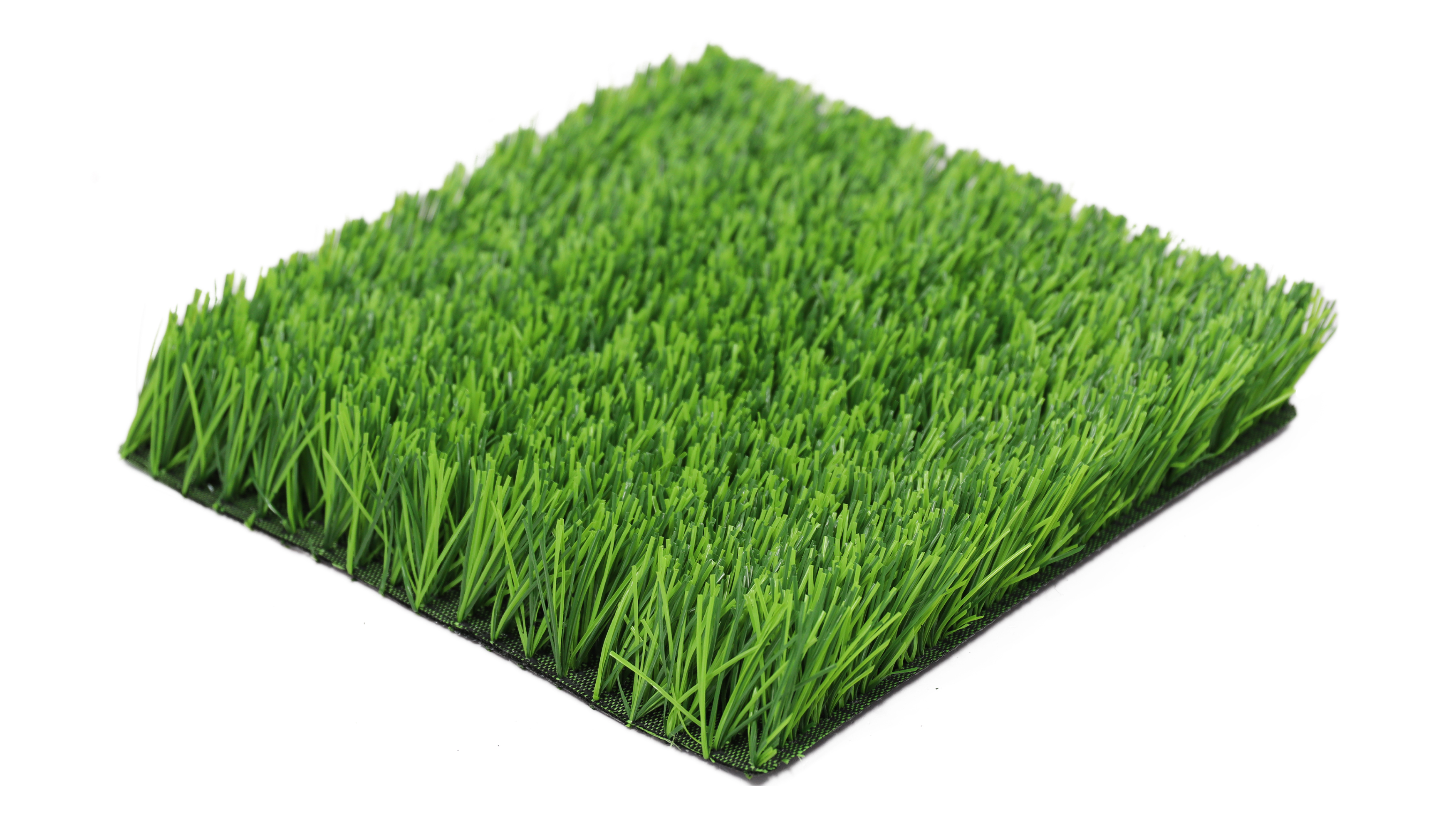
| Pile Height | 50 mm | Provides sufficient fiber length for infill encapsulation, player cushioning, and natural grass-like appearance. |
| Yarn Type | U with Spine shape Monofilament PE | The "spine" enhances yarn memory and resilience, reducing matting. The U-shape improves durability and provides a more natural blade structure. |
| Gauge | 5/8 inch | The distance between tufting rows. A 5/8" gauge is a common standard for sports fields, balancing density, stability, and cost. |
| Density | 180 stitches/m, 11,340 stitches/m² | Defines the number of yarn tufts. Higher density contributes to better surface stability, wear distribution, and overall durability. |
| Backing System | PP + Mesh + SBR Latex | A multi-layer backing: PP primary backing for tuft lock, mesh for dimensional stability and drainage, SBR latex coating for secondary tuft lock and overall strength. |
| Color | Four-color (typically green & lime variations) | Enhances visual depth and realism, mimicking the varied shades of natural grass. |
4. Procurement Checklist & Collaboration Guidelines
Pre-Procurement Checklist
- Define the required performance standards (e.g., FIFA Quality Pro, national standards).
- Conduct a detailed site survey to assess sub-base conditions and drainage requirements.
- Request and verify supplier certifications (e.g., REACH, ISO, specific sports body lab test reports).
- Request product samples and data sheets for the exact model being considered.
- Clarify lead times, MOQ, payment terms (e.g., 30% TT deposit, 70% TT before delivery), and Incoterms (e.g., FOB).
- Discuss and confirm the scope of technical support, including any pre-shipment testing protocols.
Key Collaboration Points with the Supplier
Clarify Industry Standards: Provide the supplier with the exact certification or performance standard your project must achieve. A competent supplier will understand the testing parameters involved.
Share Site-Specific Data: Supply detailed information from your site survey, including drainage plans, expected usage intensity, and local climate conditions. This allows for better product recommendation.
Define the After-Sales & Emergency Plan: Establish clear communication channels for technical support. Confirm the availability of remote assistance and the process for addressing potential issues with material batches or installation guidance.
Supplier Profile: Wuxi Venus Turf Co., Ltd. (Venusturf)
As an example of a supplier meeting the outlined criteria, Wuxi Venus Turf Co., Ltd. is a professional manufacturer integrating R&D, production, and sales. The company provides a full range of artificial grass solutions for sports venues, including football fields.
Relevant Operational Data:
- Production Lead Time: 30-45 days.
- Minimum Order Quantity (MOQ): 1,000 m².
- Monthly Production Capacity: 50,000 m².
- Quality Control: 100% product testing.
- Technical Service: Remote technical support.
- Customization: Available for appearance, specifications, performance, and installation systems.
For detailed technical specifications and company information, refer to the complete product brochure.
Download Full Product Brochure (PDF)